zenpundit.com » complexity

Archive for the ‘complexity’ Category

Guest Post:A Hipbone Approach to Analysis III.

Saturday, October 30th, 2010


Charles Cameron is the regular guest-blogger at Zenpundit, and has also posted at Small Wars Journal, All Things Counterterrorism, for the Chicago Boyz Afghanistan 2050 roundtable and elsewhere.  Charles read Theology at Christ Church, Oxford, under AE Harvey, and was at one time a Principal Researcher with Boston University’s Center for Millennial Studies and the Senior Analyst with the Arlington Institute:

A Hipbone Approach to Analysis III.

by Charles Cameron

I’ve been slowly prepping this series of pieces about my analytic approach — and the mysterious business of “connecting the dots” — for a while, but.. Jeff Jonas, whose work I only recently ran across, has given me “another piece of the puzzle” and a slew of new dots to connect, so here’s a quick impression of some new (for me) terrain that connects with other areas I have long been familiar with.

1

What it comes down to in my post today is this: I would like to reconcile “connecting the dots” with “putting together the pieces of the puzzle”.

Both metaphors have to do with “seeing the big picture”, and one of them (“connecting the dots”) has to do directly with nodes and edges, i.e. with those systems we call graphs and networks, while the other suggests a far subtler set of connections.

Consider this: n+1 is the next dot in the series of integers after n, with “+1” being the only link necessary — you can represent that on a graph with two nodes and an edge. But if you had the sky of the northern hemisphere in one hand (hey, this is a thought experiment) and five square miles of landscape around Winchester Cathedral in the other, finding just where to fit the cathedral (and the surrounding, branching, leafy trees nearby) snugly into the sky would be a far trickier business, and the links between air and leaf and stone molecules would be very many — we should be grateful for the ease with which the sky accommodates itself in reality to the cathedral and the trees (and the cathedral and the trees to the sky) — and for the ease with which a painter like Turner can capture the effect…
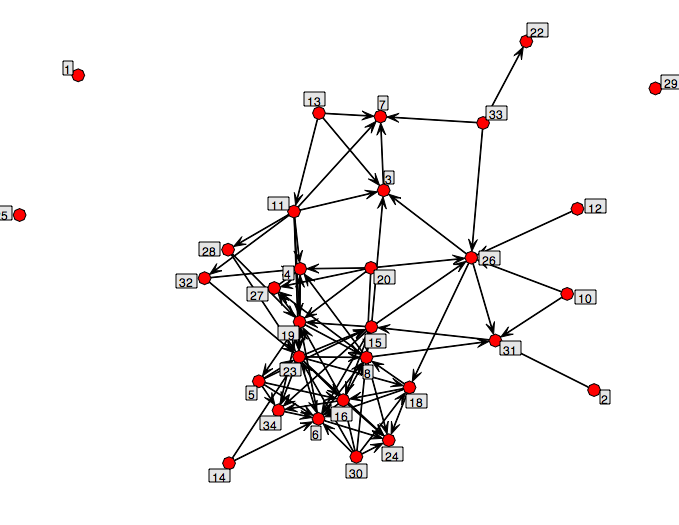
Two puzzle pieces, I mean, may have to fit along many aspects of their intersection, while dots can be connected by a single common thread.

2

I’ve only recently “met” the mind of Jeff Jonas, but he has some remarkable things to say about puzzles — for one thing, he writes about the levels of, well, computation involved in solving a jigsaw puzzle:

The first piece you take out of the box and place on the work surface requires very little computational effort. The second and third pieces require almost equally insignificant mental effort. Then as the number of pieces on the table grows the effort to determine where the next piece goes increases as well. But there is a tipping point where the effort to determine where to place the next piece gets easier and easier … despite the fact the number of puzzle pieces on the table continues to grow.

That in itself is a fascinating thought to dwell on, in fact it’s the sort of piece of the puzzle that gives me an epiphany — Jonas talks about puzzle pieces that provoke epiphanies, too:

Some pieces produce remarkable epiphanies. You grab the next piece, which appears to be just some chunk of grass – obviously no big deal. But wait … you discover this innocuous piece connects the windmill scene to the alligator scene! This innocent little new piece turned out to be the glue.

I’m processing this as a theologian / philosopher / poet, and Jonas has just given me a new angle on the theme of the intersection of frames of reference that Arthur Koestler in The Act of Creation takes to be the fundamental element in insights ranging all the way from casual jokes about rabbis to — let me give you a more powerful example — the Taniyama-Shimura Conjecture which, if I’ve understood the layman’s version correctly, began as a hunch that the otherwise entirely distinct mathematical zones known as “elliptic curves” and “modular forms” could be mapped onto each other – and wound up once proven, successfully bridging algebra with analysis.

Now, I am no no no no mathematician — but I am a student of conceptual bridges, so if I’ve phrased myself poorly here, please bear with me. The point is to think freshly about how one idea connects with another.

Koestler’s insight at the intersection between two fields (for this is essentially a matter of multiple-frame, and thus cross-disciplinary, thinking) is, I’d suggest, Jonas’ epiphanic piece of the puzzle.

Awesome.

3

But as we are trying to figure out the puzzle pieces — and this applies to “what is the meaning of life?” as much as to “what threat should be uppermost in our concern?” — Jonas has more to throw at us:

There may be more than one puzzle in the box, some puzzles having nothing to do with others. There may be duplicate pieces, pieces that disagree with each other, and missing pieces. Some pieces may have been shredded and are now unusable. Other pieces are mislabeled and/or are exceptionally well crafted lies.

I would like to add that puzzles may not be the only thing in the (universal) box. There’s a quote that originates somewhere in Heidegger, to the effect that “A puzzle is the unknown, to be solved, while a mystery is the unknowable, to be entered into and dwelt within.” As I say, I’ve only just run into Jonas’ thoughts, but I’d like to integrate that piece of the puzzle in with the ideas he’s providing – why not have a go at the mystery too while we’re about it?

4

So what happens with ideas? How do they connect?

Hermann Hesse, the Nobel laureate in literature who gave us Siddhartha and Steppenwolf and The Journey to the East, won his Nobel for his most ambitious novel, The Glass Bead Game (Das Glasperlenspiel, also known in English as Magister Ludi). It is an amazing piece of work that inspired at least one other book by another Nobel laureate — Manfred Eigen’s Laws of the Game: How the Principles of Nature Govern Chance — gave John Holland (he of genetic algorithms) the ruling metaphor for his life’s work, was an early and profound influence on Christopher Alexander’s thinking about pattern languages, and in general serves as a catalyst for grand scale creativity among a disparate crowd of very bright minds.

It is about a game — a game on the order of the complete works of JS Bach. And the essence of the game is the juxtaposition of thoughts.

It is about “connecting the dots” and “putting together the pieces of the puzzle” on the grand scale, to create not a single link between ideas, not a small “bigger picture” deploying a half-dozen or so insights, but a vast architecture of ideas that encompasses all “deep” human thought and connects all “beautiful” cognizable patterns. Hesse uses the image of an organist playing an organ to describe the play of ideas that composes his Game, writing:

All the insights, noble thoughts, and works of art that the human race has produced in its creative eras, all that subsequent periods of scholarly study have reduced to concepts and converted into intellectual values the Glass Bead Game player plays like the organist on an organ. And this organ has attained an almost unimaginable perfection; its manuals and pedals range over the entire intellectual cosmos; its stops are almost beyond number.

And in Hesse’s central, musical metaphor, the myriad thoughts that comprise what he terms the “hundred-gated cathedral of Mind” are linked one with another by likeness — by identity, isomorphism, homology, symmetry, parallelism, opposition, analogy, metaphor…

5

I’ll have to move us deep into the territory of the arts and humanities here, because Hesse himself was supremely versed in those areas, but in doing so I would remind you that John Holland wrote of his life’s work, “If I could get at all close to producing something like the glass bead game I can’t think of anything that would delight me more.”

Here’s Hesse on the analogical / isomorphic nature of the moves that connect ideas — “only connect!” said EM Forster — in his great Game:

Throughout its history the Game was closely allied with music, and usually proceeded according to musical or mathematical rules. One theme, two themes, or three themes were stated, elaborated, varied, and underwent a development quite similar to that of the theme in a Bach fugue or a concerto movement. A Game, for example, might start from a given astronomical configuration, or from the actual theme of a Bach fugue, or from a sentence out of Leibniz or the Upanishads, and from this theme, depending on the intentions and talents of the player, it could either further explore and elaborate the initial motif or else enrich its expressiveness by allusions to kindred concepts. Beginners learned how to establish parallels, by means of the Game’s symbols, between a piece of classical music and the formula for some law of nature. Experts and Masters of the Game freely wove the initial theme into unlimited combinations. For a long time one school of players favored the technique of stating side by side, developing in counterpoint, and finally harmoniously combining two hostile themes or ideas, such as law and freedom, individual and community. In such a Game the goal was to develop both themes or theses with complete equality and impartiality, to evolve out of thesis and antithesis the purest possible synthesis.

It is Bach, it is Hegel, it is the very essence of creativity, it is the associative, metaphoric nature of mind and brain (and I won’t get more than toe-deep in the “deep problem” of consciousness here).

6

And it does involve combining the understanding of both puzzle and mystery, to return to that distinction from Heidegger:

I suddenly realized that in the language, or at any rate in the spirit of the Glass Bead Game, everything actually was all-meaningful, that every symbol and combination of symbols led not hither and yon, not to single examples, experiments, and proofs, but into the center, the mystery and innermost heart of the world, into primal knowledge. Every transition from major to minor in a sonata, every transformation of a myth or a religious cult, every classical or artistic formulation was, I realized in that flashing moment, if seen with a truly meditative mind, nothing but a direct route into the interior of the cosmic mystery, where in the alternation between inhaling and exhaling, between heaven and earth, between Yin and Yang, holiness is forever being created.

Hesse is proposing his intuition that the world of ideas is a mandala-form array of symmetries with a “vanishing point” in the center.

Well, I have leapt far from my original topic, Jeff Jonas’ comments on piecing together a puzzle, but I hope the bungee-cord I’ve been depending on has held your attention, and now as always, at the far end of the extension there’s a bouncing-back.

7

The human mind “connects the dots” and “pieces together the puzzle” by recognizing likenesses — pattern recognition, if you like.

But just how human analogical thinking functions is not exactly an easy question…

Guest post: A Hipbone Approach to Analysis II.

Friday, October 29th, 2010

 Charles Cameron is the regular guest-blogger at Zenpundit, and has also posted at Small Wars Journal, All Things Counterterrorism, for the Chicago Boyz Afghanistan 2050 roundtable and elsewhere.  Charles read Theology at Christ Church, Oxford, under AE Harvey, and was at one time a Principal Researcher with Boston University’s Center for Millennial Studies and the Senior Analyst with the Arlington Institute:

A Hipbone Approach to Analysis II.

by Charles Cameron

Let’s call this one Hopscotch across the disciplines.

…our intelligence community failed to connect those dots…
        –  President Obama, Remarks on Security Reviews, Jan 05, 2010

I’ve been giving quite some thought over the past fifteen years to this issue of connecting dots.

My internet handle, hipbone, does double duty for me, since it refers to Ezekiel’s apocalyptic prophecy as featured in the lyric, “hip bone connected to you back bone”, in the old spiritual, Dem Bones, Dem Dry Bones. On the one hand it points to apocalyptic, by which I mean the soon expectation of a sudden and complete transformation in world affairs, very possibly accompanied, triggered or accomplished by extreme violence, with the end result being a highly favored “new heaven and new earth” or “new world order” depending on who is doing the expectation. On the other hand, it points directly to the idea of “connecting the dots” itself, since the entire song is about connections. I have been working on both fronts at least since 1995.

1

Connecting the dots is a matter of thinking, and there are two basic strategies of thought available to the human mind: linear thinking, which proceeds via cause and effect along a single track, and which is the major style of thought used within disciplinary silos, and lateral thinking, which skips sideways across silos and disciplines on wings of metaphor and analogy. Machines can crunch numbers and do some of our linear thinking for us: but it’s up to the analysts to cover the lateral front.

2

Let’s go aphoristic:

Expectation is algorithm: there are no algorithms for the unexpected.

I’d like to connect the dots … to blind spots.

Blinds spots are the spots we can’t, or won’t, and in any case don’t see. They fall into the category of the invisible. Visionaries are those who can see the invisible, who peer into our blind spots, into those places where we can’t see the connections between the dots, and can therefore easily be blind-sided. There’s an almost Borgesian thickness to the way things tie into one another here: the unexpected is by definition what we can’t predict, what blunt force thinking can’t predict — but it’s not invisible to those whose practice is to peer into the invisible, to aficionados of the subtler associative / metaphorical strategy…

3

Let’s go mythic.

There are two major strategies in life, two main ways of tackling problems, just as there are two heroes in the ‘Spider Woman” myth, which Joseph Campbell said was the central myth of the Americas. In Navajo terms, these twin heroes are called Monster Slayer and Child Born of Water, and their names may already give us the sense that one represents a brute force approach while the other is cannier, subtler — and able to achieve things his twin could barely imagine.

The Massive Ordnance Penetrator may be able to penetrate 60 feet of concrete, but the Grand Canyon was created by the natural flow of water — and as Lao Tzu said, “Nothing under Heaven is more soft and yielding than water, yet for eroding the hard and strong, nothing can surpass it.”

You can pitch this one-two punch at a variety of levels. The military can be seen as the nation’s Monster Slayer, its intelligence community as the Child Born of Water. You could see Thomas Barnett’s Leviathan as Monster Slayer, his SysAdmin as Child Born of Water. Or within the IC, you could say that software that can “crunch mega amounts of data” takes the Monster Slayer approach — but it requires cognitive skills and insight of a Child Born of Water sort to know when a student’s slightly eccentric interest represents a threat to the lives of three thousand office workers…

4

Let’s go analogic.

I’m thinking of the flight school students who “focused on learning to control the aircraft in flight, but took no interest in takeoffs or landings” — who asked one instructor where they could take lessons on jets without learning to fly smaller planes first, a request he concluded indicated they were “either joking or dreaming”.

In the not-so-terror-conscious atmosphere pre-9/11, a lack of interest in takeoffs and landings might have seemed quirky — but the “connections” weren’t obvious enough for the info to travel all the way up the FBI food-chain to the very top, as it would today. In post-9/11 retrospect, such things look a bit different – but I presume it still took reasoning by analogy for an instructor in a SE Asian diving school to recognize that a student who appeared less interested in the business of avoiding the bends and surfacing safely than in learning underwater swimming might pose a similar threat.

With 20/20 hindsight, this sort of thing seems glaringly obvious: even Monster Slayer could see it.

5

Let’s think about ignorance for a moment.

There’s Rumsfeld’s famous quip about known unknowns and unknown knowns, there are the genres of black swans and unintended consequences, there is what’s obvious and non-obvious, there are blind spots and hidden assumptions — and it’s the non-obvious that blindsides us, right?

We could rephrase the Spider Woman idea to state that Monster Slayer proceeds in terms of the obvious, while Child Born of Water works with the non-obvious. Jami Miscik, at that time Deputy Director for Intelligence at CIA, once remarked, “To truly nurture creativity, you have to cherish your contrarians and give them opportunities to run free”.

Child Born of Water is the contrarian, the maverick, the one whose oblique angle on things provides insight by… making non-obvious connections between the non-visible dots.

Guest Post: A Hipbone Approach to Analysis

Saturday, October 23rd, 2010

Charles Cameron is the regular guest-blogger at Zenpundit, and has also posted at Small Wars Journal, All Things Counterterrorism, for the Chicago Boyz Afghanistan 2050 roundtable and elsewhere.  Charles read Theology at Christ Church, Oxford, under AE Harvey, and was at one time a Principal Researcher with Boston University’s Center for Millennial Studies and the Senior Analyst with the Arlington Institute:

A Hipbone Approach to Analysis

by Charles Cameron

I think it’s about time I laid out some of the basic thinking behind the style of analysis that I refer to as the “hipbone” approach.

Seen from one angle, it has to do with Sun Tzu’s double-whammy: “know your enemy, know yourself”.

F Scott Fitzgerald wrote, “The test of a first-rate intelligence is the ability to hold two opposing ideas in mind at the same time and still retain the ability to function.” Let me be blunt about this: if you want to “know yourself” and “know your enemy” as Sun Tzu recommends you should, you’ll need to be able to keep two opposing minds in mind at the same time – and still retain the ability to function.

The hipbone approach uses very simple concept-mapping tools and some fairly subtle insights derived from a lifetime of introspection and the arts to facilitate and annotate that process, and to make the resulting understandings available to others.

But first, let’s get down to the kind of thinking that lies behind this approach.

1

One thing I want to know is: what are the most subtle and complex mini-structures that the human mind can take in, more or less at one swoop. Then I’d like to know what their moving parts are, how — to the extent that they have a “main thrust” — they handle parallelisms and reconcile oppositions to that thrust, and what they do with stuff that’s oblique or orthogonal to it, how they put constraints to use in service of expression, what use they make of decoration, how they handle ignorance, how they reconcile head and heart, certainty and doubt, and how they keep the surface mind occupied while affecting the deeper layers of our being… And I want to know that, viscerally — to feel it in my bones, if you like – because I’d like to be able to do more or less the same thing with regard to complex real-world problems, on a napkin, by myself, or with friends or enemies.

2

I want to know what those things are because (a) they’re the most nourishing things I can feed myself, and I need all the nourishment I can get, and (b) because it turns out that if I can come up with product that has the same formal properties, I’ll be able to explain things both to myself and other people that otherwise leave me stuttering platitudes.

Somewhere right about there, I run into a quotation like this one, from Cornelius Castoriadis in his World in fragments: writings on politics, society, psychoanalysis, and the imagination:

Remember that philosophers almost always start by saying: “I want to see what being is, what reality is. Now, here is a table. What does this table show to me as characteristic of a real being?” No philosopher ever started by saying: “I want to see what being is, what reality is. Now, here is my memory of my dream of last night. What does this show to me as characteristic of a real being?” No philosopher ever starts by saying “Let Mozart’s Requiem be a paradigm of being, let us start from that.” Why could we not start by positing a dream, a poem, a symphony as paradigmatic of the fullness of being and by seeing in the physical world a deficient mode of being, instead of looking at things the other way round, instead of seeing in the imaginary — that is, human — mode of existence, a deficient or secondary mode of being?

What I think I’m hearing here, half-hidden in the words, is that the Mozart Requiem is one of those high-density, subtle and complex mini-structures.

And I agree — in fact I find myself thinking of the arts that way, as the natural places to look for high-density, subtle and complex models of reality.

3

Of course, it would be absurdly neat if nobody else had ever noticed this, and I could take all the credit for myself – but no, the great anthropologist and cybernetician Gregory Bateson makes pretty much the same observation about poetry:

One reason why poetry is important for finding out about the world is because in poetry a set of relationships get mapped onto a level of diversity in us that we don’t ordinarily have access to. We bring it out in poetry. We can give to each other in poetry the access to a set of relationships in the other person and in the world that we are not usually conscious of in ourselves. So we need poetry as knowledge about the world and about ourselves, because of this mapping from complexity to complexity.

Poems are precisely “high-density, subtle and complex mini-structures” – that’s how they manage the “mapping from complexity to complexity” – and so the question comes up, what’s the role of structure in the arts?

4

Let’s take a quick look at musical structure, and at polyphony and counterpoint in particular. Your enemy’s perspective and your own – or the many perspectives of the various stakeholders in a complex, perhaps “sticky” or “wicked” problem – can be compared with the different, often discordant melodies from which a Bach or Mozart or Beethoven weaves a fugue – melodic themes which are not infrequently “inverted” or in “contrary motion”.

So what can the musical structure of counterpoint teach us, who are faced with real-world situations comprised of different needs and ideals — often discordant, often in counterpoint or opposition to one another, often in “contrary motion”?

Here’s Edward Said, discussing the Israeli-Palestinian problem in terms (gasp!) of musical form:

When you think about it, when you think about Jew and Palestinian not separately, but as part of a symphony, there is something magnificently imposing about it. A very rich, also very tragic, also in many ways desperate history of extremes — opposites in the Hegelian sense — that is yet to receive its due. So what you are faced with is a kind of sublime grandeur of a series of tragedies, of losses, of sacrifices, of pain that would take the brain of a Bach to figure out. It would require the imagination of someone like Edmund Burke to fathom.

Like him or leave him, Said in this paragraph is clearly thinking along similar lines to the ones I’m proposing.

Or to move to yet another art, that of theater — what can we learn about the simulation and modeling of complex issues from Shakespeare? Keith Oatley’s Shakespeare’s invention of theatre as simulation that runs on minds is a serious exploration of that possibility.

5

I’m going to return to the arts, and lay out a theory of what an art is and how it works, in a later post in this series – but for now, let me just say that I’ve devised a cognitive mapping tool, or more precisely a family of games and mapping tools, that I call “HipBone Games and Analysis” because they’re all about the way one idea connects with another – just as “the hip-bone’s connected to the thigh-bone” in the song.

And as I commented recently on Zenpundit:

What I’m aiming for is a way of presenting the conflicting human feelings and understandings present in a single individual, or regarding a given topic in a small group, in a conceptual map format, with few enough nodes that the human mind can fairly easily see the major parallelisms and disjunctions, as an alternative to the linear format, always driving to its conclusion, that the white paper represents. Not as big as a book, therefore, let alone as vast as an enormous database that requires complex software like Starlight to graphically represent it, and not solely quantitative… but something you could sketch out on a napkin, showing nodes and connections, in a way that would be easily grasped and get some of the human and contextual side of an issue across.

6.

To balance Sun Tzu’s “know your enemy, know yourself” with which I began, I’ll offer by way of counterpoint Christ’s “But I say unto you which hear, Love your enemies, do good to them which hate you” (Luke 6.27). And now for two of my favorite words: more soon…

Guest Post: Shipman on Boyd and Beyond, 2010

Thursday, October 21st, 2010

J. Scott Shipman is the owner of a boutique consulting firm in the Metro DC area that is putting Boyd’s ideas into action.

Boyd and Beyond, 2010

by J. Scott Shipman

Boyd & Beyond 2010, 15-16 October 2010

Mr. Stan Coerr (GS-15 Marine Corps, LtCol, USMCR), coordinator. Hosted by the USMC Command and Staff College at the Marine Corps University, Quantico, VA.

This was my first Boyd conference. I discovered Boyd in early 2005 through Robert Coram’s book, BOYD, The Fighter Pilot Who Changed the Art of War. I did not know what to expect of the conference, and was anxious to meet guys I’d corresponded with over the last couple of years (the ones who made it: Robert Coram, Fred Leland, Don Vandergriff, and Adam Elkus); so my thinking going in was at least I’d get to meet these guys regardless, and besides Quantico is right down I-95 from my home.

As others have already observed, Boyd 2010 exceeded any expectation. It was a pleasure to be in the same room with such an impressive collection of talent and intellect and listen to what they have done and continue to do with Boyd’s work and ideas. At the end of the first day, I felt my head was going to explode—and heard many others echoing similar sentiment. I told a friend, those two days were like drinking from a fire hydrant.

As many readers are probably already aware, the reaction to the conference has been universally positive, and calls for a 2011 event have been heard and is scheduled for 14-15 October 2011 at Quantico, same location. Stan Coerr and the USMC University deserve our gratitude for this recent event and the opportunity to reconvene next year. The bar, has indeed been set high.

What follows is from my notes, and I apologize in advance if I leave out something I should have remembered. I will try and avoid repeating too much of Adam Elkus’ excellent review, so all presenters are not covered—while all presenters provided valuable and enlightening insights. At the conclusion, I’ve added the references of books and online links that I heard (there were many more) recommended, and books and articles I recommended during the conference.

The day began with a colorful introduction to Boyd by Robert Coram. He related the circumstances of how he came to write BOYD, and shared several stories of the evolution of the book and the people he met. Coram reported that as of the conference, 73,000 copies of BOYD are in print—not bad for a book about someone most people have never heard of.

Ray Leopold, PhD, (the third acolyte) gave a touching and penetrating retrospective of how he came to be associated with John Boyd, and how that association changed his life for the better. Of interest, Ray shared a common introduction that he and Boyd used when they visited other Air Force officers. They would write the following on the blackboard:

DUTY, HONOR, COUNTRY

They would then cross these familiar words out, and replace with:

Pride, Power, Greed

From Boyd’s perspective, the military industrial complex and the inherent bureaucracy had (and in my humble opinion, continues) corrupted the original intent of those core principles military members are taught to embrace.

Don Vandergriff followed with a fast-paced explanation of his continuing efforts within the US Army to advocate Outcome Based Training and Education (T&E). He follows with successful practical examples of allowing his student to think and adapt-“off-script.” Vandergriff also recommended the work of Dr. Robert Bjork, Dean of the School of Psychology at UCLA, particularly his presentation “How We Learn Versus How We Think We Learn: Implications for the Organization of Army Training.”

General Paul Van Riper (LtGen, USMC, Ret) was the keynote and gave a compelling address on mental models and systems theory. Throughout his talk, he added insight into how John Boyd’s ideas found a home in the USMC. Gen Van Riper made the distinction between informational knowledge and transformational knowledge, and the “eloquent schema” that is OODA. He also discussed systems theory, and distinguished between linear systems (cause & effect), complex systems, and interactive complex systems. Of the later, he reminded that these systems are non-linear and unknowable using a deductive approach, and one output is emergent behavior(s).

Marcus Mainz (Major, USMC) provided insight into how he is using Boyd’s ideas in the training and development of young Marine officers and how he and his colleagues are creating the desire to learn. LtCol Mike Grice (USMC) provided our group with insight into how Boyd’s ideas translate in the field—having just returned from Afghanistan and a tour in one of Iraq’s more dangerous provinces. Both of these officers reflect well on the USMC—and if this caliber of leadership and thought is any indication, the USMC is in good hands in the years to come.

On the second day, Linton Wells, PhD, (CAPT, USN, Ret) gave a talk on naval maneuver warfare. Dr. Wells was providing a preview of his update to a seminal article of the same title he wrote for Proceedings in December 1980. Dr. Wells also provided one of the best quotes of the two days: “make knowledge accidents happen.”

Fred Leland’s presentation revolved on how he has used Boyd’s work to teach law enforcement personnel how to make good decisions. Fred began his talk with an absolutely frighteningly disturbing video from the dash-cam of a young police officer caught in a dangerous place. Fred lives his curricula, as he is an active duty police lieutenant, so his presentation had a resonance unique to our gathering.

Terry Barnhart, PhD, (Pfizer R&D) provided unique insight into how he is using Boyd’s ideas (OODA, to be specific) in his company’s R&D efforts. Barnhart, in my estimation, is onto something very powerful. He repurposed Boyd’s OODA from the traditional vernacular into: See, Reframe, Experience, Grow—but the intent remains. Dr. Barnhart placed great emphasis on “SEE” where his definition is: “assume it is wrong” and see without prejudice. He reported exciting results from using this and another model derived from Boyd’s work.

Chip Pearson, Managing Partner of a software company in Minnesota, gave an impassioned recounting of how he used/uses Boyd’s concepts to start and successfully operate his software company. His philosophy, “we make meaning, not money.” Chip focused on values, capability, and objectives. On his management philosophy, he remarked, “complete independent action scares the hell out of people”—which is how he wants his organization to operate.

Jussi Jaakonahon, from Nokia, travelled the furthest, coming from Norway, to give his talk on his experience using OODA in IT security exercises. He confirmed Boyd’s emphasis on sharing information of validity and integrity, and adapting on the fly to the mission. During this exchange someone remarked: “companies die because they do the right thing too long.” We hope he will be able to join us for both days next year.

CORRECTION:

I was contacted by Jussi Jaakonaho, I misspelled his name—this is the correct spelling. He came from Finland, not Norway. This quote should be attributed to Jussi: “companies won’t die because of their false actions. they die because of the continuing of the same actions for too long (which once were right).”

My sincere apologies for the inaccuracies. 
There was a language barrier, and as a Southerner, English is my second language:))

Dave Foster provided an introduction to his draft paper on portfolio complexities in the fog of war. One goal of his paper is helping to shrink the knowledge-doing gap. Foster is on to something, and I’m guessing this forum will help him advance his ideas.

TJ Jankowski (Col, USMCR) was the anchor man for our two days. His talk, COIN Technology and Universal Structures of Technical Knowledge, dealt with emerging theories of a taxonomy of technologies. His ideas are based on the work of Dr. Rias van Wyk which advances the idea of “a fundamental structure of technological knowledge, based in part on a very precise definition of technology and a functional  classification of all technological knowledge.” (TJ Jankowski follow-up email) The implications of these ideas could be revolutionary in our ability to conduct macro technology analysis.

Alan D. Beyerchen, Clausewitz, Nonlinearity ?and the Unpredictability of War http://www.clausewitz.com/readings/Beyerchen/CWZandNonlinearity.htm

DoD Command and Control Research Program (CCRP) by Tom Czerwinski: http://www.dodccrp.org/events/13th_iccrts_2008/CD/library/html/pdf/Czerwinski_Coping.pdf

Hew Strachan, Clausewitz’s On War: A Biography

http://www.amazon.com/gp/product/0802143636/ref=ord_cart_shr?ie=UTF8&m=ATVPDKIKX0DER

John Shook, Managing to Learn: Using the A3 Management Process

http://www.amazon.com/Managing-Learn-Using-Management-Process/dp/1934109207/ref=sr_1_1?ie=UTF8&qid=1287607276&sr=8-1

Nik Gowing, “Sky Full of Lies and Black Swans” (free registration required to access whole article)

http://www.bbcworldnews.com/Pages/Programme.aspx?id=362

Richard E. Neustadt and Ernest R. May, Thinking in Time: The Uses of History for Decision-Makers

http://www.amazon.com/Thinking-Time-Uses-History-Decision-Makers/dp/0029227917/ref=sr_1_1?ie=UTF8&qid=1287610406&sr=8-1

A few titles I recommended:

Seen recently here at Zenpundit comes with a hearty recommendation:

Magic and Mayhen, The Delusions American Foreign Policy from Korea to Afghanistan by Derek Leebaert

http://www.amazon.com/Magic-Mayhem-Delusions-American-Afghanistan/dp/1439125694/ref=sr_1_1?s=books&ie=UTF8&qid=1287610785&sr=1-1

Jim Storr, The Human Face of War. Storr does not hold Boyd and OODA in high regard, however there is much in this excellent book to admire and much to learn—it is worth the $100 price tag.

http://www.amazon.com/Human-Face-War-Birmingham-Studies/dp/1847065236/ref=sr_1_1?ie=UTF8&s=books&qid=1287611995&sr=1-1

Robert Leonhard, The Principles of War For the Information Age. Again, Leonhard is not a Boyd fan, but an important contribution to how we think—his IT ideas are dated, but the core is thought-provoking.

http://www.amazon.com/Principles-War-Information-Age/dp/0891417133/ref=sr_1_1?ie=UTF8&s=books&qid=1287612234&sr=1-1

Michael Van Nooten, The Law of the Somalis. The late Mr. Van Nooten married into a Somali tribe and used his training as an attorney to propose innovative ideas for the peaceful coexistence of Western jurisprudence with systems based on tribes or clans.

http://www.amazon.com/Law-Somalis-Foundation-Economic-Development/dp/156902250X/ref=sr_1_1?s=books&ie=UTF8&qid=1287612336&sr=1-1

Fredrich Hayek, Economics and Knowledge.

http://www.virtualschool.edu/mon/Economics/HayekEconomicsAndKnowledge.html

Fredrich Hayek, The Use of Knowledge in Society.

http://home.uchicago.edu/~vlima/courses/econ200/spring01/hayek.pdf

Many thanks to Mark for making this venue available, and I hope to see you next year at Boyd & Beyond 2011.

Google’s DARPA of Foreign Policy Cometh?

Wednesday, October 20th, 2010

Interesting. I suggested something like this years ago.

….What the USG desperately needs is a national security equivalent to DARPA that can both engage in deep thinking and have the freedom to run pilot programs to enhance America’s strategic influence that can later be expanded by our traditional power bureaucracies. This would be far more than a just a federally funded think tank – RAND, Brookings, Hoover , Heritage, AEI, CATO, CFR, Carnegie, CSIS and others all do a fine job of policy analysis. They also give statesmen a productive place to hang their hat as an alternative to whoring themselves out as corporate or ideological lobbyists. Another one of those is not what the times require.

What I’m proposing is a lot closer to a cross between a soft-power version of the Institute for Advanced Studies and a clandestine service – one with the objective of developing innovative programs to maximize the influence of American values and promote “Connectivity ” in nations mired in the endemic, isolated, misery of the “Gap”. This is not what the USG normally does. The bias of State and Defense, State in particular, when dealing with foreign policy questions tend to be orientated toward day to day, tactical, crisis management….

Google appears to be trodding down that very path:

Google Grabs State Dept. Star Jared Cohen for Foreign Policy “Think/Do Tank”

Jared Cohen joined Google last week as the director of its newly created Google Ideas “think/do tank”-an entity whose objective is to dream up and try out ideas that address the challenges of counterterrorism, counterradicalism, and nonproliferation, as well as innovations for development and citizen empowerment. He has also landed a side gig as an adjunct fellow at the Council on Foreign Relations, focusing on innovation, technology, and statecraft.

Google has now hired Cohen to set up Google Ideas, which will look for innovative approaches to some of the stickiest international issues of the day. Out of his New York office, Cohen will, he told Foreign Policy, seek to “[build] teams of stakeholders with different resources and perspectives to troubleshoot challenges.” As for why he decided to give this a shot in the private sector, rather than in the public sphere, to which these issues have traditionally belonged, Cohen says there are “things the private sector can do that the U.S. government can’t do.”

The big thing is the resources and the capabilities. There are not a couple hundred [computer] engineers in the State Department that can build things; that’s just not what government does. You don’t necessarily have some of the financial resources to put behind these things. It’s really hard to bring talented young people in; there are not a lot mechanisms to do it. [And] on some topics, it’s very sensitive for government to be the one doing this.

During the Cold War, DARPA was a great success, as government bureaucracies go, partly because secrecy freed it from the normal political and bean counting constraints. The other reason was that DARPA’s focus was primarily upon engineering types of problems. Technically difficult, innovative and exploratory problems to be certain, but generally not the sort of socially constructed or influenced “wicked problems“. Or “intractable ones” ( DARPA delved into technical problems that were, due to the technological level of that earlier era, also intractable, but that is still a different kettle of fish from socioeconomic, perceptually intractable, problems). It would seem that Google Ideas will be tackling the harder set of problems to solve.

Google Ideas is an entity to watch but all the observation will be detrimental to the accomplishment of it’s mission, as the nature of social wicked problems carry with them vested interests determined to defend the dysfunctional status quo from which they derive benefits. In some scenarios, with extreme violence. In others, with political pressure. There’s a reason these problems in the human realm go unsolved – sweet reason and pilot program rational incentives might not appeal to leaders of La Familia or Palestinian Islamic Jihad.

Google might also need a formidible Google PMC.

Hat tip to Larry Dunbar.


Switch to our mobile site

