zenpundit.com » 2012

Archive for 2012

Perception and Strategy Part I.

Tuesday, March 20th, 2012

Jason Fritz at Inkspots had a thoughtful post about Afghanistan in light of recent events and made some points regarding strategy well worth further consideration. I suggest that you read his post in full, but I will comment on excerpts of his remarks below in a short series of posts. Here’s the first:

Delicate strategic balancing: perception’s role in formulating strategy

…..That all said, incidents in Afghanistan these past few months have caused me to question the validity of strategies that hinge upon the perspectives of foreign audiences*. This is not to negate the fact that foreign perspectives affect nearly every intervention in some way – there has been plenty of writing on this and believe it to be true. I firmly believe that reminding soldiers of this fact was possibly the only redeeming value of the counterinsurgency manual. To say nothing of this excellent work. But strategies that hinge upon the perspectives of foreign populations are another matter altogether. 

I think Jason is correct to be cautious about either making perception the pivot of strategy or throwing it overboard altogether. The value of perception in strategy is likely to be relative to the “Ends” pursued and the geographic scale, situational variables and longitudinal frame with which the strategist must work. The more extreme, narrow and immediate the circumstances the more marginal the concern about perception. Being perceived favorably does not help if you are dead. Being hated for being the victor (survivor) of an existential war is an acceptable price to pay.

Most geopolitical scenarios involving force or coercion though, fall far short of Ludendorf’s total war or cases of apocalyptic genocide. Normally, (a Clausewitzian would say “always”) wars and other violent conflict consist of an actor using force to pursue an aim of policy that is more focused politically and limited than national or group survival; which means that the war or conflict occurs within and is balanced against a greater framework of diverse political and diplomatic concerns of varying importance.  What is a good rule of thumb for incorporating perception into strategy?

According to Dr. Chet Richards, the advice offered by John Boyd:

….Boyd suggested a three part approach:

  • With respect to ourselves, live up to our ideals: eliminate those flaws in our system that create mistrust and discord while emphasizing those cultural traditions, experiences, and unfolding events that build-up harmony and trust.  [That is, war is a time to fix these problems, not to delay or ignore them. As an open, democratic society, the United States should have enormous advantages in this area.]
  • With respect to adversaries, we should publicize their harsh statements and threats to highlight that our survival is always at risk; reveal mismatches between the adversary’s professed ideals and how their government actually acts; and acquaint the adversary’s population with our philosophy and way of life to show that the mismatches of their government do not accord with any social value based on either the value and dignity of the individual or on the security and well being of society as a whole.  [This is not just propaganda, but must be based on evidence that our population as well as those of the uncommitted and real/potential adversaries will find credible.]
  • With respect to the uncommitted and potential adversaries, show that we respect their culture, bear them no harm, and will reward harmony with our cause, yet, demonstrate that we will not tolerate nor support those ideas and interactions that work against our culture and fitness to cope. [A “carrot and stick” approach.  The “uncommitted” have the option to remain that way—so long as they do not aid our adversaries or break their isolation—and we hope that we can entice them to join our side. Note that we “demonstrate” the penalties for aiding the enemy, not just threaten them.]

I would observe that in public diplomacy, IO  and demonstrations of force, the United States more often than not in the past decade, pursued actions in Afghanistan and Iraq that are exactly the opposite of what Boyd recommended. We alienated potential allies, regularly ignored enemy depredations of the most hideous character, debased our core values, crippled our analysis and decision-making with political correctness and lavishly rewarded treachery against us while abandoning those who sacrificed at great risk on our behalf . We are still doing these things.

Most of our efforts and expenditures at shaping perception seem to be designed by our officials to fool only themselves.
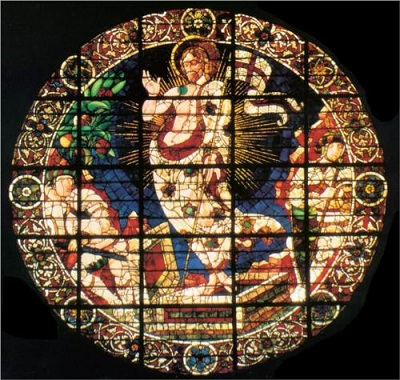
Which world is more vivid? This, or the next?

Monday, March 19th, 2012

[ by Charles Cameron — bin Laden, Abu Bakr, Bernard of Clairvaux, Qur’an burning, Tora Bora, David Ignatius, Emptywheel, and impassioned belief ]
.


image: Paulo Uccello (1443) depicts the Resurrection
life after the grave, seen through a glass, darkly

We keep on stumbling over this one.

To the western mind, mostly, this world is axiomatically more vivid than the next. But there are those for whom the next life is axiomatically the more vivid – even if their day to day practices are geared to success and continuity in this life.

And this has consequences for our own lives, in the world around us — and for security.

1.

Some who are of this mind – bin Laden in this video among them — may quote or paraphrase Abu Bakr‘s message to Khosru:

I have come to you with an army of men that love death, as you love life.

That particular quote is from the rich tapestry of Islam – but Jewish history speaks also of Kiddush ha-Shem, martyrdom for the glory of God, which became in the time of the crusades “the exemplary answer of Jews threatened in their life and faith” when offered the options of conversion to Christianity or death.

And in Christendom, there is St Bernard of Clairvaux, who is quoted as writing in his letter to the Templars at the time of the Second Crusade:

The Christian who slays the unbeliever in the Holy War is sure of his reward, the more sure if he himself is slain.

and for good measure in his sermon promoting the Crusade:

Christian warriors, He who gave His life for you, to-day demands yours in return. These are combats worthy of you, combats in which it is glorious to conquer and advantageous to die.

2.

It is with this difference in axiomatic understanding in mind, that we should approach such issues as the relative importance – in our own minds, and in those of many Afghans – of the loss of human life in a night raid, as compared with the burning of copies of the Qur’an [In Reactions to Two Incidents, a U.S.-Afghan Disconnect]:

The mullah was astounded and a little angered to be asked why the accidental burning of Korans last month could provoke violence nationwide, while an intentional mass murder that included nine children last Sunday did not.

“How can you compare the dishonoring of the Holy Koran with the martyrdom of innocent civilians?” said an incredulous Mullah Khaliq Dad, a member of the council of religious leaders who investigated the Koran burnings. “The whole goal of our life is religion.”

And a quick note here — this is an issue I’ve raised before, eg in Burning scriptures and human lives, in Of Quantity and Quality I: weighing man against book, and more recently in On fire: issues in theology and politics – ii.

3.

The same understanding also explains bin Laden’s retreat to the Tora Bora caves. As I said in an early guest post here on ZP, with a hat-tip to Lawrence Wright and his book The Looming Tower:

When bin Laden, at the lowest point of his jihadist efforts, leaves the Yemen for Afghanistan and betakes himself to the Tora Bora caves, he will inevitably remind some Muslims of the Prophet himself, who at the lowest point of his prophetic vocation left Mecca for Medina and sought sanctuary in a cave — where by the grace of his God, a spider’s web covered the entrance in such a way that his enemies could not see him.

Our natural tendency in the west is to see Tora Bora in terms of military topography, as a highly defensible, almost impregnable warren of caves deep within some of the world’s most difficult mountain territory. What we miss may be precisely what Muslim piety will in some cases see — that bin Laden’s retreat there is symbolically aligned with the “sunna” or life of the Prophet, and thus with the life of Islam itself — in much the same way that Christians, in the words of Thomas a Kempis, may practice “the Imitation of Christ”.

4.

It was in fact Emptywheel‘s piece about bin Laden’s comment re killing President Obama (and thus promoting Joe Biden) that caught my attention today and prompted this post.

Emptywheel quoted the same passage from David Ignatius that had triggered my own post On the “head of infidelity” and the tale of Abdul-Rahman ibn Awf late yesterday —

“The reason for concentrating on them,” the al-Qaeda leader explained to his top lieutenant, “is that Obama is the head of infidelity and killing him automatically will make [Vice President] Biden take over the presidency… “

— and commented:

OBL was going to kill Obama not for the sake of killing the US President, but because Biden, who served in the Senate for 36 years, almost 12 of which he served as one or another powerful committee Chair, “is totally unprepared for that post, which will lead the U.S. into a crisis.”

I just don’t think that’s right. I think it’s wrong, in fact, but [and here’s the important part] subtly wrong.

I believe that OBL lived at the confluence of worlds — one that we might call mythic or spiritual, and one that’s the one we call the “real” world. I believe that it was his myth, archetype, spirit based reality that was the more vivid to him, the one to which he was entrained, and that he found means in the practical world of strategies and tactics to adhere to the demands of that other world.

A world that was both invisible to us, and to him axiomatically victorious – at least as much so in death as in life.

On the “head of infidelity” and the tale of Abdul-Rahman ibn Awf

Monday, March 19th, 2012

[ by Charles Cameron — linking some late notes of OBL with his 1996 Declaration of War ]
.


photo credit: Maqam of Abdul-Rahman,
Nate Mathews, The Azanian Sea

I was reading David Ignatiusaccount of the forthcoming Abbottabad papers a couple of days ago, and was struck by a phrase bin Laden used in describing Obama:

Before his death, Osama bin Laden boldly commanded his network to organize special cells in Afghanistan and Pakistan to attack the aircraft of President Obama and Gen. David Petraeus.

“The reason for concentrating on them,” the al-Qaeda leader explained to his top lieutenant, “is that Obama is the head of infidelity and killing him automatically will make (Vice President Joe) Biden take over the presidency. … Biden is totally unprepared for that post, which will lead the U.S. into a crisis. As for Petraeus, he is the man of the hour … and killing him would alter the war’s path” in Afghanistan.

Obama is the head of infidelity — that had quite a ring to it.

And so, as I was rereading the text of bin Laden’s 1996 Declaration of War against the Americans Occupying the Land of the Two Holy Places this morning, I couldn’t help but notice his early use of the same phrase in that context:

And the story of Abdur-Rahman Ibn Awf about Ummayyah Ibn Khalaf shows the extent of Bilal’s (may Allah be pleased with him) persistence in killing the head of the Kufr: “the head of Kufr is Ummayyah Ibn Khalaf…. I shall live not if he survives” said Bilal.

Here’s the story of the Companion Abdul-Rahman ibn Awf as bin Laden recounts it, in the paragraph immediately preceding the one just quoted:

Abdul-Rahman Ibn Awf -may Allah be pleased with him- said: (I was at Badr where I noticed two youths one to my right and the other to my left. One of them asked me quietly (so not to be heard by the other) : O uncle point out Aba-Jahl to me. What do you want him for? , said Abdul Rahman. The boy answered: I have been informed that he- Aba-Jahl- abused the Messenger of Allah (), I swear by Allah, who have my soul in His hand, that if I see Aba-Jahl I’ll not let my shadow departs his shadow till one of us is dead. I was astonished, said Abdul Rahman; then the other youth said the same thing as the first one. Subsequently I saw Aba-Jahl among the people; I said to the boys do you see? this is the man you are asking me about. The two youths hit Aba-Jahl with their swords till he was dead. Allah is the greatest, Praise be to Him: Two youths of young age but with great perseverance, enthusiasm, courage and pride for the religion of Allah’s, each one of them asking about the most important act of killing that should be induced on the enemy. That is the killing of the pharaoh of this Ummah – Aba Jahl-, the leader of the unbelievers (Mushrikeen) at the battle of Badr. The role of Abdul Rahman Ibn Awf, may Allah be pleased with him, was to direct the two youths toward Aba-Jahl. That was the perseverance and the enthusiasm of the youths of that time and that was the perseverance and the enthusiasm of their fathers. It is this role that is now required from the people who have the expertise and knowledge in fighting the enemy. They should guide their brothers and sons in this matter; once that has been done, then our youths will repeat what their forefathers had said before: “I swear by Allah if I see him I’ll not let my shadow to departs from his shadow till one of us is dead”.

Bin Laden clearly saw himself, from the time of his Declaration through to the end in Abbottabad, as a modern-day Abdul-Rahman ibn Awf, directing the persevering and enthusiastic youth…

The Facebook pages of public diplomacy & the Billboards of unbelief

Monday, March 19th, 2012

[ by Charles Cameron — Facebook diplomacy between Israeli and Iranian individuals, atheist proselytizing in the US, popular media uses in a “monitory” world ]
.

I have long been intrigued by some of the unofficial ways in which we communicate with one another — some of you may recall an earlier post of mine on a spate of religious arguments carried out on “duelling buses“, while another more recent post noted some of the stencilled graffiti and at times quite sophisticated artwork featured on the walls around Tahrir Square during the demonstrations there…

1.

In much the same spirit, I’d like to offer here for your consideration four thumbnails of images recently posted on Facebook by individual citizens in Israel and Iran, in response to a posting (above) by two Israeli graphic artists, Ronnie Edri and Michal Tamir, which seems to have triggered quite a response in both countries.

The two Israeli posters appear to have posted images of individuals, perhaps themselves. The Iranian posters, interestingly, used images of Abdol-Hossein Sardari, the “Iranian Schindler” (upper image), with a caption that reads in part:

Abdol Hossain Sardari, a junior Iranian diplomat, found himself almost by accident in charge of Iran’s mission in Paris in 1940 and went on to help up to 2,000 Iranian Jews flee France…

and an image of the tomb of Esther and Mordecai — the tomb in Hamadan, Iran, of the same Jewish heroine recently celebrated at Purim, and pointedly referenced by Netanyahu in his gift of a Megillah to Obama — and a popular site of pilgrimage for Iran’s present day Jewish population.

Apparently there has been quite an exchange of these graphics, although some have been on the more caustic side, expressing what I can only call .. strangelove

2.

My other graphic examples are of a pair of billboards recently put up by American Atheists:

As we might expect, these were to be displayed (respectively) in or near Jewish (above) and Muslim (below) communities — the Jewish-oriented billboard in the Williamsburg area of Brooklyn, New York, and the Islamic-oriented billboard in Paterson, New Jersey.

According to the MSNBC report where I first ran across these billboards a couple of weeks ago, a Williamsburg rabbi said the sign in his district was “a disgrace. .. The name of God is very holy to us and to the whole world” — while the American Atheists’ president David Silverman reported he had not received “any blowback” from the Muslim Community in Patterson.

One imagines that some in each community would have had hurt feelings, while some in each community clearly had the good sense to show tolerance.

3.

These images tie in, I believe, with John Keane‘s notion of “monitory democracy” [link is to .pdf] that our blog-friend David Ronfeldt discussed in his post today… with our discussions here [1, 2] of the wicked complexity of many of the problems that face us… and also perhaps of the Slaughter doctrine [1, 2, 3]of the responsibility to protect

The Said Symphony: move 19

Sunday, March 18th, 2012

[ by Charles Cameron – extended analytic game on Israeli-Palestinian conflict — for those who wish to catch up, our game thus far consists of an intro to the game and game board, followed by moves 1-5, 6-9, then moves 10-11 which together constitute a meditation, moves 12, 13-15, 16-17, and most recently before this, move 18 with cadenza ]

Move 19: The view from above

Move content:

Discussing strategy, the very canny LTG (USMC, Ret’d.) Paul Van Riper had this to say:

What we tend to do is look toward the enemy. We’re only looking one way: from us to them. But the good commanders take two other views. They mentally move forward and look back to themselves. They look from the enemy back to the friendly, and they try to imagine how the enemy might attack them. The third is to get a bird’s-eye view, a top-down view, where you take the whole scene in. The amateur looks one way; the professional looks at least three different ways.

A bird’s-eye view, a hawk’s eye view, a top-down view, an overview, a view from 30,000 feet, a God’s eye view, a view from above, a zoom…

If move 18 and its cadenza gave us a view of the depth of vision or insight that is necessary for a full and rich understanding of the world we live in — its qualitative or spiritual scope, if you like — this next move, with its picnic and drone-sight, addresses its breadth in space and time — materially and quantitatively speaking.

The classic expression of the sheer material scope of the universe was put together by Charles and Ray Eames in their justly celebrated film, Powers of Ten, from which the lower of these two images is drawn:

Here are some other relevant scans of the scope of things, in terms of time and space:

The Scale of the Universe 2
A Brief History of The Universe
The Known Universe
A Time-Lapse Map of Every Nuclear Explosion Since 1945

These are impressive videos to be sure, but as an aside I’ll invite you to ask yourselves how well they compare with this zoom in words, a poem by the zennist, ecologist, essayist and poet Gary Snyder, from his book, Axe Handles: Poems:

Such breadth of vision, such craft.

*

If this “material scope of things” too has a cadenza, it would be that all of this is shot through with some primary oppositions, dappled as the poet Gerard Manley Hopkins would have it, with swift, slow; sweet, sour; adazzle, dim — as indicated in the drone-sight and picnic double image at the head of this move.

This dappling, this constant flux of opposites, takes many forms — day and night lead to the more abstract light and dark, which can then be interpreted morally as good and evil, to which we respond with repulsion and attraction as the case may be, building our worldviews from love or fear…

At different scales the opposites that matter most to us may have different names and shadings, but here I’d just like to draw attention to the dappling of our world with:

competition and cooperation
Darwin‘s natural selection and Kropotkin‘s mutual aid
duel and duet (ah! — a favorite phrasing of mine)
war and peace

Provocatively, we find this dappling in scriptures, too, wherein the ripples of such verses as “The LORD is a man of war: the LORD is his name” (Exodus 15.3) dropped like a stone into the pond of the human mind, meet with the ripples of other verses such as “God is love; and he that dwelleth in love dwelleth in God, and God in him” (I John 4.16).

There are times when we take such oppositions literally, perhaps too literally, and times when we begin to see oppositions as abstract and theoretical end-points to what is in fact a yin-yang process continually unfolding…

Which brings me by a commodius vicus of recirculation to this image of the great opposition between war and peace, its dappling, its unfolding:

Links claimed:

To the Lamb, move 18: this move presents the material scope of the universe in counterpoint to its visionary scope as laid out in move 18 with its cadenza.

To Revelation, move 17 — the word revelation means unveiling, as we have seen, and our sciences and technologies, with their spectra of telescopes, microscopes, cameras and zooms, are unveiling and revealing to us much about the physicality of the world we live in — much that was accounted for in other times and places through intuition, vision and poetry.

This scientific and technical revelation of material existence, for many of us moderns, has largely eclipsed the mode of visionary revelation of move 17 — yet it cannot eradicate it. Implicit in this move, then, is the sense that we carry with us both subjective and objective, inner and outer, qualitative and quantitative understandings — though the data that “sight” and “insight” provide us with may be different in kind, and resolving them may be something of a koan to us, the deep problem in consciousness as philosophers of science have named it — and that we can discount neither one if we are to have and maintain a rich sense of our situation.

Comment:

If the two previous moves have shown us the scope of the universe we co-inhabit, perhaps we should now make our own zoom in, much as James Joyce did when he had the schoolboy Stephen inscribe his name and address in his geography book as Stephen Dedalus, Class of Elements, Clongowes Wood College, Sallins, County Kildare, Ireland, Europe, The World, Universe – an address that Stephen then read both forwards and backwards, finding himself in one direction, and finding in the other that he had no means of knowing what might lie beyond the universe…

Imagine then, skipping rapidly from (unimaginable) cosmos via such things as the intriguingly named End of Greatness to galaxy or nebula…

…solar system and planet — whence we can slow down and zero gently in on the Middle (or as my friend Ralph Birnbaum would call it, the Muddle) East, Israel / Palestine, Jerusalem / Al Quds / the Temple Mount / Noble Sanctuary – and to such matters of contemplative vision and tribal passion as the first, second and projected third Temples, the al-Aqsa mosque.

Our increasing focus will bring us, then, to that the rock which Jews believe marks the place where Abraham bound his son Isaac (the Akedah), and which Muslims believe to be the place of ascent of the Prophet to the celestial realms (the Mi’raj) on his Night Journey (Qur’an, Al-Isra).

Here again myth and history collide, and both visionary and material considerations merge in the heart of the what my friend the Israeli journalist Gershom Gorenberg has justly called “the most contested piece of real estate on earth”.


Switch to our mobile site