Tim Furnish recently taught a course on Jihad, Apocalypse and Terrorism at the Middlebury Institute of International Studies at Monterey, and suggested to Melissa Roddy, one of his students, that she should submit this piece for our consideration. I’m happy to welcome Melissa as a guest poster here at Zenpundit. She has an intriguing suggestion to make regarding the frequent use of face coverings by IS members when they’re basically showing off their capacity for butchering those with whom they disagree. Your comments are welcome. — Charles Cameron
**
While viewing photos of Islamic State (IS) jihadists recently, an irony suddenly came into sharp focus. If these exterminators are in fact true believers, why do they always hide their faces?
Of course the practical reason is to avoid identification by governments and military forces intent on vanquishing IS. But what does it say about their commitment to a mission that has included the slaughter and enslavement of anybody and everybody they please? In every gruesome image projected in Western media of “Jihadi John” and/or his cohorts slicing through the neck of some poor soul or mass murdering innocent men, women and children, the perpetrator portrays fierce pride beneath the safety of a ski mask.
Their masks may hide their faces, but they expose the doubt in their hearts. A true believer would have no fear. A true believer would show his face to the world to prove devout confidence that his mission is in service of and blessed by Allah. A true believer would have no fear of exposure. A true believer would be confident that Allah would clear any obstacle from his path. A true believer would want to strip anonymity from such acts, because to show his face would be a declaration of faith.
It is bloody clear, IS butchers hide behind their ski masks, because, despite their boasts of religious fervor, in their heart of hearts they know they are nothing more than power hungry, murderers, rapists and thieves, with no respect for Allah’s creation. They are exactly the opposite of righteous. Their masks demonstrate the fear that in death these monsters will face an eternity in Hell for being instruments of Shaitan wearing false masks of piety simply to satisfy their bloodlust.
[ by Charles Cameron — my latest for LapidoMedia gives Sunni, Shia background, & importantly the shift from Zarqawi to Baghdadi — followed by a chaser from Will McCants ]
.
My latest from Lapido, opening paras:
TO SENIOR military officers, intelligence analysts and policy-makers, blood and guts are more real than fire and brimstone.
To the followers of ISIS – which now calls itself the Islamic State – however, not only do the concepts of hell fire and the gardens of paradise seem real, the hope of heaven and fear of hell are powerful recruiting tools, morale boosters and motivating forces.
While the battlefield is real to them, to lose one’s life on that battlefield is viewed as victory, and as martyrdom rewarded with a painless death, avoidance of Judgment Day and a direct passage to paradise.
And that vivid expectation of paradise is accompanied by a sense that in any case, ‘the end is nigh’.
That is why the ‘caliphate’ established by Abu Bakr al-Baghdadi has named its English-language magazine after the town of Dabiq.
Indeed, Dabiq’s first issue opens with a quote from Abu Musa’b al-Zarqawi, the brutal founder of the group that became the Islamic State:
‘The spark has been lit here in Iraq, and its heat will continue to intensify – by Allah’s permission – until it burns the crusader armies in Dabiq.’
The town of Dabiq is obscure enough that you won’t find it indexed in David Cook’s Contemporary Muslim Apocalyptic Literature, nor in French diplomat-scholar Jean-Pierre Filiu’s Apocalypse in Islam.
Will McCants, in his book The ISIS Apocalypse: The History, Strategy, and Doomsday Vision of the Islamic State due out later this month, quotes a leader of the Syrian opposition as saying, ‘Dabiq is not important militarily.’
And yet Abu Bakr al-Baghdadi, like Abu Musa’b al-Zarqawi before him, makes it a centrepiece of his strategy and propaganda.
Will McCants gave a useful response in his Sources & Methods podcast interview yesterday, at the 35.00 mark — answering a question about apocalypticism in IS:
I think it’s really important in terms of attracting foreign fighters from the west. If you think about what gets a foreigner motivated to leave their home and travel to an insanely violent conflict zone, there are few things that might motivate people more than the belief that the end times are right around the corner. So I see a lot of that apocalyptic propaganda from the Islamic State really directed towards foreign fighters. But also you know in the Middle East, after the Iraq war in 2003, apocalypticism began to get a lot more currency than it used to have. You know, before the war, apocalypticism among Sunnis was really kind of a fringe subject as compared to the Shia, for whom it’s been an important topic for centuries – for modern Sunnis, they kind of looked down on it, that’s something that the Shia speculate on, but that’s not really our bag. The US invasion of Iraq really changed the ways that Sunni’s thought about the end times. And then with the Arab Spring coming, and all the political turmoil that followed in its wake, it’s given an apocalyptic framework far more currency than it ever had as a way to explain political upheaval in the region.
[ by Charles Cameron — perhaps it’s not Wittenberg but Westphalia we should be praying for ]
.
**
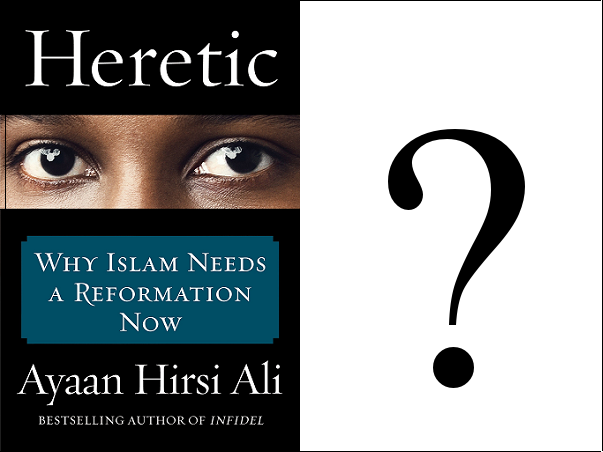
Ayaan Hirsi Ali clearly believes we need an Islamic Reformation, and she’s not alone. That much Mehdi Hasan concedes in a Guardian piece titled Why Islam doesn’t need a reformation:
In recent months, cliched calls for reform of Islam, a 1,400-year-old faith, have intensified. “We need a Muslim reformation,” announced Newsweek. “Islam needs reformation from within,” said the Huffington Post. Following January’s massacre in Paris, the Financial Times nodded to those in the west who believe the secular Egyptian president, Abdel Fattah el-Sisi, “could emerge as the Martin Luther of the Muslim world”.
Hasan’s piece was evidently written in answer to the Guardian’s take on Hirsi Ali’s latest book, Heretic: Why Islam Needs a Reformation Now by Ayaan Hirsi Ali – review, and is subtitled, Those who are calling for a ‘Muslim Martin Luther’ should be careful what they wish for. His reason?
Martin Luther..
Luther did not merely nail 95 theses to the door of the Castle church in Wittenberg in 1517, denouncing clerical abuses within the Catholic church. He also demanded that German peasants revolting against their feudal overlords be “struck dead”, comparing them to “mad dogs”, and authored On the Jews and Their Lies in 1543, in which he referred to Jews as “the devil’s people” and called for the destruction of Jewish homes and synagogues.
I have described elsewhere the movements of “purification” inspired by such men as the Arabian Ahmad ibn Abdul Wahhab, the Algerian/Libyan Muhammad bin Ali al-Sanusi, the Sudanese Muhammad Ahmad al-Mahdi, the Iranian activist Jamal ad-Din al-Afghani and the Egyptian theologian Muhammad Abduh. In a fundamental aspect, their teachings and movements resembled those set off in northern Europe by Luther and Calvin. These Christians and Muslims shared a belief in the absolute authority of the unalterable word of God as set out in the original texts. Their task was to go back to discover the “pure” message and lead their followers to implement it. However much they differed, both the Muslims and the Protestants were in this sense salafis.
To my mind, that’s a far more persuasive analysis.
Perhaps what we’re seeing today is an Islamic version of the European Wars of Religion, following a Salafist “Reformation”?
In which case it might be time to work and pray for an Islamic Peace of Westphalia.
[ by Charles Cameron — my title is taken from the book of Job — known to Islam as the prophet Ayyub — chapter 38 verse 7 ]
.
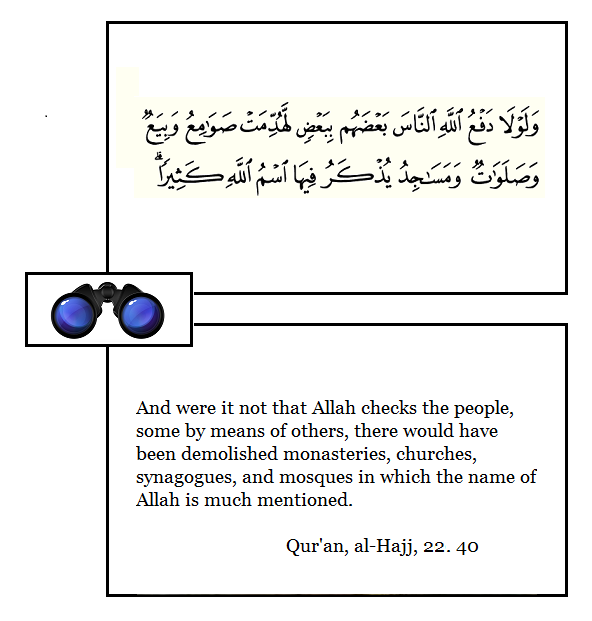
Let’s begin with Qur’an 22. 40:
I can deeply appreciate a perspective as respectful as this.
**
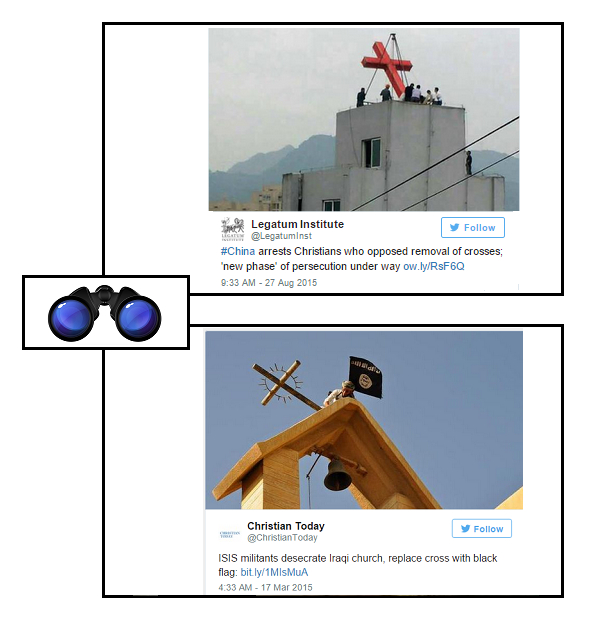
Consequently, I am even more deeply saddened when the Islamic State tears down the crosses atop churches —
than I am when the Chinese do the same exact thing..
**
And I’d suggest that the phrase “were it not that Allah checks the people, some by means of others, there would have been demolished monasteries, churches, synagogues, and mosques” as indicating that those who check / repel / drive back those others who demolish such places of worship, do so in accordance with the divine will..
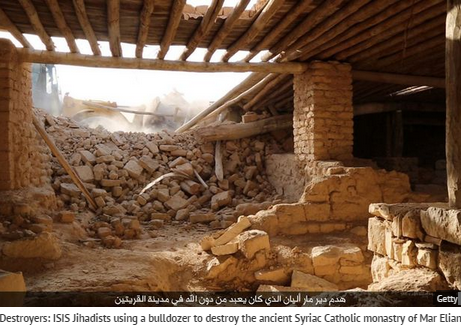
Here, members of the Islamic State bulldoze a monastery..
Such acts, then, should be checked, prevented, surely, by those who honor the Qur’an.
The question that remains is how best to accomplish this.
**
Likewise, there is the phrase about “monasteries, churches, synagogues, and mosques in which the name of Allah is much mentioned”..
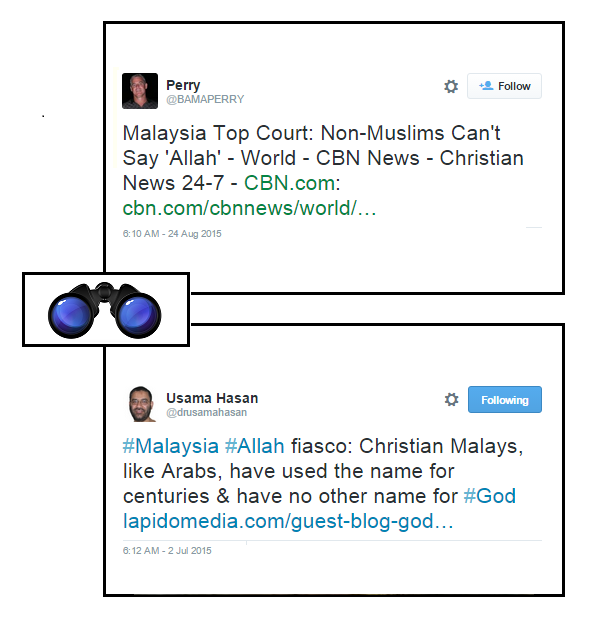
Apparently, the “name of Allah” was “much mentioned” in monasteries and churches at the time of the Prophet, and we may therefore wonder why Malaysian Muslims would wish to ban the use of that name by Christians —
One of the oldest evidences of Christian use of the word ‘Allah’ can be found in a Bible translation from 1514.
That’s two years after Michaelangelo finished painting the Sistine Chapel ceiling, and three years before Martin Luther posted his 95 Theses to the door of Wittenberg Cathedral.
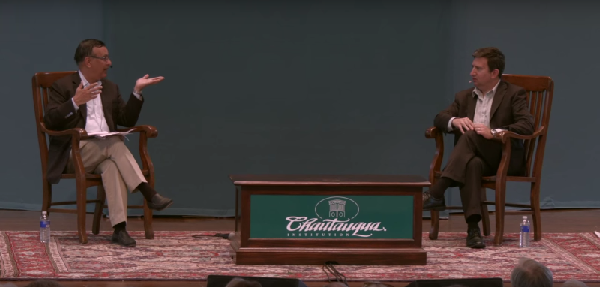
[ by Charles Cameron — Ambassador Husain Haqqani and Daveed Gartenstein-Ross at Chautauqua ]
.
**
From the outset, when cheers went up for Daveed’s birthplace, Ashland, Oregon, and Ambassador Haqqani’s, Karachi — and for the brilliant meeting of the minds that is Chautauqua — it was clear that we were in the presence of two gracious, witty and informed intelligences, and the seriousness of the conversation between them that followed did nothing to reduce our pleasure in the event. Daveed called it “easily the best experience I have ever had as a speaker.”
I’ll highlight some quotes from each speaker, with the occasional comment:
**
Amb. Haqqani:
None of the countries except Egypt, Turkey and Iran, none of the countries of the Middle East are in borders that are historic, or that have evolved through a historic process. And that’s why you see the borders a straight lines. Straight lines are always drawn by cartographers or politicians, the real maps in history are always convoluted because of some historic factor or the other, or some river or some mountains.
And now that whole structure, the contrived structure, is coming apart.
Then most important part of it is, that this crisis of identity – who are we? are we Muslims trying to recreate the past under the principles of the caliphate .. or are we Arabs, trying to unify everybody based on one language, or are we these states that are contrived, or are we our ethnic group, or are we our tribe, or are we our sect? And this is not only in the region, it’s also overlapping into the Muslim communities in the diaspora..
**
If Amb. Haqqani emphasized the multiple identities in play in the Arabic, Islamic, Sunni, Shia, Sufi, and tribal worlds in his opening, Daveed’s emphasis was on the failure of the post-Westphalian concept of the nation state.
Daveed G-R:
In the economic sphere there’s this thing that is often called “legacy industries” – industries that fit for another time, but are kind of out of place today. Think of Blockbuster Video, once a massive, massive corporation.. that’s a legacy industry. So when Ambassador Haqqani talks about how it’s not just in the Middle East that we have this crisis of identity, I think the broader trend is that the Westphalian state that he spoke about, the kind of state that was encoded after the Peace of Westphalia, looks to a lot of people who are in this generation of the internet where ideas flow freely, it looks like a legacy industry.
Why do you need this as a form of political organizing? And what ISIS has shown is that a violent non-state actor, even a jihadist group that is genocidal and implements as brutal a form of Islamic law as you could possibly see, it can hold territory the size of Great Britain, and it can withstand the advance of a coalition that includes the world’s most powerful countries including the United States. And what that suggests is that alternative forms of political organization can now compete with the nation state.
**
The Ambassador then turned to the lessons we should take from 1919’s US King–Crane Commission, reporting on the break-up of the Ottoman Empire — they concluded that it gave us
a great opportunity — not likely to return — to build .. a Near East State on the modern basis of full religious liberty, deliberately including various religious faiths, and especially guarding the rights of minorities
— down to our own times.
Amb. Haqqani:
What we can be sure of is that the current situation is something that will not be dealt with without understanding the texture of these societies. So for example, when the United States went into Iraq without full understanding of its sectarian and tribal composition, and assumed that, all we are doing is deposing a dictator, Saddam Hussein, and then we will hold elections and now a nice new guy will get elected, and things will be all right -– that that is certainly not the recipe. So what we can say with certainty in 2015 is .. over the last century what we have learnt is: outsiders, based on their interests, determining borders is not a good idea, and should certainly not be repeated. Assuming that others are anxious to embrace your culture in totality is also an unrealistic idea.
The sentence that follows was a stunner from the Ambassador, gently delivered — a single sentence that could just as easily have been the title for this post as the remark by Daveed with which I have in fact titled it:
Let me just say that, look, he ideological battle, in the Muslim world, will have to be fought by the likes of me.
Spot on — and we are fortunate the Ambassador and his like are among us.
**
Daveed then turned to another topic I have freqently emphasized myself.
Daveed G-R:
The power of ideas – we as Americans tend not to recognize this when it falls outside of ideas that are familiar to us. So one thing that the US has been slow to acknowledge is the role of the ideology that our friend and ally Saudi Arabia has been promulgating globally, in fomenting jihadist organizations.
And one of the reasons we have been slow to recognize that. I mean one reason is obvious, which is oil. .. But another reason has been – we tend to think of ideas that are rooted in religion – as a very post-Christian country – we tend to think of them as not being real – as ideas which express an ideology which is alien to us –as basically being a pretext, with some underlying motivation which is more familiar to us. That it must be economics, or it must be political anger. I’m not saying those are irrelevant, they’re not – but when Al-Qaida or ISIS explains themselves, taking their explanation seriously and understanding where they’re coming from – not as representatives of Islam as a whole, but as representatives of the particular ideology that they claim to stand for – we need to take that seriously. Because they certainly do.
**
Amb. Haqqani:
The world is not a problem for Americans to solve, it’s a situation for them to understand.
Life is not a problem to be solved but a mystery to be lived.
**
Toward the end of the discussion, Daveed touched on some ideas of recurrent interest to Zenpundit readers..
Daveed G-R:
Looking at the US Government, questions that I ask a lot are: Why are we so bad at strategy? Why are we so bad at analysis? Why do we take such a short term view and negate the long term?
He then freturned to the issue of legacy industries and nation-states:
Blockbuster is a legacy industry. And the reason why legacy industries have so much trouble competing against start-up firms, is because start-ups are smaller, it’s more easy for them to change course, to implement innovative policies, to make resolute decisions – they can out-manoeuver larger companies. And so larger companies that do well adapt themselves to this new environment where they have start-up competitors. Nation-state governments are legacy industries. Violent non-state actors are start-up compoetitors.
— and had the final, pointed word:
We’re a legacy industry ina world of start-up competitors.
**
Having offered you these tastes, at this point I can only encourage you to watch the whole hour and a quarter, filled to the brim with incisive and articulately-stated insights:
Zenpundit is a blog dedicated to exploring the intersections of foreign policy, history, military theory, national security,strategic thinking, futurism, cognition and a number of other esoteric pursuits.