That said, “pull” is the fulcrum for all 20th century orgs that hope to adapt to the 21st, not just public education. Hierarchies, including states, can no longer completely dominate, only aspire to generally arbitrate, or concentrate their powers in an asymmetric fashion. To do this, over the long term, requires putting attracting the allegiance of clients and allies capable of taking independent initiative in harmony with the org’s vision rather than relying primarily upon coercion to force people to mechanistically follow orders.
Not sure that too many people in our hallowed institutions “get it”.
….War rooms are therefore places which can pull in relevant information, which can process it effectively by working out what is most important at a given moment, and which can make timely decisions as a result of processing this information. They must become expert in Boyd’s OODA loop – Observe, Orient, Decide, Act (although I appreciate some prefer to think of this the other way round – you inevitably act first, and observe after).
War rooms should have the following characteristics:
They must have clear objectives. In electoral politics, the objective is clear: win the election. In permanent campaigns or in business, objectives are usually less clear. Is the war room there to act as a rapid rebuttal machine, for example, to defend a business’ reputation (Wal-Mart set one of these up back in 2005)? Or is it to help re-organise a business? War room staff must know exactly why they are there.
They should have a small staff and clear lines of authority. War rooms are often created because prior decision-making structures failed, perhaps because there were too many people involved in discussions, or because no one knew where authority lay. These were reasons why the most famous political war room of all – Clinton’s in 1992 – was created. They need be tight so that people don’t get bogged down by endless people given their opinions, and they need to have clear lines of authority so that everyone knows who can make what decision.
They must have executive authority. It sounds like an obvious point and in many ways it is, but I remember one campaign where we worked in the campaign office but ultimate authority for decisions lay off-site. It was a debacle as you can imagine. War rooms must contain those people who can actually make decisions.
I reviewed Jones’ 2008 book here on chicagoboyz in April, and followed it up more recently with a late September review of a similar book by Canadian “Michael Ross” on his time with Mossad.
I found both books surprisingly revelatory about the organizational culture of these two intelligence organizations, but found little that would interest the James Bond crowd, or be of much value operationally to foreign governments.
Jones’ book was by far the most damning, however, because he illustrated (with incidents from his own deep-cover career) the extent to which the CIA now operates for its own bureaucratic benefit with minimal attention to its central mandate – gathering actionable intelligence. All the most virulent criticisms of the Tea Party against big government are understatements when it comes to how national security has been subordinated to the HR nostrums of the day at CIA. Jones effectively outlined how “the emperor has no clothes.” Not so much inept as indifferent. As someone operating under “deep cover” in the clandestine branch, away from the support and comforts of consular life, he was certainly qualified to note the career paths and day-to-day obsessions of the “home office” and his colleagues. While he didn’t name names, he described enough duplicity and lassitude in the CIA’s management and staffing to earn the undying enmity of “tap dancers” and “clock watchers” alike.
Most notably, Jones outlined in some detail how the vast number of clandestine officers that were supposedly hired and deployed by the CIA post 9/11 (at huge expense) were posted to the continental US. Numbers were further bulked up by counting support staff as “officers.” Meanwhile, CIA clandestine officers already in the field overseas at the time were being methodically hindered and removed to avoid bureaucratic risk. Jones contrasted this institutional predilection with his time in Iraq as part of a largely Army team of intelligence agents.
Apparently the Panetta CIA will now conduct lawfare against one of its own, after having done so much to limit his success when he was overseas secretly working on WMD proliferation. No good deed goes unpunished. Execute the messenger when the news is bad.
It’s still early days in the legal matter. I’ve not seen any indication that Jones’ legal team has formed a strategy for protecting or saving their client. Goodness knows Jones’ pocketbook will necessarily take a massive hit, as may well be the intent of the suit in the first place. Having spent years delaying out-of-pocket reimbursements during Jones’ active clandestine career (to the tune of tens of thousands of dollars), it’s only appropriate that the CIA would try to take back what they did pay him. Pour encourager les autres.
After risking his life overseas, there’s some irony that his own employers will hold him accountable for leaking their institutional dysfunction, rather than any actual secrets.
Will a change in control of the House mean that the CIA finds itself under Congressional scrutiny for misleading elected representatives about how they were spending billions of dollars? One would imagine that Jones’ defense lawyers will be dropping hints about the potential perjury committed by his CIA managers testifying on the Hill over the last decade. Be a shame if something should happen to all those shiny careers. Horse-trading ahead, I assume.
The intelligence agency that works safest, works not at all. And a CIA entirely based in the US or ensconced behind the walls of embassies can look busy without actually being busy. The current CIA bureaucracy, for entirely understandable reasons, has preferred Potemkin villages and iron rice bowls to aggressive intelligence-gathering. Jones’ misfortune is to have been a witness to it all. I hope this all turns out OK for him.
My mini-book review offers additional details for those with an interest in intelligence organizations.
Charles Cameron is the regular guest-blogger at Zenpundit, and has also posted at Small Wars Journal, All Things Counterterrorism, for the Chicago Boyz Afghanistan 2050 roundtable and elsewhere. Charles read Theology at Christ Church, Oxford, under AE Harvey, and was at one time a Principal Researcher with Boston University’s Center for Millennial Studies and the Senior Analyst with theArlington Institute:
Zen here – I think Charles has hit upon a primal psychological mechanism that comes into full flower as societies break down and war begins to shade into warlordism. We have seen this repeatedly in history from Tamerlane’s mounds of skulls to Khmer Rouge killing fields. Mad Barons, Dogmeat Generals, Friekorps kapteins and butchers long since forgotten by history- there’s a gravitational pull toward atavistic, symbolic, destruction as social norms erode under the corrosive effects of escalating violence.
Mexico, Africa, Zarqawi?
by Charles Cameron
I’ve been struck by a couple of passages I’ve run across in my reading recently that remind me of what I can only call “brutality with religious overtones”. 1. Mexico
There have been a fair number of articles about the various Mexican cartels, but the excerpt from Ed Vulliamy’s book, Amexica: War Along the Borderline that’s now online at Vanity Fair is the one that caught my eye yesterday.
Here’s Vulliamy’s account of a conversation with Dr. Hiram Muñoz of Tijuana:
He explained his work to me during the first of several visits I have made to his mortuary. “Each different mutilation leaves a message,” he said. “The mutilations have become a kind of folk tradition. If the tongue is cut out, it means the person talked too much—a snitch, or chupro. A man who has informed on the clan has his finger cut off and maybe put in his mouth.” This makes sense: a traitor to a narco-cartel is known as a dedo — a finger. “If you are castrated,” Muñoz continued, “you may have slept with or looked at the woman of another man in the business. Severed arms could mean that you stole from your consignment, severed legs that you tried to walk away from the cartel.”<¶>Earlier this year, 36-year-old Hugo Hernandez was abducted in Sonora; his body turned up a week later in Los Mochis, Sinaloa, but not in a single piece. His torso was in one location, his severed arms and legs (boxed) in another. The face had been cut off. It was found near city hall, sewn to a soccer ball.
That’s the brutality — I haven’t see the book itself yet, but I gather it also gets into the narco-corrida music and the “quasi-Catholic cult of Santíssima Muerte” — which brings me to the second part of my interest – the religious aspect.
As Vulliamy mentions, there’s the cult of Holy Death, to be sure, a sort of shadow or inverse of the Blessed Virgin — a Dark Mother for dark times, or perhaps a revival of the ancient Mictlancihuatl, lady of the Dead? — with her own liturgy, too:
Almighty God: in the name of the Father and of the Son and of the Holy Spirit, we ask for your permission to summon Saint Death. Welcome, White Sister: we find ourselves gathered here at this altar of the Romero Romero family and of each one of us, to offer you a Mass that we hope you will like…
Which brings us to the Robin-Hood-like bandit and folk-saint, Jesus Malverde, to whom prayers such as the following [FBI .pdf, see p. 20] are offered:
Lord Malverde, give your voluntary help to my people in the name of God. Defend me from justice and the jails of those powerful ones. Listen to my prayer and fill my heart with happiness. For you shall make me fortunate.
Oh Malverde! The Vatican did not believe you to be holy and would not canonize you, but when they brought the Caterpillars to tear down your hood, you broke one machine and nobody could move you away, you broke another, leaving those who disrespect you speechless — and when the third one broke, they said, “Let Malverde’s chapel alone.”
Right beside the syncretistic quasi-Catholicism, there’s also a Protestant angle: La Familia is the group that, in Vulliamy’s words, “made its ‘coming out’ known in a famous episode: bowling five severed heads across the floor of a discotheque.” Time magazine reported on what it termed Mexico’s Evangelical Narcos:
Federal agents seized one copy of La Familia’s Bible in a raid last year. Quoted in local newspapers, the scripture paints an ideology that mixes Evangelical-style self-help with insurgent peasant slogans reminiscent of the Mexican Revolution. “I ask God for strength and he gives me challenges that make me strong; I ask him for wisdom and he gives me problems to resolve; I ask him for prosperity and he gives me brain and muscles to work,” Moreno writes, using terms that could be found in many Christian sermons preached from Mississippi to Brazil. But on the next page, there’s a switch to phrases strikingly similar to those coined by revolutionary Emiliano Zapata. “It is better to be a master of one peso than a slave of two; it is better to die fighting head on than on your knees and humiliated; it is better to be a living dog than a dead lion.”
What’s troubling here is that there is only one undoubtedly “evangelical” phrase in all those that Time quotes, and it is one of then ones said to resemble the aphorisms of Emilio Zapata. “It is better to be a living dog than a dead lion” is a pretty direct borrowing from Ecclesiastes 9.4 in the King James Version: “To him that is joined to all the living, there is hope: for a living dog is better than a dead lion.”
But that’s not actually all. I didn’t mention it at the time, but “I ask God for strength and he gives me challenges that make me strong; I ask him for wisdom and he gives me problems to resolve; I ask him for prosperity and he gives me brain and muscles to work” is almost word-for-word the same as a poem attributed to Islam — or Judaism for that matter. Indeed, it can be hard to tell who is borrowing from whom – but one final source for the La Familia bibleis known – it’s the book Wild at Heart by John Eldredge, the pastor of a ministry in Colorado Springs, who must have been surprised at the uses to which his writings were being put.
In any case, as I said on Zenpundit: These people have a theology, and we should be studying it. 2. Africa
I have stood in a blood-splattered house in Tanzania where an old woman had just been beaten to death for being a “witch” who cast spells on her neighbors. I have stood in battlefields in the Congo where the troops insist with absolute certainty they cannot be killed because they have carried out a magical spell that guarantees, if they are shot, they will turn briefly into a tree, then charge on unharmed. I have been cursed in Ethiopia by a witch-doctor with “impotence, obesity, and then leprosy” for asking insistently why he charged so much to “cure” his patients. (I’m still waiting for the leprosy.) Where do these beliefs come from? What do so many Africans get out of them? Can they be changed? These are questions that are asked in Africa all the time, but we are deaf to the conversation.
That sent me in search of some early military anthropology related to guerrilla warfare I’d come across in earlier readings.
I’m quoting here from the chapter on “The Mau Mau Religion” in Maj. Hughes paper:
Leakey’s original hypothesis in Mau Mau and the Kikuyu: “Mau Mau was nothing more than a new expression of the old KCA … a political body that was banned … because it had become wholly subversive.” Furthermore, “Mau Mau was synomomous with the new body called the in school, Kenya African Union…” However, Leakey admits to a reversal of his original hypothesis in Defeating Mau Mau, and goes on to say, “Mau Mau, while to some extent synonymous with these political organizations, was in fact a religion and owed its success to this fact more than to anything else at all.”<¶>He then proceeds to attribute the origin of Mau Mau to an “ideology transfer,” wherein the religious beliefs of the Kikuyu transitioned from their ancient tribal religion to Euro-Christianity to Mau Mau. The first transition took place artificially, as the missionaries stripped away the traditional beliefs and supplanted them with “20th Century Europe’s concept of Christianity.” The second transition was more natural and evolutionary than the first. A reactionary hybrid of the old and the new developed, because the supplanted concepts would not hold up in their society. There were too many contradictions between the old and the new, mainly due to the 20th Century European “add-ons.”
Most of us have a pretty fixed view of what religion is, should be, or isn’t. Some of my readers no doubt hold to a evangelical Christian position, some are Catholic, some perhaps Buddhist, agnostic or atheist, and some perhaps Muslim. Each of us tends to take our own view of a particular religion as normative, but the reality is that the history of each of the great world religions contains sanctions for both peace-making and warfare — and human nature itself encompasses a range of behaviors that run from the kind of atavistic violence described above to the forgiving and compassionate impulse behind the Beatitudes…
And while economic pressures and political frustrations may be enough to power great struggles, when religious rituals, beliefs and feelings are added into the mix, it can quickly become even more lethal. 3. And Zarqawi?
All of which leaves me wondering how close the parallels are between the Mau Mau in LSB Leakey’s account, La Familia and the other Mexican cartels — and the brutalities of jihadists such as Abu Musab al-Zarqawi.
Charles Cameron is the regular guest-blogger at Zenpundit, and has also posted at Small Wars Journal, All Things Counterterrorism, for the Chicago Boyz Afghanistan 2050 roundtable and elsewhere. Charles read Theology at Christ Church, Oxford, under AE Harvey, and was at one time a Principal Researcher with Boston University’s Center for Millennial Studies and the Senior Analyst with theArlington Institute:
The United States of Islam Video
by Charles Cameron
[ the first in a series, cross-posted fromChicago Boyz ]
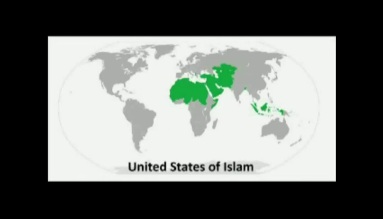
The video announces itself as “an USI Films production”. It then opens with the words “since 911 the world has changed” in white type against black, followed immediately by news clips of the WTC attacks and of President Bush describing them as “evil acts” and declaring “I have directed the full resources of our intelligence and law enforcement communities to find those responsible, and to bring them to justice.” What we shall be seeing, then, is a time-oriented video, presenting a historical context for the present moment with implications for the near future. From here we cut by way of another white on black typed message — “they started this war in afghanistan” – via clips of war footage to another – “but their agenda is much bigger and brutal than that” – and then to another clip of Pres. Bush: “Our war on terror begins with al-Qaida but it does not end there. It will not end until every terrorist group of global reach has been found, stopped, and defeated.” By this point, the background music, which is taken (for reasons both political and musical?) from Vangelis’ 1492 – Conquest of Paradise soundtrack, is swelling. A global map appears, showing much of north Africa, the middle east, Indonesia and Malaysia in green, with Pres. Bush in voice over speaking of the establishment of “a violent political utopia across the middle east which they call a Caliphate where all will be ruled according to their hateful ideology.”
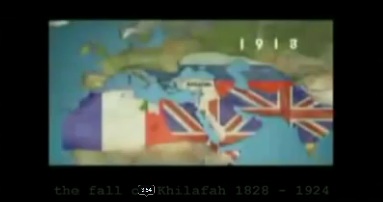
The map is titled United States of Islam. The words “they have done this before” are then followed by a series of film clips showing “the fall of the Khilafa 1828 -1924” and maps showing the slow spread of the British and French flags across north Africa and the middle east, with glimpses of Lawrence of Arabia, the Balfour declaration, and General Allenby, accompanied by the voice-over of someone I’d tentatively identify as Sheikh Imran Nazar Hosein, declaring: The Khilafa was destroyed. Who destroyed it? Why did they destroy it? How did they destroy it? When did they destroy it? What did they replace it with? With what was it replaced? And what is its destiny?
These are awesomely important questions which very few can answer today.
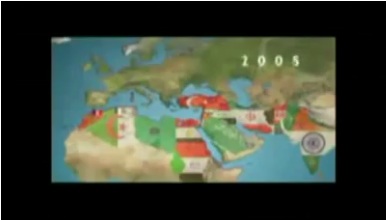
The text then states that (the west) “divided us into 54 states” and the map begins to show the various flags of the Islamic states intowhich the region was more recently divided…
ending up in 2006. And what do we want now? You might be forgiven if you haven’t already guessed:
Clips then show the toppling of Saddam’s statue in Baghdad, the Israeli army in Gaza with casualties, the October 2009 Pishin attack on the Revolutionary Guard in Iran (which was claimed by Jundullah), and a first mention of the Christmas bomber, Al Qaida and Yemen… a quick mention of Nigeria and Somalia… and “Pakistan from which they fear the most”. A newscaster from, presumably, Pakistan intones “this is called the fourth generation warfare.” That essentially brings us up to the present moment. * We have arrived at the half way point in the 10 minute video and seen the global historical context, laid out in maps and flags. We have focused in on the present from a two-hundred year sweep, and on Pakistan from the distributed ummah. What follows will expound and expand on this present moment, bringing Afghanistan into the picture alongside Pakistan, emphasizing the spiritual significance of Khorasan, and taking the battle variously to India and Jerusalem…
Zenpundit is a blog dedicated to exploring the intersections of foreign policy, history, military theory, national security,strategic thinking, futurism, cognition and a number of other esoteric pursuits.
 on
on

 security has been subordinated to the HR nostrums of the day at CIA. Jones effectively outlined how “the emperor has no clothes.” Not so much inept as indifferent. As someone operating under “deep cover” in the clandestine branch, away from the support and comforts of consular life, he was certainly qualified to note the career paths and day-to-day obsessions of the “home office” and his colleagues. While he didn’t name names, he described enough duplicity and lassitude in the CIA’s management and staffing to earn the undying enmity of “tap dancers” and “clock watchers” alike.