zenpundit.com » 4GW

Archive for the ‘4GW’ Category

Book Review: Koran, Kalashnikov and Laptop

Wednesday, July 7th, 2010

Koran, Kalashnikov and Laptop by Antonio Giustiozzi

I just finished reading Koran, Kalashnikov and Laptop: The Neo-Taliban insurgency in Afghanistan by historian Antonio Giustozzi who has subsequently gone on to write in rapid succession, Decoding the New Taliban: Insights from the Afghan Field and Empires of Mud, which I intend to read as well. Giustozzi is doing something important with his study of the Neo-Taliban insurgency that twenty years ago, a professional historian would have eschewed: applying his his historical expertise and methodology in a disciplinary synthesis to understand a dynamic, emerging, phenomenon at the center of current policy.

At the outset, Giustozzi writes:

This book is written by a historian who is trying to understand contemporary developments making use of not just the historical method, but also drawing from other disciplines such as anthropology, political science and geography. As a result, this book combines an analysis of the development of the insurgency based on available information with my ongoing work, focused on identifying the root causes of the weakness of the Afghan state.

This is a useful investigative methodological approach. “Useful” in the sense that while adhering to scholarly standards, Giustozzi offers readers the benefit of his capacity as a professional historian to evaluate new information about the war with the Neo-Taliban, while orienting it in the appropriate cultural-historical context. Not all of the information dealt with is reliable; Giustozzi candidly explains the disputes around particular unverified claims or accusations before offering his educated guess where the truth may be or the probabilities involved in a fog of war and ethno-tribal animosities.

Koran, Kalashnikov and Laptop is an academic book with a fairly detached tone and heavily endnoted chapters, which Giustozzi divided in the following manner:

1. Sources of the insurgency

2. How and why the Taliban recruited

3. Organization of the Taliban

4. The Taliban’s strategy

5. Military tactics of the insurgency

6. The counter-insurgency effort

The chapters have a wealth of detail, bordering at times on minutia, on Afghanistan’s complex and personalized system of politics which help shed light on why the effort at providing effective governance, a key COIN tenet, is so difficult. One example:

“….Strengthened as it was by powerful connections in Kabul, Sher Mohammed’s ‘power bloc’ proved quite resilient. Some of the Kabul press reported ‘criticism’, by former and current government officials from Helmand, of Daoud, whose attempts to restrain and isolate the rogue militias and police forces of helmand were described in terms of collaborationism with the Taliban. Daoud reacted by accusing the local ‘drug mafia’ of plotting against him and tried to convince President Karzai to leave him in his post, but not even British Prime Minister Tony Blair’s efforts sufficed to save him. Karzai sacked Daoud in the autumn of 2006. His replacement, Asadullah Wafa, was widely seen as a weak figure who for several months even refused to deploy to Lashkargah.”

This example is a typical one for political life in the provinces. Karzai’s counterinsurgency strategy does not have much to do with ours, and is largely antithetical to it. What we call “corruption”, Karzai sees as buying loyalty; what we call good governance, Karzai views as destabilizing his regime. We are not on the same page with Hamid Karzai and perhaps not even in the same playbook.

Giustozzi is exceptionally well-informed about Afghanistan and the political and military nuances of the old Taliban and the Neo-Taliban insurgency and the structure of Koran, Kalashnikov and Laptop is clear and well-organized. Giustozzi is informed about COIN in this context but less so generally (in a minor glitch, he posits Mao as primarily waging guerrilla war against an Imperial Japan – Mao didn’t – which did not have much of a “technological edge” – which Japan certainly did over Chinese forces, Nationalist or Communist, for most of the war) but Giustozzi is not writing to add to COIN theory literature, as he specifically noted. What the reader will get from Giustozzi is a grasp of who the Neo-Taliban are as a fighting force and the convoluted, granular, social complexity of Afghan political life in which the US is attempting to wage a COIN war.

Koran, Kalashnikov and Laptop is strongly recommended.

Reality, Strategy and Afghanistan: Some Questions

Tuesday, July 6th, 2010

Are all the strategic objectives in Afghanistan clearly defined and acheivable by military force?

Of the operational activities that might support our strategic objectives that require civilian expertise, why in nine years have we not sent adequate civilian agency representation and funding?

If military operations in Afghanistan require a single commander, why does the civilian side of the COIN campaign have authority divided between at least a half-dozen senior officials without anyone having a deliverable “final say” reporting to the President?

If Pakistan’s “partnership” is officially a requirement for strategic success (and it is), why would Pakistan be a “partner” in helping stabilize an independent regime in Afghanistan that would terminate Pakistan’s ability to use Afghanistan as “strategic depth”?

Is the Taliban more important to our national security than is al Qaida?

If we can’t get at al Qaida after nine long years to finish them off, why is that?

If Pakistan’s ISI is sponsoring the Haqqani Network, the Quetta Shura Afghan Taliban and other extremist jihadi groups, doesn’t that make the ISI as a critical component – the strategic “brains” – of the Enemy’s center of gravity?

Shouldn’t we be targeting the Enemy center of gravity if we are to acheive our strategic objectives? (If we are going to be squeamish and pants-wetting about that, how about the retired and bearded “plausibly deniable” ex-ISI guys running around FATA as “advisers” and fixers to jihadi and tribal factions?)

Should we be sending the Enemy’s strategic brains billions of dollars annually?

For that matter, is the size of our own logistical tail effectively funding the guys in black turbans shooting at American soldiers and burying IEDs? Would less be more?

Can we ever gain the initiative if the Enemy has safe sanctuaries – oh, has anyone noticed that Pakistan has twice as many Pushtuns as Afghanistan and how does that affect the odds for winning a purist COIN campaign….in 18 months?

Are COIN warfare and proxy warfare the same thing to be treated with the same policy?

If we assume the Enemy has read FM 3-24, shouldn’t we make certain that a considerable percentage of our tactical moves in AfPak are not coming out of a “cookbook”? Is the element of surprise something we can use, or is it considered unsporting these days in warfighting doctrine?

Given that most of Afghanistan’s GDP is derived from US military spending, how is the Karzai regime going to afford an ANA of the requisite size that COIN theory requires for an operational handoff at our arbitrary political deadline of 18 months?

And on a related note, if the Karzai regime in it’s entirety was suddenly frozen in carbonite like Han Solo in The Empire Strikes Back, how much more efficient and popular would the Afghan government instantly become with ordinary Afghans compared to how it is now?

If we can’t work with Karzai why can’t we work with somebody else? It’s not like he was, you know, actually elected 😉

If political authorities are not effectively linking  Ends, Ways and Means – some old-fashioned gadflys call this state of affairs “not having a strategy” – and are unlikely to acheive our objectives and said political authorities will not consider changing the objectives, what practical actions can we take in the next 18 months to seize the initiative,  maximize the harm inflicted on our enemies, ensure help for our friends and the furtherance of our own interests?

Movie Review: RESTREPO Screening

Tuesday, June 29th, 2010

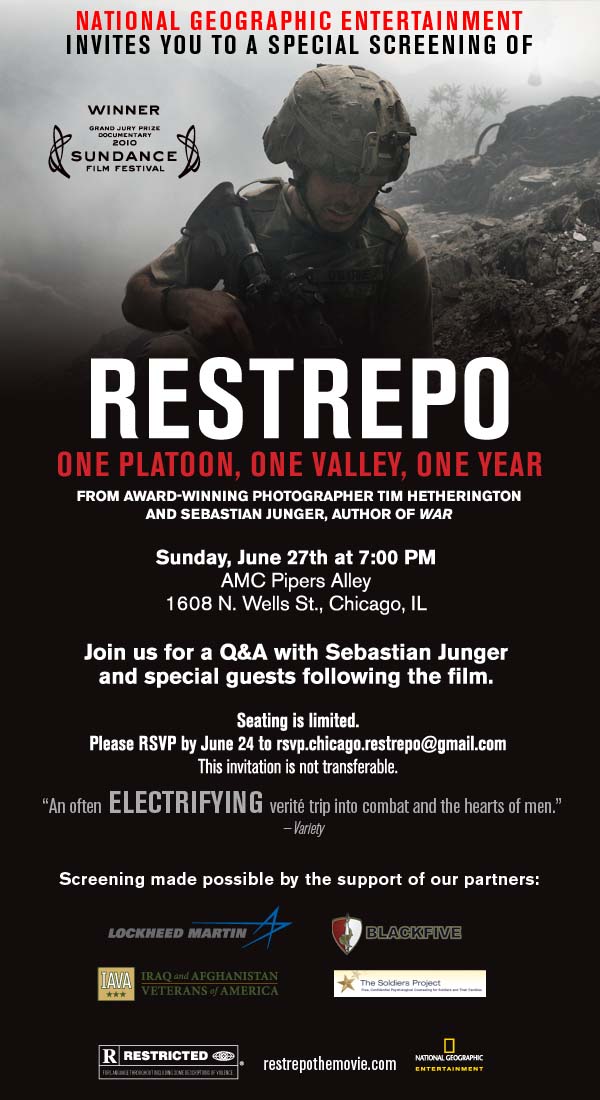
restrepo_evite_chi2.jpg  

RESTREPO 

As I mentioned yesterday, I had the good fortune to receive a courtesy invite to a screening of RESTREPO, a documentary of the experience of the second platoon of Battle Company in the Korengal valley of Afghanistan. The film takes its title from a fallen member of the platoon, a medic Pvt. Juan “Doc” Restrepo, in whose honor the platoon’s new outpost in that ferociously disputed valley is named. The film, largely compiled from footage shot by Tim Hetherington, is the companion to the book WAR by Sebastian Junger on the same subject. There are some substantial differences between the movie experience and reading the book ( which I reviewed here).

First, RESTREPO makes more explicit the harsh terrain in which the war is taking place for the young men of second platoon. If you have ever driven through the mountains of Tennessee or West Virginia, imagine those states as semi-arid, with steeper elevations and go back in time to circa 1900 so that the deeply impoverished residents are struggling to scratch a living out of sand and rocks with little or no comforts of modernity. The valley appears to always be dusty, sunny and very hot. Except up in the hills where it snows – then it looks cloudy and cold. That’s what Korengal looks like.

The Korengalis, it must be said, look like that too. Virtually every Korengali man in the film is hawk-faced gaunt and weathered, fierce faces deeply lined by sun and privation. Korengali elders have the look of determined survivors who built the fortified compounds that cling precariously to the rock wall of the hills, ascending, jerry-built. The village reminded me of what Cabrini-Green might have looked like had it been erected in the 9th century. The warmth of their elders’ feelings toward Americans can be described as “grudging”, well-demonstrated at the shura where the elders asked the Captain for the return of “Yusuf Mohammed” who had been arrested. As it turned out, young “fucking Yusuf Mohammed” had beheaded someone on a jihadi videotape and the clearly disgusted C.O. told the elders that Yusuf would not be coming back.

A second striking difference was that unlike WAR, which is narrated through Sebastian Junger’s perspective, the soldiers are speaking directly themselves, either in candid comments on patrol and in RESTREPO or in de-brief interviews. Junger accurately reflected the views of the soldiers he interviewed but where WAR has one voice, Junger’s, RESTREPO has a multitude of voices with their individual insights, irreverance, agonies, tedium, bitching, regrets and pride. Reading WAR depressed me, but watching RESTREPO, despite scenes of graphic suffering, definitely did not. If you see these young soldiers and do not come away impressed with their mettle and resilience of character, then you have a heart of stone and a head of straw.

A thought that kept coming back to me, which I think was stirred by the imagery of the valley seen in the film in a way the book did not, was that there was nothing of strategic value there whatsoever. Even the Taliban was not particularly welcome and tread very lightly among the Korengalis who are ruled by their elders to a degree that has eroded elsewhere in Afghanistan. It seemed with American operations in the Korengal we were replicating in miniature a Khe Sanh or Dien Bien Phu where the conventional army could draw out the insurgents and that the COIN elements were window dressing, Big Army humoring the party line at CENTCOM while playing a joke on the soldiers ordered to go through the motions of counterinsurgency on the ground. Junger, in his talk after the film hinted as much in saying that 150 men of Battle Company could hold their own there but could not do the COIN objectives in Korengal by themselves that required a full battalion.

After the film was over, Sebastian Junger took questions from the theater audience, which had a strong representation of veterans, including two who had served at RESTREPO and family members who lost sons in Afghanistan. He was a straight shooter in all of his answers, even the difficult moral questions and did not pretend he had all the answers or better answers and tried to testify primarily to what he personally witnessed. A performance that would make me comfortable in relying on Junger’s reporting in the future.

A moving and thought-provoking documentary, RESTREPO opens at Piper’s Alley in Chicago this Friday on July 2nd

Intriguing Analysis on NYT-Obama Admin Policy Split on Pakistan

Monday, June 28th, 2010

Pundita detects the Old Gray Lady going off Rahm Emanuel’s reservation:

Afghanistan War: Obama tries to quash New York Times mutiny

I don’t know whether the mutiny is actually against the White House or the ISAF command or both. All I’ve been able to piece together is that after fortifying themselves with rum and the battle cry, ‘We’re nobody’s poodle!‘ the New York Times editorial board gave the heave-ho to NATO’s march to the rear in Afghanistan.

So this is a very strange turn of events and worthy of examination.The mutiny might have started earlier but as near as I can figure it began June 11. On that date the New York Times reported on a version of what transpired during Karzai’s dispute with two officials….

….State Department spokesman P.J. Crowley, who evidently had not gotten the memo about the mutiny by the time of his June 25 press briefing, only poured fuel on the fire started by the mutineers:

QUESTION: … the New York Times today reported that the Pakistan army has offered to mediate for peace talks with the Taliban and also with the Haqqani network. Is the offer with you?MR. CROWLEY: Well, as we’ve said many times, this is an Afghan-led process, but obviously there are discussions going on between Afghan officials and Pakistani officials, and we certainly want to see ways in which Pakistan can be supportive of this broader process.

QUESTION: Do you see the Haqqani network coming – sharing power with the Afghan Government? Do you support that?

MR. CROWLEY: We have been very clear in terms of the conditions that any individual or any entity need to meet in order to have a constructive role in Afghanistan’s future: renouncing violence, terminating any ties to al-Qaida, and respecting the Afghan constitution. Anyone who meets those criteria can play a role in Afghan’s future.

The White House, more alarmed by the Times mutiny than Crowley’s foot-in-mouth replies, scrambled to do damage control. Yesterday Democratic Senator Dianne Feinstein and a toady in the GOP camp, Republican Senator Lindsey Graham, were packed off to Fox News Cable’s Sunday show to give assurances that if General Petraeus needed more time to win the war in Afghanistan he had it.Leon Panetta was also dispatched to the Sunday morning TV network circuit, which receives close attention here in the nation’s capital. So it came to pass that Panetta made his first appearance on American network television since he became director of the CIA. He appeared on ABC’s “This Week” and faced questions from Jake Tapper, who soon turned discussion to the June 24 Times report:

Pundita has much more here.

The problem for the Obama administration is that if the generally incurious and poorly informed American public ever grasped the nature and an accurate record of Pakistan’s ongoing sponsorship the Taliban, Pakistan would quickly become an object of hatred in the eyes of US voters which, with the right visceral image, could quickly turn passive disquiet into righteous rage. My read, and it is just an informal sense, is that frustrations with the war are building into a dangerous powder keg beneath a placid surface of widespread anxiety and concern for the well-being of the troops.

A mass-casualty act of terror on American soil traced back to Pakistan, or some grisly image broadcast from the Afghan battlefield could unleash a political tsunami.

Cameron on “A Translation of Abu Walid al-Masri’s Reply”

Thursday, June 17th, 2010

Charles Cameron, my regular guest blogger, is the former Senior Analyst with The Arlington Institute and Principal Researcher with the Center for Millennial Studies at Boston University. He specializes in forensic theology, with a deep interest in millennial, eschatological and apocalyptic religious sects of all stripes.

Zen here – some background prior to Cameron’s guest post. As I mentioned previously, Charles, a while back, posted a deeply reflective essay here at ZP and at Leah Farrall’s  All Things Counterterrorism, in response to the unusual dialogue that Farrall, a former Australian counterterrorism official, was having with  Abu Walid al-Masri, an Egyptian strategist of jihad, a sometime critic of al Qaida and an adviser to the Taliban. In other words, al-Masri is an influential voice on “the other side” of what COIN theorists like Mackinlay and Kilcullen call the “globalized insurgency” and a theorist of insurgency himself. After some delay, al-Masri responded to Charles, as Farrall described:

Abu Walid al Masri responds to Charles Cameron

Abu Walid  has responded a letter from Charles Cameron. Abu Walid’s response  to Charles can be found here.  You’ll notice when following the link, that he has a new website.It’s well worth a look. There is also an interesting comment from a reader below Abu Walid’s response to Charles; it’s from “one of the victims of Guantanamo”.

As you’ll see from his website Abu Walid is also engaging in a number of other interesting dialogues at the moment, which I am interested to read as they progress.Charles wrote his letter in response to the dialogue Abu Walid and I had a little while back. For those of you new to the site, you can find this dialogue to the right in the page links section.  The letter from Charles can be found on my blog here.

….These letters may not change anything, but they are important because  in mass media sometimes only the most controversial and polarising views tend to make it into the news.I think person to person contact, especially via mediums like this, can go some way to providing opportunities for all of us to discover or be reminded that there is more than one viewpoint and along with differences there are also similarities. Contact like this humanizes people, and in my book that’s never a bad thing.

With that context in mind, we will now let Charles take it away:

A TRANSLATION of ABU WALID al-MASRI’S REPLY

by Charles Cameron

I asked a native-speaking grad student associate of mine to give me a literal translation of Abu Walid’s response to my post, and then tweaked it to give it a reasonable combination of accuracy and fluency, and my associate has kindly given the result his thumbs up — so what follows is probably fairly close to the sense of Abu Walid’s original.

Is this a return to the Age of Chivalry? — Comments on the Response of Charles Cameron

May 31, 2010

Author: Mustafa Hamed, Abu al-Walid al-Masri

MAFA: The Literature of the Outlaws

Charles Cameron’s words, in his comment on the dialog between myself and Ms. Leah Farrall, were wonderful, both for their humanitarian depth and in their high literary style, which makes it difficult for any writer to follow him. He puts me in something of a dilemma, fearing any comparison that might be made between us in terms of beauty of style or depth and originality of ideas — but in my capacity as one of those adventurous “outlaws”, I will try to contemplate, rather than compete with, his response, since this is what logic and reason call for.

Charles Cameron was deeply in touch with the roots of the problem that the world has (justly or unjustly) called the war on terror: it is a cause that relates to the sanctity of the human individual, and his rights and respect, regardless of any other considerations around which the struggle may revolve.

No one can argue about the importance of peace, or the need all humans have for it, nor can anyone argue that war is not hideous, and universally hated.  And yet wars are still happening, and their scope is even increasing.

And now the West claims: it is terrorism — as if war on the face of the earth were the invention of Bin Laden and al-Qaida — and all this, while many others are arguing ever more forcefully that the opposite is true, that al-Qaida and Bin Laden are the invention of war merchants, and that no one can definitely declare as yet — in an unbiased and transparent way — who caused the events of September 11 and the deaths of three thousand persons.

It is not only the one who pulls the trigger who is the killer, as we know —  the one who set the stage for a crime to be committed, who arranges the theatre, and opens the doors, and lures or hires the one who pulls the trigger is even more responsible. He’s the one, after all, who carries away the spoils of the crime, then chases down the trigger-man and finishes him off — not for the sake of justice, nor for love of humanity, but to hide the evidence of the crime, to erase his own fingerprints, and assassinate the witnesses who could implicate him.

For example: was the execution of Saddam Hussein really about bringing justice? Of course not. They executed him after a travesty of a trial for the most trivial of his crimes. Nobody, however, asked him about his most significant crimes — they killed him before he could admit to them, or name the major partners who brought him to the apex of his power, and provided him with a full range of lethal weaponry including weapons of mass destruction, so he could perform mass murder with confidence in his own impunity.

I personally (and here I speak only for myself, so Ms. Farrall need not get irritated) would have preferred to have Charles Cameron as President of the US and a united Europe and the leader of NATO — then there would have been no wars in Afghanistan or Iraq, and the problem of terrorism would have ended in minutes, along with the problems in the Middle East, and nuclear militarization, and even those of poverty and pollution. Why? Because not a single one of these problems can be solved except through the logic of humanitarianism, of justice, and love for people and peace, and hatred of oppression and discrimination between people in any form — we are all the creatures of God, and to Him we shall all return.

I am reminded of Richard the Lionheart, who came to lead a big crusade to capture Jerusalem from Muslim hands. The bloody wars he led brought fatigue to everyone and benefited neither the religious or nor the day-to-day interests of either party. Leading the Muslim campaign was Sultan Salah al-Din al-Ayyubi (Saladin), King Richard’s peer in courage, chivalry and wisdom.

Both parties finally agreed that Jerusalem should remain in Muslim hands — hands which would guarantee its security and that of its people, and of both the Islamic and Christian sanctuaries, preserving their interests and protecting the sanctuaries of all, in peace.

Thereafter, King Richard retreated from Muslim lands, carrying with him a most favorable impression of the Muslims and of Saladin as he returned to his own country, while leaving a continuing memory of respect and appreciation for himself and his chivalry with Saladin and the Muslims — which is preserved in our history books down to the present day.

It was Mr. Cameron’s spirit of fairness, chivalry and true spirituality that reminded me of King Richard’s character — but sadly, it is very difficult to find a ruler in the west like King Richard, and I find it even more regrettable that Muslims should have even greater difficulty finding among themselves a ruler like Saladin.

This is because things are on the wrong track, and people are not in their rightful positions. The wrong people are in power and leading us, while the best among us are weak and under siege.

No human likes or wants this state of affairs — but are the people who are in control of this planet real human beings? Can we consider those who own 50% of the earth’s wealth human, even though they comprise no more than 2% of the human population?

In my opinion, the situation is much worse than these international statistics suggest. I believe the number of those who rule the world is far fewer, and that they own much more. They are the ones who invest in all kinds of wars wherever, and under whatever name or banner, they may be found. The mention of war translates to these people as an immediate waterfall of gold tumbling into their usurious bank vaults, which hold the world — both leaders and led — by the neck.

I speak here of all wars without exception, whether they be the First and Second World Wars, or the wars in Korea and Vietnam, or the First and Second Gulf Wars, or the Third and Fourth, yet to come — whether it be a war in Afghanistan (to hunt for the “Bin Laden and al-Qaida” mirage) or in Iraq (looking for illusory “weapons of mass destruction”) or in Bosnia, Somalia or Africa — that continent of eternal wars for the sake of gold or oil fields — Africa, that colonized continent of disease, covertly modernized in the labs of the secret services and giant pharmaceutical companies.

I wish we could return to the age of chivalry– of courageous and rightly religious knights — for then wisdom would prevail and peace would spread, and we could leave this age of the brokers and merchants of war behind us.

Muslims always call on God to bless them with a leader such as Saladin , and I think they should also pray for God to bless the West with a ruler such as Richard the Lionheart — because without a Saladin here and a Richard there, the fires of war will continue to blaze. That’s the reason the brokers of wars will not allow the appearance of a Saladdin here, nor a Richard there.

By means of the laws to fight terrorism, the emergency laws, NATO, the Security Council and the International Court of Justice, the various counter-terrorism forces around the world, the CIA and FBI, and the Army and National Guard, the Patriot Act in the US, the jails at Guantanamo and Abu Ghraib and Bagram — and the secret “black sites” and “floating prison ships”– by all these means and many others, they kill and jail and start wars, so that humans (and terrorists) are not threatened by the likes of the two great kings, Saladin and Richard.

Therefore in the situation we find ourselves in now — despite our noble dreams of an age of knighthood and chivalry as an alternative to this age of broker kings — the destiny of all humanity, and even planet earth itself, remains in question. Of course there will be an end to all this someday… but how??… and when?? I do not think any one of us has the answer.

Finally I would like to thank Charles Cameron for his care in writing and commenting, and to express again my thanks to Ms. Leah Farrall, who deserves all the credit for initiating these dialogues.

Signed: Mustafa Hamed, Abu al-Walid al-Masri


Switch to our mobile site