zenpundit.com » iraq

Archive for the ‘iraq’ Category

Bin Laden’s death and a White House or Palace

Tuesday, May 3rd, 2011

[ by Charles Cameron ]
.

Okay, you may groan and skip quickly to the next post or perhaps read with bemused interest every time I post here about Islamic eschatology — but in either case you might have hoped that the death of bin Laden would have no apocalyptic resonance whatsoever.

Sadly enough, Anjem Choudary — co-founder with Omar Bakri Muhammad of the UK’s Islamist group al-Muhajiroun – has a press release posted on his website today titled May Allah grant Sheikh Usama Martyrdom. It begins:

The announcement this morning of the death of Sheikh Usama Bin laden has been met with joy in the United States and by other enemies of Islam and Muslims. I would like remind everyone that someone much better and much more significant then Sheikh Usama Bin laden passed away in the past, namely the Messenger Muhammad (saw) and that this never stopped the Jihad nor the spread of Islam to the East and West. Indeed the Messenger Muhammad (saw) said that the day of judgement will not come until a group of Muslims conquer the White House.

The hadith in question comes from Sahih Muslim, Book 19, On Government (Kitab Al- Imara) 4483, and reads as follows:

Narrated Jabir ibn Samurah:
.
It has been narrated on the authority of Amir ibn Sa’d ibn AbuWaqqas who said: I wrote (a letter) to Jabir ibn Samurah and sent it to him through my servant, Nafi’, asking him to inform me of something he had heard from the Messenger of Allah (peace_be_upon_him). He wrote to me (in reply): I heard the Messenger of Allah (peace_be_upon_him) say on Friday, the day on which al- Aslami was stoned to death (for committing adultery): The Islamic religion will continue until the Hour has been established, or you have been ruled by twelve Caliphs, all of them being from the Quraysh. I also heard him say: A small force of the Muslims will capture the white palace, the palace of the Persian Emperor or his descendants. I also heard him say: Before the Day of Judgment there will appear (a number of) imposters. You are to guard against them. I also heard him say: When God grants wealth to any one of you, he should first spend it on himself and his family (and then give it in charity to the poor). I heard him (also) say: I shall be your forerunner at the Cistern (expecting your arrival).

I suppose I should apologize, but “until the Hour has been established” and “Before the Day of Judgment” are both clear “end times” references.

A poster on SunniForum quotes this hadith from Muslim, one of the two hadith collections regarded as most reliable and given the epithet “sahih” (authentic), and follows it with another, citing Al-Tabarani, Al-Mu’jam al-Kabeer 2.198:

Jabir b. Samura said: I heard the Messenger of Allah (may peace be upon him) say on Friday evening, the day on which Ma’ez al-Aslami was stoned to death (for committing adultery): A small force of the Muslims will capture the white house. I said: Kisra? he replied Kisra.

Be it noted that while “white palace” or “white house” would both be appropriate translations of the term used, Kisra clearly refers not to the house of the US President in Washington DC, but to the palace of Khosrau (Chosroes) I of Persia in Ctesiphon (now an impressive ruin in Iraq).

*

I expect I found the Anjem Choudary press piece following a lead from Aaron Zelin, and if so I owe him double thanks – because he also pointed me to this quote from a member of the Ansar Forum:

al-Qaeda are the people of the Victorious Sect, which recognizes the last of the banner to the Mahdi

The victorious sect is the one sect of Islam out of very many that holds fast to the Prophet’s teaching, see the hadith collected here. As UCLA historian Jean Rosenfeld noted in a comment on the al-Sahwa blog:

Al-Qaida took the Salafi myth of the Saved Sect and the Victorious Group and applied it to themselves. This is in line with the need for converts to see themselves as heroes carrying out a transcendent purpose.The Saved Sect was turned into an eschatological myth by bin Ladin and his compatriots. It is a group of warriors who sacrifice themselves for the Din, the Land, and the people. The members of the Sect are a vanguard and they are few. Not only are they attacked by their opponents, but fellow Muslims may persecute them. Thus, if the group remains small and is regarded as practicing fitnah and is denounced, that only validates the group’s certitude that it is the Saved Sect. Only this sect — out of “72 sects” (note: this is probably a symbolic number meaning “many”) — will attain paradise at the end time.

*

A couple more clear instances of end-times associations in the (Sunni) jihadist current…

The Year of Living Memory

Wednesday, April 6th, 2011

[ by Charles Cameron ]

*

Some people’s — and more to the point, some peoples’ — living memory appears to be longer than others. China, for instance, has what you might call long term living memory.

*

But first, the Crusades. When Bush 43 first used the word “crusade” in reference to the US response to 9/11, I went to Google and checked, and the first listing for “crusade against” that came up was to The Crusade Against Dental Amalgam. I’m the suspicious type, and as I suspected, the word “crusade” simply doesn’t have the same valence for most twenty-first century Americans that it has for many in the twenty-first century Arab world. In the US, a crusade is a concerted effort to change just about anything, the use of mercury in dental fillings being just one example.

Across the Arab world, however, the word has very different connotations: thus Amin Maalouf writes in The Crusades through Arab Eyes:

The Turk Mehmet Ali Agca, who tried to shoot the pope on 13 May 1981, had expressed himself in a letter in these terms: I have decided to kill John Paul II, supreme commander of the Crusades. Beyond this individual act, it seems clear that the Arab East still sees the West as a natural enemy. Against that enemy, any hostile action — be it political, military, or based on oil — is considered no more than legitimate vengeance. And there can be no doubt that the schism between the two worlds dates from the Crusades, deeply felt by the Arabs, even today, as an act of rape.

That’s long term living memory for you.

*

I’m writing this because I just read a fascinating article by Robert Barnett on the New York Review of Books blog titled The Dalai Lama’s ‘Deception’: Why a Seventeenth-Century Decree Matters to Beijing — need I say more?

The title will suffice for those who don’t have much time today — I understand, we’re all under the fire-hose one way or another — while those with the ability to sneak in ten or fifteen minutes laterally while the clock’s not watching can and should definitely read the whole thing…

*

I have just one side-observation though — the article tells us, among many other things directly relating to Tibet and the history of the Dalai Lamas:

And again, when Jiang Zemin made a brutal decision to annihilate the basically harmless Falungong cult in 1999, it is believed that he saw it as analogous to the religious movement that had started the Taiping Rebellion and nearly toppled the Qing in the mid-19th century.

I think that’s right — but what Barnett doesn’t mention, since Taiping is only an aside for him, is that the rebellion was only eventually quelled at the cost of between twenty and thirty million lives…

I mentioned my own hunch that memories of Taiping were behind the Chinese government’s fierce response to Falun Gong in question time after Ali A Allawi‘s talk on Mahdist movements in Iraq at the Jamestown Foundation a few years back, and he responded that similarly, the reason the Iraqi government took such fierce action against a small Mahdist uprising near Najaf — even calling in US air support as I recall, for an incident perhaps best compared in US terms with Waco — was that they remembered the Babi movement in their own neck of the woods, and the tens of thousands who died back in the 1850s, around the same time as the Taiping in China.

*

Living memory — which could almost be a definition of history, or at least of what historical research aims to create — can itself be long term or short, perishable or perennial.

And then there’s Psalm 90, which declares “For a thousand years in thy sight are but as yesterday when it is past, and as a watch in the night.”

Now (and I’m being playful here, albeit with a touch of serious intent) does that suggest a Memory that reaches back in perfect detail through the eons to the Big Bang and perhaps before it? Or … “twentieth century? nineteenth? the Crusades?.. it’s all a bit of a blur, I’m afraid — it all rushes by so fast…”

*

There seems to be a choice set before us as individuals — and more to the point, as peoples:

Shall we choose Lethe, and the restfulness of oblivion, or Mnemosyne — the mother of all Muses? There are, you know, immediate educational implications, and serious geopolitical implications down the road, for the choice we make…

The colors of hope

Thursday, February 10th, 2011

[ by Charles Cameron — cross-posted from Brainstormers on the Web ]

You know, we talk a lot about Facebook and Twitter as technologies for change, but how about painted fingers?

Sources: Iraq — and she was too young to vote! — Iran

“Whoever took religion seriously?”

Saturday, January 8th, 2011

[ by Charles Cameron — cross-posted from the DIME/PMESII boards at LinkedIn ]

I’ve been hammering away at the importance of a nuanced understanding of religious drivers in successful modeling of our world, and today I ran across some paragraphs from a book by Gary Sick that explain, forcefully and briefly, just why this seems like a big deal to me.

1

Sick, who was the National Security Council’s point man on Iran at the time of the Ayatollah Khomeini‘s Iranian Revolution, recounts how totally unprepared we were for the sudden emergence of a theocracy in his book, All Fall Down:

Vision is influenced by expectations, and perceptions — especially in politics — are colored by the models and analogies all of us carry in our heads. Unfortunately, there were no relevant models in Western political tradition to explain what we were seeing in Iran during the revolution. This contradiction between expectation and reality was so profound and so persistent that it interfered fundamentally with the normal processes of observation and analysis on which all of us instinctively rely.

On one level, it helps to explain why the early-warning functions of all existing intelligence systems — from SAVAK to Mossad to the CIA — failed so utterly in the Iranian case. Certainly, US intelligence capability to track the shah’s domestic opposition had been allowed to deteriorate almost to the vanishing point. But even if it had not, it would probably have looked in the wrong place. Only in retrospect is it obvious that a good intelligence organization should have focused its attention on the religious schools, the mosques and the recorded sermons of an aged religious leader who had been living in exile for fourteen years. As one State Department official remarked in some exasperation after the revolution, “Whoever took religion seriously?”

Even after it became clear that the revolution was gaining momentum and that the movement was being organized through the mosques in the name of Khomeini, observers of all stripes assumed that the purely religious forces were merely a means to the end of ousting the shah and that their political role would be severely limited in the political environment following the shah’s departure, The mosque, it was believed, would serve as the transmission belt of the revolution, but its political importance would quickly wane once its initial objectives had been achieved.

2

The blissful ignorance didn’t end back there in 1979. Right at the end of 2006, reporter Jeff Stein asked Rep. Silvestre Reyes (Dem, TX), the incoming head of the House Intelligence Committee (which has oversight of the entire US Intelligence Community) whether Al-Qaida was Sunni or Shiite – noting in two asides, “Members of the Intelligence Committee, mind you, are paid $165,200 a year to know more than basic facts about our foes in the Middle East” and “To me, it’s like asking about Catholics and Protestants in Northern Ireland: Who’s on what side?”

Reyes guessed wrong – not good – and so did a lot of other senior people in the FBI, Congress and so forth. Understandable perhaps, but still, not good.

The popular media keep many of the rest of us confused, too. Glenn Beck has been misinformed by the Christian thriller writer Joel Rosenberg, and refers to the “Twelvers” when he means the “Anjoman-e Hojjatieh” -which, to extend Stein’s point, is the equivalent of saying “Catholic Church” when you mean “Legionnaires of Christ”.

3

Okay, we know that religion has something to do with all this Iran – and Afghanistan and Pakistan and Iraq, and Yemen, and Somalia, and Nigeria — and maybe even homegrown — mess. And I agree, other people’s religions really aren’t our business normally, and it’s not surprising if we don’t know much about them.

Except, I’d say, when religions take up the sword, or have significant power to influence decisions about the use of nuclear weapons — at which point it’s appropriate to get up to speed…

A Baghdad DoubleTake and other matters

Friday, December 31st, 2010

[ by Charles Cameron ]

Zen recently posted a video of a terrific hour-plus-long speech by Doug Hofstadter – one of the best videos I’ve ever taken the time to watch – in which Hofstadter, the guy who brought us Godel Escher Bach and much more, talked about analogy and suggested that it’s at the very core of human cognition.

I posted a poem and some comments in response — they got a bit mangled in terms of formatting, which may be fixed by the time you read this – and Zen then posed a question:

Charles – there’s a large portion of visual imagery in the passage you cite: do you think the incorporation of imagery (thus activating a powerful region of the brain) enhances or distorts the underlying conceptual connection in an analogical construction?

That’s what set me off this time…

*

I think of a poem as a braiding of three strands: a strand of sound or music, a strand of image, and a strand of meaning. For convenience, I’ll usually include a fourth – wit – but it’s actually more like a pearl that can be threaded on the strand of meaning.

From my POV, the poem is thus essentially a screenplay for the mind’s eye – and if a poem begins with strong music, at the very least I’d like it to end with strong music, if it starts with wit or wordplay, I’d like it to end with that too, and if it has imagery, I’d like the images to unspool in a way not unlike the images in a movie…

When I’m reading poems by others, and particularly if I’m teaching a poetry class, I’ll sometimes notice a sudden disjunction in one of the three strands. If it’s clearly for effect, all’s well and good – but if it’s unconscious, unintended, it will always reveal an aspect of the poem that hasn’t been worked through yet, and applying conscious attention to it will result in the emergence of new material from the unconscious store that enriches the final product. Sometimes, that kind of attention reaches something that was psychologically difficult, a disjunction in soul if you like – and the result of moving through it to the finished poem can be very much like a breakthrough insight in therapy.

But “poetry is not a hospital” – if Apollinaire didn’t say that, and I used to think he did, I shall.

*

From my POV, therefore, there are analogies of sound, analogies of meaning, and analogies of image. There’s an analogy of sound between tomb and womb – we call it rhyme. There’s certainly an analogy of meaning – whence we come at birth, whither we go at death. And if you like, there’s an analogy of image – when I think of the “twinning” of those two words, I see life itself as running across a brief stretch of grass between two caves…

When as here, the analogy runs across all three braids, you have a very powerful “conceit” or poetic device.

The graphic match, together with sonic rhyme, between the visuals of a hotel room fan and the rotors of a helicopter at the beginning of Apocalypse Now parallels the sense of explosive heat and frustrated inaction of Captain Willard trapped in Saigon with the sense of freedom and clarity he feels when sent on mission up-river – again, an analogy in three strands.

*

But analogy can also cut across the senses in a different way. Here’s Hermann Hesse‘s view of the Glass Bead Game:

Throughout its history the Game was closely allied with music, and usually proceeded according to musical or mathematical rules. One theme, two themes, or three themes were stated, elaborated, varied, and underwent a development quite similar to that of the theme in a Bach fugue or a concerto movement . A Game, for example, might start from a given astronomical configuration, or from the actual theme of a Bach fugue, or from a sentence out of Leibniz or the Upanishads, and from this theme, depending on the intentions and talents of the player, it could either further explore and elaborate the initial motif or else enrich its expressiveness by allusions to kindred concepts.

Beginners learned how to establish parallels, by means of the Game’s symbols, between a piece of classical music and the formula for some law of nature. Experts and Masters of the Game freely wove the initial theme into unlimited combination.

That’s analogy cutting across disciplines, and across sensory modalities too.

There was a period of about a dozen years when I almost completely stopped writing poetry, and concentrated on devising a variant on Hesse’s game that would be playable on a napkin in a café – conceiving of it as an art that would combine tight form (think: sonnet, sonata) with the entire spectrum or palette of human thought, visual, verbal, numerical, aural.

Hesse again:

The Glass Bead Game is thus a mode of playing with the total contents and values of our culture; it plays with them as, say, in the great age of the arts a painter might have played with the colors on his palette. All the insights, noble thoughts, and works of art that the human race has produced in its creative eras, all that subsequent periods of scholarly study have reduced to concepts and converted into intellectual values the Glass Bead Game player plays like the organist on an organ. And this organ has attained an almost unimaginable perfection; its manuals and pedals range over the entire intellectual cosmos; its stops are almost beyond number. Theoretically this instrument is capable of reproducing in the Game the entire intellectual content of the universe.

And that was written before the world wide web allowed us to mingle visual, verbal, numerical and aural elements so directly in a single presentation.

You can imagine how delighted I was, therefore, to stumble upon Sven Birkerts‘ writing:

There are tremendous opportunities, and we are probably on the brink of the birth of whole new genres of art which will work through electronic systems. These genres will likely be multi-media in ways we can’t imagine. Digitalization, the idea that the same string of digits can bring image, music, or text, is a huge revolution in and of itself. When artists begin to grasp the creative possibilities of works that are neither literary, visual, or musical, but exist using all three forms in a synthetic collage fashion, an enormous artistic boom will occur.

That’s what the HipBone Games were all about…

*

That’s what I was reaching for, back in the days before I even called my games the HipBone Games — when they were still TenStones Games played on a board whose geometry I borrowed from the Sephirotic Tree – when I played TS Eliot‘s poem, The dove descending, in juxtaposition to Vaughan Williams‘ piece for violin and orchestra, The lark ascending

…matching music with poem, descent with ascent, dove with lark, and the natural world of the English countryside with the “wrought” world of Eliot’s London in the pentecostal Blitz.

I don’t think Stephen or I had web browsers at the time – we played that game using AOL’s early texting function, so the music was entirely in the mind…

And I still think of that game as one of the loveliest expressions of the “hipbone” art.

Hesse’s game really is, for me, the continuation of poetry by other means…

*

But then it turns out that analogy is an incredibly powerful aspect of human thought – and one that, IMO, we haven’t explored very deeply, perhaps precisely because it jumps silos and disciplinary boundaries, and creates fresh insight

…which is pretty much as Doug Hofstadter was suggesting in that video Zen posted.

And so this fundamentally analogical frame of mind — which I had developed in a poetic and aesthetic context and applied to the symbolism so dear to the poets, cultural anthropologists, analytical psychologists, and comparative theologians and the like — turned out to be highly applicable and seen as highly creative when applied to real world issues, when I got a job for a couple of years at a small think-tank just outside DC.

Because if linear causality is the warp of the weave of the world, acausal patterning is its woof (or weft) – and frankly, our current techno-civilization is hopelessly warped in the direction of warp, and has very little understanding of woof, of weft, of pattern — of what can only be learned from analogy.

*

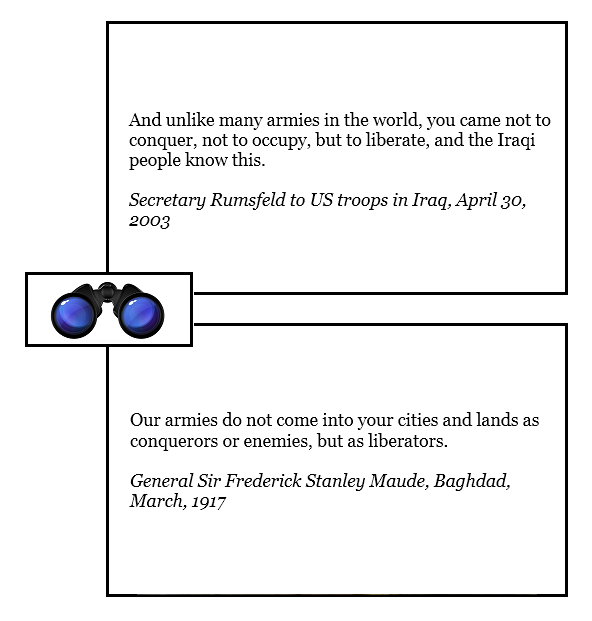
Not that there doesn’t have to be enormous care taken to avoid over-reading parallels. But consider the immediacy of the impact of this DoubleQuote, which I composed in 2003:

Eh, Zen?

Santayana echoes Marx refracts Hegel:

Hegel remarks somewhere that all great world-historic facts and personages appear, so to speak, twice. He forgot to add: the first time as tragedy, the second time as farce.

Those who cannot remember the past are condemned to repeat it

Seen from another angle: history has rhymes to match its reasons


Switch to our mobile site