It puzzles me, because I can’t quitec grasp what Raza Rumi — a very bright fellow — is up to in choosing this particular illustration. And it intrigues me, because once on a vision quest I glimpsed an outstretched eagle’s or hawk’s wing, with a similar graphical overlay of its structural essence. It’s a sight I’ve never forgotten, an exquisite linking of the real and abstract worlds, and one that I’m sadly ill-equipped to reproduce visually myself. Words don’t do it justice.
**
My third example, as you can see, is taken from a learned paper describing the use of graphs to illustrate musical compositions according to a strictly defined protocol:
What interests me here — aside from the fact that any of these digrams could be used as a board in a sufficiently complex HipBone or Sembl game — is that I ran across this particular paper within 24 hours of reading m’friend Bill Benzon‘s account of his friend Michael Bérubé and his son Jamie, introduced in this tweet:
Michael Bérubé, we read, has recently published a book about Jamie, who has Down’s, Life as Jamie Knows It: An Exceptional Child Grows Up, and it contains a series of Jamie’s drawings, of which this is one example.
Bill, who is himself the author of Beethoven’s Anvil: Music in Mind and Culture, notes “Jamie loves music, and his dad is a rock-and-roll drummer, so’s his older brother Nick, I believe.” And here’s the clincher — he then asks:
In what way are these drawings like drum beats?
So that’s two examples of novel visual representations of musical pattern in just two days, earlier this week.
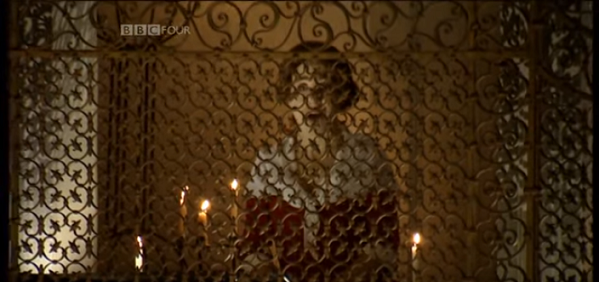
of an English woman’s choir visiting Venice to sing Vivaldi where Vivaldi himself taught and conducted the choir at the women’s Ospedale della Pietà orphanage..
**
The BBC documentary of the journey is currently available for viewing here — and here’s the women’s choir, the Schola Pietatis Antonio Vivaldi, singing Vivaldi’s complete and glorious Gloria RV 589:
[ by Charles Cameron — a light-hearted, part-musical, part-personal, part-putinesque — counterpoise to the present Presidential electoral season ]
.
You wanna make government a barrel of fun? Vote Dizzy! Vole Dizzy!
Your Politics Oughtta Be A Groovier Thing? Vote Dizzy! Vole Dizzy!
**
Okay, we’ve had a day or two to recover from the first of this year’s Presidential debates, and I’d like to give you a break from the incessant Trump no Hillary no stay home or vote Stein or Johnson or write in or whatevershindig with three possible candidates not on most lists.
One is anonymous. One is myself (ridiculous). And one — the best known of the three, but deceased, alas — plays trumpet, and ran in 1964.
**
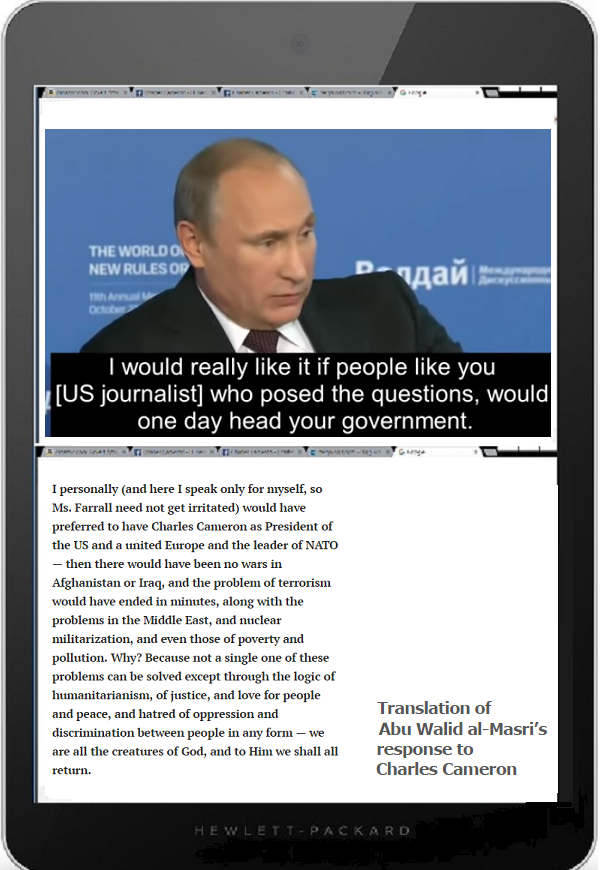
No, as far as we know, Vladimir Putin has not expressed a wish for Donald Trump to be President of the US, despite some fraternal noises. Instead, he somewhat cannily answered an unnamed US journalist’s question by wishing she could hold that office (upper panel, below):
So:
Putin’s candidate is, as far as I know, anonymous — though there’s a presumably a journalist somewhere who knows, since she was there at the time, and Putin was responding to her.
**
I probably wouldn’t have given this particular remark of Putin’s a second thought, had Abu Walid al-Masri not wished the same fate on me (lower panel, above).
Here’s how that happened.
I’d been in friendly contact with the noted Australian Federal Police counterterrorism analyst Leah Farrall for a while, when Leah struck up an email correspondence some years back with Abu Walid. The latter was among the first Arabs in Afghanistan, a journalist, a friend of Mullah Omar and bin Laden, and a fierce critic of 9/11. Both Leah and Abu Walid were bloggers, and both deeply interested in the early history and structure of Al-Qaida so, Leah thought, why not talk? And talk they did.
At one point, Leah very kindly invited me to join their conversation. I’m a know your enemy type on my father‘s side (he was a naval warrior) and a love your enemy type on my mentor‘s (he was a monk, and quite the warrior in his own way) — so I wrote to Abu Walid, and he responded:
I don’t see myself as US President any time soon — I’m a Brit born and bred, which would rule me out in any case, and a monarchist at that — but Putin’s comment to the journalist reminded me of my own equivalent in Abu Walid’s response to my letter, and gave me a quiet chuckle — hence this post.
More significant than my cameo appearance.. Years later, Abu Walid was released from house arrest in Iran. He — now dropping his nom de guerre and going by his original name, Mustafa Hamid — met in person with Leah in Alexandria, amd after months of conversations they produced an unparalleled joint work, The Arabs at War in Afghanistan (Hurst, 2015).
It is, as I said, without parallel — with a second volume to follow?
**
Okay, back to electoral candidates. How about Dizzy Gillespie? Here’s a belated tribute to the candidate who blue-notes outside the lines:
As blog-friend and jazz-meister Bill Benzonnoted recently, Dizzy Gillespie nominated himself. And how!
When I am elected President of the United States, my first executive order will be to change the name of the White House! To the Blues House.
Income tax must be abolished, and we plan to legalize ‘numbers’ – you know, the same way they brought jazz into the concert halls and made it respectable. We refuse to be influenced by the warnings of one NAACP official who claims that making this particular aspect of big business legal would upset the nation’s economy disastrously.
One of the ways we can cut down governmental expenditures is to disband the FBI and have the Senate Internal Security Committee investigate everything under white sheets for un-American activities. Understand, we won’t take no ‘sheet’ off anybody!
You wanna make government a barrel of fun? Vote Dizzy! Vole Dizzy!
[ by Charles Cameron — how Bill Benzon and Will Shakespeare lead me to Angus Wilson and Ruth Ozeki ]
.
Comments are now closed on my fairly recent post, Triangulation: Hoboken, Ramesses II, Ozymandias, so I can’t add there to the strand of the discussion that dealt with Shakespeare‘s language becoming barnacle-encrusted with time and our lack of knowledge, but today was something of a red-letter day for me, so I’ll start from there…
OSF is commissioning 36 playwrights and pairing them with dramaturgs to translate 39 plays attributed to Shakespeare into contemporary modern English between now and December 31, 2018. By seeking out a diverse set of playwrights (more than half writers of color and more than half women), we hope to bring fresh voices and perspectives to the rigorous work of translation. Each playwright is being asked to put the same pressure and rigor of language as Shakespeare did on his, keeping in mind meter, rhythm, metaphor, image, rhyme, rhetoric and emotional content. Our hope is to have 39 unique side-by-side companion translations of Shakespeare’s plays that are both performable and extremely useful reference texts for both classrooms and productions.
I’m not sure, but as we decolonialize and globalize culture (world music, eg), I suspect that English adds national streams from Barbados, Mumbai, Brooklyn, Adelaide, Louisiana and hiphop to its already rich mix, and that a Shakespeare using the spectrum of the language available in London today as keenly as Wm S used the spectrum available in London in his own day would appear no less neologistic and extraordinary than his older namesake. And then throw in an oligarch’ daughter speaking Russian, as Katherine speaks French in Henry V III.2, explaining as Katherine does, “I cannot speak your England”…
**
That’s “past is prologue”. Today, blog-friend Bill Benzon posted a brief squib that ties in with this — and here my advanture begins:
McWhorter has argued that Shakespeare’s language is so difficult that it should be “adjusted” into modern English for modern readers and theatre-goers. I’m sympathetic. Yesterday I started watching the Zeferelli movie version of Hamlet, with Mel Gibson in the title role and Glenn Close as Gertrude, and at times the language just lost me. Here’s a podcast where he discusses the subject with John Lynch.
And he explains something of what we are missing, in Hamlet for instance:
“Give thy thoughts no tongue, / Nor any unproportion’d thought his act.” First of all, thought to Shakespeare meant “plan,” not just mental activity. Thus “Give thy thoughts no tongue” meant “Don’t show your hand,” not just “button up.” “Nor any unproportion’d thought his act” – whose act? Who does the his refer to? To a modern listener this is the sort of opaque little splotch we must just let by, which in combination with the thousands of others over three hours leaves us yearning for a drink or a pillow. Actually, his could refer to things as well as men in earlier English. And act meant “execution”: the phrase meant “Do not act on your intentions until they are well proportioned, i.e. completely thought out,” not just “Don’t be a silly-billy.”
At the end, the famous “Neither a borrower or a lender be, / “For loan oft loses both itself and friend, / And borrowing dulls the edge of husbandry.” Did Shakespeare suppose that the reason one shouldn’t borrow is because it interferes with the raising of livestock? Actually, husbandry meant “thrift” at the time. It will say that in the footnotes of a Hamlet book; but at the theatre, you don’t have that with you.
**
All that led me to Kent Richmond, and I wanted to hear his voice, which gives Miranda in The Tempest these lines:
If through your magic, dearest father, you’ve
Made the wild waters roar, now let them rest.
The sky looks set to pour down stinking tar,
But then the sea, climbing the cheeks of heaven,
Dashes the fire out. O, I have suffered
With those that I saw suffer! A splendid vessel,
Which no doubt had some noble creature in her,
Dashed all to pieces! O, their cries knocked hard
Against my heart itself! Poor souls, they perished.
Had I the power of a god, I would
Have sunk the sea beneath the earth before
It could have swallowed up the good ship and
The souls that were her cargo.
Intelligible, yes, in a way that Shakepeare’s version may no longer be, and way better than a crude “version” for students of study notes — but not something that encourages me to see Richmond’s version of the play.
**
But wait — McWhorter’s title doesn’t mention Richmond, it merntions August Wilson, and his piece opens:
Reading the deserved critical huzzahs for the current production of August Wilson’s Joe Turner’s Come and Gone has me thinking about a bee always in my bonnet.
I don’t know Wilson, and I hold much of modern “poetry” in disrespect, but I go searching with little hope in my back pocket, and lo —
It is August in Pittsburgh, 1911. The sun falls out of heaven like a stone. The fires of the steel mill rage with a combined sense of industry and progress. Barges loaded with coal and iron ore trudge up the river to the mill towns that dot the Monongahela and return with fresh, hard, gleaming steel. The city flexes its muscles. Men throw countless bridges across the rivers, lay roads, and carve tunnels through the hills sprouting with houses.
From the deep and the near South, the sons and daughters of newly freed African slaves wander into the city. Isolated, cut off from memory, having forgotten the names of the gods and only guessing at their faces, they arrive dazed and stunned, their hearts kicking in their chest with a song worth singing. They arrive carrying Bibles and guitars, their pockets lined with dust and fresh hope, marked men and women seeking to scrape from the narrow, crooked cobbles and the fiery blasts of the coke furnace a way of bludgeoning and shaping the malleable parts of themselves into a new identity as free men of definite and sincere worth.
Foreigners in a strange land, they carry as part and parcel of their baggage a long line of separation and dispersement which informs their sensibilities and marks their conduct as they search for ways to reconnect, to reassemble, to give clear and luminous meaning to the song which is both a wail and a whelp of joy.
My God, the language! The warmth and depth of voice!
Since the virtues of the mountain are high and broad, the spiritual power to ride the clouds is always mastered from the mountains, and the marvelous ability to follow the wind is inevitably liberated from the mountains.
Here’s Ozeki, herself a zen priest — skip the beginning intros, start at around the 9’35” point, or at 11’17” where her actual reading from the book begins:
**
Again, such a voice! Two such voices in one day, new to me! Today I consider the world with fresh and thankful eyes.
The second of my five religions, Zen Buddhism, came about entirely as a consequence of a famous tale you allude to in your wonderful letter.
After quickly rocounting the tale in question — about the Zen patriarch Hui Neng and the “finger pointing at the moon” which should not be mistaken for the moon itself, he went on:
I spent a great deal of time that night meditating upon the gloriously full moon, a little about my finger, and a great deal about the space in between. Space. The space between. The space beyond. When I could be any or all of these, I went to bed. I thought to myself: How arbitrary it is that we should see ourselves as the finger, and as not-the-moon, when we might just as well consider ourselves the spaces in between – since without that, we could never be not-anything!
This lunar encounter served me well until about five years later I hit a terrifying crisis of identity when I lost faith in any ability to use words to communicate at all. I began to fray at the edges… If everyone’s words were their own symbols, how could we ever manage to communicate? Did we? Or were we just braying at each other at random, each one watching a different play on the stage we had been thrown together upon?
**
That phrase “the spaces in between” is particularly interesting when you think of it as referencing the space between word and what it refers to, the word “moon” and the up-there orb, the moon. You might think, “there’s no such space between, they’re in different realms, is all” — but there is a between, it’s the relationship. And that’s what all my HipBone & DoubleQuote Games are about — the relationship (mapped along a linking line, aka an “edge”) between two concepts (“nodes”). Because relationship is the essence of their antecedent, Hesse‘s Glass Bead Game. And of all relationships, perhaps those between name and thing, finger and moon, map and territory, moon and enlightenment, are among the most fascinating.
Consider, though, the relationship between person (genetically understood) and person (memetically understood), as in the case of persons of genius or great charisma.
Hermann Hesse played the Glass Bead Game himself, he tells us, in his garden, while raking leaves into the fire, and it consisted of figures he admired, talking across th4 centuries — “I see wise men and poets and scholars and artists harmoniously building the hundred-gated cathedral of the mind.” In his book, the Game does not consist of these people, but of their ideas — disembodied, if you will.
The genetics / memetics difference shows up elsewhere in intriguing ways. Should Peter, the closest disciple, lead the church after Christ‘s death, or James, his blood brother? — that’s the Jerusalem vs Rome controversy that plays out in the background to the New Testament. Should his followers follow Brigham Young, his closest disciple, after Joseph Smith‘s death. or a family member? When Kabir, the poet-saint of India died, his Hindu followers wanted to cremate his remains, his Muslim followers to bury him — when they uncovered his body, they found (so the tale is told) that it had turned to roses, and were thus able to divide his remains and perform both ceremonies.
Family has a claim to the person, discipleship has a claim to the inspiration. Funny, that.
During the Enlightenment at the end of the 17th century and the start of the 18th, a disparate group of intellectuals in Europe and the United States engaged in a long-distance discourse that became know as the Republic of Letters, or Respublica Literaria. It was one of the first transnational movements, and scholars have endlessly debated its relevance and influence upon the dramatically proclaimed Age of Enlightenment it heralded. Personally, I feel no need to explain this in terms of cause and effect – the Republic of Letters was simply the written discourse of a movement that was changing the way people thought about their relationship with the world.
It is a seldom noticed fact that while anyone who can read and write could write a letter, very few actually do – and fewer still in our current era, what it is tempting to call the Age of Distraction. Letters, rather than say postcards and other friendly waves expressed in writing, involve a kind of engagement that has become rather rare these days. A letter invites a response, asks us to think about something, requests insight from another perspective… Letters are conversations at a slow enough pace to allow the correspondents to think a out what they are saying. I would like to suggest that it takes a particular kind of introvert to engage in letter writing in this sense – a quiet soul not content to bury themselves in just their solitary activities, but willing and able to reach out in words to another, similar person. I love a good conversation in a pub or bar, or at a conference, or even on a long journey, but as enjoyable as these forms of discourse may be for me they cannot adequately substitute for the pleasure of the letter.
For Chris, blog posts are the current equivaoent of letters, and what he terms The Republic of Bloggers is a latter day equivalent of the Republic of Letters of yore.
It is similar in spirit to Col. Pat Lang‘s Committee of Correspondence, Sic Semper Tyrannis, except that there all the correspondents correspond on the one blog.
The Republic of Letters is a concept I very much appreciate, and I have tried to embody it both here and in my time at the Skoll Foundation’s Social Edge platform a decade ago.
**
At which point, I must introduce blog-friend Pundita, sometimes known as the Julia Childs of Foreign Policy discussion. She and I have been going back and forth on the topic of sacred music — qawwali, gospel, and so forth.
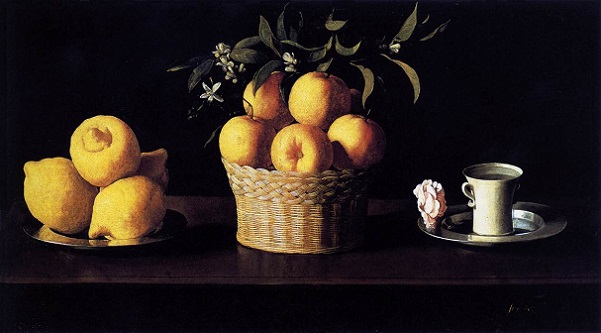
Look at the still-life at the top of this post. What do you see? If you tell me you see the Virgin Mary and the Mystery of her giving birth to the Christ, either you are already familiar with the painting, made famous in this era by Morton Lauridsen’s explanation of how it inspired his version of O Magnum Mysterium. Or you are steeped in the symbolism of the High Church and/or the use of Christian symbols in art.
I’m sorry but the symbolism is so abstract that those are the only ways to read Mary and the Virgin Birth into a painting of fruit, a flower, and a cup of water, although I’ll concede the symbolism could have been understood by well-educated Christians centuries ago in Europe.
Lauridsen himself did not understand the symbolism of the painting when he first saw it — a point he does not make clear to readers in his 2009 article for The Wall Street Journal about the painting It’s a Still Life That Runs Deep, and its role in inspiring his version of OMM.
That post was in response to something I’d sent her, recommending Lauridsen’s work. More “Republic of Bloggers” style communication!
**
Chance reading the other day brought me to Jacob Mikanowski‘s piece, Camera-phone Lucida, in which i found:
The first society to experience the problem of having too much money and too much stuff, the Dutch had multiple genres of food-related still lifes, each dealing in a different level of luxury. They began with the humble ontbijtjes, or breakfast paintings, to the slightly more elaborate banketjestukken or “little banquets,” and on to the kings of them all, the pronkstilleven, from the Dutch word for “ostentatious.” The “little breakfasts” were the domain of simple food: a plate of herrings, a freshly baked bun, a few olives, maybe a peeled lemon for a bit of color. The atmosphere in these canvases is orderly and Calvinist. By contrast, in the pronkstilleven, the prevailing mood is one of jubilant disorder. Lobsters perch precariously on silver trays. Tables are strewn with plates of oysters, overturned tankards, baskets spilling over with fruit, scattered nuts and decorative cups. Cavernous mincemeat pies jostle with lutes and the occasional monkey.
For a century scholars have sought a deeper meaning in these and other still lifes. A half-eaten cheese stood for the transubstantiated body of Christ; walnuts represented him on the cross — the meat of the nut was his flesh, the hard shell was the wood of the cross he died on.
And so — inside or outside th Republic of Bloggers — the conversation flows..
**
And if Morten Lauridsen can wring such beauty from a reading of symbolism in Zurbarán, let him do so!
Zenpundit is a blog dedicated to exploring the intersections of foreign policy, history, military theory, national security,strategic thinking, futurism, cognition and a number of other esoteric pursuits.