zenpundit.com » social science

Archive for the ‘social science’ Category

Before Disruption….Thinking

Monday, April 23rd, 2012

“What you think, you become”

    – Buddha

“We are what we frequently do”

    – Aristotle

There has been a lively and still evolving debate in the milblogosphere regarding “disruptive thinkers”, starting with Benjamin Kohlman’s post at SWJ whose editor Peter J. Munson has done a fine job steering, collecting and commenting upon. A selection:

The Military Needs More Disruptive Thinkers by Benjamin Kohlman

Disruptive Thinking, Innovation, Whatever You Want to Call It is Needed for a Military in Crisis by Peter J. Munson 

The focus on disruptive thinkers coincided with a different but relevant debate over professional military education (PME) when a scathing blast was recently  leveled at the US Army War College by Major General Robert Scales (ret.) , himself the former commandant and a strong advocate of rigorous PME.  A few of the criticisms made by General Scales at a gathering at FPRI were mentioned in a post by Thomas Ricks who believes in shutting down the service academies and war colleges and maybe just sending everyone to Yale, Princeton and Harvard for MBAs. Or something.
.
What was interesting to me is that many authors and their points had less to do with a close examination of cultivating cognitive skills than related topics of changing organizational culture, the perils of groupthink, rehashing ideas from Frans Johanssen’s The Medici Effect and John Kao’s Innovation Nation, the superiority of entrepreneurshiphidebound military bureaucracy and other tangents to indirectly create an environment in which insightful or innovative behavior might happen.  Only Mike Mazarr zeroed in to the heart of the matter, writing:
….We need to improve, for example, in the detail and specificity of critical and creative thinking methodologies that we integrate into the curriculum.
Bingo!
.
There’s nothing wrong -in fact, much to the good – with the call of Kohlman and others like Joan Johnson-Freese to deliberately combine students and faculty of radically different professional backgrounds. Such a personnel mix is a good base for horizontal thinking to take place, where discussions can range across fields generating insights and analogies and accelerating learning.
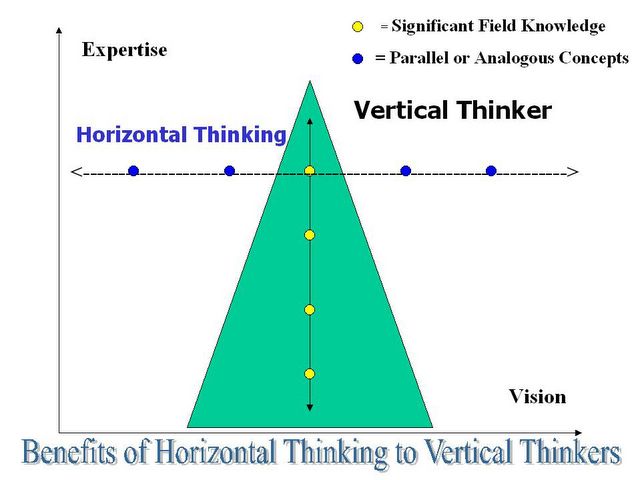
However, just assembling a broad mix of talent and putting them together in a building is not enough because it is not any more goal oriented than a MENSA social. Good things might happen, sure, but just as easily not. This is why DARPA is a lot more productive of an organization on an annual basis than the Institute for Advanced Study. There needs to be a mixture of problem-solving and play, free inquiry or experimentation and unifying goals. Communities of interest have to first have a sense of community for the vibrantly sharing and inspiring “minds on fire” effect to take place.
.
If the military or more broadly, American society, wants a larger number of creative, innovative, “disruptive”, strategic or whatever kind of thinker, then the answer is to actively and purposefully teach students creative, critical, insight-generating and strategic thinking skills and to value intellectual curiosity, skepticism, imagination and empiricism over ideology and conformity. The other indirect, “better environment”, stuff certainly improves your chance of success, but systemic improvement will only come about by making such objectives the focus of instruction and learning rather than a haphazard byproduct.
UPDATE:
At Best Defense, Ricks has provided a copy of his prepared remarks on PME as well as a link to the audiofile that I could not pull up the other day. Check out what he has to say.


Pondering Transition Ops with Quesopaper

Monday, April 16th, 2012

One of the nice things about this blog is that periodically, smart folks will send me their unpublished material for feedback and private commentary. This comes in a wide variety of formats – manuscripts, articles, book chapters, powerpoint, sometimes an entire book or novel! It is flattering and almost always informative, so I try to help where I can or at least point the sender in the direction of someone more appropriate.

Recently, I was given a peek at a very intriguing paper on “Transition Operations” by Dr Rich Ledet, LTC Jeff Stewart and Mr. Pete Turner, who blogs occasionally at quesopaper.  Pete has spent a good chunk of the past ten years in a variety of positions and capacities in Iraq and Afghanistan, where he currently is with American troops in a remote rural district and it was he who passed their draft to me. They have taken a fresh look at the subject.

While I can’t give away their “secret sauce” in detail,  I particularly liked the fact that while the  focus and advice for executing transition operations is aimed at field grade officers and their civilian agency counterparts, their vision is in sync with the ideal of having policy-strategy-operations and tactics as a seamless “whole-of-government” garment. If only we could get our politicians to think in these terms, half the battle would be over.

Their paper is now headed to a professional journal; when it is published ( as I think it will be), I will definitely be linking to it here and hopefully, that will be soon.

My reason for my bringing this up – I have the permission of the authors to do so – is that the trio have put their finger on the major doctrinal problem faced by the United States military in Afghanistan – “transition operations” being a politically charged topic, laden as it is with implied foreign policy decision making by heavyweight policy makers, is treated in very scanty fashion by FM 3-24. Compared to other aspects of COIN, very little guidance is given to the the commander of the battalion or brigade in the effort to coordinate “turnover” of responsibilities and missions to their Afghan Army, police and government allies.

This at a time when the “readiness” of Afghan units and officials to accept these burdens in the midst of a war with the Taliban is questionable, variable, controversial at home and politically extremely sensitive in Afghanistan.

And at a point where, ten years after September 11, the US State Department is no more able in terms of personnel and vision or sufficiently funded by Congress, to step up their game and take the lead role in Afghanistan from the Pentagon than it was on September 10, 2001.  SECSTATEs Condi Rice and Hillary Clinton deserve great praise for making State do more with less, but State needs wholesale reform to fit the needs of the 21st century and the money and budgetary flexibility to split foreign policy tasks more equitably with the Defense Department.

State is not going to be playing a major role on the ground in our transition out of Afghanistan, which makes guidance to our majors and colonels – and in turn to their company and platoon leaders stationed there-  all the more important.

A Cure for Dystopianism

Sunday, March 25th, 2012

Or, at least a palliative.  Civilizational progress past and future.

Metacognition and War

Friday, February 24th, 2012

A nice piece by Diana Wueger at Gunpowder & Lead:

Thinking About Thinking About War 

….Reading the heated op-eds about the necessity of war with Iran and/or Syria, it strikes me that they’re nothing new. The strange overconfidence on display in the 1910s – that war would be quick, easy, and end favorably – was echoed in the run up to Iraq and is being rehashed today. This reminded me of theRubicon Theory of War, a barely-noted article from last summer’s issue of International Security that offers valuable food for thought, particularly for those charged with thinking or writing about war. The authors address the overconfidence conundrum, namely, that people who should know better than to think war will be quick and easy often act like this is their first rodeo. The authors conclude:

When people believe they have crossed a psychological Rubicon and perceive war to be imminent, they switch from what psychologists call a “deliberative” to an “implemental” mind-set, triggering a number of psychological biases, most notably overconfidence. These biases can cause an increase in aggressive or risky military planning. Furthermore, if actors believe that war is imminent when it is not in fact certain to occur, the switch to implemental mind-sets can be a causal factor in the outbreak of war, by raising the perceived probability of military victory and encouraging hawkish and provocative policies.

Their research suggests humans are only rational actors until we make a decision – cross the Rubicon – at which point our mental apparatus will go through whatever logical leaps necessary to avoid questioning that decision. The authors frame this idea in terms of mind-sets – deliberative vs. implemental – to account for the full range of attendant biases, which they’ve laid out in a helpful table….

Metz on the Psychology of Insurgency

Saturday, January 28th, 2012

Dr. Steve Metz, a friend of ZP blog and Chairman of the Regional Strategy and Planning Department and Research Professor of National Security Affairs at the Strategic Studies Institute, has new and heavily footnoted article up at SWJ:

Psychology of Participation in Insurgency 

 It’s common sense: to make insurgents quit the fight or to deter other people from joining them, to understand their appeal, we must know what makes them tick.   This is easier said than done as we Americans face a mental barrier of our own creation–we insist on approaching insurgency (and counterinsurgency) as a political activity.  This entails a major dose of mirror imaging.  We are a quintessentially political people, but it is politics of a peculiar type, born of the European Enlightenment.  We assume that the purpose of a political system is to reconcile competing interests, priorities, and objectives.  From this vantage point, we see insurgency as a form of collective, goal-focused activity that comes about when nefarious people exploit the weaknesses of a political system.  It occurs when “grievances are sufficiently acute that people want to engage in violent protest.”[1]  The state cannot or will not address the grievances.  And since insurgency is political, so too are its solutions: strengthen the state so it can address grievances and assert control over all of the national territory.  The improved state can then return to its mission of reconciling competing interests, priorities, and objectives.

            Much of the world–including the parts prone to insurgency–sees things different.  Most often the political system is used by an elite to solidify its hold on power and defend the status quo.  Most insurgents do not seek a better political system but rather one that empowers them or, at least, leaves them alone.  People become insurgents because the status quo does not fulfill their needs.  This is a simple observation with profound implications.  It means that the true essence of insurgency is not political objectives, but unmet psychological needs (although political objectives may serve as a proxy for psychological needs as insurgent leaders seek to legitimize and popularize their efforts).

This coincides with the observation of David Kilcullen that many insurgents are purely localized “accidental guerrillas“, motivated by other drivers than political calculation – such as opportunity for excitement, the dictates of an honor culture, fear of being considered a coward, prospects for glory or booty or the aggressive territoriality of young men.  Looking at historical examples of warlords as diverse as “General Butt Naked“, the Mad Baron Ungern von Sternberg and General Abdul RashidHeavy D”  Dostum, it is evident that some men fight and kill because they revel in slaughter for it’s own sake, are skilled at combat and find purpose in war.

Indeed, as Metz writes:

….Boredom also contributes to a sense of being lost.  In rural areas and urban slums, insurgency seems to provide excitement for those whose lives are devoid of it.[21] This theme appears over and over when former insurgents explain their motives.  Ribetti, for instance, heard it from Colombians, particularly from the female insurgents she interviewed who sought to escape the tedium of a woman’s life in rural areas.[22]  Louise Shelley observed that youth violence and association with terrorism is often linked to “the glamour of living dangerously and the adrenalin flow that is associated with living precariously.”[23]  States not susceptible to insurgency have proxies for youth boredom and the need for excitement which drains these impulses into less destructive channels, whether video games, violent movies, sports, or fast cars.  Societies without alternatives–particularly ones where the educational system has collapsed like Sierra Leone, Afghanistan, and he tribal areas of Pakistan can see boredom be channeled into political violence.[24]

            The Thugs:  There are people in every society–usually young males–with a propensity for aggression and violence.  Insurgency attracts them since it is more prestigious and legitimate than crime, and has a better chance of gaining internal or external support.  It offers them a chance to justify imposing their will on others.  This is amplified when a nation has a long history of violence or major military demobilization which increases the number of thugs and puts many of them out of work.  In many parts of the world, whole generations have never known a time without brutality and bloodshed.  Sierra Leone is a perfect example of this.  The RUF emerged from a group of young people from the slums of Freetown known for their antisocial behavior.[25]  While this group sometimes provided violent muscle for politicians, it also served up the raw material for the RUF, leading Ibrahim Abdullah and Patrick Muana to label it the “revolt of the lumpenproletariat” (a word coined by Karl Marx to describe society’s lowest strata).[26]  Thugs seldom create or lead insurgencies, but they do provide many of its foot soldiers.


Switch to our mobile site