zenpundit.com » 2012 » May

Archive for May, 2012

Ullman’s Strategic Revolution?

Sunday, May 13th, 2012

Strategist Dr. Harlan K. Ullman (best known for the concept of  “Shock and Awe“) had a piece up at Atlantic Council about which I have a mix of opinions, so I am going to break it down with some excerpts and comment:

Needed Now: An Intellectual Revolution in Strategic Thinking 

Toward the end of the Cold War, Soviet military thinkers coined the phrase “Military-Technical Revolution.” Based on a combination of extraordinary advances in precision strike and in information and surveillance technologies, the MTR was successfully transformed by the Pentagon into the “Revolution in Military Affairs.”

Meant to defeat the Red Army, the RMA was a real military revolution proven in the first Iraq War in 1991 when US arms pulverized Saddam Hussein’s army; in Afghanistan quickly routing the Taliban in 2001; and again smashing Iraq two years later.

There’s more than just a semantic difference here.

A “Military Revolution” is a rare thing in history, an epochal event, like the transformation of warfare in early modern Europe , which also dovetails with the Marxist-Leninist  economic deterministic conception of what constituted a world-historical “revolutionary” event in Soviet ideology. A “Military-Technical Revolution” was a terminological effort by Soviet general officers to reduce the ideological scope of the event discussed away from a sphere predominantly governed by the supreme authority of the Party (and in practice then, by politburo ideologist, Mikhail Suslovwho was deeply suspicious of any kind of reform) to one that emphasized that radical changes in warfare originated in or would flow from purely technological innovations and could therefore be safely managed by military professionals without encroaching upon political matters.  Self-interest and institutional interest of the Red Army general staff at work.

American defense intellectuals repackaged the Red Army’s “Military-Technical Revolution” as the  “Revolution in Military Affairs” – a much narrower concept than “Military Revolution” yet broader, more flexible and open-ended than it’s Soviet parent. Eminent strategist and military historian Colin S. Gray described RMA thusly:

Military Revolutions are preceded, implemented, and succeeded by RMAs. RMA refers to a radical change in the character of war. The engines of such change include, but are by no means limited to, technological innovation. Scholars note that most historically plausible RMAs have not obviously been led by new technologies [1].

The American RMA unlike the Soviet version was more closely tied to the force-multiplying effects of the information revolution and Moore’s Law  that was to reshape the global economy, and came to be shorthanded, under Rumsfeld, as “transformation“. However, like the Soviet MTR, RMA suited the growing fascination of American military officers with operational art as the acme of professional identity and a substitute for strategy and troublesome questions of policy and politics. While “transformation” was good for making the military more efficient at applying violence, the focus on technological magic in operations tended to anesthetize senior generals from the need to attend to the vital strategic-policy dimension of war.

Back to Ullman:

….Today, American and certain allied militaries are exhausted by a decade of war. All face large and looming defense cuts meaning far less money for defense. Under these circumstances, readiness and morale become early casualties.

With the exception of North Korea (or to some states in Europe, Russia), few hostile armies are around to fight in a conventional conflict making the case for defense more diaphanous. The wars in Iraq and Afghanistan demonstrated that while military force may have been necessary, it could not make either country more governable, hardly the best argument for defense spending.

The omission of China is simply weird. I am neither a ‘Panda hugger” or a “Panda mugger” and I don’t think China should be shoehorned into the role of near-peer competitor, which it is not yet, except in the fantasies of hypernationalistic Chinese and maybe blogger/salesmen from the Lexington Institute. But how do you ignore a nation like China and the PLA in in a military-geopolitical strategic analysis?

….How can militaries deal with these facts of life? The answer is that a new revolution is desperately needed. Given the bleak funding outlook, this revolution can only be accomplished through intellect and rejuvenating strategic thinking.

British Gen. Rupert Smith’s “The Utility of Force” skillfully interpreted war in the 21st century to be about and over people — to protect and defend them or to defeat or disrupt them rather than as modern armies squaring off against one and other.

Many assumptions to unpack from few words.

I welcome Dr. Ullman’s call for an intellectual renaissance in strategic thinking which, if badly needed among the professional military class, is even more urgently required in our political class who – with some exceptions – were largely AWOL from their responsibilities of senior partnership in fashioning strategy and grand strategy with the uniformed military in the past ten years. Perhaps in a generation or two, the proliferation of grand strategy programs at elite universities that are increasingly feared by anti-American intellectual leftists, will produce a large cadre of statesman with real strategic competence.

Regarding the second paragraph, while I am sympathetic to the assumptions that 4GW environments will increase with the erosion of state sovereignty and legitimacy, the future of warfare may very well be extremely “hybridwith well-financed polities, corporations and networks fielding impressively high tech military capabilities alongside atavistic and disorganized insurgencies wallowing in blood and entrails. The latter will invite intrusion by the former and the former are sometimes going to clash with one another, as well as against postmodern warlords, superempowered individuals, urban guerrillas and networked jihadis.

….Some 15 years earlier, the concept of “shock and awe” was created in which the goal was to affect, influence and ultimately control the will and perception of an adversary (hence Smith’s “people”) with the use or threat of military force. “Shock and awe” was inspired by the Chinese philosopher Sun Tzu eons ago when he wrote that the really brilliant general wins without having to fight a battle.

Shock and awe posited four criteria: control of the environment, rapidity, (near) perfect knowledge and brilliance in execution.

The last two, combined with the realities and uncertainties of today’s international environment, form the foundations for this much needed intellectual revolution in strategic thinking.

If so, then the revolution fizzles out here.

Rapidity and brilliance in execution – or at least excellence – can be trained for, but in control of the environment, the enemy gets a vote (and so, for that matter, does the environment) and “(near) perfect knowledge” is a transient comparative advantage held (if at all) during the initial moments of a complete surprise attack. While it would be nice to have, “(near) perfect knowledge” cannot be a foundation for a strategic revolution as it is a largely unachievable standard in unhurried conditions of perfect peace, much less during the fog and friction of war.

….No one can be certain about the nature of future conflicts as the requirements for defense, once equated in largely military terms, have expanded to cover security with a far broader aperture extending well beyond armies, navies and air forces.

In future conflict, military force may or may not be necessary. But they have not been sufficient to achieve the strategic and political aims of bringing stability and security to Iraq, Afghanistan and so far Libya for example.

Further, given defense cuts, preparations for major conventional operations will be severely curtailed as both weapons and systems for those engagements as well as training will likewise be reduced, possibly dramatically. The strategic question that forms the heart of an intellectual revolution rests on how militaries can prepare for a future so filled with uncertainty while preserving traditional war fighting skills with far less money.

Ullman is correct that public expectations of “security” have expanded beyond military strength to encompass more of the DIME spectrum with, arguably, law enforcement, immigration/assimilation and cyber issues as well.

Disagree that the current political class dominated by aging Boomer fantasists will recognize that sharply curtailed military budgets mean fewer operations.It certainly has not worked that way in Britain where harshly punitive budgetary cuts to the British Army and Royal Navy have scarcely curbed Her Majesty’s government’s appetite for military intervention.  American politicians and Atrocity Boards will simply require the Pentagon eat it’s seed corn to pay for intervention piled upon intervention and when that runs dry, Congress will look at cutting veteran health benefits and pensions and hollow out the force until it breaks.

….First, militaries and strategic thinking must be oriented about obtaining (near) perfect knowledge not merely about traditional operations and employing weapons systems with far greater creativity. There must be far more learning about other, non-military tools and other regions and states round the world of import or interest to assuring national security.

The part  about creativity is spot on, but in a military where majors, colonels and brigadier generals feel they cannot sign off on something as mundane as a platoon, a company or a battalion using ATVs on patrol in Afghanistan without risking their careers, then bureaucratic micromanagement has already reached the state of military rigor mortis. Strategic thinking in the ranks cannot begin until the climate of fear is removed and the incentives for promotion changed to reward risk-taking. Just like the State Department, the Pentagon’s antiquated personnel system is out of alignment with the needs of American national security and  represents a systemic bulwark against positive change.

Pursuit of near perfect knowledge should be dropped. When Admiral Art Cebrowski helped conceive of network-centric warfare,  there was an opportunity present, through real-time sharing of  information across a military “system”, to maximize individual and unit initiative within their understanding of the commander’s intent and accelerate the operational tempo vis-a-vis the enemy. Instead, information technology, as I see it imperfectly from my far remove as a civilian kibbitzer, has empowered micromanagement with three and four star generals playing company commander, colonels playing squad leader and lawyers and powerpoint-inebriated staff officers hundreds  of miles away blocking artillery or air support requested by units under fire.

Perfect knowledge as a doctrinal benchmark encourages organizational paralysis in the face of uncertainty, rather than the fluidity, creativity and adaptiveness that Ullman seeks.

….Second, new means and methods must be created or strengthened that contribute to maintaining fighting skills that enable brilliance in operations. For example, as the British navy and air force lose both carrier and anti-submarine capacities for an interim period, units should be assigned to the US or French navies that will employ these weapons systems. The British army could deploy units to serve in Korea or Pakistan and India where conventional combat is central to those forces to maintain these skills. And new generations of war games and simulators must be invented and fielded so that many scenarios can be played out to keep skills at acceptable levels of readiness.

These are useful ideas, especially the wargames. I don’t think the British will bite though, except for “model” partnerships with the French. There’s really no good reason why there should not be an “Anglospheric” (UK, US, ANZUS, Canada) combined naval warfare planning staff and regular joint exercises.

….Third, to achieve these aims, a further revolution in military education from bottom to top is essential. Officers and troops must be prepared intellectually in order to obtain near perfect knowledge about a future that at best is opaque. And simultaneously, keeping combat skills sharp in an era of austerity when weapons and training will be in shorter supply is best done as Bobby Jones, perhaps the greatest golfer ever observed about that game — it is played in the 6-inch space between the ears!

Militaries will be reluctant to accept new or any revolutions when they are fighting for subsistence. Politicians find governing hard enough. And few are prepared to impose a revolution let alone make tough decisions.

If an intellectual revolution is to be wrought, it must come from within. But who will listen? And who will lead?

As of now, no one is leading and few understand the need to do so.

1. Colin S. Gray. Another Bloody Century. Orion Books Ltd. London. 2005.  117..

Sanctity, vision, science, ecology and the creativity of diagrams

Saturday, May 12th, 2012

[ by Charles Cameron — of [almost] no military or intelligence interest, this is a post for computer scientists, historians, scientists, artists, contemplatives and other creatives ]
.

I’ve been on a bit of a binge about medieval and renaissance diagrams recently, putting together an anthology of early “semantic networks” for the Sembl game site – but also thinking about the alternate track of art history which would focus on diagrams rather than paintings (I’m thinking of two dimensions here, hence no mention of sculpture) – an alternate history which may have something to teach our richly diagrammatic and data-visual times.

My interest in all this tracks back at least to my early encounter with an essay by the computer scientist Margaret Masterman in Theoria to Theory (1967).

*

Yesterday brought me a post from Jason Wells, a scientist and bright all-rounder I follow on Google+, in which he posted an image of the cosmos from the Ptolemaic (pre-Copernical) point of view, which I’ve put at the head of this post.

Jason commented on this diagram:

As pretty as this is, this is not how your universe works.

That is all.

The diagram Jason posted purports to be mathematically and astronomically based: it is, if you like, a quantitative diagram. I don’t happen to think it’s pretty, although the two creatures (angels, goddesses?) up towards the top of the circle may be, and the serpent eating its tail around it is nicely done -– I think it has a rather austere beauty to be honest, but I’m likely to concede to Jason that it isn’t “true” in the sense of being an accurate representation of the (abstract) laws of celestial motion.

But then I also think there’s more to truth than accuracy, useful though that may be – there’s also a qualitative element to truth, and perhaps “beauty” is (among other things) a name for it.

*

Yesterday also brought me a news bulletin that ties into that same interest in medieval and renaissance diagrams. From the Vatican Information Service (via Chant Cafe) , we learn that Hildegarde of Bingen (1098 – 1179) is now a saint of the Catholic Church with universal cultus:

Vatican City, 10 May 2012 (VIS) – The Holy Father today received in audience Cardinal Angelo Amato S.D.B., prefect of the Congregation for the Causes of Saints. During the audience he extended the liturgical cult of St. Hildegard of Bingen (1089-1179) to the universal Church, inscribing her in the catalogue of saints.

Consider, then, in contrast to Jason’s mechanistic Ptolemaic diagram, this diagram which today’s fresh-minted saint produced in the late 1140s or early 1150s to illustrate her visionary intuitions of the universe in the first of three books, Scivias:

and these two, from Liber divinorum operum:

and:

These, I take it, are purely qualitative images in contrast to the Ptolemaic diagram — making no propositional claims as to physical or mathematical accuracy, but portraying Hildegarde’s sense of cosmic order. And just as we would not argue whether it is Van Gogh or El Greco who is “right” about the skies in their respective paintings, so I don’t think Hildegarde is worried about which of her diagrams is “right” in its portrayal of the world she lived and prayed in – each one illustrates some aspect of her vision of the world, and one does not necessarily contradict another.

*

Here are two descriptions of Hildegarde’s world, which may give us some insight into the diagrams above. For the top one:

For Hildegard of Bingen, twelfth century German Benedictine abbess, the universe is like an egg in the womb of God. Her view of the universe, conditioned as it is by her times and her education, represents her visionary understanding of God’s motherhood of this sphere that we call the universe. Hers is a view that is organic and holistic, coloured neither by Greek philosophy nor Enlightenment rationalism, refreshing and strikingly “true” in its perceptions around the source of created life.

Jean Evans, RSM, Viriditas and Veritas: The Ecological Prophets Hildegard of Bingen and Miriam Therese MacGillis, OP

And for the third:

God created the world out of the four elements, to glorify His name. He strengthened the world with the wind. He connected the world to the stars. And he filled the world with all kinds of creatures. He then put human beings throughout the world, giving them great power as stewards of all Creation. Human beings cannot live without the rest of nature, they must care for all natural things.

von Bingen, Physica, 755, quoted in Stephanie Roth, The Cosmic Vision of Hildegard of Bingen,” The Ecologist 30, no. 1 (2000).

It’s probably worth mentioning that three of the “four elements” of the ancients are still known to us, though we call them “states” rather than “elements” at this point — the solid, liquid and gaseous states correspond with what the ancients called “earth”, “water” and “air”, respectively — and it has even been suggested that their “fire” corresponds to the fourth state we now term “plasmas” — not my line of business, however, so who knows?

*

Hildegarde picked up the word “viriditas” from Gregory the Great and made it peculiarly her own. It means greeness, literally, and freshness by extension — but for Hildegarde’s integral view of all that is, it also carries a theological dimension, Christ being the greening of the world for her:

For Hildegard, viriditas was an attribute of the Divine nature, a reflection of God’s goodness and beauty. It stood for vitality, fertility, fruitfulness and growth; in fact all the things that we now associate with the “greenness” of nature. For us today “greenness” is a sign that the Earth is healthy and flourishing. Similarly, for Hildegard, viriditas was synonymous with physical and spiritual health, with the continuing vivifying force of the Holy Spirit.
.
Dr Carmel Bendon Davis, Hildegard of Bingen: Eco-warrior and Superwoman

This greening or freshening is not, for Hildegarde, just a matter of earth and water, of river and forest, it is also infused with fire and air:

I am likewise the fiery life of the substance of divinity. I flame over the beauty of the fields and sparkle in the waters, and I burn in sun, moon, and stars. And with an airy wind that sustains all things with invisible life, I raise them up vitally. For air lives in greenness and flowers, waters flow as if alive, the sun, too, lives in his light, and when the moon comes to her decline she is kindled by his light, as it were to live again… Thus I, the fiery force, am hidden in [the winds], and they take fire from me, just as breath continually moves a man, and as a windy flame exists in fire. All of these live in their essence and are not found in death, because I am life.

Nor is it “merely” natural, it can also be found in the soul:

Understanding in the soul is like the Veriditas of the branches and the leaves of the tree

It is, in fact, neither exclusively natural nor supernatural, but non-dual.

*

Dylan Thomas, being a Welshman and a poet, thus has an insight that bears a family resemblance to Hildegarde’s, but phrases it in a way that leaves the “force” neither personified nor otherwise… and thus with no necessary doctrinal implication:

The force that through the green fuse drives the flower
Drives my green age; that blasts the roots of trees
Is my destroyer.
And I am dumb to tell the crooked rose
My youth is bent by the same wintry fever.

Due to the idiocy of copyright, you’ll have to go elsewhere to read the whole, fine poem.

For Hildegarde, this “force” is also Christ — for he himself is the “the fiery life of the substance of divinity” — and his coming to earth a greening and freshening of a world until then barren of the love he brought.

*

Hildegarde was the abbess in charge of a small flotilla of nuns — but also a mystic, a visionary, philosopher, poet, painter and songstress…

Her song of creation, O Viriditas, bears comparison in spirit with St FrancisCanticle of the Sun. She writes to her “green” Christ and his “green” planet:

O greenness of God’s finger
with which God built a vineyard
that shines in heaven
as an established pillar:
You are glorious in God’s preparation.
And o height of the mountain
that will never be dispersed
in the judgment of God,
you nevertheless stand from afar as an exile,
but it is not in the power
of the armed man
to seize you.
You are glorious in God’s preparation.
Glory be to the Father and to the Son
and to the Holy Spirit.
You are glorious in God’s preparation.

And she sets her words to the music of the times:

Indeed, her music is sung even today…

How’s that for a twelfth century statement of what we’d these days call “ecology”?

*

But all this risks getting far too ethereal, I have wandered far along my own epicycles from Jason Wells’ point, and methinks I should bring us back down to earth.

Dennis The Constitutional Peasant, in Monty Python and the Holy Grail, meets King Arthur and complains, “What I object to is you automatically treatin’ me like an inferior.” It’s understandable — but so, perhaps, is king Arthur’s response: “Well, I am king.”

Two worldviews clash here — and in the ensuing debate, Arthurian myth meets contemporary politics:

Dennis’ Mother: Well how’d you become king, then?
Arthur: The Lady of the Lake,… [Angel chorus begins singing in background] her arm clad in the purest shimmering samite, held aloft Excalibur from the bosom of the water signifying by Divine Providence that I, Arthur, was to carry Excalibur. [Angel chorus ends] That is why I am your king!
Dennis: Listen. Strange women lying in ponds distributing swords is no basis for a system of government. Supreme executive power derives from a mandate from the masses, not from some farcical aquatic ceremony.
Arthur: Be quiet!
Dennis: You can’t expect to wield supreme power just ’cause some watery tart threw a sword at you!
Arthur: Shut up!
Dennis: I mean, if I went ’round saying I was an emperor just because some moistened bint had lobbed a scimitar at me, they’d put me away!

Or if some bint told me the universe was a cosmic egg in the womb of God, for that matter — even if Benedict XVI did just add her to the calendar of saints.

*

Here you go, courtesy of YouTube:

*

Frankly I appreciate both modes of thinking — the mythic and the scientific — and believe we’re in the sort of territory here that Nils Bohr was thinking of when he said:

The opposite of a true statement is a false statement. But the opposite of a profound truth may be another profound truth.

For more on the story of diagrammatic and pictorial imagery in western civilization, see Ioan Couliano, Eros and Magic in the Renaissance (University of Chicago, 1987). And for more diagrams from the renaissance, there’s nothing I know of better than SK Heninger, The Cosmographical Glass: Renaissance Diagrams Of The Universe (Huntington Library, 1977).

Osama and the flute of the devil

Wednesday, May 9th, 2012

[ by Charles Cameron — curiosity and classical music leads me on a merry chase from Bach and bin Laden via LastFM and Chorus Angelus to the heraldry of the Afridi, a Forsane Alizza video and the death of Superman ]
.

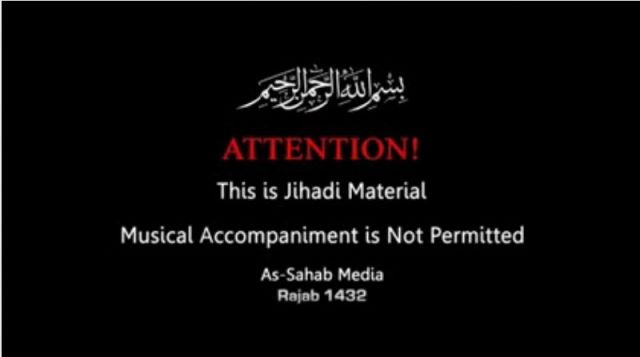
I’m grateful to JM Berger (@intelwire) and Chris Anzalone (@ibnsiqilli) for their encouragement and help with this post. JM provided the screengrab above, which shows a title card from a recent al-Zawahiri video — I suspect it may have been the one he mentioned here [text now mildly updated]:

Back in the day, when Adam Gadahn was just getting started as guru to Al Qaeda’s media operations, he released a couple of fairly slick videos designed to appeal to Western audiences by mimicking Western documentaries — up to and including the presence of a musical soundtrack.

It is therefore interesting to note that the latest release from As-Sahab (which Gadahn basically runs at this point) opens with a short disclaimer. “ATTENTION: We do not permit musical accompaniment with our productions.” One second later, a nasheed (religious song) fired up, but I guess that doesn’t count.

I’m guessing this is due to input from one of Gadahn’s Al Qaeda overseers. It’s interesting that these guys can rationalize away visits to strip clubs but they can’t handle a light orchestral score.

Chris tells me that Tehrik-i Taliban Pakistan has included similar notes in some of its videos. Indeed as JM put it in a tweet yesterday, “The odd thing is most of these guys would not be cool with music” — while as Chris noted, “Opposition to music with instruments, it should be said, isn’t unique to jihadis.”

So that’s the context: here’s the thing that interests me.

*

I can appreciate using the Old Master’s portrait of Christ that’s on the album cover to accompany a YouTube video of Bach’s B Minor Mass performed by Philippe Herreweghe (left), I can understand using a series of “nature scenes” for the Diego Fasolis performance (middle), I can even bite my lip and remain silent when someone lays a cute graphic of a wide-eyed young thing with a white rabbit (right) on top of Ton Koopman‘s version —

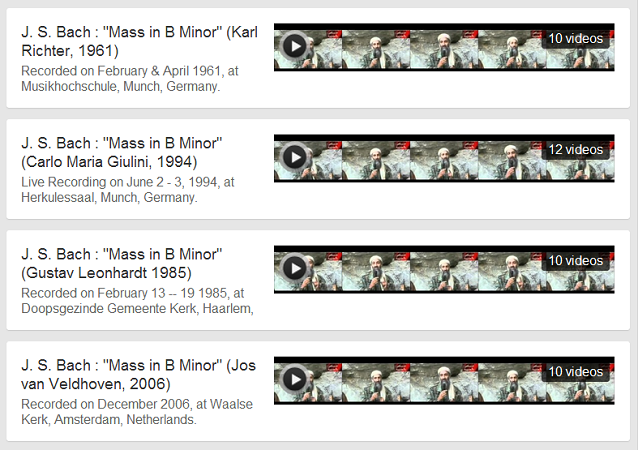
But my eyes simply bug out when I find someone has posted not one but four versions of Bach’s great Mass on YouTube, on not four but 42 separate videos, with bin Laden talking — silently, his lips moving — on each one.

Amazingly enough, that’s what someone calling themselves SOMALIAAFGHANISTAN has done.

*

Look, people, this is strange.

Lawrence Wright quotes Osama bin Laden [link, at p 167] as saying “Music is the flute of the devil”.

I was doing some research for this post on Google, and ran across this:

Fair enough, I thought, and went to Last.FM, where I found this artist featured:

Bullet for my bloody valentine.

I kid you not.

*

See, this all started because I was looking to play myself some Bach organ music and ran across a video of Marie-Claire Alain performing Bach’s BWV 767, which is pretty terrific — Alain is a great organist, it’s a remarkable work, etc etc — and found myself staring at this:

I mean, that’s not from the Bach part of my life, that’s from the part of my life that tracks jihadist utterances and theology…

*

As my friend Chris Anzalone, whose posts on jihadist graphics I always read with interest, pointed out to me, this particular video has an extensive explanation of its heraldic significance attached:

Coat of Arms Of The Famous Afridi Pashtun Afghan Pathan Tribe

Flag of the Afghan Tribe – The Afridi.

Made from historical Texts & references.

Main Circle/Islam Symbolism:

White circle: Unified, unbroken & Islam 4 stars: 4 sons of Qis/Kesh/Qais Abdur Rashid Crown: Representation of Qis/Kesh/Qais Abdur Rashid & his Bani Israel lineage which is from the Ancient Royal House of Israel Lion with Flag: The Lion of Judah/The Bravery of the Afghans & the emblem of many Afghan Kingdoms Olive Tree: Descent from the House of Israel/Bani Israel Black Background: The world in troment, pain & ignorance, showing the messianic dedication of Afghans that spread Islam through kings and Sufis throughout India.

Tribal Symbolism on Coat of Arms:

Babe Khyber/Fort: Defending the borders of Afghanistan for centuries and masters of siege warfare. They successfully held the mountain passess of Afghanistan against the counter attack of many Indian Armies. Bolt Rifle: One of the first among Afghans to master the art of local Rifle and small arms making. They were famous for their sniper marksmen skills with the 3 not 3 or .303. Camel Caravan: Afridis are skilled businessmen. AK 47: Every Afridi child is given one before passing into adulthood.
Red Background: The Traditional color of the Afridis.

Reference Material:

* The Pathans 55O B.C.-A.D. 1957 By Sir Olaf Caroe
* History of the Afghans by Bernhard Dorn
* History of the Afghans Original by Neamet Ullah (active 1613-30) in the court of the Mughal emperor Jahangir (1569-1627)
* Tareekh i Farishta
* History of the Afghans edition X by Fut’h Khan in 1718
* The Works of the Pashto Academy Peshawar University and The Pashto Dept. Islamia College Peshawar through countless publications, both online and offline, and may writers including Dr. Yusafzai, much of which you can find at Khyber.org
* History of Kohat -Gazetteer of the Kohat District
* History of Peshawar -Gazetteer of the Peshawar District
* Afghan Poetry: Selections from the poems of Khush Hal Khan Khattak., Biddulph, C.D., Saeed Book Bank, Peshawar, 1983 (reprint of 1890 ed.)
* A Grammer Of The Pukhto, Pushto: Or Language Of The Afghans, Raverty, H.G., London, 1860
* Poems from the Diwan of Khushâl Khân Khattak, MacKenzie, D.N, London, Allen & Unwin, 1965
* Notes on the Tarikh-e-Murassa, Plowden, Maj.
* Settlement Report of Bannu, Thorburn

This text, in turn, comes from a Wikipedi page on the Afridi Tribal Flag posted by a user named Afghan Historian. Who has an enviable library.

Sadly enough, Wikipedia notes “The factual accuracy of this description is disputed” — although it’s not clear by whom.

*

There are interesting references in the scholarly footnotes to the Afridi flag to “Qais Abdur Rashid & his Bani Israel lineage which is from the Ancient Royal House of Israel” and to “the messianic dedication of Afghans that spread Islam through kings and Sufis throughout India”…

The idea that the Afghans are descendants of the “lost tribes” of Israel is explored in the Jewish Virtual Library here. As to the Afghans’ “messianic dedication” — I’m not clear exactly what the word messianic means in this context, but it’s an interesting word choice in any case.

*

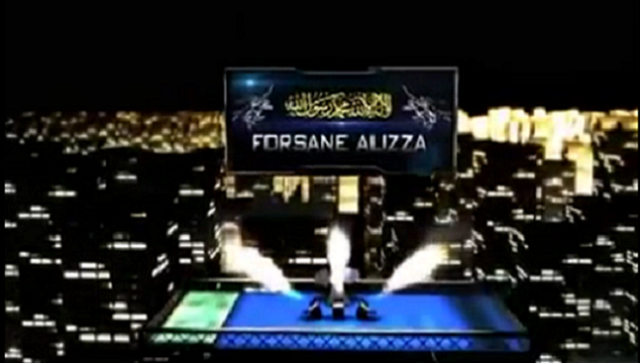
When I first looked up this image on TinEye, my image-search engine of choice, the only version it reported was from the site of Forsane Alizza, a now-disbanded group in France whose leader claims to preach only non-violence:

Je vous préviens dès maintenant que je n’ai ni armes, ni explosifs, ni drogues, ni même quoi que ce soit d’illégal. Si cela venait à arriver, soyez intelligent réfléchissez et souvenez vous que depuis sa création et jusqu’à la fin, Forsane Alizza use et n’usera, que de sa liberté d’expression et son droit à manifester contre des lois injustes et illégal au vu des droits de l’homme. D’ailleurs toutes nos actions sont non violentes et elles le resteront.

while the security police claim to have found weapons in his house.

The Forsane Alizza video, from which the snazzy image directly above was taken, shows members practicing martial arts and painball games…

*

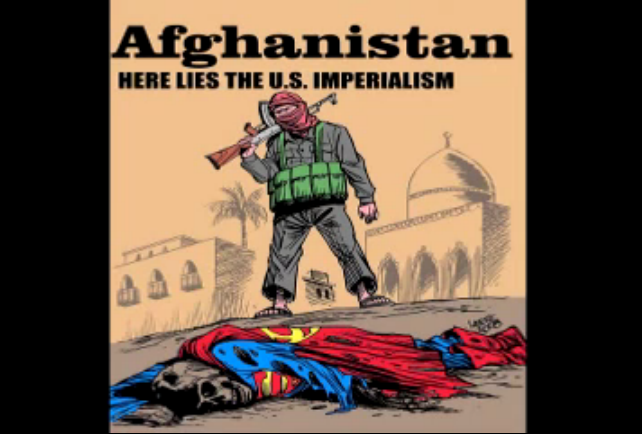
And how’s this for an illustration of Bach’s BWV 566, the C Major Toccata and Fugue — and the death of American pop culture?

To sum up: what’s all this about? Why pair Bach with bin Laden, the Afridi, the demise of superman and all the rest?

*

I don’t want to leave you with a bad taste in your mouth.

If you want to see what it’s like to hear Gustav Leonhardt conducting the Kyrie from the B Minor Mass juxtaposed with images of bin Laden, you’ll find that here. You may, of course, prefer the Herreweghe version, with another variant of his album cover with the face of Christ as the accompanying visual…

And for Marie-Claire Alain performing Bach, sans the Afridi, may I recommend this hour long recital, which I just happened upon myself thanks to this post?

Announcement: “Legacies of the Manhattan Project” May 12-13

Tuesday, May 8th, 2012

From blogfriend Cheryl Rofer as well as Molly Cernicek and Susan Voss at Nuclear Diner, – an event for those interested in nuclear weapons, science, Cold War diplomatic history, national security, strategic theory and American strategists:

Nuclear Diner Teams With Santa Fe Institute To Bring You Legacies of the Manhattan Project 

Next weekend, May 12-13, at the Santa Fe Institute, a hand-picked group of physicists, historians, social scientists, systems theorists, and writers will examine the long-term legacies of the Manhattan Project in a timely discussion of an important event in world history that still influences science and society today. Harold Agnew, who was part of the historic effort to develop the first atomic bomb, will participate in the discussion.

SFI is collaborating with the Nuclear Diner to bring the discussion to you live on Twitter. You can participate before, during, and after by searching for the hashtag #bomblegacy or following @nucleardiner. Before the event, you can also leave questions at Nuclear Diner and the Facebook event page. If you “like” the Facebook page, you will get updates throughout the week and continuing information after the workshop.

The group will discuss new information, review original records, and mine the memories of project participants to present a case study in conflict from an important period in scientific history.

More about the Santa Fe Institute working group, including biographies of the participants and discussion topics, here.

Many of SFI’s founders were senior fellows at Los Alamos National Laboratory. As the Institute has emerged as a leader in complexity science, particularly in working toward a theory of conflict in human and animal societies, the Manhattan Project has become an important case study for understanding conflict. The project’s history also illustrates the occasional tension between pure theoretical research and applied science.

Photo: Harold Agnew holding the core of the Nagasaki bomb.

An excellent opportunity for students, grad students, historians and practitioners in various fields to participate here via twitter.

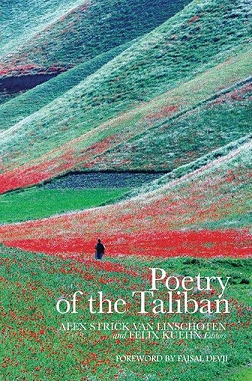
Change: a poem from The Poetry of the Taliban

Tuesday, May 8th, 2012

[ by Charles Cameron — poetry in time of war, symbolism / semiotics of blood and martyrdom, analogies with Jefferson and St Augustine, sacramental nature of reality ]
.

Felix Kuehn and Alex Strick van Linschoten’s book The Poetry of the Taliban (Hurst, Columbia UP) contains a remarkable poem composed in the 1990s by one Bismillah Sahar:
.

Change

The spring of change needs blood to rain down,
It requires the irrigation of the gardens with blood.
Valuing the blood of the people of the past
Requires the price of human blood.
Each drop of it has become a Nile of the dawn’s blood;
The Pharaohs want to fill the Nile with blood

Sitting here in California seven thousand miles and many cultures distant and more than a decade later, the phrase “spring of change” has an interesting ring to it – but it was likely not the not-yet-deposed Mubarak that Sahar was thinking of when he penned his lyric about the Pharaoh, but “the Oppressor” — whomever that might be. The imagery of the Pharaoh is a common enough trope, in fact, used for instance by the Taliban to describe President GW Bush in their magazine Al-Sumud [ link is to preview, relevant chapter of Master Narratives of islamist Extremism.

And while it is true that, as Asim Qureshi notes, “poetry links the ancient past with the modern day”, neither the trope itself nor the reference to the plight of the Jews in Egypt is exclusive to Afghanistan in specific or Islam in general. Indeed, Martin Luther King explicitly views himself as what theology would term a “type” of Moses when he says:

We’ve got some difficult days ahead. But it doesn’t matter with me now. Because I’ve been to the mountaintop. And I don’t mind. Like anybody, I would like to live a long life. Longevity has its place. But I’m not concerned about that now. I just want to do God’s will. And He’s allowed me to go up to the mountain. And I’ve looked over. And I’ve seen the promised land. I may not get there with you. But I want you to know tonight, that we, as a people will get to the promised land. And I’m happy, tonight. I’m not worried about anything. I’m not fearing any man. Mine eyes have seen the glory of the coming of the Lord.

These sacramental bleedings of the past into the present as in a palimpsest are native to the imagination and powerful in their poetic impact, as MLK’s life, final speech and death eloquently testify.

But there is a second layer of sacramental reality at work in the poem, and it lies in the repeated mention of blood. – the transition between past an present itself being presented in terms of blood spilled in the lines:

Valuing the blood of the people of the past
Requires the price of human blood.

The past requires a price from the present, then, and that price is paid in blood.

*

The poem is six lines long, and there is not a line of it that does not contain the word blood. Again:

The spring of change needs blood to rain down,
It requires the irrigation of the gardens with blood.
Valuing the blood of the people of the past
Requires the price of human blood.
Each drop of it has become a Nile of the dawn’s blood;
The Pharaohs want to fill the Nile with blood.

*

Zeus “poured bloody drops earthwards, honoring his own son, whom Patroklos was soon to destroy in fertile Troy far from his homeland”, Homer writes in the Iliad, 16.459, and the associations of rain with tears, and of spilled blood with spilled life, are ancient and pervasive.

Blood lust, blood sacrifice – the word blood is as powerful as any in the human vocabulary, so much less abstract that birth or death yet richly associated with both, while the sight or thought of blood stirs us at some archaic level of primal imagination. And what of the “irrigation of the gardens with blood”?

The gardens, first, are paradise. Next, they are paradise on earth, perhaps in one’s own village. I have written before of my memories of:

one small white-walled mosque way out on a dry stretch of road between Herat and Kandahar and its small, lush, green garden, all these years later: whatever it was to the inhabitants of that small village, to me it was “oasis” and “paradise” in perfect miniature, and it remains so in memory.

The rivers of Islam’s paradise flow with water, milk, honey and wines: so what place has blood there?

One answer would be found in the hadith, “Know that paradise is under the shade of swords”.

In his book The Shade of Swords: Jihad and the Conflict Between Islam and Christianity, named after the hadith in question, the noted journalist MJ Akbar writes:

The only reason why a person could ever want to leave paradise for this earth would be to get martyred again. Death was only a welcome release; there was no possible deed in this life that could equal jihad in reward after death. The Prophet urged Muslims to seek Firdaus, the best and brightest part of paradise, just below Allah’s throne. Allah had reserved one hundred grades of paradise only for the martyrs. The blood of the wounded would smell like musk on the day of resurrection; and nothing could interfere with Allah’s reward.

The blood of the wounded would smell like musk…

For more on musk, blood, martyrdom and the “odor of sanctity”, see my Of war and miracle: the poetics, spirituality and narratives of jihad.

And so blood is linked to paradise by martyrdom.

*

The spring of change “requires the irrigation of the gardens with blood” the poet tells us, much as Thomas Jefferson told William Stephens Smith in a letter of November 13, 1787:

The tree of liberty must be refreshed from time to time with the blood of patriots and tyrants. It is it’s natural manure.

But hold on, the same trope is found in St. Augustine‘s City of God, xx.7:

Through virtue of these testimonies, and notwithstanding the opposition and terror of so many cruel persecutions, the resurrection and immortality of the flesh, first in Christ, and subsequently in all in the new world, was believed, was intrepidly proclaimed, and was sown over the whole world, to be fertilized richly with the blood of the martyrs.

And the imagery continues, in the West, into our own day. When Pope Benedict XVI visited Mexico earlier this year, he was treading on “land that was wet with the blood of martyrs” according to Mgr. Fidel Hernández Lara, Episcopal Vicar of the Mexican Archdiocese of León.

*

The very earliest Christian accounts of martyrdom, indeed, have a distinctly sacramental flavor, as one sees by juxtaposing Ignatius of Antioch (quoted by Carolyn Forche in Susan Bergman, ed., Martyrs):

I am God’s wheat ground fine by the lion’s teeth to become purest bread for Christ

with Tertullian (Apologeticum in the translation by Lewis Carroll‘s father):

The blood of the Christians is their harvest seed

*

Joseba Zulaika subtitles his book Basque Violence — which Leah Farrall kindly pointed me to — with the words “Metaphor and Sacrament”.

Sacrament is a key word for me, obviously, and for the sake of those disinclined to religion, may I point to Gregory Bateson‘s comment in the first paragraph of the Introduction to his Mind and Nature:

Even grown-up persons with children of their own cannot give a reasonable account of concepts such as entropy, sacrament, syntax, number, quantity, pattern, linear relation, name, class, relevance, energy, redundancy, force, probability, parts, whole, information, tautology, homology, mass (either Newtonian or Christian), explanation, description, rule of dimensions, logical type, metaphor, topology, and so on. What are butterflies? What are starfish? What are beauty and ugliness?

The concept of “sacrament” occupies a place of honor second only to “entropy” in Bateson’s listing.

I am not arguing the pros and cons of publishing these poems, although I side firmly with the publisher on this. Nor am I attempting to assess the poetic value of the one poem I have quoted and examined. What I am trying to do is to give that poem the kind of reading I would want to give to any poem that interested me — one that seeks out its resonances in both local and world cultures as far as my wits can manage, showing, if possible, what power it gains from archetype, authority and form… If the poem were from the South English Legendary, for instance — which expresses similar sentiments — I’d have no hesitation calling its worldview “sacramental”.

But this is a poem from Afghanistan and Islam, not from medieval Christian England, so I should perhaps explain that in my view, any perspective which views the world as a series of legible “signs from God” — ayat, in the Arabic of the Qur’an — is a sacramental view, under the definition of sacrament that calls it “an outward and visible sign of an inward and spiritual grace”.

Blood is such a sign — of life, of its value, of its continuity by descent, and of its redemptive power even in death.

It is in sensing this semiotic / sacramental quality to Islam that we begin to grasp what translations such as these can point us to, but not directly reveal.

*****

Further reading:

From today’s NYT: Why Afghan Women Risk Death to Write Poetry
Poetry reading in Afghan culture: Reading Poetry In Kandahar
Afghan poetics: Poetry: Why it Matters to Afghans? Understanding Afghan Culture [.pdf], NPS, 2009
Talib poetry as propaganda: Johnson & Waheed, Analyzing Taliban taranas (chants): an effective Afghan propaganda artifact, Small Wars & Insurgencies, 2011
And finally, Afghans Build Peace, One Stanza at a Time


Switch to our mobile site