zenpundit.com » theory

Archive for the ‘theory’ Category

Announcement: “Legacies of the Manhattan Project” May 12-13

Tuesday, May 8th, 2012

From blogfriend Cheryl Rofer as well as Molly Cernicek and Susan Voss at Nuclear Diner, – an event for those interested in nuclear weapons, science, Cold War diplomatic history, national security, strategic theory and American strategists:

Nuclear Diner Teams With Santa Fe Institute To Bring You Legacies of the Manhattan Project 

Next weekend, May 12-13, at the Santa Fe Institute, a hand-picked group of physicists, historians, social scientists, systems theorists, and writers will examine the long-term legacies of the Manhattan Project in a timely discussion of an important event in world history that still influences science and society today. Harold Agnew, who was part of the historic effort to develop the first atomic bomb, will participate in the discussion.

SFI is collaborating with the Nuclear Diner to bring the discussion to you live on Twitter. You can participate before, during, and after by searching for the hashtag #bomblegacy or following @nucleardiner. Before the event, you can also leave questions at Nuclear Diner and the Facebook event page. If you “like” the Facebook page, you will get updates throughout the week and continuing information after the workshop.

The group will discuss new information, review original records, and mine the memories of project participants to present a case study in conflict from an important period in scientific history.

More about the Santa Fe Institute working group, including biographies of the participants and discussion topics, here.

Many of SFI’s founders were senior fellows at Los Alamos National Laboratory. As the Institute has emerged as a leader in complexity science, particularly in working toward a theory of conflict in human and animal societies, the Manhattan Project has become an important case study for understanding conflict. The project’s history also illustrates the occasional tension between pure theoretical research and applied science.

Photo: Harold Agnew holding the core of the Nagasaki bomb.

An excellent opportunity for students, grad students, historians and practitioners in various fields to participate here via twitter.

Educating Divided Minds for an Illiberal State

Friday, May 4th, 2012

Adam Elkus had well-constructed argument about the Thomas Friedman-Andrew Exum exchange:

Education and Security

Andrew Exum’s has a useful critique of Thomas Friedman’s recent piece. In a nutshell, Friedman makes the old argument that the US could buy friendship and allegiance by giving Middle Easterners more education and scholarship opportunities. To this, Exum has a rather terrific rejoinder:

“I am a proud graduate of the American University of Beirut, but do you know who else counted the AUB as their alma mater? The two most innovative terrorists in modern history, George Habbash and Imad Mughniyeh. U.S. universities and scholarship programs are nice things to do and sometimes forge important ties between peoples and future leaders, but they can also go horribly wrong and do not necessarily serve U.S. interests. There is certainly no guarantee a U.S.-style education leads to greater tolerance or gender and social equality.”

Habbash and Mughniyeh are hardly alone. Diego Gambetta and Steffen Hertog famously observed an distinct overrepresentation of scientists, engineers, and other highly educated professionals in both violent and nonviolent groups with illiberal ideologies. Gambetta and Hertog make an argument that the black-and-white mindset of certain technical groups correlate well with extremist ideologies, but I am unfamiliar with how this has been academically received so I won’t endorse their claims. To be sure, a look at 20th century history would also reveal a significant confluence of intellectuals in the humanities and social sciences being involved in either state or non-state illiberal movements. 

Indeed, the problem here may be the imbalance of educational systems that produce divided minds, where lopsided cultures of thought interact with enough disturbed individuals with a will to power. Stalin demonstrated what Communism looked like when a former Orthodox seminarian presided over a police state run by engineers; Mao one-upped him with Communism as the mystical rule of an all-powerful poet.

One of the more unfortunate trends among many bad ideas currently advertised as “education reform” is the denigration of the humanities and the reduction or elimination of the arts and history in public schools in favor of excessive standardized testing of rote skills and reasoning at the lowest levels of Bloom’s taxonomy, mostly due to Federal coercion. That this has become particularly popular with GOP politicians (though many elitist Democrats echo them) would have appalled erudite conservatives like William F. Buckley and Russell Kirk or old school libertarians who would have seen nationalization of k-12 education policy as worse than the status quo.

In an effort to appear genuinely interested in improving education, some politicians couple this position with advocacy for STEM, as the teaching of science has also been undermined by the NCLB regime and a grassroots jihad by religious rights activists against the teaching of evolution in high school biology classes. While STEM in and of itself is a good thing and better science instruction is badly needed, STEM is no more a substitute for teaching the humanities well than your left hand is a substitute for your right foot.

The modes of thinking produced by quantitative-linear- closed system-analytical reductionist reasoning and qualitative-synthesizing-alinear-imaginative -extrapolative are complementary and synergistic. Students and citizens need both. Mass education that develops one while crippling the other yields a population sharing a deeply entrenched and self-perpetuating lacunae, hostile and suspicious of ideas and concepts that challenge the veracity of their insular mental models. This is an education that tills the soil for intolerance and authoritarianism to take root and grow

Education should be for a whole mind and a free man.

The Anti-Strategy Board Cometh

Wednesday, April 25th, 2012

President Barack Obama has established by an executive order an Atrocity Prevention Board.  After the 120 day study and planning period (which will determine the writ of the APB), the board will be chaired by Samantha Power, a senior White House foreign policy adviser, NSC staffer and an aggressive advocate of R2P .

This is not likely to end well.

Presidential boards, commissions, study groups and other executive branch bodies are political agendas that power has made into bureaucratic flesh. Some, like the Warren Commission or the Iraq Study Group were transient for an instrumental purpose; others, like the Defense Policy Board put down roots and become real institutions. Some are killed for partisan reasons by new administrations (as Rumsfeld did to DACOWITS by letting it’s charter expire and then remolding it) or from congressional pique (this terminated the Public Diplomacy Commission) while some linger on for decades in zombie status, politically irrelevant but still animate, due to the inertia of bureaucracy.

What is interesting about these various bodies is that without the statutory powers granted to agencies created by legislation, they are merely empty shells unless filled with influential figures with clout or blessed by the patronage of high officials. If this is the case, even very obscure bodies can be platforms for impressive political action. Creepy and cloying old Joe Kennedy parlayed a minor post on a maritime commission and his vast fortune to become successively FDR’s SEC Chairman and the Ambassador to the Court of St. James, where he dispensed bad geopolitical advice and pushed the future careers of his sons, netting a president and two senators. The role of the Defense Policy Board in the run-up to the Iraq War is well known and I am told that one can even launch a constellation of careers and a powerhouse think tank from something as mundane and thankless as writing a COIN manual 😉

It is safe to say that the new Atrocity Prevention Board is not going to be window decoration.

Many people who are seeing what I am seeing in this move are now uneasily prefacing their critical comments with “Well, who can be against stopping atrocities, right?”. Let me say with complete candor: I can. The Atrocity Prevention Board is a great sounding  bad idea that represents an impossible task in terms of Ways, unaffordable in terms of Means and unacheivable in relation to Ends. Worse, by holding the national security community hostage to the serendipity of governmental cruelty on a global scale, the intelligent pursuit of national interests are effectively foreclosed  and the initiative ceded to random, unconnected,  events. This worst kind of institutionalized crisis management time horizon also comes weighted with implicit theoretical assumptions about the end of national sovereignty that would, I expect, surprise most Americans and which we will soon regret embracing.

Given the ambitions and missionary zeal of some R2P advocates and their ADHD approach to military intervention, it is unsurprising that this new entity was not titled “The Genocide Prevention Board”. Genocide, which the United States has definitive treaty obligations to recognize and seek to curtail, is too narrowly defined and too rare an event for such a purpose. “Atrocities” can be almost any scale of lethal violence and could possibly include “non-lethal” violence as well. This is a bureaucratic brief for global micromanagement by the United States that makes the Bush Doctrine appear isolationist and parsimonious in comparison.

A while back, while commenting on R2P, I wrote:

…As Containment required an NSC-68 to put policy flesh on the bones of doctrine, R2P will require the imposition of policy mechanisms that will change the political community of the United States, moving it away from democratic accountability to the electorate toward “legal”, administrative, accountability under international law; a process of harmonizing US policies to an amorphous, transnational, elite consensus, manifested in supranational and international bodies. Or decided privately and quietly, ratifying decisions later as a mere formality in a rubber-stamping process that is opaque to everyone outside of the ruling group.

The president is entitled to arrange the deck chairs as he sees fit, and in truth, this anti-strategic agenda can be executed just as easily through the NSC or offices in the West Wing, but the creation of a formal board is the first step to institutionalizing and “operationalizing a R2P foreign policy” under the cover of emotionalist stagecraft and networking machinations. A doctrine of which the American electorate is generally unaware and the Congress would not support legislatively (if there was a hope in Hell of passage, the administration would have submitted a wish-list bill).

This will not be a matter of just going abroad looking for monsters to slay but of a policy machine that can spew out straw monsters at need even when they don’t exist.

ADDENDUM:

What others are saying about the APB:

Foreign Policy (Walt) –Is the ‘Atrocity Prevention Board‘ a good idea?

Duck of Minerva (Western) –Institutionalizing Atrocity Prevention 

Before Disruption….Thinking

Monday, April 23rd, 2012

“What you think, you become”

    – Buddha

“We are what we frequently do”

    – Aristotle

There has been a lively and still evolving debate in the milblogosphere regarding “disruptive thinkers”, starting with Benjamin Kohlman’s post at SWJ whose editor Peter J. Munson has done a fine job steering, collecting and commenting upon. A selection:

The Military Needs More Disruptive Thinkers by Benjamin Kohlman

Disruptive Thinking, Innovation, Whatever You Want to Call It is Needed for a Military in Crisis by Peter J. Munson 

The focus on disruptive thinkers coincided with a different but relevant debate over professional military education (PME) when a scathing blast was recently  leveled at the US Army War College by Major General Robert Scales (ret.) , himself the former commandant and a strong advocate of rigorous PME.  A few of the criticisms made by General Scales at a gathering at FPRI were mentioned in a post by Thomas Ricks who believes in shutting down the service academies and war colleges and maybe just sending everyone to Yale, Princeton and Harvard for MBAs. Or something.
.
What was interesting to me is that many authors and their points had less to do with a close examination of cultivating cognitive skills than related topics of changing organizational culture, the perils of groupthink, rehashing ideas from Frans Johanssen’s The Medici Effect and John Kao’s Innovation Nation, the superiority of entrepreneurshiphidebound military bureaucracy and other tangents to indirectly create an environment in which insightful or innovative behavior might happen.  Only Mike Mazarr zeroed in to the heart of the matter, writing:
….We need to improve, for example, in the detail and specificity of critical and creative thinking methodologies that we integrate into the curriculum.
Bingo!
.
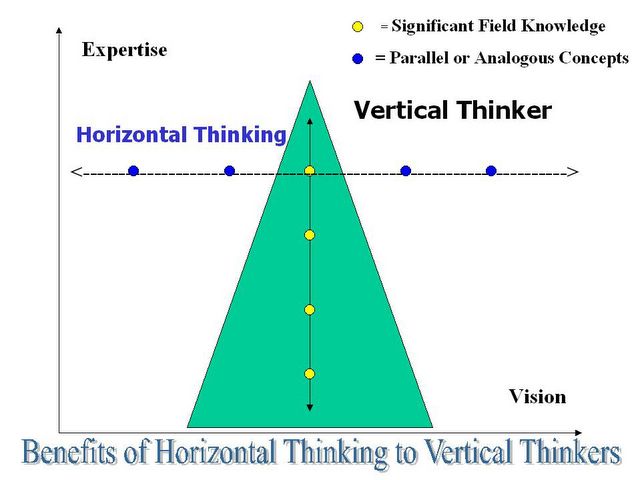
There’s nothing wrong -in fact, much to the good – with the call of Kohlman and others like Joan Johnson-Freese to deliberately combine students and faculty of radically different professional backgrounds. Such a personnel mix is a good base for horizontal thinking to take place, where discussions can range across fields generating insights and analogies and accelerating learning.
However, just assembling a broad mix of talent and putting them together in a building is not enough because it is not any more goal oriented than a MENSA social. Good things might happen, sure, but just as easily not. This is why DARPA is a lot more productive of an organization on an annual basis than the Institute for Advanced Study. There needs to be a mixture of problem-solving and play, free inquiry or experimentation and unifying goals. Communities of interest have to first have a sense of community for the vibrantly sharing and inspiring “minds on fire” effect to take place.
.
If the military or more broadly, American society, wants a larger number of creative, innovative, “disruptive”, strategic or whatever kind of thinker, then the answer is to actively and purposefully teach students creative, critical, insight-generating and strategic thinking skills and to value intellectual curiosity, skepticism, imagination and empiricism over ideology and conformity. The other indirect, “better environment”, stuff certainly improves your chance of success, but systemic improvement will only come about by making such objectives the focus of instruction and learning rather than a haphazard byproduct.
UPDATE:
At Best Defense, Ricks has provided a copy of his prepared remarks on PME as well as a link to the audiofile that I could not pull up the other day. Check out what he has to say.

2012 USAWC Strategy Conference on Youtube Part II.

Friday, April 20th, 2012

2012 US Army War College Strategy Conference is under way. Fortunately, the major events are being videotaped and uploaded to Youtube.

Panel # 1 “Panel I – An Age of Austerity: What Is It and What Does It Mean?”

Moderator: Professor Jef Troxell, U.S. Army War College
Panelists: Dr. Lawrence Korb, Senior Fellow, Center for American Progress; Mr. Tom Davis, Vice President for Strategic Planning, General Dynamics; Dr. Thomas McNaugher, Georgetown University


Switch to our mobile site