zenpundit.com » theory

Archive for the ‘theory’ Category

The Rule of Law

Saturday, March 6th, 2010

“Law stands mute in the midst of arms. “ – Marcus Tullius Cicero

“Bad laws are the worst form of tyranny” – Edmund Burke

“Make them bow their heads under the yoke of the law” – Russian proverb

Frequent commenter Schmedlap, who has a fine blog of his own, asked his readers a very important question:

Today a smart, well-traveled, experienced, knowledgeable guy was telling me that “rule of law” is a concept that we need to stop worrying about. Strongly disagreeing, I asked why. After he explained why, it became clear that he was working with a significantly different definition of “rule of law” than I knew of. It reminded me of recent discussions here and elsewhere over definitions of culture, torture, and terrorism. Given his definition of “rule of law” I agreed that it is not something that we need to worry about. If “rule of law” = his definition, then rule of law is not important. If “rule of law” = my definition, then rule of law is important.

Just curious, what is your understanding of what “rule of law” means?

I attempted to leave a comment, using a Google Chrome browser, but it failed to “stick”, so I will pontificate in my usual, windy, fashion here instead.

The Anglo-American tradition of “rule of law” is distinct from that of continental Europe or Confucianist traditions in Asia, both of which are primarily concerned in different ways with the health of the state. Anglo-American “rule of law” has been an evolutionary – and sometimes revolutionary – march to constrain the exercise of arbitrary power and, eventually, assure an egalitarian access to justice. When Norman French-speaking King John of England bitterly complained at Runnymede that the English barons might as well demand his crown, he was right. The Magna Carta was intended to curb John’s capricious tyranny with formal rules governing how and when the King could exercise power against whom.

As national monarchies coalesced out of bastard feudalism’s kingdoms and medieval principalities in the fifteenth and sixteenth centuries, the Kings propagated a theory of divine right absolutism, which to our ears seems despotic, but to a sophisticated and wealthy, emerging, European bourgeoisie at that time, sounded like music. Better living under predictable, “national” laws and a King far away than a patchwork of greedy, grasping and unpredictable nobles who were ever close at hand. That same, rational, middle-class political sentiment though, soon found fault with even Enlightened absolutism.

Lord Chief Justice Sir Edward Coke, a great man to whom much is owed, but who today is largely forgotten, was the great theorist and defender of judicial independence and common law from the whims of a sovereign. Without judicial independence, the rule of law is hardly possible because it is ultimately inseparable from the executive power; Coke was instrumental in moving elite Englishmen’s minds from accepting “Rex lex” (“The King is Law”) to demanding “Lex rex” (“The Law is king”).

The matter was not formally settled with the English Civil War, which came not long after Coke’s death, or even the Glorious Revolution of 1688; nor the American Revolution of 1776 or even at Appomattox Courthouse.  “The rule of law” is an ongoing struggle that must be constantly renewed by an active and vigilant citizenry if it is to be sustained.

Guest Post: Cameron on “High Conceptual Thinkers”

Friday, March 5th, 2010

Charles Cameron, my regular guest blogger, is the former Senior Analyst with The Arlington Institute and Principal Researcher with the Center for Millennial Studies at Boston University. He specializes in forensic theology, with a deep interest in millennial, eschatological and apocalyptic religious sects of all stripes.

High Conceptual Thinkers

by Charles Cameron

This isn’t the first time I’ve seen Eric Drexler’s advice on this topic, but unless Zen mentioned it previously, or perhaps John Robb, I don’t know where I’d have seen it before. This is the part that gets to me:

Read and skim journals and textbooks that (at the moment) you only half understand. Include Science and Nature.

Don’t avoid a subject because it seems beyond you – instead, read other half-understandable journals and textbooks to absorb more vocabulary, perspective, and context, then circle back.

Each time I see that, I have to laugh. Here’s the same tale, told from the arts and humanities side of the house…

*

When I was a lad, they sent me to Wellington College, the private boarding school that prepares officers’ sons for admission to Sandhurst, and the life of a British army officer. I was not that way inclined, to be honest, and soon found myself a nice corner of the library with a comfortable chair, which I made my own.

I scanned the books in that area more closely than most, and one set of books caught my eye. It was the set of six volumes of the Eranos Yearbooks.

Eranos was a yearly gathering in Switzerland, at which CG Jung more or less presided, and at which his scholar friends read learned papers to each other at the highest levels of their own expertise.

These books night as well have been in Ge’ez, as far as I was concerned. They talked about things like “Theriomorphic Spirit Symbolism in Fairy Tales” (which is actually about gods in wild animal form, Ganesh with his elephant’s head for example), “Aeschylus: The Eumenides” about the Greek tragedy of that name, “The Spirit of Science” (that would be Erwin Schodinger speaking, which will give you an idea of the caliber of invitees) — and those are just picked from the first of the six volumes.

And how these folks went at their discussions! If a nice quote from Horace was in order, Latin’s the language. French, yes, German too, for Kant or Nietzsche. That’s okay. But Coptic? Egyptian hieroglyphs? Diagrams culled from Kabbalistic treatises about how there’s a waterfall of grace that falls constantly from G*d through ten distinct steps to the creation we inhabit, and how to climb carefully back up before the Throne?

Scattered through the six volumes were Jung, Schrodinger, Rahner, Kerenyi, Zimmer, Puesch, Quispel (between them, these two covered the waterfront on Gnostic studies), Massignon, Corbin (ditto for Islam and its mystics and martyrs), Neumann, Eliade, Tillich, Suzuki (he brought Zen to the west), Danielou, Zimmer, van der Leeuv, Wilhelm (he brought the west the I Ching), LL Whyte… I don’t believe Wolfgang Pauli ever   attended, but 400 of his dreams were discussed there under cover of anonymity by CG Jung.

I had not the least idea what these folks were on about, maybe a third of the nouns and verbs were nouns and verbs I’d never met before, and maybe a sixth of those weren’t even in my trusty Concise Oxford Dictionary: this was true scholarship, and I was aware I was in paradise.

I left that school, thankfully, and went up to Christ Church, Oxford, where I studied Theology, and learned early on that my interest was not in studying that “particular subject as if you had to pass a test on it” — I scraped by Oxford’s intense finals with what was called a “gentleman’s Third” — and I have spent the rest of my life searching out scholarship and experiences having to do with inspiration, intuition and imagination.

I’ve found myself trotting around the globe, studying now Zen then Hinduism then Lakota shamanism, at last returning to the European west via Jung and Hermann Hesse, singing Gregorian Chant under the baton of the choir master at Solesmes, meditating, sweating my buckskin out (as they say) in “stone people’s lodges”, teaching creativity in the Los Angeles atelier of a master artist, Jan Valentin Saether — and somewhere around the age of forty, I discovered the six volumes of the Eranos Yearbooks again in a second hand bookstore, and once more read them.

This time, I found they were heady but somewhat comprehensible reading, covering the entire extent of the studies to which my fascinations had led me in the intervening years — Alchemy, the Gnostics, Sufism, Zen, the Mystery cults, poetics, comparative religion, cultural anthropology, depth psychology, symbolism, the philosophy of science.

And that roll call of contributors was the roll call of half the modern masters in each of those fields.

I have the hope that I shall live to be seventy five, and read those papers as though a peer of those who assembled by the lake there in Eranos at Jung’s invitation: that those miraculous inkings of paper will at last make almost perfect sense to me, and that maybe, perhaps, it might be, may it be so — insh’allah and the creek don’t rise — I might even be able to write the odd footnote updating a passage here or there with my own insights.

Science and Nature didn’t get a look in. For me, it was Eranos all the way.

And one more story, unrelated to Eranos, but still describing my time at Wellington:

I seem to be one of those High Conceptual sorts the Eide’s are talking about — eccentric, to be sure — and I vaguely recall being hauled into the Headmaster’s office at Wellington and being accused of plagiarism, because I had written a fifteen page paper on the Contortionists of Saint Medard, the Jansenists, and Pascal. Here we go again — prior to that, I had submittedeach week three page essays on assigned topics such as “The football game” or “What I did on vacation” — but this week my English master was sick, and had   phoned in to say we could write about whatever we wanted. I’d taken him at his word, and spread my wings — and lucky for me, I could point out that the College library didn’t have enough material on the subject of the Jansenists for me to have plausibly plagiarized my essay.

Why were the strange people of Saint Medard so interesting to this young lad? Because they contorted and tortured their bodies like yogis, in what was (as far as I could tell) the first experiential attempt within Christendom to prove the hypothesis of the triumph of mind over body.

*

Now that’s all a bit selfish and introspective by way of background. But it lets you know the kinship I feel for Drexler’s crafty strategy, and likewise for the Eide’s notion of (I hesitate to write the words) “High Conceptual Thinkers”.

I want to make two points about HCTs here.

The first is to suggest that what Zen calls seeing meta-patterns is pretty much analogical / metaphorical thinking (ie lateral vs linear): the poet’s spécialité de la maison.

The second is that there exists a great project — great as in the Olympics, great as in the search for the Grand Unified Theory in physics, great as in the Italian Renaissance — for the assembly of all human cultural and scientific knowledge in a single architecture, in the form of the conceptual Glass Bead Game of Hermann Hesse.

Lewis Lapham,  in a Harper’s editorial back in 1997 said he expected the editors at Wired would soon discover Hesse’s book, and that Microsoft would want to name software in its honor.

It hasn’t happened yet. I hope it does. And that’s another story, for another day.

Cascio on the Utility of Futurism

Tuesday, March 2nd, 2010

Jamais Cascio explains the cognitive benefits of good futurist methodology:

Foresight exercises that result in a single future story are rarely as useful as they appear, because we can’t predict the future. The goal of futures thinking isn’t to make predictions; the goal is to look for surprising implications. By crafting multiple futures (each focused on your core dilemma), you can look at your issues from differing perspectives, and try to dig out what happens when critical drivers collide in various ways.

Whatever you come up with, you’ll be wrong. The future that does eventually emerge will almost certainly not look like the scenarios you construct. However, it’s possible to be wrong in useful ways–good scenarios will trigger minor epiphanies (what more traditional consultants usually call “aha!” moments), giving you clues about what to keep an eye out for that you otherwise would have missed.

Yes. I would add that such thought experiments also help to improve pattern recognition in analyzing reality. From teasing out logically sound, if fictional, consequences, we become more discerning about recognizing causation and potential second and third order effects of events or policy choices.

Useful.

Reflecting on Neo-COIN and the Global Insurgency, Part I.

Saturday, February 27th, 2010

Read a very interesting theoretical paper critiquing the merits of “Neo-Classical COIN” contrasted with the concept of “Global Insurgency” by Dr. David Martin Jones and Dr. M.L.R. Smith in The Journal of Strategic Studies, which drew a sharp rebuttal from Dr.John Nagl, the president of CNAS, and Brian M. Burton in defense of a universally applicable COIN paradigm (big hat tip to Steve Pampinella). 

The papers deserve much wider circulation and I encourage you to find yourself a copy. Unfortunately, they are behind an irritating subscription wall, so we have to do this in 20th century, stone-age, fashion….

David Martin Jones* and M.L.R. Smith**. “Whose Hearts and Whose Minds? The Curious Case of Global Counter-Insurgency”. The Journal of Strategic Studies. Vol. 33, No. 1, 81-121, February 2010.

*University of Queensland, Australia. ** King’s College London, UK.

John A. Nagl and Brian M. Burton. “Thinking Globally and Acting Locally: Counterinsurgency Lessons from Modern Wars – A Reply to Jones and Smith.  The Journal of Strategic Studies. Vol. 33, No. 1, 123-138, February 2010.

Center for New American Security (CNAS), Washington, DC, USA.

Jones and Smith are dissecting “the extraordinary renaissance of counter-insurgency thinking within the U.S. military establishment” which they argue has “produced two distinctive schools of thought about counter-insurgency”; the “neo-classical” which constructs a framework for waging COIN from the historical understanding of Maoist guerrilla warfare, and “global counterinsurgency” which is “post-maoist”, conceptual and networked rather than territorial and hierarchical and centered in the ideological turmoil or radical salafist-jihadi Islamism. Together, the two schools comprise “neo-COIN” which yields an “incoherent” and “confused and contradictory understanding” of insurgency which is rooted in a hostility and miscomprehension of Clausewitzian thought.

The breezy summary above was, by the way, a gross simplification of a forty page, heavily footnoted, academic argument, which really needs to be read in its entirety.

Jones and Smith go into considerable depth investigating the intellectual orgins of “neo-COIN” and the leading personalities who shaped the doctrine, including Nagl, Sewall, McFate, Kilcullen, Hoffman and commanding generals like Petraeus and Chiarelli.

Of the two schools, the authors find greater flaws on the neo-classical approach to COIN:

….Ultimately though, excessive deference to Maoist theories of guerrilla warfare led neo-classicism into a strategic, Iraq-centric, cul-de-sac….

….Such crude reductionism, ultimately leads to a cdrude Maoist/Counter-Maoist paradigm that assumes holding on to physical territory, no matter the cost, is the ultimate goal of any combatant. This neo-classical reductionism not only implies that any withdrawal of forces from an occupied territory represents a defeat, it also risks inducing the kind of certainties that influenced the French approach to COIN during the Algerian War with manifestly disastrous consequences

But the global insurgency school, while more accurately conceptualizing the transnational nature of the enemy in the view of Smith and Jones, is not without problems either:

However, when it comews to identifying the drivers of jihadism, global COIN theorists are surprisingly coy. Significantly, global neo-COIN writing goes to great lengths to dismiss the religious and ideological motivation for Islamist activism. Instead, it focuses upon organizational characteristics, social networks, psychological profiling, and patterns of recruitment to understand the new global threat….Like the notion of a War on Terrorism, global counter-insurgency denotes an amorphous threat, conceals hidden assumptions and obfuscates the object of the war, namely militant, ideologized Islam or Islamism.

This “negation of ideological motivation” identified by Jones and Smith in global counter-insurgency, is blamed on two sources. First, Dr. David Kilcullen, the deeply influential Australian Army officer and anthropologist who has been the COIN adviser to the Departments of State and Defense and CENTCOM, who argues for the primacy of “sociological characteristics” as drivers to jihadism; secondly, on a fear of the implications of Clausewitzian theory that causes neo-COIN advocates to purposefully “misunderstand” On War:

From a political perspective, however such neo-COIN misunderstanding is not so strange at all. McFate evidently recognizes Clausewitz’s central premise that  ‘War is a continuation of political intercourse, carried on by other means’. It is this recognition though, that unsettles COIN theorists. The reluctance to attribute religious motives to jihadist action, the emphasis on post-Maoism and the dismissal of Clausewitz, all evince a profound neo-COIN discomfort with the political dimension of war. It is the politics of modern jihadi resistance that contemporary counter-insurgency theorists wish to avoid: for politics denotes complexity, particularity, ambiguity, controversy and the need to challenge or defend specific value systems.

COMMENTARY:

Smith and Jones have identified some real weaknesses in COIN theory, a useful service. However, either they commit the same error in diagnosing the inability of COIN theorists to wrestle frankly with Islamism as they accuse Kilcullen, Nagl, McFate etc. of having made and do so for the same reason, or they evince a childish understanding of politics. I lean toward the former.

The ignorance of irhabi-salafist radical religious ideas and internal debates is a very serious analytical problem for the United States. Few scholars or analysts can boast of simultaneously having fluency in critical langues, a deep understanding of Islamist theology and expertise/experience in terrorism/counter-terrorism studies. And really, to make astute judgments, you need to have a grasp on all three. Avoiding the religious ideology dimension is a serious error on the part of COIN thinkers and Smith and Jones are right to call them out on it.  It would be very helpful, if COIN theorists in crafting doctrine, would avail themselves of the deep understanding of Islamism offered by a Gilles Kepel or an Olivier Roy.

That said, the religious ferment of Islamism applies more to the “professional” and not the “accidental” guerrilla. To the recruiter, ideologists, operational planner and other senior leaders of al Qaida and the Taliban and far less to the rootless cannon fodder, idle adventurers, middle-class losers, itinerant tribals and other flotsam and jetsam who compose the foot soldiers of modern jihad. Applying social network analysis or organizational theory adds a useful perspective to understanding to the mass-movement characteristics of violent Islamist groups.

That is not why Kilcullen or Nagl de-emphasize religious motivations though. It is not that COIN gurus at CNAS do not understand or are uncomfortable with political dimensions or are mystified about Islam and Islamism. That’s an absurd assessment. To the contrary, they understand politics exceptionally well. COIN advocates downplay the religious motivations of Islamist terrorists and insurgents because emphasizing them will cost COIN strategy the political support of many liberal-left Democrats in Congress whose PC ideology cannot tolerate such arguments to be heard, the facts be damned. To make such an analysis, before a group that is not overly supportive of the war to begin with, is to be tagged an “Islamophobe” or a “racist” (even though the latter insult makes no sense whatsoever).

For the same reason, academia having its own PC fetishes to an even greater degree than politicians, Smith and Jones do not specifically identify the domestic political incentives COIN advocates have for ignoring religious ideology.

Arquilla on the New Rules of War

Thursday, February 25th, 2010

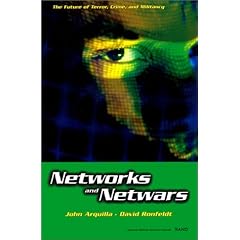
John Arqilla, along with David Ronfeldt, was the pioneering military and security theorist who forseaw the rise of networked non-state adversaries, which they detailed in their now classic book, Networks and Netwars. Below, in a Foreign Policy mag article, Arquilla expounds on the failure of the Pentagon to adapt sufficiently to leverage the power of networks or counter those opponents who have done so.

The New Rules of War

When militaries don’t keep up with the pace of change, countries suffer. In World War I, the failure to grasp the implications of mass production led not only to senseless slaughter, but also to the end of great empires and the bankruptcy of others. The inability to comprehend the meaning of mechanization at the outset of World War II handed vast tracts of territory to the Axis powers and very nearly gave them victory. The failure to grasp the true meaning of nuclear weapons led to a suicidal arms race and a barely averted apocalypse during the Cuban missile crisis.
 
Today, the signs of misunderstanding still abound. For example, in an age of supersonic anti-ship missiles, the U.S. Navy has spent countless billions of dollars on “surface warfare ships” whose aluminum superstructures will likely burn to the waterline if hit by a single missile. Yet Navy doctrine calls for them to engage missile-armed enemies at eyeball range in coastal waters.

 
The U.S. Army, meanwhile, has spent tens of billions of dollars on its “Future Combat Systems,” a grab bag of new weapons, vehicles, and communications gadgets now seen by its own proponents as almost completely unworkable for the kind of military operations that land forces will be undertaking in the years ahead. The oceans of information the systems would generate each day would clog the command circuits so that carrying out even the simplest operation would be a terrible slog.
 
And the U.S. Air Force, beyond its well-known devotion to massive bombing, remains in love with extremely advanced and extremely expensive fighter aircraft — despite losing only one fighter plane to an enemy fighter in nearly 40 years. Although the hugely costly F-22 turned out to function poorly and is being canceled after enormous investment in its production, the Air Force has by no means given up. Instead, the more advanced F-35 will be produced, at a cost running in the hundreds of billions of dollars. All this in an era in which what the United States already has is far better than anything else in the world and will remain so for many decades.
 
These developments suggest that the United States is spending huge amounts of money in ways that are actually making Americans less secure, not only against irregular insurgents, but also against smart countries building different sorts of militaries. And the problem goes well beyond weapons and other high-tech items. What’s missing most of all from the U.S. military’s arsenal is a deep understanding of networking, the loose but lively interconnection between people that creates and brings a new kind of collective intelligence, power, and purpose to bear — for good and ill…..”

Read the rest here.

It was nice to see Arquilla give some props to VADM Art Cebrowski, who is underappreciated these days as a strategic thinker and is much critricized by people who seldom bothered to read anything he actually wrote. Or who like to pretend that he had said a highly networked Naval task force is a good way to tackle an insurgency in an arid, mostly landlocked, semi-urban, middle-eastern nation.

It also occurs to me that one of the reasons that the USAF resisted drones tooth and nail is that robotics combined with swarming points to en end ( or serious diminishment) of piloted warplanes. Eliminating the design requirements implicit in human pilots makes for a smaller, faster, more maneuverable, more lethal aircraft that will probably be infinitely cheaper to make, more easily risked in combat and usable for “swarming”. Ditto attack helicopters.

Of course, nuclear bombers will probably stay in human hands. Probably.

ADDENDUM:

Contentious Small Wars Council thread on Arquilla begun by “student of war” and defense consultant Wilf Owen. I have weighed in as has Shlok Vaidya.


Switch to our mobile site
