zenpundit.com » al qaida

Archive for the ‘al qaida’ Category

Egypt: the jihad’s receding tide?

Saturday, February 5th, 2011

[ by Charles Cameron — cross-posted from Chicago Boyz ]

Here’s the evidence I’m seeing for one hopeful outcome…

From an Egyptian FaceBook page:

I will NOT accept that religious groups hijack what we have been doing for their own agenda. A large group of the ones organizing them yesterday were people in galabeyas and long beards shouting “Al Jihad fe Sabeel Allah (Jihad in the name of Allah), you have to continue fighting, we will win this war, if you die here today, you will be a martyr and go straight to heaven, don’t stop, fight, fight, fight”. NO! This is NOT why we were in the streets on Friday being tear gassed and dodging rubber bullets and it is not why we have been going to Tahrir everyday to be heard. The reason why this revolt went through and became successful was because it was not religiously or politically charged.

quoted on the The International Centre For The Study Of Radicalisation blog – ICSR is a joint venture between King’s College London, the University of Pennsylvania, Israel’s Interdisciplinary Center, Herzliya, and the Jordan Institute of Diplomacy.

*

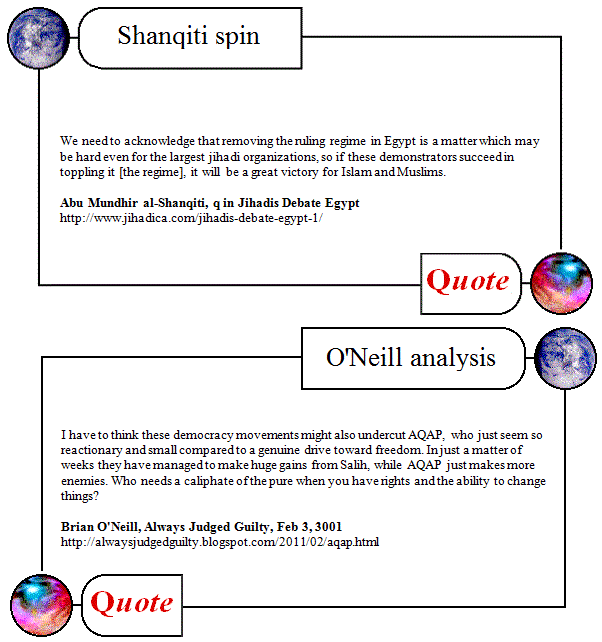
This DoubleQuote first presents a jihadist spin on things, from a legal team member at Minbar al-Tawhid wa’l-Jihad, in Quote #1:

Below that, and lending it both context and irony, is a comment from one of our best analysts of the situation in the Yemen, a former editor for the Yemen Observer.

*

John Robb gives the same general message a little strategic push…

What’s the best way to defuse Islamic radicalism across the ME and beyond? Help make the protest in Egypt work.

.
Sources: ICSRShanqitiO’NeillRobb Feb. 3, 2011.

“Whoever took religion seriously?”

Saturday, January 8th, 2011

[ by Charles Cameron — cross-posted from the DIME/PMESII boards at LinkedIn ]

I’ve been hammering away at the importance of a nuanced understanding of religious drivers in successful modeling of our world, and today I ran across some paragraphs from a book by Gary Sick that explain, forcefully and briefly, just why this seems like a big deal to me.

1

Sick, who was the National Security Council’s point man on Iran at the time of the Ayatollah Khomeini‘s Iranian Revolution, recounts how totally unprepared we were for the sudden emergence of a theocracy in his book, All Fall Down:

Vision is influenced by expectations, and perceptions — especially in politics — are colored by the models and analogies all of us carry in our heads. Unfortunately, there were no relevant models in Western political tradition to explain what we were seeing in Iran during the revolution. This contradiction between expectation and reality was so profound and so persistent that it interfered fundamentally with the normal processes of observation and analysis on which all of us instinctively rely.

On one level, it helps to explain why the early-warning functions of all existing intelligence systems — from SAVAK to Mossad to the CIA — failed so utterly in the Iranian case. Certainly, US intelligence capability to track the shah’s domestic opposition had been allowed to deteriorate almost to the vanishing point. But even if it had not, it would probably have looked in the wrong place. Only in retrospect is it obvious that a good intelligence organization should have focused its attention on the religious schools, the mosques and the recorded sermons of an aged religious leader who had been living in exile for fourteen years. As one State Department official remarked in some exasperation after the revolution, “Whoever took religion seriously?”

Even after it became clear that the revolution was gaining momentum and that the movement was being organized through the mosques in the name of Khomeini, observers of all stripes assumed that the purely religious forces were merely a means to the end of ousting the shah and that their political role would be severely limited in the political environment following the shah’s departure, The mosque, it was believed, would serve as the transmission belt of the revolution, but its political importance would quickly wane once its initial objectives had been achieved.

2

The blissful ignorance didn’t end back there in 1979. Right at the end of 2006, reporter Jeff Stein asked Rep. Silvestre Reyes (Dem, TX), the incoming head of the House Intelligence Committee (which has oversight of the entire US Intelligence Community) whether Al-Qaida was Sunni or Shiite – noting in two asides, “Members of the Intelligence Committee, mind you, are paid $165,200 a year to know more than basic facts about our foes in the Middle East” and “To me, it’s like asking about Catholics and Protestants in Northern Ireland: Who’s on what side?”

Reyes guessed wrong – not good – and so did a lot of other senior people in the FBI, Congress and so forth. Understandable perhaps, but still, not good.

The popular media keep many of the rest of us confused, too. Glenn Beck has been misinformed by the Christian thriller writer Joel Rosenberg, and refers to the “Twelvers” when he means the “Anjoman-e Hojjatieh” -which, to extend Stein’s point, is the equivalent of saying “Catholic Church” when you mean “Legionnaires of Christ”.

3

Okay, we know that religion has something to do with all this Iran – and Afghanistan and Pakistan and Iraq, and Yemen, and Somalia, and Nigeria — and maybe even homegrown — mess. And I agree, other people’s religions really aren’t our business normally, and it’s not surprising if we don’t know much about them.

Except, I’d say, when religions take up the sword, or have significant power to influence decisions about the use of nuclear weapons — at which point it’s appropriate to get up to speed…

WikiLeaks: Critical Foreign Dependencies

Thursday, December 9th, 2010

[ by Charles Cameron ]

The most interesting part of the WikiLeaks-posted State Department Request for Information: Critical Foreign Dependencies, it seems to me, is the part that ties in with Zen’s recent post Simplification for Strategic Leverage.

Zen referenced Eric Berlow‘s recent TED talk to the effect that sometimes a complex network can be made effectively simple by reducing it to the graph of nodes and links within one, two or three degrees of the node you care about and wish to influence.

“Simplicity often lies on the other side of complexity”, Dr Berlow says, and “The more you step back, embrace complexity, the better chance you have of finding simple answers, and it’s often different than the simple answer that you started with.”

*

This resonates neatly with a few things I’ve been thinking and talking about for some time now.

1. There’s the need for visualization tools that don’t operate with as many nodes as there are data points in a database like Starlight — I’ve been wanting to reduce the conceptual “load” that analysts or journos face from thousands, sometimes tens of thousands of nodes, to the five, seven, maybe ten or twelve nodes that the human mind can comfortably work with:

What I’m aiming for is a way of presenting the conflicting human feelings and understandings present in a single individual, or regarding a given topic in a small group, in a conceptual map format, with few enough nodes that the human mind can fairly easily see the major parallelisms and disjunctions, as an alternative to the linear format, always driving to its conclusion, that the white paper represents. Not as big as a book, therefore, let alone as vast as an enormous database that requires complex software like Starlight to graphically represent it, and not solely quantitative… but something you could sketch out on a napkin, showing nodes and connections, in a way that would be easily grasped and get some of the human and contextual side of an issue across.

2. There’s the fact that the cause is typically non-obvious from the effect. In the words of Jay Forrester, the father of stocks and flows modeling:

From all normal personal experience, one learns that cause and effect are closely related in time and space. A difficulty or failure of the simple system is observed at once. The cause is obvious and immediately precedes the consequence. But in complex systems, all of these facts become fallacies. Cause and effect are not related in either time or space… the complex system is far more devious and diabolical than merely being different from the simple systems with which we have experience. Though it is truly different, it appears to be the same. In a situation where coincident symptoms appear to be causes, a person acts to dispel the symptoms. But the underlying causes remain. The treatment is either ineffective or actually detrimental. With a high degree of confidence we can say that the intuitive solutions to the problems of complex social systems will be wrong most of the time.

3. There’s the need to map the critical dependencies of the world, which became glaringly obvious to me when we were trying to figure out the likely ripple effects that a major Y2K rollover glitch – or panic – might cause.

Don Beck of the National Values Center / Spiral Dynamics Group captured the possibility nicely when he characterized Y2K as “like a lightening bolt: when it strikes and lights up the sky, we will see the contours of our social systems.” Well, the lightning struck and failed to strike, a team from the Mitre Corporation produced a voluminous report on what the material and social connectivity of the world boded in case of significant Y2K computer failures, we got our first major glimpse of the world weave, and very few of the possible cascading effects actually came to pass.

I still think there was a great deal to be gleaned there — as I’m quoted as saying here, I’m of the opinion that: “a Y2K lessons learned might be a very valuable project, and even more that we could benefit from some sort of grand map of global interdependencies” – and agree with Tom Barnett, who wrote in The Pentagon’s New Map:

Whether Y2K turned out to be nothing or a complete disaster was less important, research-wise, than the thinking we pursued as we tried to imagine – in advance – what a terrible shock to the system would do to the United States and the world in this day and age.

4. That such a mapping will necessarily criss-cross back and forth across the so-called cartesian divide between body & mind (materiel and morale, wars and rumors of wars, banks and panics):

You will find I favor quotes and anecdotes as nodes in my personal style of mapping — which lacks the benefits of quantitative modeling, the precision with which feedback loops can be tracked, but more than compensates in my view, since it includes emotion, human identification, tone of voice.

The grand map I envision skitters across the so-styled “Cartesian divide” between mind and brain. It is not and cannot be limited to the “external” world, it is not and cannot be limited to the quantifiable, it locates powerful tugs on behavior within imagination and powerful tugs on vision within hard, solid fact.

Doubts in the mind and runs on the market may correlate closely across the divide, and we ignore the impacts of hope, fear, anger and insight at our peril.

*

Getting back to the now celebrated WikiLeak, which even al-Qaida has noticed, here’s the bit — it’s really just an aside –that fascinates me:

Although they are important issues, Department is not/not seeking information at this time on second-order effects (e.g., public morale and confidence, and interdependency effects that might cascade from a disruption).

It seems to me that the complex models which Starlight provides, and Eric Berlow pillories, overshoot on one side of the problem – but avoiding all second-order effects?

One cause, one effect, no unintended consequences?

What was it that Dr Berlow just said? “if you focus only on that link, and then you black box the rest, it’s actually less predictable than if you step back, consider the entire system”…

Avoid all second-order effects?

If you ask me, that’s overshooting on the other side.

A draft of what’s on my mind lately

Sunday, December 5th, 2010

by Charles Cameron
[ cross-posted from ChicagoBoyz ]

I’ve been thinking…

*

Reports, overstatements and underestimates

There are factual reports of violence and threats of violence, which are within the proper province of journalism and intelligence gathering.

There are also overstatements of such reports, generally resulting from paranoia, hatred, recruitment, or the desire to increase sales of advertising or munitions.

And there are understatements of such reports, generally resulting from sheer ignorance or a desire to be diplomatic.

*

Religious sanctions for violence

Similarly, there are factual reports of sanctions for violence in the scriptures, hagiographies and histories of various religions.

There are also overstatements of such reports, attributing to entire religions the beliefs and or activities of a significant subsection or outlier group of that religion

And there are understatements of such reports, avoiding the attribution of violence to religious beliefs regardless of whether the religious correlation is a “cover” for other motives or a sanction powerfully affecting the actions of those who respond to it.

*

Proportional and disproportionate responses

There are actions which represent a balanced and proportional response to threats or acts of violence, whether they be made at home or abroad, by the military or law enforcement, for reasons of just war or of security.

There are actions which present an unbalanced and disproportionate heightened response to acts of violence, into which category I would place both over-reactive military responses and over-reactive domestic security measures.

And there are inactions which are no less unbalanced as responses to acts or threats of violence, as with political wool-gathering or appeasement, bureaucratic failures to implement realistic information sharing and dot-connection within the IC, or public aversion to factual news or intelligent, nuanced analysis.

*

Ideals, kumbaya and skepticism

There are honest statements of aspiration for peaceable outcomes to current and future conflicts.

There are versions of such aspirations which naively overlook the very real correlations between religious sanctions and violence.

And there are skeptical aversions to such aspirations, which no less naively overlook the very real differences which are present between the most angry, the most terrified, the most politically driven, the most financially interested and the most generous members of any and every religious and irreligious viewpoint.

*

Let’s talk…

It is useful to bear these distinctions of category in mind, and to make accurate appraisals of one’s information inputs in terms of which categories they fall under, and how much trust one should therefore place in them.

There: it was on my mind and I have said it.

This is, as my title indicates, a first draft. I hope it will spark some interesting conversations, and lead to further insight and refinement…

Wikileaks and the Search for a Cryptographic Mythology

Thursday, December 2nd, 2010

[ by Charles Cameron ]

Jean Rosenfeld of the UCLA Center for the Study of Religion just posted a comment on an earlier Zenpundit post of mine, opening up a topic which may interest some readers here: that of Wikileaks founder Julian Assange’s mythological associations.

1

Jean had earlier pointed me to Assange’s use of the name “Marutukku” to describe his encryption program, and a little fishing brought me to these two Assange-related documents:

One Man’s Search for a Cryptographic Mythology
Enuma Elish

2

I’d been idly wondering about cryptographic mythology myself, as it happens, nudged by vague memories of a cache of porno images tweaked by jihadists as encoding devices for steganography.

Steganography is the cryptographic – or is it kabbalistic? — art devised by one Abbot Trithemius, whose 1518 Polygraphia is the first work on cryptography printed in Europe, and whose Steganographia was known in MS to such hermetic philosophers as Cornelius Agrippa, Giordano Bruno and John Dee. Jim Reeds captures the ambiguity of Trithemius’ work nicely in his paper, Solved: The Ciphers in Book III of Trithemius’s Steganographia, when he asks:

Is it [the Steganographia] primarily an exposition of cryptographic techniques disguised as angel magic, or is it primarily a magic work disguised as cryptography?

Readers of Frances Yates and Ioan Couliano will be somewhat familiar with these matters.

And jihadist steganography? The technique itself is described in the al-Fajr Information Center’s Technical Mujahid magazine of Feb. 2007 according to a Jamestown Foundation Terrorism Monitor piece, but the reports of actual jihadist use of the technique may turn out to be fabrications.

3

But it was Julian Assange‘s bliss we were trying to follow, right?

Assange sidekick Suelette Dreyfus wrote The Idiot Savants’ Guide to Rubberhose — which is the manual for Assange’s crypto program… but this business of naming the program gets complicated, eh?

Dreyfus explains:

If you’re wondering about the name of this program, Marutukku is the internal development name (it’s spelled Ru-b-b-e-r-h-o-s-e, but it’s pronounced M-a-r-u-t-u-k-k-u)

In case you didn’t get it, there may be a play on Lewis Carroll there, and the exchange Alice has with the White Knight in Through the Looking-Glass as to what the name of a certain very sad song is called.

Alice aside – and such detours are in fact the very method of discovery in non-linear thinking – Dreyfus offers as an epigraph to her piece the following quote:

The third name is MARUTUKKU, Master of the arts of protection, chained the Mad God at the Battle. Sealed the Ancient Ones in their Caves, behind the Gates.

which she attributes to “The Akkadian Creation Epic”. That would be the Enuma Elish.

Assange, in his One Man’s Search for a Cryptographic Mythology, attributes his choice of the name Marutukku to a conversation he had with a friend concerning the Enuma Elish, telling us (after much other curious and wandering stuff) that his friend recommended the god Marduk’s third name to him, saying

The third name is MARUTUKKU, Master of the arts of protection, chained the Mad God at the Battle. Sealed the Ancient Ones in their Caves, behind the Gates.

Assange liked the idea, observing, “Even the very word MARUTUKKU looked like it had been run through a product cipher”.

A little later in the same document, he quotes from the Enuma Elish, and the phrases given above appear in the quoted excerpts from that text – although they are not present in the version “Based on the translation of E. A. Speiser, with the additions by A. K. Grayson, Ancient Near Eastern Texts Relating to the Old Testament, third edition, edited by James Pritchard (Princeton, 1969), pp. 60-72; 501-503, with minor modifications” that Assange offers us on the sibling-page at Enuma Elish.

As Dr. Rosenberg pointed out to me, “the quote — if it is a translation — differs from other translations I found on the Internet. It is more specific and extensive and ‘mythological.'”

4

Okay, I’ve kept what may be the most practical (ie 21st century) “creative leap” made by my skittish and wandering mind for this, my penultimate paragraph.

Oxford’s Anders Sandberg blogs today about Assange’s application of network theory to conspiracies, quoting Assange as saying:

Conspiracies are cognitive devices. They are able to out think the same group of individuals acting alone Conspiracies take information about the world in which they operate (the conspiratorial environment), pass it around the conspirators and then act on the result. We can see conspiracies as a type of device that has inputs (information about the environment) and outputs (actions intending to change or maintain the environment).

And Anders’ summary of Assange’s position? “In short, conspiracies are a kind of collective intelligence enhancement.”

[ admission: I associate the name Anders Sandberg with some brilliant early net writings on role-playing games and the hermetic tradition – I’m hoping this is the same guy ]

5

Finally, let’s go back to that enhancement of the Enuma Elish text. That phrase, “Sealed the Ancient Ones in their Caves, behind the Gates” struck me, too – it reminded me of the Chthulu Mythos of HP Lovecraft, and its apocalypse:

That cult would never die until the stars came right again and the secret priests would take Cthulhu from His tomb to revive His subjects and resume His rule of earth. The time would be easy to know, for then mankind would have become as the Great Old Ones; free and wild, and beyond good and evil, with laws and morals thrown aside and all men shouting and killing and revelling in joy. Then the liberated Old Ones would teach them new ways to shout and kill and revel and enjoy themselves, and all earth would flame with a holocaust of ecstasy and freedom.

And with that quote from Lovecraft, courtesy of Erik Davis, we have returned by a commodius vicus of recirculation back to the hermetically sealing and revealing world of John Dee.


Switch to our mobile site