zenpundit.com » al qaida

Archive for the ‘al qaida’ Category

More Mackinlay – On Why the USG Doesn’t “Get” AQ as a “Global Insurgency”

Monday, April 19th, 2010

I continue to be impressed with Dr. John Mackinlay‘s  The Insurgent Archipelago . You might not agree with everything Mackinlay has to say on insurgency or COIN theory but his book is deeply thought-provoking the way The Pentagon’s New Map, Brave New War or The Genius of the Beast are thought-provoking books. As a reader, you highlight. You underline. You scribble praise, condemnation or some relevant factoid in the margins.

This is going to be an influential text.


In Mackinlay’s view, America and the West have failed to adequately understand what and whom they are fighting in the War on Terror. The phenomenon that has eluded them is that alongside older, Maoist iterations of guerrilla warfare, the cutting edge of insurgency has evolved up into a decentralized, networked, partly virtual, Post-Maoism. General staffs, intelligence services, national security officials and diplomats remained hypnotized by the Maoist model that was so frequently aped in the 60’s and 70’s by secular leftists and Third World Marxists in Vietnam, Algeria and subsaharan Africa.

Some excerpts, followed by my analysis, which you are free to disagree with or just put in your own two cents about in the comments section:

Mackinlay writes [p. 164]:

….NATO governments and a majority of their security staff did not recognize post-Maoism as a form of insurgency either. Although they lived in a post-industrial era and directly experienced its social consequences, they dealt with post-9/11 insurgent phenomenon from a Maoist perspective; they neither saw it nor engaged it as a global movement that involved a greater array of dispersed supporters. They also failed to recognize it as an insurgency.

Very true. Even though if the organizational behavior of al Qaida and its affiliated movements had taken place within one nation-state, Cold War era graybeard officials and international law NGO activists of 2001-2004 vintage would have called them a guerilla movement; that al Qaida’s activities took place across many international borders seriously confounded them in an intellectual sense. Obviously, they must be common criminals, no different than junkies who stick-up a 7-11, to be properly mirandized! Call the FBI and have OJ’s dream team ready when we make an arrest! Or Osama is a state-sponsored terrorists of Saddam! No, wait, of Iran!

And so it went, and still goes on to this day as the USG contorts itself into a legal pretzel  in order to never have proper war crimes trials or execute convicted war criminals. Or even admit they are “Islamists” motivated by a reified ideology (Mackinlay’s term “Post-Maoist” may soon come in to vogue at the NSC).

America is like the Gulliver of COIN, bound fast by the cords of politically correct nonsense.

….Because few academics had explained insurgency as a multidisciplinary, as opposed to a narrowly military, process they failed to see how their own populations were vulnerable to insurgent movements, and that when it happened to them it would not look like its classic Maoist antecedent. Countering insurgency required a counterintuitive effort and making this intellectual leap was problematic when military planners had such an idee fixe of insurgency as eternally Maoist form.

I interpret this paragraph as Mackinlay blending the Euro-Anglo-American state of affairs, but it does not apply equally to all, in my view.

Humanities and social science academics are simply not as good at or as intellectually comfortable with true multidisciplinary thinking as are their counterparts in the hard sciences. Nor are the social science faculty particularly friendly, in most universities, toward the US national security and intelligence communities or the Pentagon (though I suspect the situation in 2010 is better than in 2000 or 1990). Nor are American universities oversupplied with military historians or scholars of strategic studies.

Academia, however is not at fault as much as Mackinlay indicates. Even if we had Clausewitz collaborating with Ibn Khaldun and Marshall Mcluhan to write our white papers, the USG interagency process is fundamentally broken and could not execute their recommendations. State is grossly underfunded, institutionally disinclined to turn out FSO’s in the mold of Errol Flynn and is in need of a systemic overhaul. USIA and USAID need to be reborn as heavyweight players. The CIA has problems almost as severe as does State and does not play well with others, including the DNI. There is no “whole of government” approach present that could approximate an “operational jointness”, so presidents increasingly rely on the military as the hammer for all nails ( the military may not do the right thing but at least it does something, as the saying goes).

Mackinlay writes [p. 164-165]

….By 2008 the most up-to-date doctrine was still stuck in expeditionary form, in other words focused on a campaign epicentre that lay in a particular overseas territory and its traditional, or at best modernising, society. The following characteristics that distinguished post-Maoism had not been engaged:

  • The involvement of multiple populations which challenged the concept of a center of gravity
  • Mass communications and connectivity
  • The migration factor
  • The virtual factor
  • The centrality of propaganda of the deed in the insurgent’s concept of operations
  • The bottom-up direction of activist energy
  • Absence of plausible end-state objectives in the insurgent’s manifesto

Mackinlay gets much right here but some things wrong – and what is incorrect is arguably quite important – but as an indictment of the failure of the West to adequately address globalized insurgency, it is spot on in many respects.

First, in regard to Mackinlay’s attack on Clausewitzian theory, I am not persuaded that a “center of gravity” for our enemies does not exist or apply so much as its form is not a particularly convenient one (i.e. -easily targetable) or politically comfortable for our elites to acknowledge.

We could conceive of al Qaida’s CoG being Bin Laden’s inner circle hiding somewhere in Pakistan – probably Rawalpindi – that we do not yet dare to strike. Or we could say that the CoG is al Qaida’s “plausible promise” that the “far enemy” of radical Islamism, the US, can be brought down, as was the USSR, by being bled to death by drawing America into endless and expensive wars. Or that the CoG is al Qaida’s peculair, Qutbist-inspired, takfiri, revolutionary Islamist ideology. Our elites recoil from openly confronting any of those possible scenarios but that does not mean that a CoG is not present, only that we lack the will to attack their CoG head-on.

US COIN doctrine is expeditionary – essentially internal COIN for America ended with the Compromise of 1877 and the end of three centuries of “Indian Wars”. Political correctness, not doctrinal rigidity, precludes recognizing Islamist lone wolf terrorists like Maj. Hasan as anything other than mentally ill spree killers, no different from the school shooters at Columbine or Andrew Cunanan. The USG would not recognize an insurgency in the states as an insurgency even if it had flags, a government-in-exile, an air force and armored divisions. Even the capture of verified and admitted members of al Qaida inside the United States, who are covered by a properly authorized AUMF, causes an epidemic of pants-wetting among the elite, if we proceed to try them with military tribunals or commissions.

We do not have a political elite as a national leadership who are prepared to entertain the full strategic ramifications of the existence of a “globalized insurgency”. They do not ignore it completely – the COIN doctrine articulated best by David Kilcullen and John Nagl is to de-fang al Qaida as a strategic threat by isolating it from the “Accidental Guerrilla” groups whose Islamist concerns are parochial and national in character rather than global. So, al Qaida is seen by the American national security community as a de facto globalized insurgency with a reach that extends everywhere – except of course inside the United States. Unless we intercept foreign Islamist terrorists crossing the border or boarding a plane, any violent actions committed here resembling terrorism are purely a law enforcement issue and must be wholly unrelated to Islamist extremism.

It’s a bizarrely illogical strategic worldview – and I fear its’ ostrich-like mentality has already spread from War on Terror policy to matters related to the empirically demonstrable, but continuously downplayed, spillover effects of Mexico’s growing narco-insurgency, where high officials prohibit unvarnished “truth telling” from practitioners in the field from reaching the ears of key decision-makers. It’s no way to run a war – or a country – unless the intent is to lose the former by systematically crippling the ability to respond of the latter.

Mackinlay’s characteristics of “Post-Maoism” strike directly and the political and methodological nerve clusters of a Western elite whose power and status are invested in hierarchical, bureaucratic, institutional structures that are defended from urgent demands to reform, in part, by their ideology of political correctness.

Khan on Taliban Warfare

Friday, April 2nd, 2010

I take a very skeptical position toward America’s alliance with Pakistan, whose elite, to put it as charitably as I can, have a myopic policy toward the Taliban and Islamist extremist groups. That said, the DoD has in previous decades, had standing mil-mil exchanges with Pakistan’s Army that were usually better and far more productive than our diplomatic relationship with Islamabad  ( a situation that is mirrored in Latin American relations). This tradition generally involves talented Pakistani officers partaking in training and educational programs with their American counterparts or studying in our war colleges.

Going back through recent articles at SWJ leads me to recommend the following judicious analysis of the Taliban by LTC. Ehsan Mehmood Khan, currently a student at National Defense University. It’s an excellent survey of the Taliban’s strengths at formulating and implementing their political-military strategy within the context of different strategic schools of thought and it should have attracted more attention than it received when it was first published at SWJ Blog.

 A Strategic Perspective on Taliban Warfare

Taliban Warfare has occupied news headlines in the global information expanse for over a decade. It is also a topic of choice for academics and scholars. However, the subject is often viewed and analyzed in a subjective rather than objective manner. It is mostly looked at across the prism of terrorism – atrocities and crimes against humanity committed by a group of non-state, though not stateless, bandits. Seldom has a theorist or practitioner picked up the pen to draw on the military aspects of the war so as to reach correct conclusions as to how could this war come to an acceptable-by-all end. This line of thought and reasoning might hold good for a given category of politicians but the students of military strategy and those involved in kinetic operations in a counterinsurgency campaign remain bewildered on the nature of the war. There is a need to understand Taliban as people, not monster, and as warriors not gangsters. Likewise, Taliban Warfare is required to be understood in correct military perspective rather than a mere act of crime, terrorism or banditry.

Metz on Unruly Clients

Wednesday, March 31st, 2010

Dr. Steve Metz of SSI takes on a theme of the “tail wagging the dog” in geopolitical relationships in World Affairs Journal:

Unruly Clients: The Trouble with Allies

When Congress approved a massive, five-year assistance package for Pakistan in the fall of 2009, much of it earmarked for strengthening the country’s military and security forces, Pakistani leaders reacted by immediately biting the hand that was trying to feed them. During a talk in Houston, former President Pervez Musharraf slammed the conditions in the bill, asserting that Pakistan knew better than the United States how to root out terrorists. General Ashfaq Kiyani, the Pakistani army chief, labeled the offer of support “insulting and unacceptable.” Members of the Pakistani parliament called the $7.5 billion appropriation “peanuts.” Some of this grumbling may have been for show, another example of Pakistan’s finely honed skill at extracting more and more money from the United States, but it also reflected a cynicism and sense of estrangement on the part of the Pakistani elites. And in this regard the episode highlights a central flaw in American security strategy: reliance on allies whose perceptions, priorities, values, and objectives tend to be quite different from our own.

….So where does all this leave U.S. strategy? Americans could soldier on, hoping for miracles and redefining expectations at each inevitable failure. Washington’s flawed allies will continue superficial reform, at least until they conclude that the political and personal costs of doing so outweigh the benefits. But husbanding of power rather than the decisive defeat of the extremists or the building of a stable, liberal system will always remain their goal. They will never fully share America’s view of the threat or the solution to it. Some, like Nuri Kamal al-Maliki in Iraq, may eventually reach a point where they can wield power without much American assistance. Recognizing that association with the United States erodes their legitimacy, leaders in this position will end or downgrade the U.S. alliance, pressuring violent extremists who pose a direct threat to them while ignoring or even cooperating with those who target only foreigners. Others like Karzai-and whoever rules Pakistan-will continue to minimize conflict with violent extremists who do not target them directly and reject reform that might undermine them or the elites who support them.

Read the whole thing here.

A similar argument to Metz’s analysis of 21st century strategic foreign policy was made in The Cold War: A New History by John Lewis Gaddis, who detailed the extreme headaches satellite leaders caused Khrushchev and Brezhnev, or American troubles with the Shah, Somoza and Ngo Dinh Diem during the Cold War. Patrons who become dependent upon clients are hostage to their pawn’s incompetence and perverse defiance of political realities. In that myopia, patrons lose sight of their own real interests.
Metz hits on that delicate point, regarding the diffuse character of Islamist extremism:

….Americans ought to stop hoping for miracles and find realistic and affordable methods of protecting their interests. Continued improvement in homeland security is part of this. There may even come a time when the United States must consider limiting access to the American homeland for individuals from regions and nations that give rise to violent extremism. 

If the United States cannot get effective and reliable security cooperation with various Muslim states like Yemen or Pakistan, a more cost-effective response than turning all of our own domestic procedures into “security theater” is to sharply circumscribe immigration and travel from those states to a level consistent with “best practice” counterintelligence norms until we garner the cooperation we require in clamping down on our enemies. There’s no shortage of applicants for visas from other backgrounds in Asia, Africa, Latin America and Europe who pose few if any risks to American society. This by no means would solve all our security problems but it will put a dent in the probability of another underpants bomber getting a plane ticket to visit.

Cameron on Conflicts of Commands, Part III. – A Guest Post Series

Tuesday, March 16th, 2010

Charles Cameron, my regular guest blogger, is the former Senior Analyst with The Arlington Institute and Principal Researcher with the Center for Millennial Studies at Boston University. He specializes in forensic theology, with a deep interest in millennial, eschatological and apocalyptic religious sects of all stripes.  Here is part III. of a three part series by Charles, entitled “CONFLICT OF COMMANDS”.

Conflict of Commands III: Two pre-Hasan documents

by Charles Cameron

In my research on the topic of “conflict of commands” I ran across two documents from October and November of 2001 which make for interesting reading in the wake of Major Hasan’s slide presentation and the Fort Hood shooting.

The first is a MEMRI post, and hence both copyrighted and readily available on the web. It s titled Terror in America (23) Muslim Soldiers in the U.S. Armed Forces in Afghanistan: To Fight or Not to Fight? and dated November 7, 2001, and the intro paragraph reads as follows:

As soon as the U.S. geared up for the war against the Taliban regime in Afghanistan, Muslim military personnel in the American armed forces began to deal with the question of the religious permissibility of their participation in battle. Army Chaplain Capt. Abd Al-Rasheed Muhammad, the Imam of Walter Reed Army Medical Center in Washington, D.C. sent an inquiry on the matter to the North American Fiqh (Islamic Jurisprudence) Council, which in turn referred the matter to clerics in the Arab world. The clerics issued a Fatwa permitting Muslim soldiers to take part in the fighting if there was no alternative, and the council delivered the ruling to Capt. Muhammad. But on October 30, the editor of the Arabic London daily Al-Sharq Al-Awsat reported that the clerics who signed this Fatwa had changed their minds and abrogated their previous Fatwa with a new one prohibiting participation of Muslim soldiers in the war in Afghanistan.

The rest you can read on the MEMRI site.

The second document was actually posted a little earlier on the State Department site, although it is no longer available there. Dated 16 October 2001 and titled U.S. Islamic Leaders Issue Fatwa on U.S. Muslim Soldiers Fighting Terrorists, as far as I can determine, it is currently only present (outside of archive.org) on the Department’s Jakarta site.

Interestingly enough, this document also includes a quote from another person whose name has been much in the news in connection with Islamism: Chaplain Yee — the Chinese-American US Army Chaplain who ministered to the Muslim inmates at Guantanamo Bay, was charged in 2003 with sedition, espionage and other crimes, and held in a Navy brig until all charges against him were dropped. Yee is quoted as saying back in 2001 that “Muslims on his base have come to him with worries about being ordered to fight Muslims overseas”.

I think this document is worth reposting in full, and would simply note my surprise that neither this official State Department statement nor the MEMRI document appears to have formed part of any discussion of the Fort Hood incident in open source materials that I have seen. I hope the IC is doing better in this regard — but if these materials have been overlooked by the relevant classified inquiries too, I wonder whether this might not be yet another result of the sort of thing Gregory Treverton comments on in his 2009 paper “Bridging the Divide between Scientific and Intelligence Analysis” from the Center for Asymmetric Threat Studies, Swedish National Defense College:

Analysts do not have the freedom to explore issues by pursuing them down the rabbit hole, so to speak. There is a hard andfast process in place that determines what they look at, when, and in some cases, to what end.

*U.S. Islamic Leaders Issue Fatwa on U.S. Muslim Soldiers Fighting Terrorists:

*

U.S. Muslim soldiers need to defend their country and combat terrorism
By Phillip Kurata
Washington File Staff Writer
16 October 2001

Washington — Two prominent Islamic scholars in the United States have issued a fatwa, or legal opinion, on the importance of American Muslims serving in the U.S. military to defend their country and combat terrorism.

“All Muslims ought to be united against all those who terrorize the innocents, and those who permit the killing of non-combatants without a justifiable reason. The Muslim soldier must perform his duty in this fight despite the feeling of uneasiness of ‘fighting without discriminating.’ His intention must be to fight for enjoining of the truth and defeating falsehood. It’s to prevent aggression on the innocents, or to apprehend the perpetrators and bring them to justice,” the fatwa reads.

It was written by Taha Jabir Al-Alawani, President of the Fiqh Council of North America and President of the Graduate School of Islamic and Social Sciences, and Sheikh Muhammad Al-Hanooti, a member of the fiqh council. The two Islamic scholars issued their legal opinion in response to a query submitted by Chaplain Abdul-Rashid Muhammad, the most senior Muslim chaplain in the U.S. military, who sought guidance on the permissibility of U.S. Muslim servicemen to participate in the war effort in Afghanistan and other Muslim countries.

“Muslims are part of the American society. Anyone who feels he’s fighting in a just war must fight,” Al-Alawani said.

“We abide by every law of this country except those laws that are contradictory to Islamic law,” said Sheikh Al-Hanooti. The sheikh added that U.S. Muslim military personnel may refuse to fight on the grounds of conscientious objection.

“If any Muslim serving in the U.S. Armed Forces has a conscientious objection to combat and believes that it is against Islamic principles to fight in any war, then that individual has the right to stand by his or her concience,” Al-Hanooti said. “They realize, of course, that they may be administratively separated from the military as a result of their choice.”

Muhammad, who is stationed at the Walter Reed military hospital in Washington, says there is no conflict between being a loyal soldier and a loyal Muslim. He is helping some Muslim American servicemen deal with their qualms about fighting terrorists who claim to represent Islam.

“It is time now for us to not only wake up, but speak up,” Muhammad said in a recent interview. “The prophet said when we see evil action we are compelled to change it with our hand, challenge it with our tongue or at least hate it in our heart.”

Muhammad, an African American who was raised as a Baptist, became the first Muslim chaplain in the U.S. military in 1993. Until then, all the 3,150 U.S. military chaplains were either Jews or Christians. In 1996, a second Muslim chaplain was commissioned by the Navy. Since then the number of Muslim chaplains in the U.S. military has grown to 14.

Qaseem Uqdah, a Marine Corps veteran who is executive director of the American Muslim Armed Forces and Veteran Affairs Council, said the Muslim military chaplains include Muslims who were born into the faith in Asia, Africa and the Middle East and Muslim converts, who include several African Americans, an Anglo-American and a Chinese American. Uqdah’s group has been selected by the U.S. military to recommend people as Muslim chaplain candidates.

U.S. military officials say a shortage of candidates with the required education limits the number of Muslim military chaplains. Three Muslim chaplains are currently being trained at the Hartford Seminary in Connecticut.

The newest Muslim chaplain is James Yee, a Chinese American and a graduate of the West Point military academy, who was born into a Lutheran family. He became interested in Islam while a student and later spent four years studying Arabic and Islam in Damascus, Syria. Currently he serves with the 29th Signal Battalion at Fort Lewis, Washington.

Chaplain Yee said that Muslims on his base have come to him with worries about being ordered to fight Muslims overseas.

“An act of terrorism, the taking of innocent civilian lives is prohibited by Islam, and whoever has done this needs to be brought to justice, whether he is Muslim or not,” Chaplain Yee said.

Review: Senator’s Son by Larson

Monday, March 15th, 2010

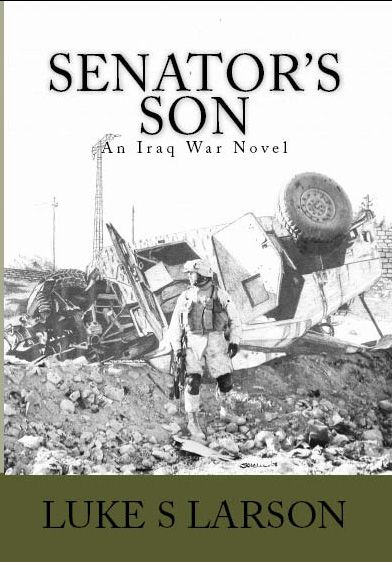
larson.jpg

Senator’s Son: An Iraq War Novel by Luke S. Larson

Fiction is not a genre that I usually review here, or get an opportunity to read often, but I received a courtesy review copy of a book Senator’s Son, by Iraq war vet, Marine officer and new novelist Luke Larson and was curious. The Iraq War and the War on Terror have produced a fine array of thoughtful books by veterans, war reporters and military thinkers like FiascoOne Bullet Away  and The Strongest Tribe, all of which were non-fiction memoirs, journalistic histories and quasi-policy books. By virtue of writing Senator’s Son as a novel, Larson was taking a different path in explaining his war.

There are two books at once in Senator’s Son. The first, is of course, a story, with characters and a plot and rising action, action, tragedy and theme – all the usual aspects of literature which I am not especially practiced at evaluating here. The second part is a contextual explanation of COIN by an author who lived the Iraq War. To his credit, Larson contacted me personally to request a “No bulls**t review”, so I will give the man what he asked for.

As an explanation of COIN, I think the book is a must read for anyone unfamiliar with the subject and the nuanced complexities that COIN entails. The gritty, unforgiving, human suffering and moments of triumph of soldiers waging “pop-centric” COIN that gets lost in powerpoint slides, in the dry abstractions of journal articles and blogospheric arguments far removed from the ground is present in ample measure in Senator’s Son. Many times, I paused in a passage and thought, “hmmm….I did not consider that”. Or “This is what the soldiers bear up under without complaint”. More people need to read that and digest what we ask of our men and women in Iraq and Afghanistan.

Senator’s Son also lays out, fairly methodically, how COIN theory may have been interpreted and debated by soldiers outside the wire, including cameo appearances or mention of real life COIN leaders woven into the story. The characters Bama, Cash, Rogue, Isaac, Gonzo the Iraqi and more, resist and adapt, struggling with their environment, unseen enemies and the political pressures of higher authorities, registering both frustration and progress in executing the mission of Golf Company. There’s even diagrams. If Senator’s Son is not on official COIN reading lists, it should be.

As a pure novel, judged on literary standards, Senator’s Son reflects its’ status as a “first novel” of a talented author whose vision of the craft is emerging. Larson excels at creating scenarios, staccato vignettes for the characters to act ( Larson may also have a future as a screenwriter – his book naturally flows in the mind like a movie). There’s always a believable, environmental, “texture” present that exceeds that of short story and science fiction writers, yet as a novelist, Larson leaves enough to the reader’s imagination so that the story moves at a dramatic pace.

Characterization in Senator’s Son is uneven. It takes a while for the individual personalities of the characters to shine beyond their common “Marine-ness” and we get only the briefest glimpse of the malign nature of the enemy, and that secondhand through the eyes of an Iraqi character. That probably is an accurate representative of the experience of most US soldiers and Marines in Iraq who are not interrogators; furthermore, having the antagonist that the characters struggle against be the total environment is perfectly legitimate. It would have been interesting for me to have seen how Larson would develop and utilize a figure who was the focus of evil; however that task would be fairly incompatible with getting an effective message across regarding COIN, success of which does not hinge on the defeat of super-villains or the resolution of black-white moral absolutes but is complexity written in shades of gray.

Finally, as an avid reader, I found Senator’s Son to be a page-turner. Several times, I looked at the clock while reading for what seemed to me a short time, noted it was 1:30 am and was regretful that I had to put it on my bedstand ( I always finished the chapter first though 🙂 ) only to repeat the process the following night.  Strongly recommended.

ADDENDUM – OTHER REVIEWS of SENATOR’S SON by:

Thomas P.M. Barnett 

Shrinkwrapped 

Shane Deichman


Switch to our mobile site

