zenpundit.com » culture

Archive for the ‘culture’ Category

Guest Post: DARPA, STORyNet and the Fate of the War by J. Scott Shipman

Wednesday, March 2nd, 2011

J. Scott Shipman, the owner of a boutique consulting firm in the Metro DC area that is putting Col. John Boyd’s ideas into action, is a longtime friend of this blog and an occasional guest-poster. Scott has an important report regarding the “war of ideas” against the Islamist-Takfirist enemy in Afghanistan after attending a workshop hosted by DARPA.

DARPA, STORyNet and the Fate of the War

by J. Scott Shipman

 I had the opportunity to attend a DARPA workshop yesterday called STORyNet. The purpose was to survey narrative theories, to better understand the role of narrative in security contexts, and to survey the state of the art in narrative analysis and decomposition tools (see below): 

This STORyNET workshop has three goals:

1. To survey narrative theories.

These empirically informed theories should tell us something about the nature of stories: what is a story? What are its moving parts? Is there a list of necessary and sufficient conditions it takes for a stimulus to be considered a story instead of something else? Does the structure and function of stories vary considerably across cultural contexts or is there a universal theory of story?

2. To better understand the role of narrative in security contexts.

What role do stories play in influencing political violence and to what extent? What function do narratives serve in the process of political radicalization and how do theyinfluence a person or group’s choice of means (such as violence) to achieve political ends? How do stories influence bystanders’ response to conflict? Is it possible to measure how attitudes salient to security issues are shaped by stories?

3. To survey the state of the art in narrative analysis and decomposition tools.

How can we take stories and make them quantitatively analyzable in a rigorous, transparent and repeatable fashion? What analytic approaches or tools best establish a framework for the scientific study of the psychological and neurobiological impact of stories on people? Are particular approaches or tools better than others for understanding how stories propagate in a system so as to influence behavior?

I was alerted to the meeting by a member at one of my “groups” at LinkedIn and just barely made the registration cut-off. It was a good meeting, but not reassuring on our situation in Afghanistan—you’ll see why  below.

As a “hobby” I’ve been tinkering with the implications of patterns with respect to language and communications. Just about every presumption I have articulated over the last several months is being pursued in one way or another—which is good news for our guys. While the on-going research is good, I do believe there is room for better and more imaginative thinking, although I didn’t say anything during the meeting for once, I kept my mouth shut and just listened.

This is exceptionally brief and decidedly non-techincal.  Here are some observations of interest:

  • In Afghanistan, stories (those who tell them and those who believe) are central to our geopolitical strategy and policies.
  • There is underway, a “battle of the narratives,” where any “counter” narrative developed by the US must have credibility. This seems obvious, but the speaker observed the “story telling” was more important than the story. Given the high illiteracy rate, this makes sense.
  • We [DARPA] are reviewing chants (which are wildly popular), video, magazines, poetry, the Internet, and sermons as thematic vehicles for analysis.
  • The language of the Taliban is not secular, and not the language of the insurgency—for the Taliban everything hangs on the legacy of jihad and religious struggle.
  • The Taliban not willing to negotiate on matters of jihad. They are using a unified vision of Islam giving their struggle a noble foundation against the corruption of outsiders who want to “Christianize” the nation.
  • The Taliban uses symbology to portray the struggle as a cosmic conflict against Christian invaders and US puppets (those cooperating with the US). Framing this symbology to communicate clearly the frame of the righteous vs. the infidels.
  • The Taliban manipulates the language to connect the current struggle to previous struggles of “warrior poets.” There is hope a “discourse” can be created that will counter this framing [personal note: I’m not optimistic]. The Taliban uses different language to subjugate rural and urban dwellers, and actually have standard operating procedures for dealing with villages that resist.
  • The cognitive patterns of rural Afghanistan are “foreign” to most Westerners and they use alien methods of knowledge transfer (chants, often under the influence of hashish).
  • We are adding a geospatial element to our analysis of local and personal narratives (which includes subject, verb, object) with respect to identified “master narratives.”
  • Internet data is indexed, with an eye toward predictive analysis and situational awareness (and interestingly, “sentiment” analysis). We are finding predictive power from the topology of “networks”  used in models.
  • From a neuroscience perspective, there was an amazing talk on empathy. It turns out, based on fMRI testing that empathy is quite predictable across subjects. Research indicates people “care more” about an “in-group” to which they belong more than an “out group.” The speaker defined the brain as a “parliament” of competing parties and nuanced spectrums [personal note: this elegant description tracks with everything I’ve read on the topic.]. 
  • One presenter observed that after 10 years of war, we’re finally “getting” the importance of Pashtun culture and language. This presenter also noted US is still in need of people with language skills sufficient to adequately support the effort.

– End

COMMENTARY:

Zen here:

First, I’d  like to cordially thank Scott for letting me share his insights gleaned from the workshop here with ZP readers. This is one of those fascinating events largely unavailable to those folks residing outside a reasonable driving distance from the Beltway.

Secondly, I am heartened that the brilliant folks at DARPA are taking the theological-ideological discourse of the enemy seriously in analyzing the power of narrative. Charles Cameron makes that point here with regularity. Michael Scheuer, Gilles Kepel and Olivier Roy did so even before 9/11. Our political appointees and policy makers remain steadfastly allergic to this reality, unable to process or discuss in public with coherence how religious ideas are a root for political extremism. Col. David Kilcullen, who certainly understands political Islam better than most and whose creative and analytical acheivements in structuring a framework for countering insurgency are second  to none, eschews dealing with the topic in his theoretical writings on COIN where it can be avoided. That is the cost imposed by the political correctness to which our ruling elite are psychologically welded.

 It comes as no surprise to me that only after “10 years of war” are we finally “getting the importance of Pashtun culture”. 

Maybe at the dawn of the 22nd century we will be “old hands”.
Sycophancy that!

Tuesday, March 1st, 2011

quo-wow.jpg

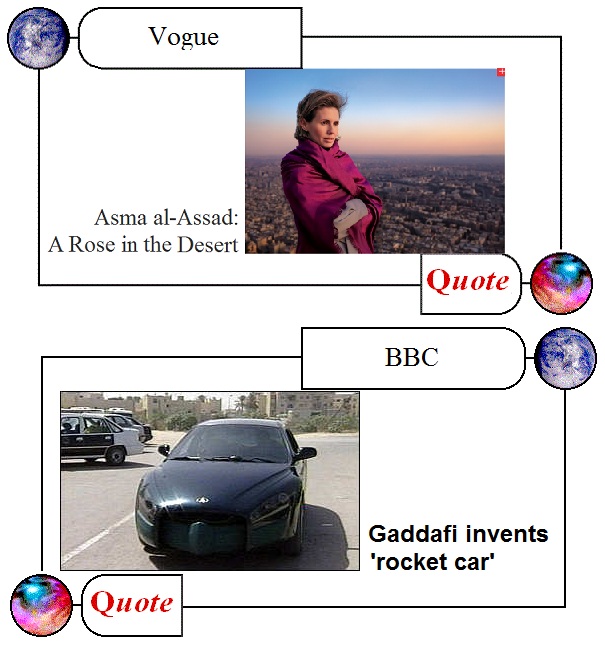
These are genuine images with genuine headlines — from Vogue on February 25, 2011 and from the BBC back in September, 1999. The articles’ respective texts are informative, too…

Asma al-Assad is glamorous, young, and very chic—the freshest and most magnetic of first ladies. Her style is not the couture-and-bling dazzle of Middle Eastern power but a deliberate lack of adornment. She’s a rare combination: a thin, long-limbed beauty with a trained analytic mind who dresses with cunning understatement. Paris Match calls her “the element of light in a country full of shadow zones.”

Libyan leader Colonel Muammar Gaddafi has invented a sleek James Bond-style car, which Libya says is the safest vehicle on earth. … The interior is replete with air bags, an inbuilt electronic defence system, and a collapsible bumper which protects passengers in head-on collisions.

For an astounding tour of “the fashion industry’s faux pas on global issues,” see The Zoolander Effect in today’s Foreign Policy.

Return of the Vanished Imam?

Monday, February 21st, 2011

quomusa-al-sadr.jpg

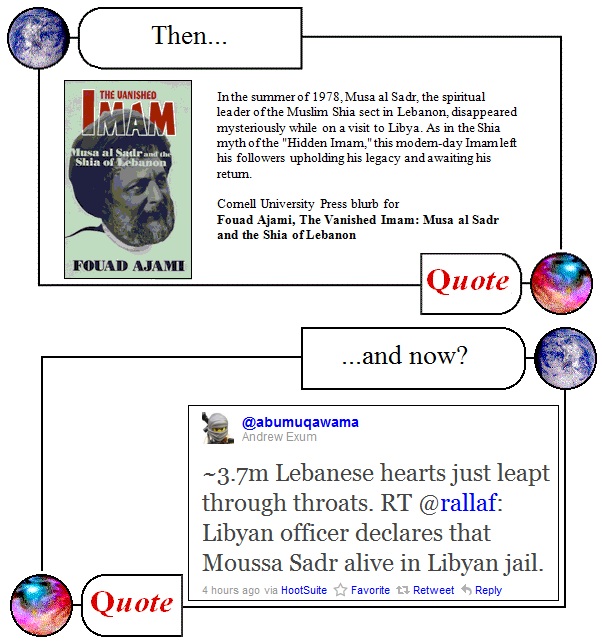
Fouad Ajami’s The Vanished Imam: Musa al Sadr and the Shia of Lebanon was among the first books I read about matters Islamic, and the close parallel between the vanishing of Musa al-Sadr and the vanishing — or, more properly speaking, Ghayba or occultation — of the Twelfth Imam or Mahdi struck me forcibly at the time.

I don’t have my copy to hand, so I can’t tell how strongly Ajami himself made the comparison — but I was certainly not alone. Daniel Pipes, in his review of Ajami’s book writes:

What made the Imam’s vanishing so significant is that it exactly fit the millennial expectations of Shiism, a faith premised on the disappearance of righteous leaders and their reappearance at the end of time.

And now it may be — the report has yet to be confirmed — that Imam Musa is back among us.

@rallaf is an Associate Fellow at London’s Chatham House.

*

The mind sees one thing, which reminds it of something else. It’s the oldest trick in the book, and it depends on the recognition of pattern, or you might say, parallelism.

The return of Imam Musa would be significant not merely for his admirers, not only for what he might have to say or what role — now aged 82, after 30 years in prison — he might yet play, but also, I suspect, for the vivid premonition of the Mahdi his return might stir…

Egypt: Life imitates digital art

Wednesday, February 16th, 2011

[ by Charles Cameron ]

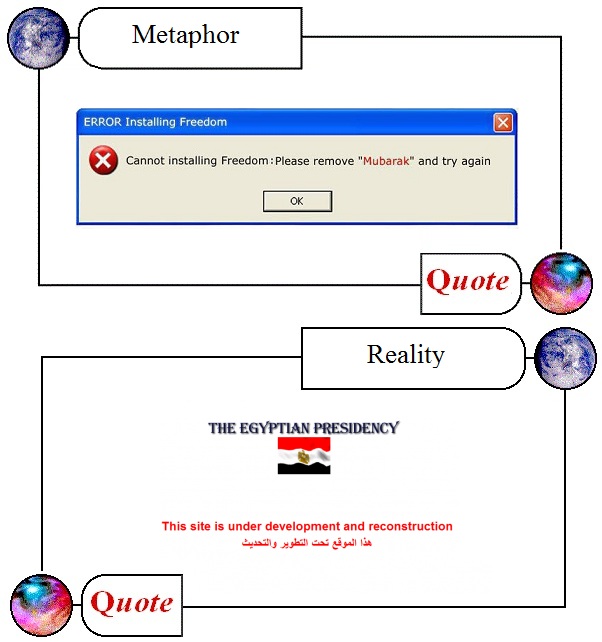
The first “quote” in this pair is a clever, geeky commentary on the situation in Egypt from shortly before the fall of Mubarak.

quowesbite.jpg

The second is a screen capture made today from the official Egyptian Presidency site — virtuality meets reality.

[ This post is a follow-up to my earlier DoubleQuote Egypt: uninstalling ]

History as a Gen Ed Credit for Engineering Students Aspiring to Naval Leadership

Tuesday, February 15th, 2011

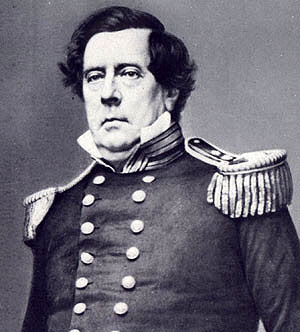
Commodore….errr….what’shisnameagain???

As a rule, I generally do not write about US Navy affairs because it is not an area of expertise for me and I think Galrahn covers that territory admirably well without my poor help. Every so often though, an item from our sea-roving friends catches my eye that I am qualified to speak about and today is one of those days.

Teaching naval history has become an inconvenience to those entrusted with training our nation’s future captains and admirals because they need to get the budgetarily “sexy” topic of “cyber warfare” into the US Naval Academy curriculum. Yes, that’s right. Because someday, in the midst of battle, the combatant commander of PACOM will be furiously barking out HTML code at the bridge of the Eisenhower, above the cries of wounded men.

Gentlemen, gentlemen….in matters of education, fundamentals come before esoterica!

I strongly recommend this post by LCDR Benjamin “BJ” Armstrong, historian, pilot and Navy officer who tackled this subject with an enviable grace and eloquence at the USNI blog:

HH104, WWATMD…

….More than policy or naval strategy, Mahan believed in teaching officers the best ways to approach the challenges of command.  He saw his job as a Naval War College plankowner in those terms, about teaching command, and to do so he turned to history.  But, it wasn’t just senior officers who needed grounding in our naval past.  He wrote in his very first published article, winning third place in “Proceedings” annual essay contest, that history was also a key foundation for learning at the Naval Academy.

When he said that history “lies at the foundation,” it wasn’t just a convenient turn of phrase.  He believed that before subjects like gunnery, engineering, or even cyber-warfare, could be taught a Midshipman needed to know why he was learning them.  Why did any of it matter?  The best way to show a student why hitting the target in gunnery class was important was to teach him the history that showed what happened when crews weren’t drilled properly.  Perhaps he would teach the Midshipman about Captain James Lawrence sailing Chesapeake out of Boston harbor with a green and undrilled crew in 1813 to face HMS Shannon, a short time later uttering his final command, “Don’t give up the ship” just before he succumbed to his wounds and the British boarding party swarmed aboard in victory.  Maybe the Midshipman would recognize the words…from the battle flag bearing the phrase in Memorial Hall that was flown at the Battle of Lake Erie.  Mahan felt that once a Midshipman understood the importance of mastering the craft, of studying their trade, a subject like weapons systems engineering would become important even to the lowly humanities major.

The second part of Mahan’s statement is also important, “all sound military conclusions and practices.”  In our age of checklist leadership and officers educated as engineers there is a desire to approach leadership challenges as equations where certain inputs are guaranteed to give you the desired results.  But Mahan doesn’t say all “correct” military conclusions and practices, he says “sound.”

Mahan recognized that both naval strategy (conclusions) and combat leadership (practices) were art, not science.  In his book “Naval Strategy: Compared and Contrasted with the Principles and Practice of Military Operations on Land,” published in 1911, Mahan compared naval officers to artists.  He wrote that artists had to learn certain techniques, mediums and certain skills, but that wasn’t what made their artwork great.  In the end “art, out of materials which it finds about, creates new forms in endless variety,” artists take those foundation basics and then mix and match them based on inspiration and experience to create a masterpiece.  History helps us understand that frequently there are no right answers to military questions of strategy or leadership.  There are only “sound conclusions,” which are drawn from understanding basics and history.  Demonstrating this great truth to Midshipman early in their education, say as a Plebe before they have taken three years worth of engineering classes that teach them there is always an equation and a correct answer, is much more valuable than having them learn it after years of service.

Bravo!

This decison is wrong on so many levels it amounts to pedagogical malpractice. It should be reversed.

What kind of mind do we want our Navy officers to have in the moment of decision?  An admiral in command of a carrier task force has more destructive power at his disposal than any man on earth except for the ruler of Russia and the President of the United States. At a crisis point, it is too late to roll back the clock to gain the benefit of a career of professional reading, discussion and reflection on the lessons of naval warfare, strategy and statesmanship. EE courses are good things, and demonstrably useful, but they do not inculcate the same habits of mind as does the learning of history.

Historically, the US Navy was the plenipotentiary service of the United States with it’s admirals and commodores assuming extremely sensitive diplomatic or even proconsular duties alongside their responsibilities of military command. The careers of Farragut, Perry, Dewey, Leahy, King, Nimitz and others of lesser rank attest to how naval command has always been deeply entwined in American history with statesmanship and keen political insight. The 21st century will be no different.

The lessons of history are a sword and shield.


Switch to our mobile site