Here’s an early indicator of jihadist strategic thinking from Sheikh Husain b. Mahmoud on the Ansar forums — Leah Fcalls him “a very influential figure, and not only in the virtual world” — via Aaron Zelin‘s fine collection & collation of jihadist source materials on his Jihadology blog (link to safe-for-download English version):
I call all the Mujahideen of the world and all their supporters, to prevent their tears from flowing and to keep their rage to themselves, so that it can act as a volcano which explodes at its proper time. We do not want sporadic operations of vengeance. Rather, we want special operations which are properly planned out, with wisdom and patience, so that it can bear its fruit, and make America forget the attacks on Washington and New York, and say goodbye to the good old days. This is an extremely important matter, as individual and random operations of vengeance usually have negative effects, and as crying and showing ones sadness brings joy to the enemies of Allah. It is incumbent upon the leaders of Jihad to rearrange their cards and announce a successor to Sheikh Usama, may Allah have mercy on him, and then start to plan the coming stages with experience, looking into what is in the greater interest of the Ummah.
[ by Charles Cameron — cross-posted with minor alteration from SmartMobs ]
*
Jarret Brachman is one of our brightest analysts of jihadist behavior on the internet. He was the first Director of Research with the Combating Terrorism Center at West Point, and is the author of Global Jihadism: Theory and Practice.
“I have not lived so long, Spartans, without having had the experience of many wars, and I see among you of the same age as myself, who will not fall into the common misfortune of longing for war from inexperience or from a belief in it’s advantage and safety”
One thing on which most commentators, academics and former officials seem to agree is that the United States government has a difficult time planning and executing strategy. Furthermore, that since 1991 we have been without a consensus as to America’sgrandstrategy, which would guide our crafting of policy and strategy. This failing bridges partisan divisions and departmental bureaucracies; there are many career officials, political appointees and even a few politicians, who can explain the nuances of the Afghan War, or the Libyan intervention, the depreciatory tailspin of the US Dollar or America’s Russia policy – but none who would venture to say how these relate to one another, still less to a common vision.
Sadly, they do not, in fact, relate to one another – at least not, as far as I can discern, intentionally.
Few American policies or even military operations (!) in one country can be said to have been conceived even within a coherent and logically consistent regional strategy and it is not just common, but normal, to have DIME agencies working at completely contradictory purposes in the same area of operations. The interagency process, to the extent that it exists, is fundamentally broken and incapable of interagency operational jointness; and the institutional coordinating mechanism for any “whole of government” effort, the National Security Council, has become too consumed with crisis management. A mismatched prioritization of resources which leaves little time for the kind of long range planning and strategic thinking that allows nations to seize the initiative instead of reacting to events.
It would be a useful corrective for the better conception and execution of US policy, for the President and the Congress to create a special board for grand strategy that could give presidents and key officials frank assessments and confidential guidance to help weave their policy ideas into a durable and overarching national strategy. One that might last beyond a few days’ headlines in The New York Times.
The President of the United States, of course has a number of bodies that could, should but do not always provide strategic advice. There’s the Defense Policy Advisory Board, an Intelligence Advisory Board, the National Intelligence Council, the State Department’sPolicy Planning Staff, theOffice of Net Assessment and not least, the NSC itself and the Joint Chiefs of Staff, whose Chairman, by act of Congress, is the military advisor to the President and Secretary of Defense. While strategic thinking does percolate from these entities, many have very specific mandates or, conversely, wide ranging briefs on matters other than strategy. Some operate many levels below the Oval Office, are filled with superannuated politicians or have personnel who, while intellectually brilliant, are excessively political and untrained in matters of strategy. The Joint Chiefs, the professionals of strategy, are highly cognizant of the Constitutional deference they are required to give to civilian officials and are very leery of overstepping their bounds into the more political realms of policy and grand strategy.
What the President could use is a high level group just focused on getting strategy right – or making sure we have one at all.
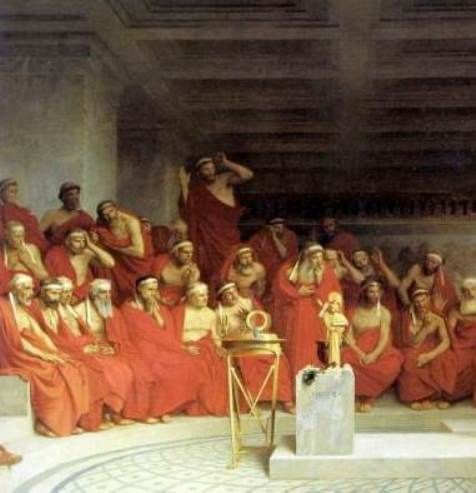
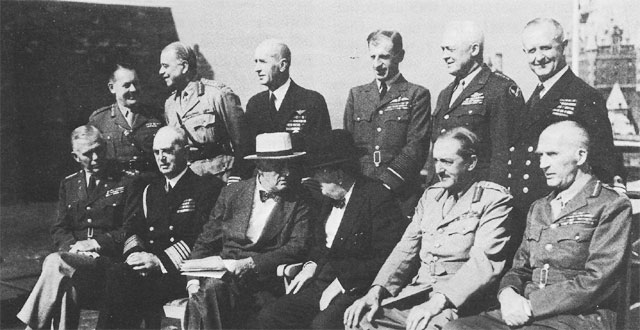
I’m envisioning a relatively small group composed of a core of pure strategists leavened with the most strategically oriented of our elder statesmen, flag officers, spooks and thinkers from cognate fields. A grand strategy board would be most active at the start of an administration and help in the crafting of the national strategy documents and return periodically when requested to give advice. Like the Spartan Gerousia, most of the members ( but not all) would be older and freer of the restraint of institutional imperatives and career ambitions. Like the Anglo-American joint chiefs and international conferences of WWII and the immediate postwar era, they would keep their eye on the panoramic view.
The Octagon Conference – FDR, Churchill and the Combined Chiefs of Staff
Here’s my grand strategy board in a hypothetical perfect world, unlike the one that prevails inside the beltway. I’m sure people will quibble with particular names or will suggest others. I freely admit, for example, that I do not have the best grasp of who our leading intellectual powerhouses are in the Navy, Air Force or the closed world of intelligence analysis and this impairs my ability to put together the list. Nevertheless, I’m trying anyway:
Let’s start with a group of acclaimed and eminent strategic thinkers who have demonstrated over a long tenure, their ability to consider matters of war, peace and statecraft as well as the nuances of strategic theory:
Thomas Schelling -Chairman
Andrew Marshall
Edward Luttwak
Colin Gray
Joseph Nye
Next, some senior statesmen:
Henry Kissinger
George Schultz
Zbigniew Brzezinski Madeleine Albright
General officers and one colonel with a demonstrated talent for challenging conventional assumptions:
Lieutenant General Paul van Riper
General James Mattis
General Jack Keane
Colonel John Warden
Two economists:
Alan Greenspan
Nouriel Roubini
Two scientists:
Freeman Dyson E.O. Wilson
Mixed group of strategists, historians, practitioners and theorists:
David Kilcullen
John Robb
John Negroponte Barry Posen
Antulio Echevarria Chet Richards
Micheal Vlahos
Thomas P.M. Barnett
Stephen Biddle
Robert Conquest
Duane Clairridge
Jack Matlock
Martin van Creveld
Visionaries and Contrarians:
Nicholas Nassim Taleb William Gibson
Ray Kurzweill
Andrew Bacevich
What are the problems with my grand strategy board (aside from having zero chance of coming into being)?
For one, it is probably way too large. In my efforts to balance expertise in strategy with varied thinking it grew bigger than what is manageable in real life, if the group is to be productive.
Secondly, it is an exceedingly white, male and conservative leaning list – though to some extent that reflects the criteria of experience, the field of strategy itself and the nature of American politics. Barbara Ehrenreich, for example, is definitely bright but her politics are fundamentally opposed to effectively maximizing American power in the world or the use of military force – thus making her of little use except as a voice of dissent.
Another limitation of this exercise is the idiosyncratic eclecticism of my approach – this was a blog post written over a few days in my spare time and not a methodical inquiry into who in American life would verifiably be the “best qualified” to help construct a grand strategy. There are “insiders” who command great respect within the national security, defense and intelligence communities who are unknown to the general public, or even this corner of the blogosphere, who would be enormously helpful to such a board. Finally, a grand strategy board would not be a panacea; it would be subject to all the inertial pressures that over time would reduce it’s ability to effect change, just as the Policy Planning Staff and the NSC have been “neutered” over decades by the forces of the status quo.
That said, the above group or one reasonably comparable to it could, for a time, markedly improve the construction of strategy , assuming American leaders are willing to enlist such advice, put aside short term political considerations and pursue long term strategic goals.
Whom would you nominate to a grand strategy board?
Colin Gray is one of the four or five go-to strategic thinkers around today. Joseph Nye, the father of the soft power concept, is a seminal figure in Political Science and International Relations.
….Unfortunately, although the concept of American soft power is true gold in theory, in practice it is not so valuable. Ironically, the empirical truth behind the attractive concept is just sufficient to mislead policymakers and grand strategists. Not only do Americans want to believe that the soft power of their civilization and culture is truly potent, we are all but programmed by our enculturation to assume that the American story and its values do and should have what amounts to missionary merit that ought to be universal. American culture is so powerful a programmer that it can be difficult for Americans to empathize with, or even understand, the somewhat different values and their implications held deeply abroad. The idea is popular, even possibly authoritative, among Americans that ours is not just an “ordinary country,” but instead is a country both exceptionally blessed (by divine intent) and, as a consequence, exceptionally obliged to lead Mankind. When national exceptionalism is not merely a proposition, but is more akin to an iconic item of faith, it is difficult for usually balanced American minds to consider the potential of their soft power without rose-tinted spectacles. And the problem is that they are somewhat correct. American values, broadly speaking “the American way,” to hazard a large project in reductionism, are indeed attractive beyond America’s frontiers and have some utility for U.S. policy. But there are serious limitations to the worth of the concept of soft power, especially as it might be thought of as an instrument of policy. To date, the idea of soft power has not been subjected to a sufficiently critical forensic examination. In particular, the relation of the soft power of attraction and persuasion to the hard power of coercion urgently requires more rigorous examination than it has received thus far.
….In 2007, Richard Armitage and I co-chaired a bipartisan Smart Power Commission of members of Congress, former ambassadors, retired military officers, and heads of non-profit organizations at the Center for Strategic and International Studies in Washington. We concluded that America’s image and influence had declined in recent years and that the United States had to move from exporting fear to inspiring optimism and hope.
The Smart Power Commission was not alone in this conclusion. Even when he was in the George W. Bush administration, Defense Secretary Robert Gates called on Congress to commit more money and effort to soft-power tools including diplomacy, economic assistance, and communications because the military alone cannot defend America’s interests around the world. He pointed out that military spending then totaled nearly half a trillion dollars annually, compared with a State Department budget of just $36 billion. In his words, “I am here to make the case for strengthening our capacity to use soft power and for better integrating it with hard power.” He acknowledged that for the secretary of defense to plead for more resources for the State Department was as odd as a man biting a dog, but these are not normal times. Since then, the ratio of the budgets has become even more unbalanced.
One of the ironies here, is that the United States, through the private sector production of goods, services and intellectual property, has since WWII been overwhelming successful in exporting our “soft power” into foreign cultures to an extent seldom matched in history. However, the ability of the USG to capitalize on this latent-passive global acculturation through public diplomacy has ranged from minimal to excruciatingly counterproductive when our words, deeds and image are in serious disharmony.
Zenpundit is a blog dedicated to exploring the intersections of foreign policy, history, military theory, national security,strategic thinking, futurism, cognition and a number of other esoteric pursuits.