zenpundit.com » tribes

Archive for the ‘tribes’ Category

The Need for Old Hands: Mackinlay on Old COIN

Friday, March 19th, 2010

Currently reading The Insurgent Archipelago by John Mackinlay. Not finished yet but I found this passage striking:

….The ratio of coloniser to colonised – and of the tiny British contingent to the vast numbers of the native population – suggested that a degree of consent to their presence was already inherent. The officials in each colony were competitively selected from an educated and ambitious British upper class, in many cases they were talented and intrepid men, used to living and campaigning in the field, with an intelligent grasp of their territory, its people, languages and culture. They survived and succeeded on their wits, natural authority and knowledge. When the colonised population rose up in insurrection and military force was rushed to the scene, it was subordinated to these same British administrators who became responsible for the direction of the campaign. All the problems of devising a political strategy, ensuring the legitimacy of the military actions and restoring the structures of governance were taken care of by a familiar hub of individuals. It was a continuously reconvening club in which personal relationships tended to override the ambiguities of their civil-military partnership.

Admittedly, there’s a shiny high gloss of romantic nostalgia for the Raj here, polishing the historical reality. The British Empire also saw examples of arrogance or cruelty by British colonial officials that helped provoke uprisings like the Sepoy Mutiny. Or, high-level imperial administrators could zealously pursue local colonial expansion, as Viscount Milner did in starting the needless Second Anglo-Boer War, which partially involved putting down a grueling Trekboer insurgency, that ultimately weakened the Empire at the strategic level.

Those calamities, as expensive and bloody as they were, were exceptions. Mackinlay is correct in assessing the value of Britain’s colonial administrative class, whose deliberate cultivation of “Old Hands” permitted a sixth of the earth’s surface to be ruled relatively cheaply from Whitehall. Lord Milner, for all his faults, could at least speak to President Kruger in his own language and understood the Boer states on which he was waging war, even if he disdained the Afrikaner settlers. It’s hard to imagine many American statesmen or senior generals (or sadly, CIA agents and diplomats) fluently debating foreign counterparts in Arabic, Pashto, Farsi or Chinese. British officialdom took the time – and had the time, professionally – to learn the languages, dialects and customs of the peoples with whom they allied or fought, conquered and ruled.

Not so in contemporary peacekeeping /crypto-COIN operations , according to Mackinlay:

By the 1990’s the colonial officials who had been the key element in every operation since Cardwell were now missing. Coalition forces were intervening in countries that were the antithesis of the former colonies, where the incoming military were regarded as occupiers and where there was no familiar structure of colonial officials and district officers to be seen. Moreover, the diplomats who belatedly attempted to fill this role, although no doubt intellectually brilliant, crucially lacked the derring-do, local credibility and natural authority of their colonial era predecessors. A few extra hands from the Foreign Office or the State Department could not compensate for the loss….

….Although at a local level the British counter-insurgent techniques proved to be successful, broader problems presented themselves as a result of an absence of strategy and a failure of campaign design, particularly in the civil-military structures. It was simply not a realistic option to fill the void left by the departure of a national government – with all its natural expertise and authority – with a band-aid package of contracted officials and flat-pack embassies.

New Hands cannot act or think like Old Hands. They lack not only the in-country experience and linguistic skills but the entire worldview and personal career interests of the American elite mitigate against it. “Punching tickets” is incompatible with becoming an Old Hand and aspiring to be an Old Hand is incompatible with continued employment at most foreign policy agencies of the USG.

American Foreign Service Officers, CIA personnel and flag officers never had the same historical frame of reference as their Imperial British cousins, but the culture of the Eastern Establishment approximated a high church Yankee Republican version that provided an elan, a worldly knowledge and moral certitude until the Establishment’s will to power and self-confidence was broken by the Vietnam War. Subsequent generations of American elite have been indoctrinated in our best institutions to instinctively distrust the marriage of cultural knowledge and political skills to the service of advancing national interest as “Orientalism“.

I am not an admirer of Edward Said but the man was no fool. He understood the strategic importance for his radical political faction of populalrizing the de-legitimization the learning of other cultures and languages as immoral for any reason except partisanship in their favor against the interests of the predatory West. This is why something as esoteric and parsimoniously funded as “Human Terrain Teams” meet with volcanic rage from  academic leftists, especially in the fields of anthropology and political science. This is the sort of censorious mindset that would have  made the works of Herodotus, Alexis de Tocqueville, the Marquis de Custine, Richard Francis BurtonT.E. Lawrence, Ruth Benedict, Rene GroussetRaphael Patai and Bernard Lewis, to name just a few, impossible.

Recovering our capacity to act effectively and see with clarity requires the training of a new generation of Old Hands to interpret and act as policy stewards and agents in regions of the world in which most Americans are unfamiliar and likely to remain so. Current academic PC ideological fetishes reigning at our Ivy League universities artificially shrink our potential talent pool. Alternative educational pathways through military service academies, think tanks, professional and Cross-cultural associations and better USG training programs need to be developed to route around the university gateway that is largely in control of keepers hostile or indifferent to American foreign policy objectives. By the same token, USG agency and military personnel and security clearance policies need a systemic overhaul to better take advantage of those already in service who find their career paths blocked or frustrated.

We waste talent on a massive scale.
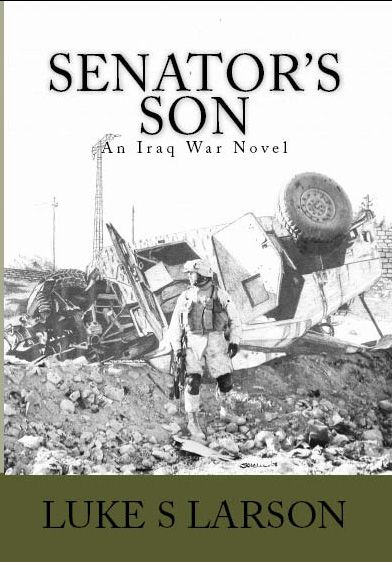
Review: Senator’s Son by Larson

Monday, March 15th, 2010

larson.jpg

Senator’s Son: An Iraq War Novel by Luke S. Larson

Fiction is not a genre that I usually review here, or get an opportunity to read often, but I received a courtesy review copy of a book Senator’s Son, by Iraq war vet, Marine officer and new novelist Luke Larson and was curious. The Iraq War and the War on Terror have produced a fine array of thoughtful books by veterans, war reporters and military thinkers like FiascoOne Bullet Away  and The Strongest Tribe, all of which were non-fiction memoirs, journalistic histories and quasi-policy books. By virtue of writing Senator’s Son as a novel, Larson was taking a different path in explaining his war.

There are two books at once in Senator’s Son. The first, is of course, a story, with characters and a plot and rising action, action, tragedy and theme – all the usual aspects of literature which I am not especially practiced at evaluating here. The second part is a contextual explanation of COIN by an author who lived the Iraq War. To his credit, Larson contacted me personally to request a “No bulls**t review”, so I will give the man what he asked for.

As an explanation of COIN, I think the book is a must read for anyone unfamiliar with the subject and the nuanced complexities that COIN entails. The gritty, unforgiving, human suffering and moments of triumph of soldiers waging “pop-centric” COIN that gets lost in powerpoint slides, in the dry abstractions of journal articles and blogospheric arguments far removed from the ground is present in ample measure in Senator’s Son. Many times, I paused in a passage and thought, “hmmm….I did not consider that”. Or “This is what the soldiers bear up under without complaint”. More people need to read that and digest what we ask of our men and women in Iraq and Afghanistan.

Senator’s Son also lays out, fairly methodically, how COIN theory may have been interpreted and debated by soldiers outside the wire, including cameo appearances or mention of real life COIN leaders woven into the story. The characters Bama, Cash, Rogue, Isaac, Gonzo the Iraqi and more, resist and adapt, struggling with their environment, unseen enemies and the political pressures of higher authorities, registering both frustration and progress in executing the mission of Golf Company. There’s even diagrams. If Senator’s Son is not on official COIN reading lists, it should be.

As a pure novel, judged on literary standards, Senator’s Son reflects its’ status as a “first novel” of a talented author whose vision of the craft is emerging. Larson excels at creating scenarios, staccato vignettes for the characters to act ( Larson may also have a future as a screenwriter – his book naturally flows in the mind like a movie). There’s always a believable, environmental, “texture” present that exceeds that of short story and science fiction writers, yet as a novelist, Larson leaves enough to the reader’s imagination so that the story moves at a dramatic pace.

Characterization in Senator’s Son is uneven. It takes a while for the individual personalities of the characters to shine beyond their common “Marine-ness” and we get only the briefest glimpse of the malign nature of the enemy, and that secondhand through the eyes of an Iraqi character. That probably is an accurate representative of the experience of most US soldiers and Marines in Iraq who are not interrogators; furthermore, having the antagonist that the characters struggle against be the total environment is perfectly legitimate. It would have been interesting for me to have seen how Larson would develop and utilize a figure who was the focus of evil; however that task would be fairly incompatible with getting an effective message across regarding COIN, success of which does not hinge on the defeat of super-villains or the resolution of black-white moral absolutes but is complexity written in shades of gray.

Finally, as an avid reader, I found Senator’s Son to be a page-turner. Several times, I looked at the clock while reading for what seemed to me a short time, noted it was 1:30 am and was regretful that I had to put it on my bedstand ( I always finished the chapter first though 🙂 ) only to repeat the process the following night.  Strongly recommended.

ADDENDUM – OTHER REVIEWS of SENATOR’S SON by:

Thomas P.M. Barnett 

Shrinkwrapped 

Shane Deichman

Mackinlay’s Insurgent Archipelago & Other Books

Tuesday, March 9th, 2010

The Insurgent Archipelago by John Mackinlay

At the strong recommendation of Colonel Gian Gentile, I ordered The Insurgent Archipelago: From Mao to Bin Laden by Dr. John Mackinlay of King’s College, London and a hardcover copy just arrived this afternoon. Judging from the table of contents and the sources in Mackinlay’s endnotes, The Insurgent Archipelago will present a tightly written argument on the nature of COIN. For a well regarded  and informative review, see David Betz of Kings of War blog, brief excerpt below:

Review: The Insurgent Archipelago

….The book is sweeping, as the subtitle ‘From Mao to Bin Laden’ suggests; yet it is also admirably succinct at 292 pages including notes and index.[2] In design it is exceedingly clear, consisting of three parts-‘Maoism’, ‘Post-Maoism’, and ‘Responding to Post-Maoism’, which reflect the basic components of his argument. Insurgency’s classical form is the brainchild of the carnivorously ambitious strategic and political genius Mao Zedong who gave meaning to the now familiar bumper sticker that insurgency is ’80 per cent political and 20 per cent military’. Mao’s innovation was to figure out what to fill that 80 per cent with: industrial scale political subversion by which he was able to harness the latent power of an aggrieved population to the wagon of political change, to whit the victory of the Chinese Communist Party in the Chinese Civil War which ended with the proclamation of the People’s Republic of China in 1949

….The problem is that what we now face in the form of ‘global insurgency’ is not Maoism but Post-Maoism-a form of insurgency which differs significantly from that which preceded it.[6] We have, in essence, been searching for the right tool to defeat today’s most virulent insurgency in the wrong conceptual tool box. This is perhaps the most uncomfortable truth to be laid out in this book; another worrying one is that the security interests of Western Europe differ markedly from those of the United States-because the threat in the former emerges from their own undigested Muslim minorities which are alienated further by their involvement in expeditionary campaigns which, arguably at least, serve the needs of the latter well enough

Oddly, this will be the second book by a former British Gurkha officer that I’ve read in the last six months; the first being The Call of Nepal: My Life In the Himalayan Homeland of Britain’s Gurkha Soldiers by Colonel J.P. Cross, which I played a minor role in getting reissued here by Nimble Books, along with Lexington Green. After just thumbing through a few pages, Dr. Mackinlay already strikes me as a far less mystically inclined military author than does the esteemed but eccentric Colonel Cross.

I am way behind in my book reviews. Fortunately, Charles Cameron is stepping up with a new series of posts this week, which will give me some time to write reviews at least for Inside Cyber Warfare: Mapping the Cyber Underworld and Senator’s Son: An Iraq War Novel and then read Mackinlay. Ah, this designated guest blogger business is proving to be most convenient! 🙂

Reflecting on Neo-COIN and the Global Insurgency, Part I.

Saturday, February 27th, 2010

Read a very interesting theoretical paper critiquing the merits of “Neo-Classical COIN” contrasted with the concept of “Global Insurgency” by Dr. David Martin Jones and Dr. M.L.R. Smith in The Journal of Strategic Studies, which drew a sharp rebuttal from Dr.John Nagl, the president of CNAS, and Brian M. Burton in defense of a universally applicable COIN paradigm (big hat tip to Steve Pampinella). 

The papers deserve much wider circulation and I encourage you to find yourself a copy. Unfortunately, they are behind an irritating subscription wall, so we have to do this in 20th century, stone-age, fashion….

David Martin Jones* and M.L.R. Smith**. “Whose Hearts and Whose Minds? The Curious Case of Global Counter-Insurgency”. The Journal of Strategic Studies. Vol. 33, No. 1, 81-121, February 2010.

*University of Queensland, Australia. ** King’s College London, UK.

John A. Nagl and Brian M. Burton. “Thinking Globally and Acting Locally: Counterinsurgency Lessons from Modern Wars – A Reply to Jones and Smith.  The Journal of Strategic Studies. Vol. 33, No. 1, 123-138, February 2010.

Center for New American Security (CNAS), Washington, DC, USA.

Jones and Smith are dissecting “the extraordinary renaissance of counter-insurgency thinking within the U.S. military establishment” which they argue has “produced two distinctive schools of thought about counter-insurgency”; the “neo-classical” which constructs a framework for waging COIN from the historical understanding of Maoist guerrilla warfare, and “global counterinsurgency” which is “post-maoist”, conceptual and networked rather than territorial and hierarchical and centered in the ideological turmoil or radical salafist-jihadi Islamism. Together, the two schools comprise “neo-COIN” which yields an “incoherent” and “confused and contradictory understanding” of insurgency which is rooted in a hostility and miscomprehension of Clausewitzian thought.

The breezy summary above was, by the way, a gross simplification of a forty page, heavily footnoted, academic argument, which really needs to be read in its entirety.

Jones and Smith go into considerable depth investigating the intellectual orgins of “neo-COIN” and the leading personalities who shaped the doctrine, including Nagl, Sewall, McFate, Kilcullen, Hoffman and commanding generals like Petraeus and Chiarelli.

Of the two schools, the authors find greater flaws on the neo-classical approach to COIN:

….Ultimately though, excessive deference to Maoist theories of guerrilla warfare led neo-classicism into a strategic, Iraq-centric, cul-de-sac….

….Such crude reductionism, ultimately leads to a cdrude Maoist/Counter-Maoist paradigm that assumes holding on to physical territory, no matter the cost, is the ultimate goal of any combatant. This neo-classical reductionism not only implies that any withdrawal of forces from an occupied territory represents a defeat, it also risks inducing the kind of certainties that influenced the French approach to COIN during the Algerian War with manifestly disastrous consequences

But the global insurgency school, while more accurately conceptualizing the transnational nature of the enemy in the view of Smith and Jones, is not without problems either:

However, when it comews to identifying the drivers of jihadism, global COIN theorists are surprisingly coy. Significantly, global neo-COIN writing goes to great lengths to dismiss the religious and ideological motivation for Islamist activism. Instead, it focuses upon organizational characteristics, social networks, psychological profiling, and patterns of recruitment to understand the new global threat….Like the notion of a War on Terrorism, global counter-insurgency denotes an amorphous threat, conceals hidden assumptions and obfuscates the object of the war, namely militant, ideologized Islam or Islamism.

This “negation of ideological motivation” identified by Jones and Smith in global counter-insurgency, is blamed on two sources. First, Dr. David Kilcullen, the deeply influential Australian Army officer and anthropologist who has been the COIN adviser to the Departments of State and Defense and CENTCOM, who argues for the primacy of “sociological characteristics” as drivers to jihadism; secondly, on a fear of the implications of Clausewitzian theory that causes neo-COIN advocates to purposefully “misunderstand” On War:

From a political perspective, however such neo-COIN misunderstanding is not so strange at all. McFate evidently recognizes Clausewitz’s central premise that  ‘War is a continuation of political intercourse, carried on by other means’. It is this recognition though, that unsettles COIN theorists. The reluctance to attribute religious motives to jihadist action, the emphasis on post-Maoism and the dismissal of Clausewitz, all evince a profound neo-COIN discomfort with the political dimension of war. It is the politics of modern jihadi resistance that contemporary counter-insurgency theorists wish to avoid: for politics denotes complexity, particularity, ambiguity, controversy and the need to challenge or defend specific value systems.

COMMENTARY:

Smith and Jones have identified some real weaknesses in COIN theory, a useful service. However, either they commit the same error in diagnosing the inability of COIN theorists to wrestle frankly with Islamism as they accuse Kilcullen, Nagl, McFate etc. of having made and do so for the same reason, or they evince a childish understanding of politics. I lean toward the former.

The ignorance of irhabi-salafist radical religious ideas and internal debates is a very serious analytical problem for the United States. Few scholars or analysts can boast of simultaneously having fluency in critical langues, a deep understanding of Islamist theology and expertise/experience in terrorism/counter-terrorism studies. And really, to make astute judgments, you need to have a grasp on all three. Avoiding the religious ideology dimension is a serious error on the part of COIN thinkers and Smith and Jones are right to call them out on it.  It would be very helpful, if COIN theorists in crafting doctrine, would avail themselves of the deep understanding of Islamism offered by a Gilles Kepel or an Olivier Roy.

That said, the religious ferment of Islamism applies more to the “professional” and not the “accidental” guerrilla. To the recruiter, ideologists, operational planner and other senior leaders of al Qaida and the Taliban and far less to the rootless cannon fodder, idle adventurers, middle-class losers, itinerant tribals and other flotsam and jetsam who compose the foot soldiers of modern jihad. Applying social network analysis or organizational theory adds a useful perspective to understanding to the mass-movement characteristics of violent Islamist groups.

That is not why Kilcullen or Nagl de-emphasize religious motivations though. It is not that COIN gurus at CNAS do not understand or are uncomfortable with political dimensions or are mystified about Islam and Islamism. That’s an absurd assessment. To the contrary, they understand politics exceptionally well. COIN advocates downplay the religious motivations of Islamist terrorists and insurgents because emphasizing them will cost COIN strategy the political support of many liberal-left Democrats in Congress whose PC ideology cannot tolerate such arguments to be heard, the facts be damned. To make such an analysis, before a group that is not overly supportive of the war to begin with, is to be tagged an “Islamophobe” or a “racist” (even though the latter insult makes no sense whatsoever).

For the same reason, academia having its own PC fetishes to an even greater degree than politicians, Smith and Jones do not specifically identify the domestic political incentives COIN advocates have for ignoring religious ideology.

Senator’s Son

Wednesday, February 17th, 2010

larson.jpg

Senator’s Son: An Iraq War Novel  by Luke S. Larson

Just received a review copy of new author Luke Larson’s novel Senator’s Son. I can probably count on the fingers of one hand the number of works of fiction that I have reviewed at ZP, but two things caught my attention about Senator’s Son:

First, the novel is historical realism with a theme of COIN. Secondly, the author Luke Larson is a decorated Marine officer with two tours in Iraq under his belt. Flipping the pages reveals a gritty, sometimes humorous, staccato writing style and military/strategy/policy issues that are discussed here, or at SWJ or Abu Muqawama come to life through the eyes of still learning practitioners. I’m looking forward to reading Senator’s Son and reviewing it in full in late February or early March ( need to finish Carr’s Inside Cyber Warfare first).

Setting aside the book itself, something else occurred to me – that we have reached the point where the war is now appearing not as news, but as literature; Iraq and Afghanistan are proving to be culturally transformative wars for America in ways that the Gulf War or the Korean War were not.

If you consider WWI, the Great War represented an existential crisis for Western Civilization that found expression in the Lost Generation and, in Germany, the polar opposite novels All Quiet on the Western Front and Storm of Steel as well as Hemingway’s A Farewell to ArmsThe Spanish Civil War electrified international opinion, foreshadowing as it did the ideological death-match of the 20th century, and yielded Orwell’s Homage to Catalonia. WWII and the Vietnam War have generated an ocean of histories down to the minutest detail, as well as their share of novels, short stories and movies. It is noteworthy, that most of the time, literature and history followed the conclusion of peace, be it in victory or defeat.

In our time, the books on the war in Iraq, or Afghanistan or against terrorism are arriving while the conflict is still in full throttle, in time to shape the perceptions of policymakers and the public to an unprecedented extent. Something is happening out there, an inchoate need for answers or reassurance that writers are attempting to answer. Most of these books so far have been non-fiction, journalistic instant histories salted with examples of policy analysis and war memoirs.

Senator’s Son marks a new turn toward a wave of fiction addressing the crucible of America’s current wars. Literature can shape a nation’s psyche more profoundly than even the most soberly researched work of history.


Switch to our mobile site