zenpundit.com » 21st century

Archive for the ‘21st century’ Category

The Anti-Strategy Board Cometh

Wednesday, April 25th, 2012

President Barack Obama has established by an executive order an Atrocity Prevention Board.  After the 120 day study and planning period (which will determine the writ of the APB), the board will be chaired by Samantha Power, a senior White House foreign policy adviser, NSC staffer and an aggressive advocate of R2P .

This is not likely to end well.

Presidential boards, commissions, study groups and other executive branch bodies are political agendas that power has made into bureaucratic flesh. Some, like the Warren Commission or the Iraq Study Group were transient for an instrumental purpose; others, like the Defense Policy Board put down roots and become real institutions. Some are killed for partisan reasons by new administrations (as Rumsfeld did to DACOWITS by letting it’s charter expire and then remolding it) or from congressional pique (this terminated the Public Diplomacy Commission) while some linger on for decades in zombie status, politically irrelevant but still animate, due to the inertia of bureaucracy.

What is interesting about these various bodies is that without the statutory powers granted to agencies created by legislation, they are merely empty shells unless filled with influential figures with clout or blessed by the patronage of high officials. If this is the case, even very obscure bodies can be platforms for impressive political action. Creepy and cloying old Joe Kennedy parlayed a minor post on a maritime commission and his vast fortune to become successively FDR’s SEC Chairman and the Ambassador to the Court of St. James, where he dispensed bad geopolitical advice and pushed the future careers of his sons, netting a president and two senators. The role of the Defense Policy Board in the run-up to the Iraq War is well known and I am told that one can even launch a constellation of careers and a powerhouse think tank from something as mundane and thankless as writing a COIN manual 😉

It is safe to say that the new Atrocity Prevention Board is not going to be window decoration.

Many people who are seeing what I am seeing in this move are now uneasily prefacing their critical comments with “Well, who can be against stopping atrocities, right?”. Let me say with complete candor: I can. The Atrocity Prevention Board is a great sounding  bad idea that represents an impossible task in terms of Ways, unaffordable in terms of Means and unacheivable in relation to Ends. Worse, by holding the national security community hostage to the serendipity of governmental cruelty on a global scale, the intelligent pursuit of national interests are effectively foreclosed  and the initiative ceded to random, unconnected,  events. This worst kind of institutionalized crisis management time horizon also comes weighted with implicit theoretical assumptions about the end of national sovereignty that would, I expect, surprise most Americans and which we will soon regret embracing.

Given the ambitions and missionary zeal of some R2P advocates and their ADHD approach to military intervention, it is unsurprising that this new entity was not titled “The Genocide Prevention Board”. Genocide, which the United States has definitive treaty obligations to recognize and seek to curtail, is too narrowly defined and too rare an event for such a purpose. “Atrocities” can be almost any scale of lethal violence and could possibly include “non-lethal” violence as well. This is a bureaucratic brief for global micromanagement by the United States that makes the Bush Doctrine appear isolationist and parsimonious in comparison.

A while back, while commenting on R2P, I wrote:

…As Containment required an NSC-68 to put policy flesh on the bones of doctrine, R2P will require the imposition of policy mechanisms that will change the political community of the United States, moving it away from democratic accountability to the electorate toward “legal”, administrative, accountability under international law; a process of harmonizing US policies to an amorphous, transnational, elite consensus, manifested in supranational and international bodies. Or decided privately and quietly, ratifying decisions later as a mere formality in a rubber-stamping process that is opaque to everyone outside of the ruling group.

The president is entitled to arrange the deck chairs as he sees fit, and in truth, this anti-strategic agenda can be executed just as easily through the NSC or offices in the West Wing, but the creation of a formal board is the first step to institutionalizing and “operationalizing a R2P foreign policy” under the cover of emotionalist stagecraft and networking machinations. A doctrine of which the American electorate is generally unaware and the Congress would not support legislatively (if there was a hope in Hell of passage, the administration would have submitted a wish-list bill).

This will not be a matter of just going abroad looking for monsters to slay but of a policy machine that can spew out straw monsters at need even when they don’t exist.

ADDENDUM:

What others are saying about the APB:

Foreign Policy (Walt) –Is the ‘Atrocity Prevention Board‘ a good idea?

Duck of Minerva (Western) –Institutionalizing Atrocity Prevention 

Before Disruption….Thinking

Monday, April 23rd, 2012

“What you think, you become”

    – Buddha

“We are what we frequently do”

    – Aristotle

There has been a lively and still evolving debate in the milblogosphere regarding “disruptive thinkers”, starting with Benjamin Kohlman’s post at SWJ whose editor Peter J. Munson has done a fine job steering, collecting and commenting upon. A selection:

The Military Needs More Disruptive Thinkers by Benjamin Kohlman

Disruptive Thinking, Innovation, Whatever You Want to Call It is Needed for a Military in Crisis by Peter J. Munson 

The focus on disruptive thinkers coincided with a different but relevant debate over professional military education (PME) when a scathing blast was recently  leveled at the US Army War College by Major General Robert Scales (ret.) , himself the former commandant and a strong advocate of rigorous PME.  A few of the criticisms made by General Scales at a gathering at FPRI were mentioned in a post by Thomas Ricks who believes in shutting down the service academies and war colleges and maybe just sending everyone to Yale, Princeton and Harvard for MBAs. Or something.
.
What was interesting to me is that many authors and their points had less to do with a close examination of cultivating cognitive skills than related topics of changing organizational culture, the perils of groupthink, rehashing ideas from Frans Johanssen’s The Medici Effect and John Kao’s Innovation Nation, the superiority of entrepreneurshiphidebound military bureaucracy and other tangents to indirectly create an environment in which insightful or innovative behavior might happen.  Only Mike Mazarr zeroed in to the heart of the matter, writing:
….We need to improve, for example, in the detail and specificity of critical and creative thinking methodologies that we integrate into the curriculum.
Bingo!
.
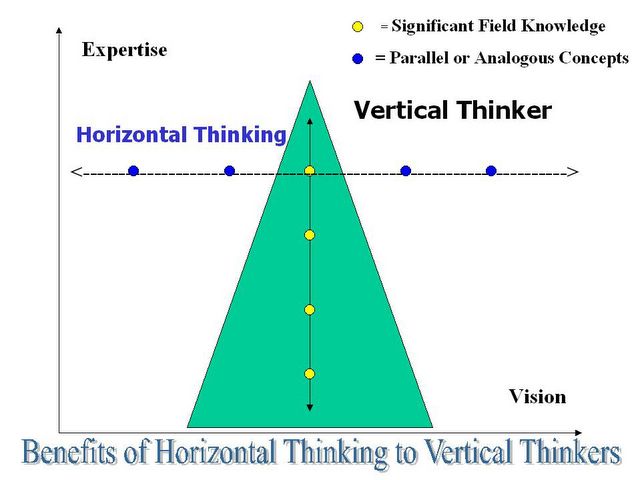
There’s nothing wrong -in fact, much to the good – with the call of Kohlman and others like Joan Johnson-Freese to deliberately combine students and faculty of radically different professional backgrounds. Such a personnel mix is a good base for horizontal thinking to take place, where discussions can range across fields generating insights and analogies and accelerating learning.
However, just assembling a broad mix of talent and putting them together in a building is not enough because it is not any more goal oriented than a MENSA social. Good things might happen, sure, but just as easily not. This is why DARPA is a lot more productive of an organization on an annual basis than the Institute for Advanced Study. There needs to be a mixture of problem-solving and play, free inquiry or experimentation and unifying goals. Communities of interest have to first have a sense of community for the vibrantly sharing and inspiring “minds on fire” effect to take place.
.
If the military or more broadly, American society, wants a larger number of creative, innovative, “disruptive”, strategic or whatever kind of thinker, then the answer is to actively and purposefully teach students creative, critical, insight-generating and strategic thinking skills and to value intellectual curiosity, skepticism, imagination and empiricism over ideology and conformity. The other indirect, “better environment”, stuff certainly improves your chance of success, but systemic improvement will only come about by making such objectives the focus of instruction and learning rather than a haphazard byproduct.
UPDATE:
At Best Defense, Ricks has provided a copy of his prepared remarks on PME as well as a link to the audiofile that I could not pull up the other day. Check out what he has to say.

History Will Judge Only if We Ask the Right Questions

Wednesday, April 18th, 2012

Thomas Ricks of CNAS recently had a historically-minded post at his Best Defense blog at Foreign Policy.com:

What Tom would like to read in a history of the American war in Afghanistan 

I think I’ve mentioned that I can’t find a good operational history of the Afghan war so far that covers it from 2001 to the present. (I actually recently sat on the floor of a military library and basically went through everything in its stacks about Afghanistan that I hadn’t yet read.)

Here are some of the questions I would like to see answered:

–What was American force posture each year of the war? How and why did it change?

–Likewise, how did strategy change? What was the goal after al Qaeda was more or less pushed in Pakistan in 2001-02?

–Were some of the top American commanders more effective than others? Why?

–We did we have 10 of those top commanders in 10 years? That doesn’t make sense to me. 

–What was the effect of the war in Iraq on the conduct of the war in Afghanistan?

–What was the significance of the Pech Valley battles? Were they key or just an interesting sidelight?

–More broadly, what is the history of the fight in the east? How has it gone? What the most significant points in the campaign there?

–Likewise, why did we focus on the Helmand Valley so much? Wouldn’t it have been better to focus on Kandahar and then cutting off and isolating Oruzgan and troublesome parts of the Helmand area?

–When did we stop having troops on the ground in Pakistan? (I know we had them back in late 2001.) Speaking of that, why didn’t we use them as a blocking force when hundreds of al Qaeda fighters, including Osama bin Laden, were escaping into Pakistan in December 2001?

–Speaking of Pakistan, did it really turn against the American presence in Afghanistan in 2005? Why then? Did its rulers conclude that we were fatally distracted by Iraq, or was it some other reason? How did the Pakistani switch affect the war? Violence began to spike in late 2005, if I recall correctly — how direct was the connection?

–How does the war in the north fit into this?

–Why has Herat, the biggest city in the west, been so quiet? I am surprised because one would think that tensions between the U.S. and Iran would be reflected at least somewhat in the state of security in western Afghanistan? Is it not because Ismail Khan is such a stud, and has managed to maintain good relations with both the Revolutionary Guard and the CIA? That’s quite a feat. 

Ricks of course, is a prize winning journalist and author of best selling books on the war in Iraq, including Fiasco and he blogs primarily about military affairs, of which Ricks has a long professional interest and much experience.  Ricks today is a think tanker, which means his hat has changed from reporter to part analyst, part advocate of policy. That’s fine, my interest here are in his questions or rather in how Ricks has approached the subject.

First, while there probably ought to be a good “operational history” written about the Afghan War – there’s a boatload of dissertations waiting to be born – I think that in terms of history, this is the wrong level at which to begin asking questions. Too much like starting a story in the middle and recounting the action without the context of the plot, it skews the reader’s perception away from motivation and causation.

I am not knocking Tom Ricks. Some of his queries are important – “What was the effect of the war in Iraq on the conduct of the war in Afghanistan?”  – rises to the strategic level due to it’s impact and the light it sheds on national security decision making during the Bush II administration, which I suspect, will not look noble when it is revealed in detail because it almost never is, unless you are standing beside Abraham Lincoln as he signs the Emancipation Proclamation.  Stress, confusion, anger and human frailty are on display. If you don’t believe me, delve into primary sources for the Cuban Missile crisis sometime.  Or the transcripts of LBJ and NIxon. Exercise of power in the moment is uncertain and raw.

But most of the questions asked by Ricks were “operational” – interesting, somewhat important, but not fundamental. To understand the history of our times, different questions will have to be asked in regard to the Afghan War. Here are mine for the far off day when documents are declassified:

What was the evolution of the threat assessment posed by Islamist fundamentalism to American national security by the IC from the Iranian revolution in 1979 to September 11, 2001?  Who dissented from the consensus? What political objections or pressures shaped threat assessment?

What did American intelligence, military and political officials during the Clinton, Bush II and Obama administrations know of the relationship between the ISI and al Qaida and when did they know it?

What did American intelligence, military and political officials during the Clinton, Bush II and Obama administrations know of the relationship between Saudi intelligence, the House of Saud and al Qaida and when did they know it?

What did American intelligence, military and political officials during the Clinton, Bush II and Obama administrations know of the relationship between the Taliban and al Qaida and when did they know it?

In the aftermath of 9-11, how did Saudi leverage over global oil markets effect American strategic decision making?

In the aftermath of 9-11, how did Pakistani nuclear weapons effect American strategic decision making?

In the aftermath of 9-11, how did the “Iraq problem”  effect American strategic decision making?

In the aftermath of 9-11, how did nuclear terrorism threat assessments effect American strategic decision making?  Did intelligence reports correlate with or justify the policy steps taken?

Who made the call on tolerating Pakistani sanctuaries for al Qaida and the Taliban and why?

Was there a net assessment of the economic effects of a protracted war in Afghanistan or Iraq made and presented to the POTUS? If not, why not?

Why was a ten year war prosecuted with a peacetime military and a formal declaration of war eschewed?

How did the ideological convictions of political appointees in the Clinton, Bush II and Obama impact the collection and analysis of intelligence and execution of war policy?

Who made the call for tolerating – actually financially subsidizing – active Pakistani support for the Taliban’s insurgency against ISAF and the Government of Afghanistan and why?

What counterintelligence and counterterrorism threat assessments were made regarding domestic Muslim populations in the United States and Europe and how did these impact strategic decisions or policy?

What intelligence briefs or other influences caused the incoming Obama administration to radically shift positions on War on Terror policy taken during the 2008 campaign to harmonize with those of the Bush II administration?

What discussions took place at the NSC level regarding the establishment of a surveillance state in the “Homeland”, their effect on our political system and did any predate September 11, 2001 ?

What were the origins of the Bush administration’s  judicial no-man’s land policy regarding “illegal combatants” and “indefinite detention”, the recourse to torture but de facto prohibition on speedy war crimes trials or capital punishment?

The answers may be a bitter harvest.

Pondering Transition Ops with Quesopaper

Monday, April 16th, 2012

One of the nice things about this blog is that periodically, smart folks will send me their unpublished material for feedback and private commentary. This comes in a wide variety of formats – manuscripts, articles, book chapters, powerpoint, sometimes an entire book or novel! It is flattering and almost always informative, so I try to help where I can or at least point the sender in the direction of someone more appropriate.

Recently, I was given a peek at a very intriguing paper on “Transition Operations” by Dr Rich Ledet, LTC Jeff Stewart and Mr. Pete Turner, who blogs occasionally at quesopaper.  Pete has spent a good chunk of the past ten years in a variety of positions and capacities in Iraq and Afghanistan, where he currently is with American troops in a remote rural district and it was he who passed their draft to me. They have taken a fresh look at the subject.

While I can’t give away their “secret sauce” in detail,  I particularly liked the fact that while the  focus and advice for executing transition operations is aimed at field grade officers and their civilian agency counterparts, their vision is in sync with the ideal of having policy-strategy-operations and tactics as a seamless “whole-of-government” garment. If only we could get our politicians to think in these terms, half the battle would be over.

Their paper is now headed to a professional journal; when it is published ( as I think it will be), I will definitely be linking to it here and hopefully, that will be soon.

My reason for my bringing this up – I have the permission of the authors to do so – is that the trio have put their finger on the major doctrinal problem faced by the United States military in Afghanistan – “transition operations” being a politically charged topic, laden as it is with implied foreign policy decision making by heavyweight policy makers, is treated in very scanty fashion by FM 3-24. Compared to other aspects of COIN, very little guidance is given to the the commander of the battalion or brigade in the effort to coordinate “turnover” of responsibilities and missions to their Afghan Army, police and government allies.

This at a time when the “readiness” of Afghan units and officials to accept these burdens in the midst of a war with the Taliban is questionable, variable, controversial at home and politically extremely sensitive in Afghanistan.

And at a point where, ten years after September 11, the US State Department is no more able in terms of personnel and vision or sufficiently funded by Congress, to step up their game and take the lead role in Afghanistan from the Pentagon than it was on September 10, 2001.  SECSTATEs Condi Rice and Hillary Clinton deserve great praise for making State do more with less, but State needs wholesale reform to fit the needs of the 21st century and the money and budgetary flexibility to split foreign policy tasks more equitably with the Defense Department.

State is not going to be playing a major role on the ground in our transition out of Afghanistan, which makes guidance to our majors and colonels – and in turn to their company and platoon leaders stationed there-  all the more important.

Going to Try this App

Sunday, April 15th, 2012

Paper for iPad


Switch to our mobile site