zenpundit.com » iraq

Archive for the ‘iraq’ Category

Martyrdom, messianism and Julian Assange

Thursday, December 23rd, 2010

[ by Charles Cameron ]

Martyr and messiah are two of the more intense “roles” in the religious vocabulary, and unlike mystics and saints, both martyrs and messiahs tend to have an impact, not just within their own religious circles but in the wider context of the times.

Martyr and messiah are also words that can be bandied about fairly loosely — so a simple word-search on “messiah” will reveal references to a third-person platform game with some gunplay and the white messiah fable in Avatar, while a search on “martyr” might tell you how to become a martyr for affiliate networks, just as a search on “crusade” will turn up crusades for justice or mental health – my search today even pointed me to a crusade for cloth diapers.

1. Martyrdom and messianism in WikiLeaks

Unsurprisingly, perhaps, both terms crop up occasionally in WikiLeaks, with the Government of Iraq, for instance, banning use of the word “martyr” for soldiers who died in the war with Iran, and US diplomats wiring home a report by an opposition psychiatrist to the effect that “Morally, Chavez [of Venezuela] combines a sense of tragedy and romanticism (a desire for an idyllic world) to project a messianic image.” Indeed, the whole paragraph is choc-a-bloc with that kind of imagery, and worth quoting in full:

Ideologically, Chavez wants to project an image of a “utopian socialist,” which de Vries described as someone who is revolutionary, collectivist, and dogmatic. In reality, de Vries argues, Chavez is an absolute pragmatist when it comes to maintaining power, which makes him a conservative. Coupled with Chavez’ self-love (narcissism), sense of destiny, and obsession with Venezuelan symbolism, this pragmatism makes Chavez look more like fascist, however, rather than a socialist. Morally, Chavez combines a sense of tragedy and romanticism (a desire for an idyllic world) to project a messianic image. De Vries, however, said Chavez is a realist who uses morals and ethics to fit the situation.

PM Netanyahu of Israel was using the term “messianic” with a little more precision when he described the Iranian regime as “crazy, retrograde, and fanatical, with a Messianic desire to speed up a violent ‘end of days.'”

2. Julian Assange in the role of martyr

The words martyr and messiah, then, carry a symbolic freight that is at the very least comparable to that of flags and scriptures – so it is interesting that both terms crop up in the recent BBC interview with Julian Assange.

My reading of the interview suggests that it is Assange himself who introduces the meme of martyrdom, though not the word itself, when he answers a question about the impact of the sexual accusations against him, “What impact so you think that will have on your organisation and what sort of figure do you think you, Julian Assange, cut in the face of all this. How will you be regarded? What will it do to you?” with the response, “I think it will be quite helpful for our organisation.”

In the follow up, interviewer John Humphrys twice uses the word “martyr” explicitly:

Q: Really? You see yourself as a martyr then?

JA: I think it will focus an incredible attention on the details of this case and then when the details of this case come out and people look to see what the actions are compared to the reality of the facts, other than that, it will expose a tremendous abuse of power. And that will, in fact, be helpful to this organisation. And, in fact, the extra focus that has occurred over the last two weeks has been very helpful to this organisation.

and:

Q: Just to answer that question then. You think this will be good for you and good for Wikileaks?

JA: I’ve had to suffer and we’ve had incredible disruptions.

Q: You do see yourself as a martyr here.

JA: Well, you know, in a very beneficial position, if you can be martyred without dying. And we’ve had a little bit of that over the past ten days. And if this case goes on, we will have more.

3. Julian Assange in the role of messiah

If the role of martyr implies, at mimimum, that one suffers for a cause, that of messiah implies that one leads it in a profound transformation of the world. Both terms are now found in association with the word “complex” – which applies whenever a individual views himself or herself as a martyr or messiah – but a “messianic complex” is presumably more worrisome than a “martyr complex” if only for the reason that there are many more martyrs than messiahs, many more willing to suffer for a cause than to lead it.

It is accordingly worth noting that it is the interviewer, John Humphrys, who introduces both the word “messianic” and the concept of a “messianic figure” into the interview, although Assange makes no effort to wave it away…

Q: Just a final thought. Do you see yourself… as some sort of messianic figure?

JA: Everyone would like to be a messianic figure without dying. We bringing some important change about what is perceived to be rights of people who expose abuses by powerful corporations and then to resist censorship attacks after the event. We are also changing the perception of the west.

Q: I’m talking about you personally.

JA: I’m always so focussed on my work, I don’t have time to think about how I perceive myself… I had time to perceive myself a bit more in solitary confinement. I was perfectly happy with myself. I wondered what that process would do. Would I think “my goodness, how have I got into this mess, is it all just too hard?”

The world is a very ungrateful place, why should I continue to suffer simply to try and do some good in the world. If the world is so viciously against it ,why don’t I just go off and do some mathematics or write some books? But no, actually, I felt quite at peace.

Q: You want to change the world?

JA: Absolutely. The world has a lot of problems and they need to be reformed. And we only live once. Every person who has some ability to do something about it, if they are a person of good character, has the duty to try and fix the problems in the environment which they’re in.

That is a value, that, yes, comes partly from my temperament. There is also a value that comes from my father, which is that capable, generous men don’t create victims, they try and save people from becoming victims. That is what they are tasked to do. If they do not do that they are not worthy of respect or they are not capable.

4. Julian Assange, martyr and messiah?

I think it is clear that both Assange and his interviewer are in effect reframing the religious terms “martyr” and “messiah” in non-religious, basically psychological senses — although I don’t suppose Assange is exactly claiming to have the two “complexes” I mentioned above.

Here’s what’s curious about this reframing, from a religious studies point of view:

Assange’s implicit acceptance of a “messianic” role undercuts the specific force of the role of “martyr” – one who gives his life for the cause. “Everyone” he says, “would like to be a messianic figure without dying.” Assange wouldn’t exactly object to being a martyr without dying, too.

Guest Post: Mexico, Africa, Zarqawi?

Thursday, October 28th, 2010

Charles Cameron is the regular guest-blogger at Zenpundit, and has also posted at Small Wars Journal, All Things Counterterrorism, for the Chicago Boyz Afghanistan 2050 roundtable and elsewhere.  Charles read Theology at Christ Church, Oxford, under AE Harvey, and was at one time a Principal Researcher with Boston University’s Center for Millennial Studies and the Senior Analyst with the Arlington Institute:

Zen here – I think Charles has hit upon a primal psychological mechanism that comes into full flower as societies break down and war begins to shade into warlordism. We have seen this repeatedly in history from Tamerlane’s mounds of skulls to Khmer Rouge killing fields. Mad Barons, Dogmeat Generals, Friekorps kapteins and butchers long since forgotten by history- there’s a gravitational pull toward atavistic, symbolic, destruction as social norms erode under the corrosive effects of escalating violence.

Mexico, Africa, Zarqawi?

by Charles Cameron

I’ve been struck by a couple of passages I’ve run across in my reading recently that remind me of what I can only call “brutality with religious overtones”.
1. Mexico

There have been a fair number of articles about the various Mexican cartels, but the excerpt from Ed Vulliamy’s book, Amexica: War Along the Borderline that’s now online at Vanity Fair is the one that caught my eye yesterday.

Here’s Vulliamy’s account of a conversation with Dr. Hiram Muñoz of Tijuana:

He explained his work to me during the first of several visits I have made to his mortuary. “Each different mutilation leaves a message,” he said. “The mutilations have become a kind of folk tradition. If the tongue is cut out, it means the person talked too much—a snitch, or chupro. A man who has informed on the clan has his finger cut off and maybe put in his mouth.” This makes sense: a traitor to a narco-cartel is known as a dedo — a finger. “If you are castrated,” Muñoz continued, “you may have slept with or looked at the woman of another man in the business. Severed arms could mean that you stole from your consignment, severed legs that you tried to walk away from the cartel.”<¶>Earlier this year, 36-year-old Hugo Hernandez was abducted in Sonora; his body turned up a week later in Los Mochis, Sinaloa, but not in a single piece. His torso was in one location, his severed arms and legs (boxed) in another. The face had been cut off. It was found near city hall, sewn to a soccer ball.

That’s the brutality — I haven’t see the book itself yet, but I gather it also gets into the narco-corrida music and the “quasi-Catholic cult of Santíssima Muerte” — which brings me to the second part of my interest – the religious aspect.

As Vulliamy mentions, there’s the cult of Holy Death, to be sure, a sort of shadow or inverse of the Blessed Virgin — a Dark Mother for dark times, or perhaps a revival of the ancient Mictlancihuatl, lady of the Dead? — with her own liturgy, too:

Almighty God: in the name of the Father and of the Son and of the Holy Spirit, we ask for your permission to summon Saint Death. Welcome, White Sister: we find ourselves gathered here at this altar of the Romero Romero family and of each one of us, to offer you a Mass that we hope you will like…

Which brings us to the Robin-Hood-like bandit and folk-saint, Jesus Malverde, to whom prayers such as the following [FBI .pdf, see p. 20] are offered:

Lord Malverde, give your voluntary help to my people in the name of God. Defend me from justice and the jails of those powerful ones. Listen to my prayer and fill my heart with happiness. For you shall make me fortunate.

There are even miracles attributed to him:

Oh Malverde! The Vatican did not believe you to be holy and would not canonize you, but when they brought the Caterpillars to tear down your hood, you broke one machine and nobody could move you away, you broke another, leaving those who disrespect you speechless — and when the third one broke, they said, “Let Malverde’s chapel alone.”

Right beside the syncretistic quasi-Catholicism, there’s also a Protestant angle: La Familia is the group that, in Vulliamy’s words, “made its ‘coming out’ known in a famous episode: bowling five severed heads across the floor of a discotheque.” Time magazine reported on what it termed Mexico’s Evangelical Narcos:

Federal agents seized one copy of La Familia’s Bible in a raid last year. Quoted in local newspapers, the scripture paints an ideology that mixes Evangelical-style self-help with insurgent peasant slogans reminiscent of the Mexican Revolution. “I ask God for strength and he gives me challenges that make me strong; I ask him for wisdom and he gives me problems to resolve; I ask him for prosperity and he gives me brain and muscles to work,” Moreno writes, using terms that could be found in many Christian sermons preached from Mississippi to Brazil. But on the next page, there’s a switch to phrases strikingly similar to those coined by revolutionary Emiliano Zapata. “It is better to be a master of one peso than a slave of two; it is better to die fighting head on than on your knees and humiliated; it is better to be a living dog than a dead lion.”

As I commented on Zenpundit a while back,

What’s troubling here is that there is only one undoubtedly “evangelical” phrase in all those that Time quotes, and it is one of then ones said to resemble the aphorisms of Emilio Zapata. “It is better to be a living dog than a dead lion” is a pretty direct borrowing from Ecclesiastes 9.4 in the King James Version: “To him that is joined to all the living, there is hope: for a living dog is better than a dead lion.”

But that’s not actually all. I didn’t mention it at the time, but “I ask God for strength and he gives me challenges that make me strong; I ask him for wisdom and he gives me problems to resolve; I ask him for prosperity and he gives me brain and muscles to work” is almost word-for-word the same as a poem attributed to Islam — or Judaism for that matter. Indeed, it can be hard to tell who is borrowing from whom – but one final source for the La Familia bible is known – it’s the book Wild at Heart by John Eldredge, the pastor of a ministry in Colorado Springs, who must have been surprised at the uses to which his writings were being put.

In any case, as I said on Zenpundit: These people have a theology, and we should be studying it.
2. Africa

My thoughts turned to Africa when I read another paragraph recently, this one from Johann Hari’s review, The Valley of Taboos, of V.S. Naipaul’s new book, The Masque of Africa: Glimpses of African Belief:

I have stood in a blood-splattered house in Tanzania where an old woman had just been beaten to death for being a “witch” who cast spells on her neighbors. I have stood in battlefields in the Congo where the troops insist with absolute certainty they cannot be killed because they have carried out a magical spell that guarantees, if they are shot, they will turn briefly into a tree, then charge on unharmed. I have been cursed in Ethiopia by a witch-doctor with “impotence, obesity, and then leprosy” for asking insistently why he charged so much to “cure” his patients. (I’m still waiting for the leprosy.) Where do these beliefs come from? What do so many Africans get out of them? Can they be changed? These are questions that are asked in Africa all the time, but we are deaf to the conversation.

That sent me in search of some early military anthropology related to guerrilla warfare I’d come across in earlier readings.

James R Price and Paul Jureidini’s 1964 Witchcraft, Sorcery, Magic, and Other Psychological Phenomena and their Implications on Military and Paramilitary Operations in the Congo, and Roger D Hughes’s 1984 Emergency in Kenya: Kikuyu and the Mau Mau Insurrection are both of considerable interest here — but it is LSB Leakey, the world-class British archaeologist initiated as a boy into the Kikuyu ways, who has written the most provocative summary of the relationship between political and religious violence and ritual that I’m interested in tracking.

I’m quoting here from the chapter on “The Mau Mau Religion” in Maj. Hughes paper:

Leakey’s original hypothesis in Mau Mau and the Kikuyu: “Mau Mau was nothing more than a new expression of the old KCA … a political body that was banned … because it had become wholly subversive.” Furthermore, “Mau Mau was synomomous with the new body called the in school, Kenya African Union…” However, Leakey admits to a reversal of his original hypothesis in Defeating Mau Mau, and goes on to say, “Mau Mau, while to some extent synonymous with these political organizations, was in fact a religion and owed its success to this fact more than to anything else at all.”<¶>He then proceeds to attribute the origin of Mau Mau to an “ideology transfer,” wherein the religious beliefs of the Kikuyu transitioned from their ancient tribal religion to Euro-Christianity to Mau Mau. The first transition took place artificially, as the missionaries stripped away the traditional beliefs and supplanted them with “20th Century Europe’s concept of Christianity.” The second transition was more natural and evolutionary than the first. A reactionary hybrid of the old and the new developed, because the supplanted concepts would not hold up in their society. There were too many contradictions between the old and the new, mainly due to the 20th Century European “add-ons.”

Most of us have a pretty fixed view of what religion is, should be, or isn’t. Some of my readers no doubt hold to a evangelical Christian position, some are Catholic, some perhaps Buddhist, agnostic or atheist, and some perhaps Muslim. Each of us tends to take our own view of a particular religion as normative, but the reality is that the history of each of the great world religions contains sanctions for both peace-making and warfare — and human nature itself encompasses a range of behaviors that run from the kind of atavistic violence described above to the forgiving and compassionate impulse behind the Beatitudes…

And while economic pressures and political frustrations may be enough to power great struggles, when religious rituals, beliefs and feelings are added into the mix, it can quickly become even more lethal.
3. And Zarqawi?

All of which leaves me wondering how close the parallels are between the Mau Mau in LSB Leakey’s account, La Familia and the other Mexican cartels — and the brutalities of jihadists such as Abu Musab al-Zarqawi.

Bacevich – How Do we Know When War is Over?

Thursday, April 29th, 2010

From the Strategy Conference…..

The Surge, Rigor, Yardsticks and Mediums

Wednesday, April 7th, 2010

Andrew Exum said the Surge succeeded. Dr. Bernard Finel says “prove it“.

From Abu Muquwama:

Just Admit It: The Surge Worked

….We can argue about how many other factors aside from U.S. diplomatic and military operations led to the stunning drop in violence in 2007. There was a civil war in 2005 and 2006, tribes from al-Anbar “flipped” in 2006, and Muqtada al-Sadr decided to keep his troops out of the fight for reasons that are still not entirely clear. Those are just three factors which might not have had anything to do with U.S. operations. But there can be no denying that a space has indeed been created for a more or less peaceful political process to take place. Acts of heinous violence still take place in Baghdad, but so too does a relatively peaceful political process.

From BernardFinel.com:

Did the Surge Succeed?

….Violence was a problem for Iraqi civilians and for the U.S. military.  Reducing violence has unquestionably served humanitarian purposes in Iraq and has also saved American lives.  But that has nothing to do with “conceptual space” or the broader “success” of the surge.

I mean, come on, if you’re going to write a post that essential expects to settle a debate like this one, snark and assertions much be balanced with rigorous analysis.  But Exum doesn’t demonstrate any real understanding of the dynamics of violence in civil conflicts.

My suggestion is that you first read each gentleman’s posts in their entirety.

The first part of the dispute would be what is the standard of “success” that we are going to use to evaluate “the Surge”. I’m not certain that Exum and Finel, both of whom are experts in areas of national security and defense, would easily arrive at a consensus as to what that standard of measurement would be. Perhaps if they sat across from one another at a table and went back and forth for an hour or so. Or perhaps not. I have even less confidence that folks whose interests are primarily “gotcha” type partisan political point-scoring on the internet, rather than defense or foreign policy, could agree on a standard. Actually, I think people of that type would go to great lengths to avoid doing so but without agreement on a standard or standards the discussion degenerates into people shouting past one another.

In my view, “the Surge” was as much about domestic political requirements of the Bush administration after November 2006 as it was about the situation on the ground in Iraq. In my humble opinion, COIN was a better operational paradigm that what we had been doing previously in Iraq under Rumsfeld and Bremer, but the Bush administration accepted that change in military policy only out of desperation, as a life preserver. That isn’t either good or bad, it simply means that measuring the Surge is probably multidimensional and the importance of particular aspects depends on who you are. An Iraqi shopkeeper or insurgent has a different view from a USMC colonel or a blogger-political operative like Markos Moulitsas Zúñiga. Ultimately, the standard selected involves a level of arbitrary judgment. I can say the Surge was a success because the US was not forced to execute a fighting withdrawal from Iraq as some, like William Lind, was likely to happen but that’s probably not a narrow enough standard to measure the Surge fairly.

The second part of the dispute involves methodological validity, or “rigor” in making the evaluation, which was raised by Dr. Finel. I agree with Finel that in intellectual debate, rigor is a good thing. Generally in academia, where social scientists frequently suffer from a bad case of “physics envy”, this means unleashing the quants to build a mathematical model to isolate the hypothetical effects of a particular variable. I freely admit that I am not certain how this could be done in a situation as complex as the Iraqi insurgency-counterinsurgency in 2007 and still retain enough reliability to relate to reality. The act of isolating one variable is itself a gross distortion of the reality of war. There would have to be some kind of reasonable combination of quantitative and qualitative methods here to construct an argument that is comprehensive, rigorous and valid. I think Bernard should propose what that combination might be in approximate terms.

The third part of the dispute involves the medium for the rigorous argument over the Surge. I’d suggest that, generally, a blog post is not going to cut it for reasons intrinsic to the medium. First, blog posts have an unspoken requirement of brevity due the fact that audience reads them on a computer screen. While you can say something profound in just a few words, assembling satisfactory evidentiary proofs in a scholarly sense requires more space – such as that provided by a journal article or book. Blogging is good for a fast-paced exchange of ideas, brainstorming, speculation and, on occasion, investigative journalism. It’s a viral, dynamic medium. While there are examples of bloggers rising to levels of greater intellectual depth, these are exceptions rather than the rule in the blogosphere.

This is not a dispute that is going to be resolved because the parties are unlikely to find a common ground on which they can agree to stand.

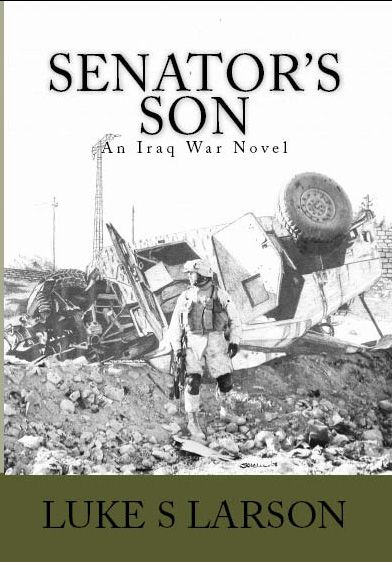
Review: Senator’s Son by Larson

Monday, March 15th, 2010

larson.jpg

Senator’s Son: An Iraq War Novel by Luke S. Larson

Fiction is not a genre that I usually review here, or get an opportunity to read often, but I received a courtesy review copy of a book Senator’s Son, by Iraq war vet, Marine officer and new novelist Luke Larson and was curious. The Iraq War and the War on Terror have produced a fine array of thoughtful books by veterans, war reporters and military thinkers like FiascoOne Bullet Away  and The Strongest Tribe, all of which were non-fiction memoirs, journalistic histories and quasi-policy books. By virtue of writing Senator’s Son as a novel, Larson was taking a different path in explaining his war.

There are two books at once in Senator’s Son. The first, is of course, a story, with characters and a plot and rising action, action, tragedy and theme – all the usual aspects of literature which I am not especially practiced at evaluating here. The second part is a contextual explanation of COIN by an author who lived the Iraq War. To his credit, Larson contacted me personally to request a “No bulls**t review”, so I will give the man what he asked for.

As an explanation of COIN, I think the book is a must read for anyone unfamiliar with the subject and the nuanced complexities that COIN entails. The gritty, unforgiving, human suffering and moments of triumph of soldiers waging “pop-centric” COIN that gets lost in powerpoint slides, in the dry abstractions of journal articles and blogospheric arguments far removed from the ground is present in ample measure in Senator’s Son. Many times, I paused in a passage and thought, “hmmm….I did not consider that”. Or “This is what the soldiers bear up under without complaint”. More people need to read that and digest what we ask of our men and women in Iraq and Afghanistan.

Senator’s Son also lays out, fairly methodically, how COIN theory may have been interpreted and debated by soldiers outside the wire, including cameo appearances or mention of real life COIN leaders woven into the story. The characters Bama, Cash, Rogue, Isaac, Gonzo the Iraqi and more, resist and adapt, struggling with their environment, unseen enemies and the political pressures of higher authorities, registering both frustration and progress in executing the mission of Golf Company. There’s even diagrams. If Senator’s Son is not on official COIN reading lists, it should be.

As a pure novel, judged on literary standards, Senator’s Son reflects its’ status as a “first novel” of a talented author whose vision of the craft is emerging. Larson excels at creating scenarios, staccato vignettes for the characters to act ( Larson may also have a future as a screenwriter – his book naturally flows in the mind like a movie). There’s always a believable, environmental, “texture” present that exceeds that of short story and science fiction writers, yet as a novelist, Larson leaves enough to the reader’s imagination so that the story moves at a dramatic pace.

Characterization in Senator’s Son is uneven. It takes a while for the individual personalities of the characters to shine beyond their common “Marine-ness” and we get only the briefest glimpse of the malign nature of the enemy, and that secondhand through the eyes of an Iraqi character. That probably is an accurate representative of the experience of most US soldiers and Marines in Iraq who are not interrogators; furthermore, having the antagonist that the characters struggle against be the total environment is perfectly legitimate. It would have been interesting for me to have seen how Larson would develop and utilize a figure who was the focus of evil; however that task would be fairly incompatible with getting an effective message across regarding COIN, success of which does not hinge on the defeat of super-villains or the resolution of black-white moral absolutes but is complexity written in shades of gray.

Finally, as an avid reader, I found Senator’s Son to be a page-turner. Several times, I looked at the clock while reading for what seemed to me a short time, noted it was 1:30 am and was regretful that I had to put it on my bedstand ( I always finished the chapter first though 🙂 ) only to repeat the process the following night.  Strongly recommended.

ADDENDUM – OTHER REVIEWS of SENATOR’S SON by:

Thomas P.M. Barnett 

Shrinkwrapped 

Shane Deichman


Switch to our mobile site

