zenpundit.com » analytic

Archive for the ‘analytic’ Category

WikiLeaks: Counterpoint at the State Department?

Wednesday, December 8th, 2010

[ by Charles Cameron ]

[ note: all links are to youtube videos ]

The pianist Glenn Gould is celebrated for his ability to bring the different and at times positively oppositional voices in a fugue by Bach to our attention, so that we follow each one separately while hearing all at the same time as a single whole. What is less known is that he liked to sit at a table in a truck stop and listen to the different conversations at the other tables and booths, mentally braiding their pale or brightly colored threads of human together into an analogous tapestry — one voice harmonizing with or conflicting against another, here a new subject introduced, there an echo of an earlier idea heard in a fresh context, with the murmurings of waitresses punctuated by the kaching! of the cash register, the hydraulic hiss of a door closing — conversation as counterpoint.

Organizations and individual alike, we all have different and at times dissonant voices, and strive to bring them to some kind of resolution. The many stakeholders debating an issue in town halls, blogs or letters to the editor, the many drives within each one of us, idealistic, hopeful, defeated, paralytic, angry, evasive, sluggish, vengeful, curious, alert, defiant, all have voices, all constitute an experience of polyphony, a “music of many voices”, in point counter point.

One of my interests is to find a way to score these many fugues, these musics of meaning.

My DoubleQuotes, then, can be considered as two-part inventions, attempts to show the multiple tracking of the mind — whether of a single individual, as in this case, or of a group, a community, a world divided – so that something of the music begins to be visible, and some of the dissonances can move towards necessary resolution.

*

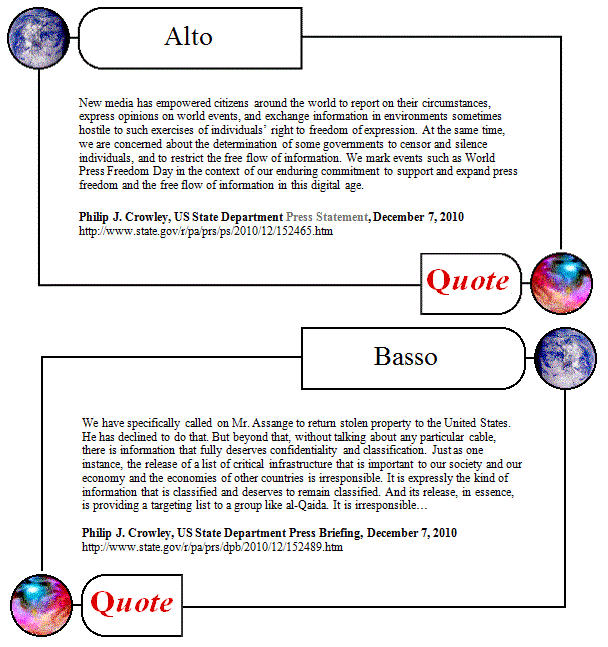
QUOwikileaks

*

I believe there is unresolved irony between these two statements, made on the same day by Philip J Crowley, the US State Department’s Assistant Secretary, Bureau of Public Affairs – but each has its reasons, and there are arguments to be made for both transparency and opacity, diplomacy and publicity, secrets and revelations.

Between them lies the possibility I think of as a virtual music of ideas.

*

Bach published a series of two-part inventions, BWV 772–801, and wrote of them that he intended to offer them as an honest method

by which the amateurs of the keyboard – especially, however, those desirous of learning – are shown a clear way not only (1) to learn to play cleanly in two parts, but also, after further progress, (2) to handle three obligate parts correctly and well; and along with this not only to obtain good inventions (ideas) but to develop the same well; above all, however, to achieve a cantabile style in playing and at the same time acquire a strong foretaste of composition…

Later comes the Art of Fugue.

Simplification for Strategic Leverage

Sunday, December 5th, 2010

Remember this much ridiculed visual monstrosity?:

Excessively complex representations, much less the bureaucratic systems in practice, are poor vehicles for efficient communication of strategic conceptualizations to the uninformed – such as those downstream who must labor to execute such designs. Or those targeted by them for help or harm.  In addition to the difficulty in ascertaining prioritization, the unnaturally rigid complexity of the bureaucracy generally prevents an efficient focus of the system’s resources and latent power. The system gets in it’s own way while eating ever growing amounts of resources to produce less and less, leading to paralysis and collapse.

Does it have to?

Here’s an interesting, very brief take on analytical simplification from a natural scientist and network theorist Dr. Eric Berlow on how to cull simplification – and thus an advantage – out of complex systems by applying an ecological paradigm.

Cognitive simplification will be a critical strategic tool in the 21st century.

A draft of what’s on my mind lately

Sunday, December 5th, 2010

by Charles Cameron
[ cross-posted from ChicagoBoyz ]

I’ve been thinking…

*

Reports, overstatements and underestimates

There are factual reports of violence and threats of violence, which are within the proper province of journalism and intelligence gathering.

There are also overstatements of such reports, generally resulting from paranoia, hatred, recruitment, or the desire to increase sales of advertising or munitions.

And there are understatements of such reports, generally resulting from sheer ignorance or a desire to be diplomatic.

*

Religious sanctions for violence

Similarly, there are factual reports of sanctions for violence in the scriptures, hagiographies and histories of various religions.

There are also overstatements of such reports, attributing to entire religions the beliefs and or activities of a significant subsection or outlier group of that religion

And there are understatements of such reports, avoiding the attribution of violence to religious beliefs regardless of whether the religious correlation is a “cover” for other motives or a sanction powerfully affecting the actions of those who respond to it.

*

Proportional and disproportionate responses

There are actions which represent a balanced and proportional response to threats or acts of violence, whether they be made at home or abroad, by the military or law enforcement, for reasons of just war or of security.

There are actions which present an unbalanced and disproportionate heightened response to acts of violence, into which category I would place both over-reactive military responses and over-reactive domestic security measures.

And there are inactions which are no less unbalanced as responses to acts or threats of violence, as with political wool-gathering or appeasement, bureaucratic failures to implement realistic information sharing and dot-connection within the IC, or public aversion to factual news or intelligent, nuanced analysis.

*

Ideals, kumbaya and skepticism

There are honest statements of aspiration for peaceable outcomes to current and future conflicts.

There are versions of such aspirations which naively overlook the very real correlations between religious sanctions and violence.

And there are skeptical aversions to such aspirations, which no less naively overlook the very real differences which are present between the most angry, the most terrified, the most politically driven, the most financially interested and the most generous members of any and every religious and irreligious viewpoint.

*

Let’s talk…

It is useful to bear these distinctions of category in mind, and to make accurate appraisals of one’s information inputs in terms of which categories they fall under, and how much trust one should therefore place in them.

There: it was on my mind and I have said it.

This is, as my title indicates, a first draft. I hope it will spark some interesting conversations, and lead to further insight and refinement…

A DoubleQuote for Anders

Friday, December 3rd, 2010

[ by Charles Cameron ]

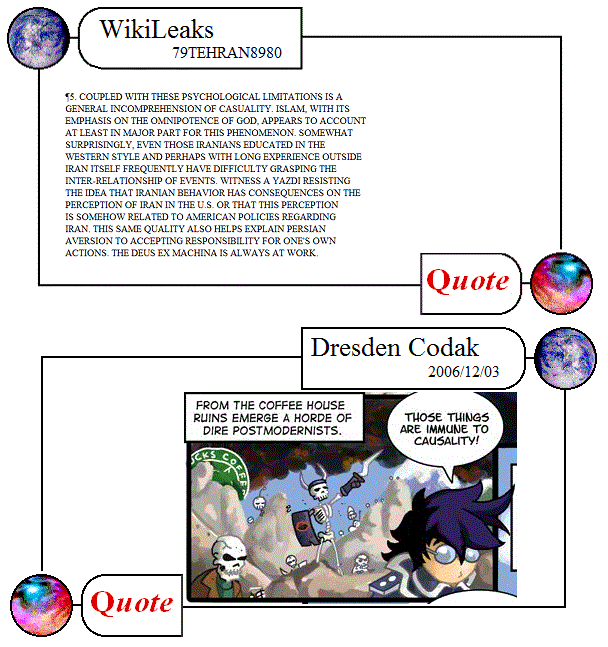
One of my hobbies is finding apposite quotes to juxtapose — I call them DoubleQuotes and think of them as twin pebbles dropped into the mind-pool for the pleasure of watching the ripples…

And I particulartly enjoy it when one of my DoubleQuotes manages to span different sensory streams — aural, visual, verbal, numerical, cinematic — as here, with text and image.

This one’s for Anders Sandberg.

QUOAcausal

I’d been carrying around the quote from WikiLeaks for a few days, but it was running across the Dresden Codak via Anders’ Andart blog today that gave me the second “dot” to connect with the first.

Wikileaks and the Search for a Cryptographic Mythology

Thursday, December 2nd, 2010

[ by Charles Cameron ]

Jean Rosenfeld of the UCLA Center for the Study of Religion just posted a comment on an earlier Zenpundit post of mine, opening up a topic which may interest some readers here: that of Wikileaks founder Julian Assange’s mythological associations.

1

Jean had earlier pointed me to Assange’s use of the name “Marutukku” to describe his encryption program, and a little fishing brought me to these two Assange-related documents:

One Man’s Search for a Cryptographic Mythology
Enuma Elish

2

I’d been idly wondering about cryptographic mythology myself, as it happens, nudged by vague memories of a cache of porno images tweaked by jihadists as encoding devices for steganography.

Steganography is the cryptographic – or is it kabbalistic? — art devised by one Abbot Trithemius, whose 1518 Polygraphia is the first work on cryptography printed in Europe, and whose Steganographia was known in MS to such hermetic philosophers as Cornelius Agrippa, Giordano Bruno and John Dee. Jim Reeds captures the ambiguity of Trithemius’ work nicely in his paper, Solved: The Ciphers in Book III of Trithemius’s Steganographia, when he asks:

Is it [the Steganographia] primarily an exposition of cryptographic techniques disguised as angel magic, or is it primarily a magic work disguised as cryptography?

Readers of Frances Yates and Ioan Couliano will be somewhat familiar with these matters.

And jihadist steganography? The technique itself is described in the al-Fajr Information Center’s Technical Mujahid magazine of Feb. 2007 according to a Jamestown Foundation Terrorism Monitor piece, but the reports of actual jihadist use of the technique may turn out to be fabrications.

3

But it was Julian Assange‘s bliss we were trying to follow, right?

Assange sidekick Suelette Dreyfus wrote The Idiot Savants’ Guide to Rubberhose — which is the manual for Assange’s crypto program… but this business of naming the program gets complicated, eh?

Dreyfus explains:

If you’re wondering about the name of this program, Marutukku is the internal development name (it’s spelled Ru-b-b-e-r-h-o-s-e, but it’s pronounced M-a-r-u-t-u-k-k-u)

In case you didn’t get it, there may be a play on Lewis Carroll there, and the exchange Alice has with the White Knight in Through the Looking-Glass as to what the name of a certain very sad song is called.

Alice aside – and such detours are in fact the very method of discovery in non-linear thinking – Dreyfus offers as an epigraph to her piece the following quote:

The third name is MARUTUKKU, Master of the arts of protection, chained the Mad God at the Battle. Sealed the Ancient Ones in their Caves, behind the Gates.

which she attributes to “The Akkadian Creation Epic”. That would be the Enuma Elish.

Assange, in his One Man’s Search for a Cryptographic Mythology, attributes his choice of the name Marutukku to a conversation he had with a friend concerning the Enuma Elish, telling us (after much other curious and wandering stuff) that his friend recommended the god Marduk’s third name to him, saying

The third name is MARUTUKKU, Master of the arts of protection, chained the Mad God at the Battle. Sealed the Ancient Ones in their Caves, behind the Gates.

Assange liked the idea, observing, “Even the very word MARUTUKKU looked like it had been run through a product cipher”.

A little later in the same document, he quotes from the Enuma Elish, and the phrases given above appear in the quoted excerpts from that text – although they are not present in the version “Based on the translation of E. A. Speiser, with the additions by A. K. Grayson, Ancient Near Eastern Texts Relating to the Old Testament, third edition, edited by James Pritchard (Princeton, 1969), pp. 60-72; 501-503, with minor modifications” that Assange offers us on the sibling-page at Enuma Elish.

As Dr. Rosenberg pointed out to me, “the quote — if it is a translation — differs from other translations I found on the Internet. It is more specific and extensive and ‘mythological.'”

4

Okay, I’ve kept what may be the most practical (ie 21st century) “creative leap” made by my skittish and wandering mind for this, my penultimate paragraph.

Oxford’s Anders Sandberg blogs today about Assange’s application of network theory to conspiracies, quoting Assange as saying:

Conspiracies are cognitive devices. They are able to out think the same group of individuals acting alone Conspiracies take information about the world in which they operate (the conspiratorial environment), pass it around the conspirators and then act on the result. We can see conspiracies as a type of device that has inputs (information about the environment) and outputs (actions intending to change or maintain the environment).

And Anders’ summary of Assange’s position? “In short, conspiracies are a kind of collective intelligence enhancement.”

[ admission: I associate the name Anders Sandberg with some brilliant early net writings on role-playing games and the hermetic tradition – I’m hoping this is the same guy ]

5

Finally, let’s go back to that enhancement of the Enuma Elish text. That phrase, “Sealed the Ancient Ones in their Caves, behind the Gates” struck me, too – it reminded me of the Chthulu Mythos of HP Lovecraft, and its apocalypse:

That cult would never die until the stars came right again and the secret priests would take Cthulhu from His tomb to revive His subjects and resume His rule of earth. The time would be easy to know, for then mankind would have become as the Great Old Ones; free and wild, and beyond good and evil, with laws and morals thrown aside and all men shouting and killing and revelling in joy. Then the liberated Old Ones would teach them new ways to shout and kill and revel and enjoy themselves, and all earth would flame with a holocaust of ecstasy and freedom.

And with that quote from Lovecraft, courtesy of Erik Davis, we have returned by a commodius vicus of recirculation back to the hermetically sealing and revealing world of John Dee.

Switch to our mobile site

