zenpundit.com » cultural intelligence

Archive for the ‘cultural intelligence’ Category

Book Review: Narcos Over the Border by Robert J. Bunker (Ed.)

Tuesday, April 5th, 2011

Narcos Over the Border: Gangs, Cartels and Mercenaries by Dr. Robert J. Bunker (Ed.)I just finished my review copy of Narcos Over the Border. It is one of the more disturbing academic works recently published in the national security field, not excluding even those monographs dealing with Islamist terrorism and Pakistan. If the authors of this granular examination of Mexico’s immense problems with warring narco-cartels, mercenary assassins, systemic corruption, 3rd generation gangs and emerging “Narcocultas”of Santa Muerte are correct – and I suspect they are – Mexico’s creeping path toward state failure reprsents a threat to American national security of the first order.

The 237 page, heavily footnoted, book is organized into three sections: Organization and Technology Use by the narcos networks, Silver or Lead on their carrot and stick infiltration/intimidation of civil society and the state apparatus, and Response Strategies for the opponents of the cartels. Bunker’s co-authors Matt Begert, Pamela Bunker, Lisa Campbell, Paul Kan, Alberto Melis, Luz Nagle, John Sullivan, Graham Turbiville, Jr., Phil Wiliams and Sarah Womer bring an array of critical perspectives to the table from academia, law enforcement, intelligence, defense and security fields as researchers and practitioners. The effort to blend disciplinary approaches in Narcos Over the Border is both an intentional and commendable effort to break down academic and policy silos and bureaucratic “turf” perspectives that prevent analyzing Mexico’s security dilemmas as an interrelated threat increasingly resembling a full-fledged insurgency (albeit not on the classic Maoist Model).Some impressions I gained from reading Narcos Over the Border include:

  • The Narco-Cartels and the Zetas, which fight each other as well as Mexico’s military ( Mexican police generally are infiltrated, intimidated, outgunned and seriously outclassed by the Cartel gunmen, Zetas and Guatemalan Kaibiles) are better armed and better trained than are the Taliban. The deadly and efficient Zetas and Kaibiles are superior to regular Mexican military forces and have established safe haven training camps in Central America.
  • Narco-cartels are properly speaking, no longer narco-cartels but transnational criminal syndicates involved in a wider array of revenue generating activities, but with professional intelligence and military capabilities, and increasingly, political, social and religious agendas that are functionally reminiscient of Hezbollah and HAMAS.
  • The Mexican state is severely hampered in it’s response to the threat presented by the cartels by it’s own strategic use of corruption as a cost saving measure and a tool for sustaining elite control of Mexican politics, as well as a method of personal enrichment by members of Mexico’s ruling class.
  • The eschewing of the extreme violence by the cartels North of the border appears to be more of a sign of a strategic policy by cartel and Zeta bosses than a lack of capacity or evidence of a lack of infiltration into American society. To the contrary, Mexican cartel links to acutely dangerous American prison and street gangs such as the Mexican Mafia and MS-13 are significant and well documented.
  • The cartels are global, not regional or local operators.
  • The culture of the Narco-cartels, which draws on some romantic Mexican social and religious underground traditions, particularly the hybrid cartel La Familia , is morphing into a very dangerous “Narcocultas”, a neo-pagan, folk religion featuring ritualistic violence, beheadings and torture-murders carried out for reasons other than economic competition.
  • Mexico has departed the realm of having a serious law enforcement problem and has graduated to a significant counterinsurgency war against the cartels in which the Mexican state is treading water or making progress against some cartels (possibly displacing their activities to weaker states in Central America).

The authors do not assume the worst case scenario, state collapse, for Mexico but rather an insidious “hollowing out” of the state by the cartels and a mutation of Mexico’s native culture to host a 4GW nightmare. As Robert Bunker writes:

What is proposed here is that Mexico is not on it’s way to becoming a “rotting corpse” but potentially something far worse – akin to a body infected by a malicious virus. Already, wide swaths of Mexico have been lost to the corrupting forces and violence generated by local gangs, cartels and mercenaries. Such narco-corruption faced few bariers given the fertile ground already existing in Mexico derived from endemic governmental corruption at all levels of society and in some ways, it even further aided the ‘virus’ spreading through Mexican society from this new infection. Among it’s other symptoms, it spreads values at variance with traditional society, including those:

….conceivably derived from norms based on slaveholding, illicit drug use, sexual activity with minors and their exploitation in prostitution, torture and beheadings, the farming of humans for body parts, the killing of innocents for political gain and personal gratification and the desecration of the dead.

While meticulous, Narcos Over the Border is not all-encompassing in scope.  A fundamentally Mexico-centric collection of scholarly articles, it does not deal extensively with American policy makers involved in Mexico’s narco-insurgency, the intricacies of cartel financial operations or undertake case studies of narco activities in Mexican-American communities, though the authors do track narco-cartel and gang presence in cyberspace. Narcos Over the Borders represents a starting point for deeper investigation of narco-insurgency and for a national security comunity that has thus far treated Mexico as a third tier problem, a policy call to arms.Strongly recommended.

Burning scriptures and human lives

Tuesday, April 5th, 2011

[ by Charles Cameron ]

*

Which is more sacred? You own life? Or an ideal you would be willing to die for?

I ask this, because we often think, act and speak as though one human life, any human life, is automatically more sacred, more to be preserved, than any idea – or book.

We make allowances, to be sure, and “thou shalt not murder” is no doubt closer to the Hebrew than “thou shalt not kill” – but we tend to think of human life as a paramount value, and in this we have the support both of our legal code (“murder one”) and of many scriptures, including the Qur’an, which declares, “whoso saveth the life of one, it shall be as if he had saved the life of all mankind” (for details, see below).

And I also ask this because Martin Luther King said, “If a man hasn’t discovered something that he will die for, he isn’t fit to live” — and even if I find MLK’s exact phrasing a little strange, I think I know what he’s getting at.

Somehow, then, I think we can agree that there may at times be good reasons to value something that’s not a human life but an ideal of some sort more than one’s own life itself, but that in general, a human life, any human life, is of comparable worth to one’s own.

.

One:

Which brings me to this thought experiment – a list of rhetorical questions designed to elicit thought, not to be answered like a questionnaire…

how-sacred-is.gif

.

Two:

These are rhetorical questions, and I’m asking them for specific reasons.

Under Islamic theology, for instance, the Qur’an cannot be destroyed, since it says of itself (Sura 82, al-Buruj, 21-22:

Surely this is a Glorious Qur’an, inscribed on an Imperishable Tablet.

It is physically possible to burn a physical “copy” [mushaf] of the Qur’an in book form— one particularly obnoxious pastor in Florida has recently done so, although he had been warned in advance by GEN Petraeus:

the safety of our soldiers and civilians would be put in jeopardy and accomplishment of the mission would be made more difficult.

— and the Muslims who recently bombed a Sufi shrine in the Punjab no doubt burned more than one such copy / mushaf, hence my final question in the list above.

.

Three:

I could add many other questions to the list — for instance:

  • For Protestants: How precious is the Saving Blood?
  • For Catholics: If someone bombs a church in which the Mass is being celebrated, does that destroy the Marriage Feast of the Lamb of which every Eucharist is a foretaste?
  • And if someone assassinates the priest while he is “in persona Christi” (in the person of Christ) celebrating Mass, does that kill Christ (again)?

That last, I should add, did in fact happen, not only more recently to Archbishop Romero in El Salvador, but also, several centuries ago, in the little parish church of the village of Brightwell-cum-Sotwell near Oxford where I was raised — and is commemorated there by a brass which reads:

Here lyeth the body of Master John Scoeffyld who died on the 15th day of the month of May in the year of our Lord 1507, on whose soul may God have mercy, Amen

So you see, I have a personal interest in these things…

.

Four:

As to the value of a human life, opinions vary…

Some humans feel the need to hold ethical discussions before wantonly taking other human lives:

For weeks, they had weighed the ethics of bagging “savages” and debated the probability of getting caught. Some of them agonized over the idea; others were gung-ho from the start. But not long after the New Year, as winter descended on the arid plains of Kandahar Province, they agreed to stop talking and actually pull the trigger.

Mark Boal, The Kill Team, Rolling Stone, March 27, 2011

Around two percent of the human race is psychopathic, I’ve read, and most of us can be strongly tugged and swayed by peer-pressure, this was wartime — the pressure-cooker of souls — and whatever got into those men could very likely get inside me, too.

Who’s to say I wouldn’t buckle under pressure like that?

.

Five:

But I’m at peace, here, philosophizing.

One could perhaps be forgiven for thinking the US values the loss of “two sons, two daughters and one grandchild” to an Afghan villager in Gardez at two sheep, because that’s all the payment that’s mentioned in a 2-page ABC News article about VADM William McRaven‘s visit to the village, in which he offered to sacrifice one of the sheep at the door by way of asking for forgiveness, as is customary among the Pashtun. That ABC report, however, was based on and cited a first-hand report in the London Times, which mentions also that the Afghan generals present “gave the family a wad of cash wrapped in a handkerchief. Relatives said there was almost $30,000 (£19,000).” The ABC version omitted that part… That’s a bit better than a couple of sheep – but even so, two sons, two daughters and a grandchild?

Look, that’s better than what the German Bundeswehr is willing to pay for the victims of an admitted bombing error in Afghanistan that killed a hundred or so people, perhaps five of whom were Taliban. From another ABC News report, worth reading in its entirety:

Now the Bundeswehr will be paying $5,000 — not for each life that was lost, but to each family of a victim or multiple victims. In other words, all families will receive the same compensation, no matter how many of their members were killed in the Kunduz bombing.

.

Six:

But, you know – no mention there of the sacred, except perhaps in VADM McRaven’s exemplary gesture.

So let’s go back to some religious authorities…

There is the Mishnah (Sanhedrin 4) teaching:

Therefore man was created alone to teach you that whoever destroys a single life from Israel, is considered by Scripture as though he destroyed an entire world; and whoever preserves a single life from Israel, is considered by Scripture as though he had preserved an entire world.

Some would argue that the qualification, “from Israel” renders this passage less than universal in its implications — yet the same passage goes on to say, without making any distinction between Jew and Gentile:

the Supreme King of kings, the Holy One, Blessed is He, fashioned each man in the mold of the first man, yet not one of them resembles another. Therefore, every single person is obliged to say: The world was created for my sake.

That would appear to cover every created human being… and that is clearly the sense of the Qur’an, in Sura 5, al-Maeda, 32:

We decreed for the Children of Israel that whosoever killeth a human being for other than manslaughter or corruption in the earth, it shall be as if he had killed all mankind, and whoso saveth the life of one, it shall be as if he had saved the life of all mankind.

Less generous and more specific, alas, is the Shafi’i jurist Ahmad ibn Naqib al-Misri, who writes in his Reliance of the Traveler:

The indemnity for the death or injury of a woman is one-half the indemnity paid for a man. The indemnity paid for a Jew or Christian is one-third of the indemnity paid for a Muslim. The indemnity paid of a Zoroastrian is one-fifteenth of that a Muslim

.

Seven:

I’ve already admitted that if the pressure were sufficient I might buckle – what about inspiration, how strong could I be if need be, how high do I reach?

So.

I ask myself: how much suffering am I ready to take on myself, to save the life of a child dying of leukemia in some country far from my home? And if my actions to date are anything to go by, my answer must be: not much.

That’s my walk.  Here’s the talk I talk.

Life is infinitely complex and rich in nuance — dappled, as Hopkins says, with swift, slow; sweet, sour; adazzle, dim

The value of one human life is the value of the world. The Qur’an is indestructible. It is deeply inadvisable to threaten, attempt or facilitate the destruction of man, world, or book:

He fathers-forth whose beauty is past change: Praise him.

Inspire #5: between front and back covers

Thursday, March 31st, 2011

[ by Charles Cameron ]

*

Okay. When what goes into the opening paragraphs of an editor’s note at the front of a magazine corresponds pretty exactly to what’s on the back cover, you have a sort of conceptual bracket that’s “holding” the rest of the content, and it pays to pay attention.

Here are the first paras of the “Letter from the Editor” that is featured on page 5 of the latest issue of AQAP’s English language magazine, Inspire, immediately after the front cover and index pages:

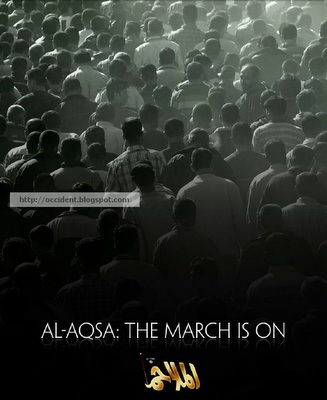
The cover of this issue is about the Tsunami of change that is sweeping the Arab world. With the removal of the despots, the ummah will speak its voice, and when it does, it will chant: Here we start and in al-Aqsa we’ll meet.The biggest barrier between the mujahidin and freeing al-Aqsa were the tyrant rulers. Now that the friends of America and Israel are being mopped out one after the other, our aspirations are great that the path between us and al-Aqsa is clearing up.

There could be no freeing of Palestine with the presence of the likes of King Abdullah to the East, Hosni Mubarak to the West and al-Saud to the South. Now that Hosni is gone, we heard the Imam of the Friday prayers praying: “O Allah we ask you to allow us to meet in al-Aqsa,” and the millions in Tahrir square roared with one voice: Amin.

Note that this explicitly ties the front cover (“about the Tsunami of change that is sweeping the Arab world”) with the back (“Here we start and in al-Aqsa we’ll meet”), shown here:

inspire-5-al-aqsa-the-march-is-on.jpg

[ graphic courtesy of Ibn Siqilli ]

As I’ve noted before, al-Aqsa isn’t just the focal point of the Palestinian / Israeli question, nor it is only the place at which the Prophet alighted from his steed, Buraq, and ascended to receive the divine instructions for prayer in the Miraj — it is also the destination of the Mahdi‘s victorious army in the Khorasan strand of ahadith.

Indeed, it has been suggested that the Pierced Rock of the Dome of the Rock in al-Aqsa is closely related to the Black Stone of the Kaaba. Kanan Makiya, in his part-fictional part-documentary book, The Rock, quotes Charles Matthews‘ translation of Burhan al-Din ibn Firka al-Fazari‘s Kitab Ba’ith al-Nufus ila Ziyarat al-Quds al-Mahrus (The Book of Arousing Souls to Visit Jerusalem’s Holy Walls) from Matthews’ Palestine: Mohammedan Holy Land:

Verily, the Kaaba is in an equivalent position to the Frequented House in the Seventh Heaven, to which the angels of Allah make pilgrimage. And if rocks fell from it, they would have fallen on the place of the Rock of the Temple of Mecca [i.e. the Black Stone]. And indeed, Paradise is in the Seventh Heaven in an equivalent position to the Holy Temple (in Jerusalem) and the Rock; and if a rock had fallen from it, it would have fallen upon the place of the Rock there. And for this case the city is called Urushalim, and Paradise is called Dar al-Salam, the House of Peace.

Indeed, David Roxburgh mentions all these matters, writing in Salma Khadra Jayyusi et al., The city in the Islamic world, vol. 1. p 756:

This movement corresponded to other efforts — before, during, and after the Crusades — to establish “geo-theological” connections between Jerusalem and Mecca, whose preeminent sanctity was inviolable up until the end of days. Examples linking Mecca to Jerusalem include the Prophet Muhammad’s nocturnal journey from Mecca to Jerusalem (isra) and his ascension from Jerusalem to the throne of God (miraj); the underground joining of the waters of Zamzam to Silwan (var. Siloam) during the “feast of the sacrifice” (id al-adha); and the transfer of the Kaba and its black stone from Mecca to Jerusalem during the last days. these various traditions linked Jerusalem to Mecca, sometimes by sets of doubled features, in a near symmetry and in a calendar that will culminate during the end of days.

So there’s an eschatological dimension to all these parallelisms, too…

*

And if for no other reason, then because I happen to love doubled features, symmetries and analogies of all sorts (and we were already speaking of graphics and Inspire #5), let me add this:

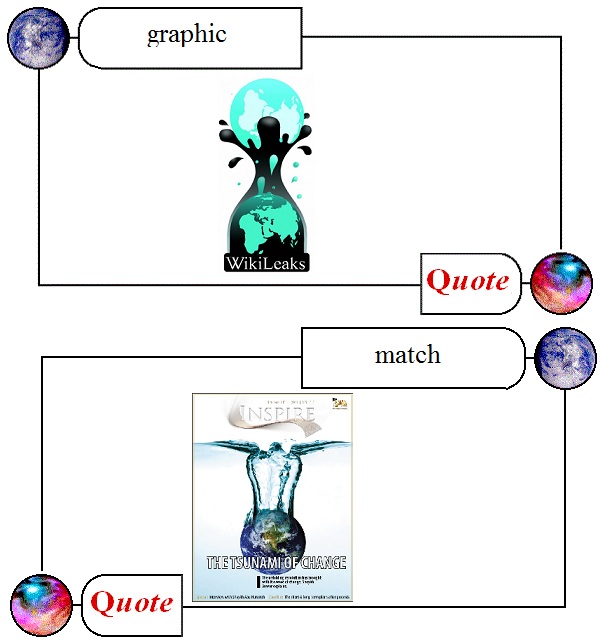
A tweet from @webradius via @azelin that I saw today noted that “the cover of Inspire 5 is remarkably similar to a wikileaks logo”.

I liked it.  And I’ve translated it here into my own DoubleQuotes format:

quographic-match.jpg

For those who are unfamiliar with the phrase, graphic match is another term for match cut — the gambit whereby one shot in a movie is directly juxtaposed to another with which it bears a close resemblance – essentially, a film director’s equivalent of rhyme.

Wikipedia gives two classic examples which are of particular interest to me because there is a “rhyme” between them, too, albeit a far more indirect one – the second being an hommage to the first.

Stanley Kubrick‘s 2001: A Space Odyssey contains a famous example of a match cut. After an ape discovers the use of bones as a tool and a weapon, there is a match cut to a spacecraft or satellite in orbit. The match cut helps draw a connection between the two objects as exemplars of primitive and advanced tools respectively.

Michael Powell and Emeric Pressburger‘s A Canterbury Tale contains the influence for the 2001: A Space Odyssey match cut in which a fourteenth century falcon cuts to a World War II aeroplane. The sense of time passing but nothing changing is emphasised by having the same actor, in different costumes, looking at both the falcon and the aeroplane.

*

Conclusion:

Parallelisms really are worth watching — always bearing in mind that one thing is never quite the same as another…

Of war and miracle: the poetics, spirituality and narratives of jihad

Wednesday, March 30th, 2011

[ by Charles Cameron ]

*

Issue #5 of the AQAP magazine Inspire is now available for viewing.

I am reasonably confident that with attention focused on such things as al-Awlaki‘s response to the various uprisings across the middle east, the delightful computer graphic (a throw back to the era of green print on black screens) which shows Ben Ali and Mubarak “booted” and Gadhafi and Saleh “in progress” – and the translation of a chunk of Abu Musab as-Suri on “Individual Terrorism Jihad and the Global Islamic Resistance Units” – a lot of eyes will glaze over during the course of reading “My Life In Fallujah” (pp. 56 ff).

The piece sounds promising – something to read about Fallujah from the enemy viewpoint for after action / lessons learned purposes… but then it gets into miracles:

The brothers received extraordinary miracles from Allah as a sign to strengthen them and these miracles were in all different forms. It got to the point where some of the things that occurred might not have been believable to the brothers had they not seen them with their own eyes but that is the grace of Allah which He bestows on whom He wills.

… and my bet is that snoring ensues…

Though not among the readers to whom it is pitched.

.
One:

What if we don’t regard the piece as a mirror for our own knowledge of events in Fallujah, but as an opening into the enemy’s grand narrative and – gasp – spirituality?

The piece continues:

Now let me relate some of the stories of fighting with the enemy and the miracles some of the brothers received. I will start mentioning some of these great miracles

There was a brother named Abu az-Zubair as-Sana’ani. He was killed at the beginning days of the battle. We used to go out in the daytime to engage with the enemy. Hardship and severe exhaustion were afflicting us due to the hot weather that was in the beginning of Ramadan.

So that brother came at the time of afternoon and sought permission from the Amir to break his fast. Some brothers advised him to have patience and suggested to him that he could have a shower and then rest for a while. The brother went inside to sleep out of fatigue and we were sitting in front of that house. The brother didn’t sleep long and we saw him coming out towards us with a cheerful face saying to us that he had seen a dream while he was asleep. The brothers asked him what was it; he told them that he saw a very beautiful woman coming to him, carrying a plate full of all kinds of fruits. She was waking him up, standing by his head and telling him: O Abu az-Zubair, don’t break your fast. You are invited to break your fast with us today. The brother then said that he felt comfort and relief. There was a brother called Abu Tariq who interpreted dreams so he told him that by Allah’s will, it will be something good. After that the brother decided to continue fasting.

We had a timetable for twelve people to cook food and that day was his turn. He went to the kitchen and we stayed outside, sitting next to the wall of that house so that we weren’t seen by the spy planes. We stayed there until it was about time to break fast. Suddenly an F-16
jet showed up in the horizon and targeted that kitchen with a missile where that brother was! A while after when the dust had settled, we went in the kitchen and saw that brother had been martyred. It was amazing how the smell of musk was all over the room, how the smile was on his face!

Thereupon the brothers’ moral was raised and they were making takbir. These were from the unforgettable moments.

It seems wise to compare this with the Miracle of Uthmaan recounted by Abdullah Azzam on p. 27 of his book, The signs of Ar-Rahmaan in the Jihad of Afghanistan — indeed, I’m surprised Inspire didn’t make the connection:

One morning Uthmaan (ra) said: Last night I saw Rasulullah sallAllaahu alayhi wa sallam in my dream, and he said: Oh Uthmaan, break your fast with us. He was martyred that same day, whilst in the state of fasting.

If one considers such stories not as “superstitious” or examples of “magical thinking” – one easy way to discount them – nor as “diabolic” and emblematic of a “false religion” – another – if, in fact, one reads them with some empathy for their content as faith-narratives, they are profoundly moving, and will no doubt be so to many of their intended readers.

This particular narrative – an earthly fast broken in heaven – could well be a motif in the Aarne-Thompson classification system for folkloric motifs.

Note also the reliance on dreams and dream interpretation – a reliance which also figures prominently in the transcript of bin Laden‘s discussion of 9/11.

.
Two:

Another miracle was the incident of Abu Abd ar-Rahman at-Turki who was a student of knowledge that memorized the Qur’an and the six books of hadith. He was amongst a group that went out to confront a breakthrough of the enemy. While the brothers were gathered to organize a defensive plan, this brother made takbir and rushed towards the enemy. Some brothers called him back but he didn’t pay attention to their words. He shouted back to them saying “I am seeing the hoor! I am seeing the hoor!” When this brother reached the enemy’s area, he was shot by a tank shell leaving his lower body completely severed. Some brothers managed to drag him out of there to a safe house which I was in. Even though the brother was between consciousness and unconsciousness, he was still advising brothers to fear Allah and to keep firm upon the truth. His lower half was ripped out, yet he was still reassuring the brothers and would always raise his vision upwards telling them that he is seeing the hoor coming, and that they should keep firm because this is the path of jannah. At hearing that, the brothers’ spirits were high and they felt relieved. Abu Abd ar-Rahman declared the shahada and then kept fainting until his soul departed his body. At that point we smelled the musk coming out of him and saw peace on his face. This smell of musk from the mujahidin would be something that was smelt regularly.

This “smell of musk” too (also found in the story of Abu az-Zubair above) is a regular feature of martyrdom tales, and features in the same work by Azzam, for instance in this report:

Moulana Arsalaan narrated to me:A student named Abdul Baseer attained shahaadat while with us. It was very dark. Fathullah, another mujaahid, and I went in search of his body. He said to me: “Is the Shaheed close. I perceive a fragrant scent”. I picked up the scent, and we reached the body by following the scent. In the darkness, I could see a noor (light) in the blood, which was gushing forth from his wound.

Indeed, as I have pointed out before, this motif has a parallel in the Catholic tradition of the “odor of sanctity” – “the perfume-like scent given forth by the bodies of saints during their lifetime or after death … symbols of the fragrance of extraordinary virtue” [as defined in Fr. John Hardon’s Modern Catholic Dictionary].

It appears in the Arthurian legends, too, as Malory describes the death of Sir Lancelot – notice here, too, the motif of the joyous dream:

And so after midnight, against day, the Bishop [that] then was hermit, as he lay in his bed asleep, he fell upon a great laughter. And therewith all the fellowship awoke, and came to the Bishop, and asked him what he ailed. Ah Jesu mercy, said the Bishop, why did ye awake me? I was never in all my life so merry and so well at ease. Wherefore? said Sir Bors. Truly said the Bishop, here was Sir Launcelot with me with mo angels than ever I saw men in one day. And I saw the angels heave up Sir Launcelot unto heaven, and the gates of heaven opened against him. It is but dretching of swevens, said Sir Bors, for I doubt not Sir Launcelot aileth nothing but good. It may well be, said the Bishop; go ye to his bed, and then shall ye prove the sooth. So when Sir Bors and his fellows came to his bed they found him stark dead, and he lay as he had smiled, and the sweetest savour about him that ever they felt.

.
Three:

There was a brother named Abu Dujanah at-Taifi. As soon as he entered Fallujah at the beginning of the battle, he asked the brothers to let him go to the front lines but the brothers told him that he had to learn shooting first. He replied, “By Allah! I won’t be anywhere except the front lines.” His brother was present there so they agreed to his request and allowed him to go there.Thereupon he said: ”By Allah! If the Americans come forward, then Allah will see from us that which He loves.” He then went to stay inside a trench to keep an eye on the front lines.On the second day when he saw the enemy breaking through, he jumped out and got ready to strike them with an RPG but before he could fire it, he was struck by a tank, and as a result, his body was torn apart. His body stayed there for six days before we were able to retrieve it.

To our surprise, blood was still coming out of his body even though the weather was so hot that if you were to place a piece of meat outside for half a day, it would eventually get rotten.

His blood was seeping as if he was just killed and his index finger was in the position of tashahud [that section of Muslim prayer where the index finger is raised while reciting the shahada or confession of faith]. His brother was a little bit sad at hearing the news but once he saw his body, he felt so much comfort.

E Cobham Brewer’s Dictionary of Miracles: Imitative, Realistic, and Dogmatic looks to be a terrific source for the kind of research I’m doing here – that’s the “Brewer” of Brewer’s Dictionary of phrase and fable – and p 372 of the 1894 edition has a section on “Bodies of Saints Incorruptible” prefaced by a quotation from Psalm 16.10: “Thou wilt not suffer Thy Holy One to see corruption”.

His body preserved, his finger raised in the gesture of  salat … powerful.

.
Four:

Another incident that has to be mentioned is when the Americans were breaking-through from the direction of the Shuhada district. The brothers in that area were few in numbers so they were attacked fiercely and their lines were nearly broken but all praise be to Allah, it started drizzling all of a sudden, and then the brothers were strengthened and encouraged. The enemy was fleeing so we did not know whether they fled because of the brothers fighting or because they saw something else. The enemy acted as though they had been frightened by something. The brothers only numbered six. The enemy was massive as they were accompanied by tank corps and armoured vehicles but their withdrawal was bizarre. At that time we remembered the verse of the Qur’an where Allah says:

And sent down upon you from the sky, rain by which to purify you and remove from you the evil [suggestions] of Shaytan and to make steadfast your hearts and plant firmly thereby your feet [8: 11].

Once again, the motif of merciful rain should not be unfamiliar to us – if not from the New Testament‘s “He makes His sun rise on the evil and on the good, and sends rain on the just and on the unjust” then at least from Shakespeare‘s “The quality of mercy is not strain’d, / It droppeth as the gentle rain from heaven / Upon the place beneath…”

.
Five:

How many references to literary analysis, or archetypal analysis for that matter, can you find in Heuer‘s classic Psychology of Intelligence Analysis?

Corn’s Caliphates in Wonderland

Saturday, March 26th, 2011


They Just Don’t Make Caliphates Like They Used To….

SWJ Blog featured a lengthy (30 page) essay by Dr. Tony Corn on….well….many things. Corn begins with caliphates and then sort of takes off much like a blown up balloon abruptly released by a child prior to tying a knot in the end.

The Clash of the Caliphates: Understanding the Real War of Ideas by Dr. Tony Corn

….For one thing, within the global umma, there appears to be as many conceptions of the ideal Caliphate as there are Muslims. This grass-roots longing for a symbol of unity should be heard with the proverbial Freudian -third ear,?? and seen for what it really is, i.e., a symptom rather than a disease. For another, by agreeing to establish diplomatic relations with the 57-member Organization of the Islamic Conference (OIC), America and Europe have, in essence, already granted the OIC the status of a Quasi-Caliphate.

More important still, it is time for Western policy-makers to realize that the ideological rivalry between Saudi Arabia and Iran that has been going on since 1979 constitutes nothing less than a Clash of the Caliphates. Through a soft power strategy blurring the distinction between -public diplomacy?? and -political warfare,?? -humanitarian aid?? and -religious propaganda,?? the two states have been the main drivers of the re-Islamization process throughout the Muslim world. The one-upmanship dynamic generated by the rivalry between these two fundamentalist regimes is the main reason why, from the Balkans to Pakistan, the re-Islamization of the global umma has taken a radical, rather than moderate, dimension.

Ok, “caliphates” as a metaphor/analogy for geopolitical rivalry of Muslim states works but it is not really what Islamists or normal Muslims would mean by the term. It is a very odd usage. I’m not overly bothered by that because I tend to like analogies but Corn’s device here is apt to make the heads of area studies and Islamic history scholars explode. The whole essay is in this meandering, idiosyncratic, vein.

Now that is not to suggest that you should not read the piece. Dr. Corn held my attention all the way through and he has a number of excellent observations on many, loosely related, subjects. For example, after discussing the pernicious effects of Saudi donations and Edward Said’s agitprop theory of “Orientalism” on the intellectual objectivity of academia, Corn writes:

…The combined effect of the House of Saud and the House of Said is the first reason why the Ivory Tower has done such a poor job identifying the nature of Muslim Exceptionalism. A more indirect, yet more insidious, reason is that, unlike in the early days of the Cold War, American academics across the board today are trained in social sciences rather than educated in the humanities. For social scientists, Explanation (erklaren) and -theory-building?? take precedence over Understanding (verstehen) and -policy-making. The victory of the -numerates over the -literates in the 1970s has produced a generation of scholars who show a certain virtuosity when it comes to -research design, but display an amazing lack, not just of historical literacy, but of -historical empathy as well. Not to make too fine a point: the Long War is being waged by a generation of policy-makers who, however articulate, never learned anything about history in their college years

Corn is spot on here. Not only is it spot on, it is likely to get much worse. After a brief qualitative “bump” from Iraq-Afghan war  language trained vets, diplos, analysts and spooks peters out, we will have the Gen Y kids with K-12 educations scrubbed free of history, foreign languages and science graduating from college with communication and marketing degrees and entering government service. Hang on to your hat when that happens.

What Corn really requires to vault his essays to the next level are the services of an experienced editor because less would be more. The man is erudite and insightful. He writes forcefully and raises a number of points that are important and with which I agree. Corn, commendably, also makes more of an effort to connect the dots than most. But maybe, if you have an essay that references David Kilcullen, Trotsky, neo-Ottomanism, lawfare, Sam Huntington, neo-COIN, Nasser, Vatican II, the Comintern, the Hapsburgs, Ataturk, public diplomacy, al- Qaradawi, social media, Fascism, Marc Lynch, Youtube, network theory, the UN, hybrid wars and the Protestant Reformation, it might be time to up the Ritalin dosage a notch. Jesus, there’s either a book proposal or four different articles in that kitchen sink of an op-ed!

Read it and take what is useful.


Switch to our mobile site