zenpundit.com » Afghanistan

Archive for the ‘Afghanistan’ Category

No man’s land, one man’s real estate, everyone’s dream?

Monday, August 17th, 2015

[ by Charles Cameron — borders and distinctions from Trump to Revelation, plus one ]
.

Donald Trump‘s “three core principles of real immigration reform”:

1. A nation without borders is not a nation.

**

G Spencer-Brown wrote of his book. Laws of Form, “The theme of this book is that a universe comes into being when a space is severed or taken apart” — or as Heinz Von Foerster rephrased him, “Draw a distinction and a universe comes into being”. Indeed, his book opens with the words:

We take as given the idea of distinction and the idea of indication, and that we cannot make an indication without drawing a distinction.

He writes:

Distinction is perfect continence.

That is to say, a distinction is drawn by arranging a boundary with separate sides so that a point on one side cannot reach the other side without crossing the boundary. For example in a plane a circle draws a distinction.

Similarly, Gregory Bateson defines an idea as “A difference or distinction or news of differences”.

**

Borders are both physical and metaphysical: the border between the physical and the metaphysical passes through human beings, who are themselves both metaphysical and physical.

Borders may thus be heeded or ignored.

Smugglers don’t necessarily ignore them, they may take them very seriously, as do those who police them. Birds, however, ignore them, fishes, lizards, languages..

There are would-be states that straddle national borders, as the Basque peoples straddle the border between France and Spain:
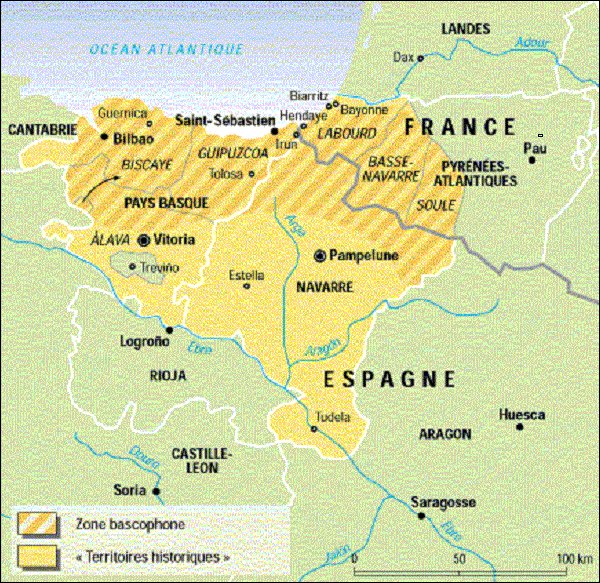
Basque France Spain 600

There are also would-be states that literally erase national borders, as in the case of IS bulldozing thw border between Iraq and Syria:
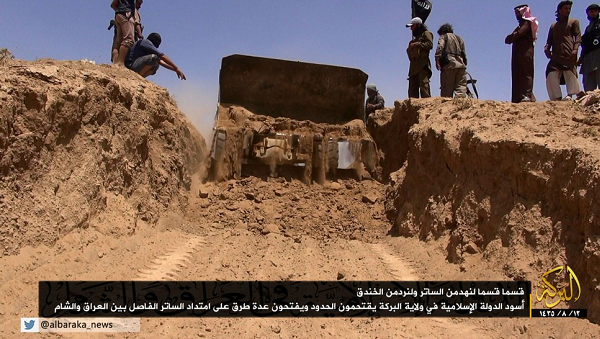
Iraq Syria Border 600

Thus while borders may be tidy in separating one from a second, they are also untidy in straddling them, neither one nor two, yet (like Janus) both.. They are, in short, thresholds, limina. And so wahat we know of liminality applies to them. I have discussed tthis previosuly on Zenpundit in Liminality II: the serious part — suffice it to say here that limiality is a condition that exacerbates, intensifies.

**

The anthropologist Mary Douglas, in her book Purity and Danger: An Analysis of Concepts of Pollution and Taboo, quotes Leviticus 19.19:

You shall keep my statutes. You shall not let your cattle breed with a different kind; you shall not sow your field with two kinds of seed; nor shall there come upon you a garment of cloth made of two kinds of stuff.

Why these disjunctions? Dougles notes the repeated refrain in just such contexts:

Ye shall therefore be holy, for I am holy

and points out that Ronald Knox correctly — if “rather thinly” — translates this:

I am set apart and you must be set apart like me

She then tells us:

Holiness means keeping distinct the categories of creation. It therefore involves correct definition, discrimination and order.

noting that:

The word ‘perversion’ is a significant mistranslation of the rare Hebrew word tebhel, which has as its meaning mixing or confusion.

and concludes

ideas about separating, purifying, demarcating and punishing transgressions have as their main function to impose system on an inherently untidy experience. It is only by exaggerating the difference between within and without, above and below, male and female, with and against, that a semblance of order is created.

**

The upper image, below, is taken from my recent post on Matrioshka cartography, and waas taken in turn from Say goodbye to the weirdest border dispute in the world in the Washington on August 1st..

SPEC DQ maps

… while the lower image is from Welcome to Liberland, the World’s Newest Country (Maybe) in the New York Times Magazine, dated Aug 11

**

Lydia Kiesling, in her post Letter of Recommendation: Uzbek in the NYT magazine today, writes:

National borders can be risibly at odds with reality, especially in Central Asia, where Turks, Mongols, Persians and others roved and mingled, where ‘‘Uzbek’’ was, for a time, more of a descriptive antonym of ‘‘Tajik’’ — no­­madic versus settled — than an ethnic classification.

And why not?

They are, after all, distinctions drawn in the mind, lines drawn on paper. Thus the Sykes-Picot map:

Sykes_Picot_Agreement_Map_signed_8_May_1916 600

Sykes was quite clear about the “lines dorawn on paper” part. He is reported to have said:

I should like to draw a line from the e in Acre to the last k in Kirkuk

The map, in other words, is not the territory: the map is a map.

To take another instance of importance in today’s world, the Durand Line:

Durand_Line_Border_Between_Afghanistan_And_Pakistan 600

Not only is the map not the territory in this case — it can be seen, as one-time Afghan president Hamid Karzai said, as “a line of hatred that raised a wall between the two brothers” — Afghanistan and Pakistan.

**

Sympathies which exist across borders can be potent forces for their dissolution. In a poem titled “Their Eyes Confer Fire” written in the 1980s about Basque country, I wrote

We have
little time,
Marie explained,
for those
who, because
it is hard
to draw
lines
across actual
mountains,
carve up
this earth on
paper.

France, Spain:
we disdain
boundaries, borders,
and border guards.

A canny reader noted that the entire poem could be read not as a description of the Basques as they exist in reality, but as a paean to the corpus callosum joining the two hemispheres of the brain — and thus the two modes of cognition of which I so recently wrote.

**

Returning to Lieberland, or Gornja Siga as the locals call it, we learn:

Gornja Siga has come, over the last few months, to assume an outsize role in the imagination of many — not only in Europe, but also in the Middle East and in the United States. Its mere existence as a land unburdened by deed or ruler has become cause for great jubilation. There are few things more uplifting than the promise that we might start over, that we might live in the early days of a better nation. All the most recent states — South Sudan, East Timor, Eritrea — were carved from existing sovereignties in the wake of bitter civil wars. Here, by contrast, is a truly empty parcel. What novel society might be accomplished in a place like this, with no national claim or tenant?

Consider one sentence alone as the key to that “outsize role in the imagination”:

There are few things more uplifting than the promise that we might start over, that we might live in the early days of a better nation.

The apocalyptic yearning here and its kinship with the Amrican dream are hard to miss — it is like a conflation of Matthew 5.14:

A city that is set on an hill cannot be hid.

with Revelation 21.1-2:

And I saw a new heaven and a new earth: for the first heaven and the first earth were passed away; and there was no more sea. And I John saw the holy city, new Jerusalem, coming down from God out of heaven, prepared as a bride adorned for her husband.

**

Plus:

Pete Turner on “Collecting Instability”

Friday, June 12th, 2015

[by Mark Safranski, a.k.a. “zen“]

Collection Center Collects Instability

Pete Turner of The Break it Down Show had a powerful post that encapsulated what is wrong with the American approach to intervention in foreign societies, both in terms of our aid and development programs as well as COIN and military assistance of various kinds.

Collection Center Collects Instability 

….A good example of what we did involves things called Collection Centers, which our government built to afford Afghan farmers a place to showcase products to vendors. The Center is supposed to create greater revenue for farmers. Despite the best of intent, and a lot of hard work, the program was and remains an utter disaster.

Why has the program been such a flop?

We, the US, came in and established these centers without ever considering how the existing system worked. We never bothered to determine how changing the system might be accepted or rejected, or cause harm to those we intended to help. We didn’t consider if the Afghans even had a system (which, of course, they did).

Instead of defining the existing system and assessing whether or how our tool might address a need, we just came in and started changing things It didn’t work, and we barely cared that it didn’t; and we reported the opposite.-

An aside–the if you read the report, look for mentions of Afghan involvement in the process. You won’t find it.  

I spoke with an Army Major in charge of the program and asked him about the existing local market chain from grower to consumer. He admitted that he didn’t know about it. When I asked why he was trying to change it, I was met with silence.

We also never considered if we were creating a harmful situation for farmers, and that ignorance caused unexpected and undesirable outcomes. At the most basic level, Taliban fighters notice “western” influence. A farmer who uses (though they never actually did) the collection center is exposing his allegiance with the US and therefore putting his family and himself in jeopardy. Further, the farmer buyer relationship is established relationship. Changing the nature of their transaction is reckless in such a conservative, Taliban influenced place. What we can’t do is create a situation that is perceived to increase uncertainty for farmers.

We built these centers throughout Afghanistan. At every instance, covering multiple units, I observed the same poor US decision-making. We never bothered to involve our Afghan partners in the decisions and never allowed them to guide us on how to work within their system. We forced these centers upon the people of Afghanistan, and wasted more than money and resources in the process. We wasted opportunities to actually improve the lot of the farmer, which makes de-legitimizing the Taliban fighters more challenging.

Read the whole post here.

Turner wore many different hats in Iraq and Afghanistan but in one extended tour in Zabul, Pete worked closely with political science Professor Richard Ledet, who in addition to his scholarly expertise, was uncannily good at donning local attire and blending in with Afghan villagers.

Dr. Richard Ledet

Turner and his partner Jon, interviewed Ledet recently on their program:

What happens when an institution attempts to make changes intending to improve the lot of others? What if they ignore culture and fail to communicate with the people designed to receive a benefit from the change? We address these questions in ourepisode with Dr. Richard Ledet.

We are fans of Rich. He’s a warrior, professor, surfer, hunter, all-around brilliant, rugged dude. His current gig is working as a Poli Sci professor at Troy University in Troy Alabama. Rich and I worked together in Afghanistan studying how effective or “affective” our work was as US assets helping Afghans. It’s not common for Poli Sci professors to get so close to the ground truth, and then to be able to test our policy and strategic programs as they implemented at the lowest level. This experience, we believe, is fascinating and applies directly to the real world.

Listen to the interview here on The Break it Down Show.

Considering various of the universes within this one

Sunday, May 31st, 2015

[ by Charles Cameron — 4th & last in a bizarre series [1, 2, 3] — I must confess I prefer the NASA stars to the game world, but Wm. Blake’s world to all the rest ]
.

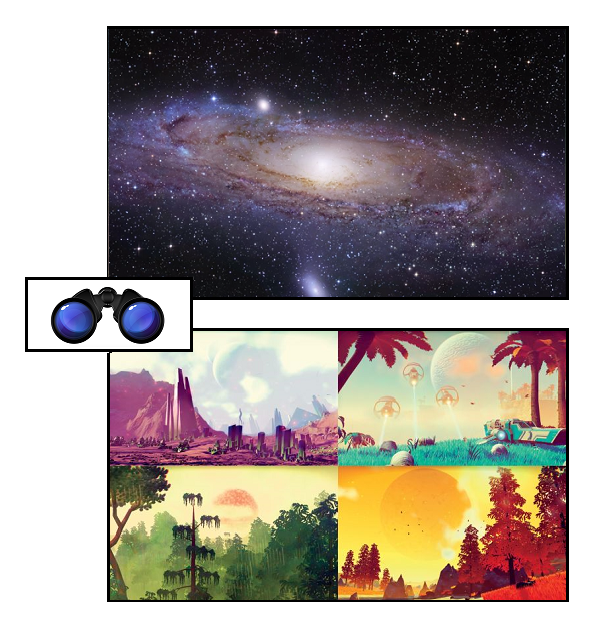
My curiosity today leads me to compare two “represented” universes, each of them pretty much guaranteed — not that I place great credence in guarantees these days — to blow my mind or at least my socks off, and / or to quake my universe!

SPEC DQ photo & game 02

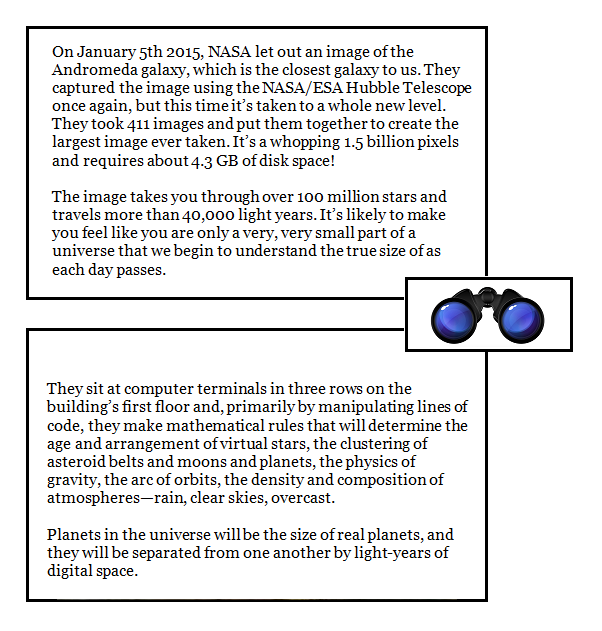
Here, to assist you in making your own comparison, are two text descriptions of the space photo (upper panel) and the game designs (lower):

SPEC DQ photo & game 01

My own feeling is that both are less awesome than their respective write-ups suggest: the NASA photo because it’s “awesomeness claim” is purely quantitative, whereas the universe is qualitative first and quantitative second; and the game images because they’re pale pastel imitations of our own world — fantastic, yes, but far from imaginative, to use the terminology Coleridge proposed.

Sources:

  • Joe Martino, NASA Has Released The Largest Picture Ever Taken. It Will Rock Your Universe
  • Raffi Khatchadourian, World Without End: Creating a full-scale digital cosmos
  • **

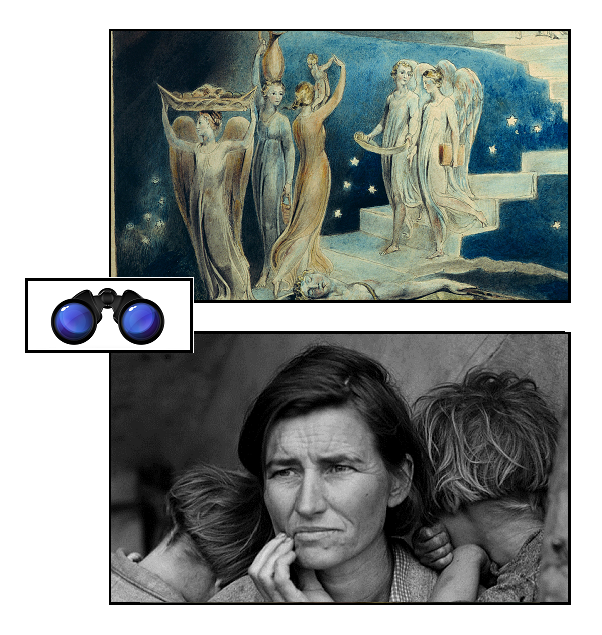
    To give us a sense of proportion — one that includes both qualitative and quantitative elements — here are some other images which, along with the ones from NASA and the game, give you a somewhat wider “range of universes” to consider — all of them in fact contained in the one we blog and read in:

    SPEC DQ Blake Lange

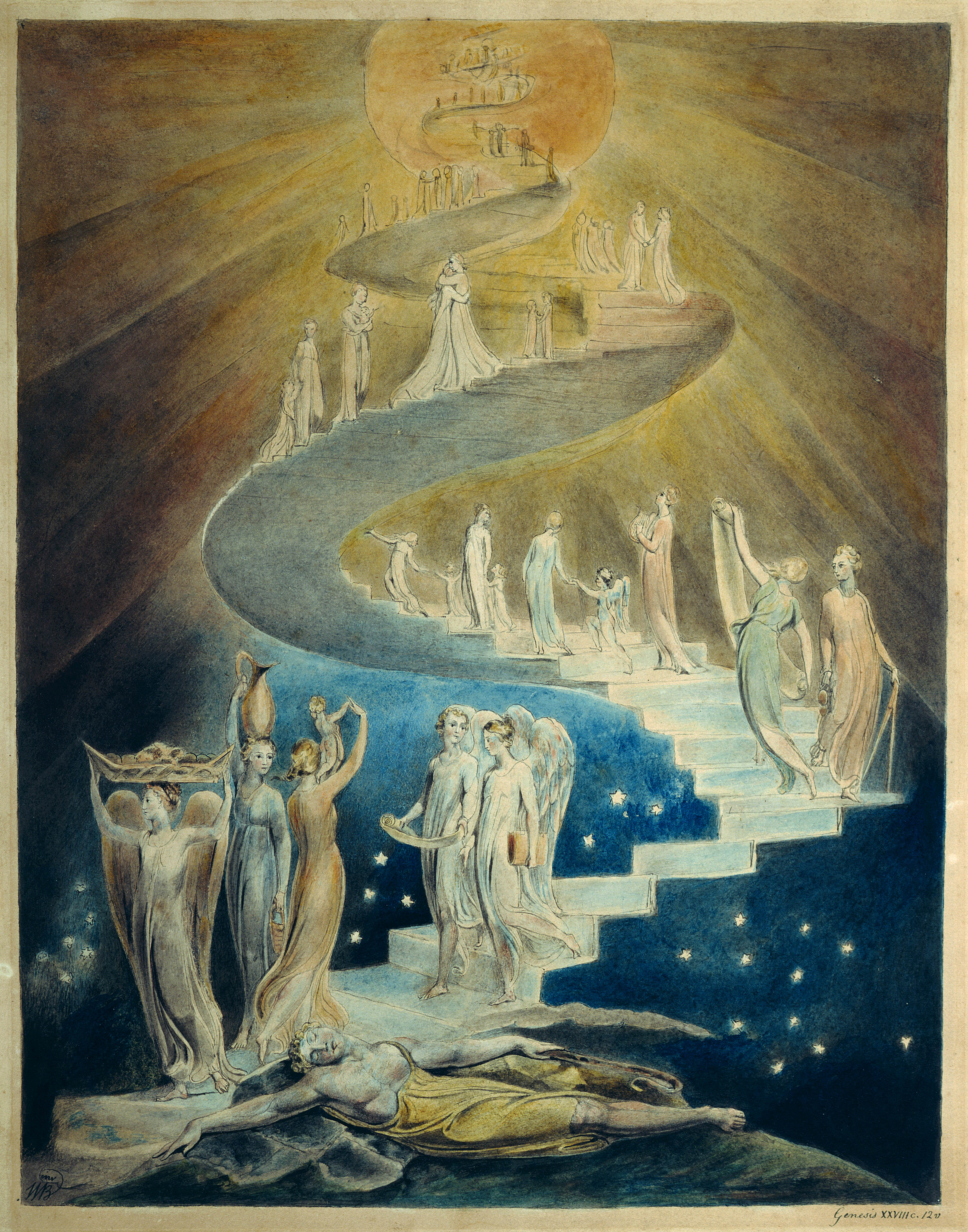
    The first pair shows two humanly-generated images, one by the visionary artist and poet William Blake, the other by the documentary photographer Dorothea Lange. Realism, meet mythic imagination.

    The second pair — aha! — shows two desert sports: one almost archaic in its brutality, the other something akin to post-modern. In the upper panel we glimpse the Afghan national sport of Bukashi, in which the headless carcass of a goat is captured and carried to the goal by terrifying horsemen; in the lower, one of the robot jockeys who have replaced child-jockeys in the camel-racing of Dubai.

    SPEC DQ buzkashi robot camel jockey

    Sources:

  • William Blake, Jacob’s Ladder
  • Dorothea Lange, Migrant Mother
  • L Lukasz, “BUZKASHI” in Mazar-e Sharif
  • Avax News, Robots replace Child Jockeys
  • **

    But let’s be fair to the two first screenshots at the top of the page. Here are the respective videos of the NASA Andromeda megapicture and the Hello Games’ No Man’s Sky for you to consider on their merits —

    — remember: there’s no accounting for tastes.. not even mine own.

    Break it Down Show – LTG Daniel P. Bolger

    Monday, March 30th, 2015

    [by Mark Safranski, a.k.a. “zen“]
      

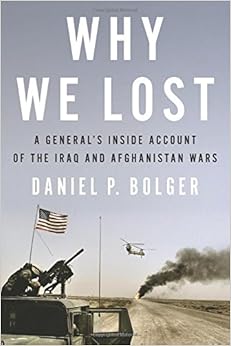
    Friend of ZP, Pete Turner and his partner Jon interview LTG Daniel P. Bolger, author of Why We Lost, at The Break it Down Show:

    The General’s Account – With Daniel P. Bolger 

    This is a great episode, a “must listen” event – insurgency, accountability, the GRU, the Taliban, counterinsurgency theory, ISIS, Boko Haram, strategy, “powerpoint generals”, ” the Fulda Gap Model”, ” we are the most irresponsible superpower in any era that I am aware of” and…..More!

    In Brief: Azzam illustrates Levi-Strauss on Mythologiques

    Friday, March 6th, 2015

    [ by Charles Cameron — the geometry of two miracle stories from Abdullah Azzam ]
    .

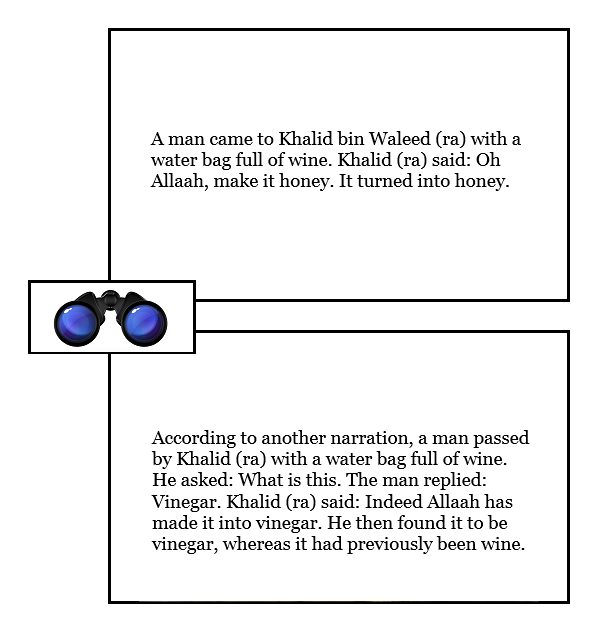
    SPEC DQ Azzam honey & vinegar

    These two tales are taken from Abdullah Azzam, Signs of ar-Rahman in the Jihad of Afghanistan.

    **

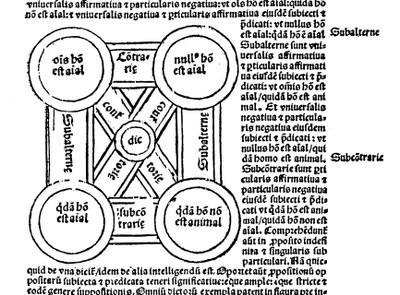
    Binary oppositions seem to be basic to the human thought process, and this simple, elegant observation has in turn given rise to a number of interesting philosopphical explorations, some of which are expressed perhaps most powerully in diagrams. I am thinking here of the medieval square of opposition — as in this diagram taken from Georg Reisch, Margarita Phylosophica tractans de omni genere scibili, Basel 1517:

    square_of_opposition SEMBL

    Algirdas Greimas developed his semiotic square from this medieval diagram —

    greimas_semiotic_square

    — and defines his square as the “visual representation of the logical articulation of any category”. In his “Towards a Theory of Modalities”, Greimas writes:

    the terms manifestation vs. immanence .. can be compared profitably with the categories surface vs. deep in linguistics, manifest vs. latent in psychoanalysis, phenomenal vs. noumenal in philosophy, etc.

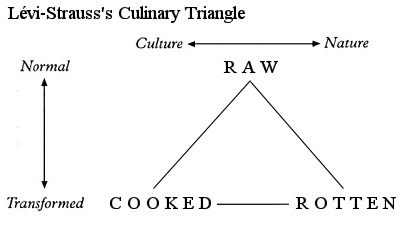
    Then there’s Levi-Strauss and his triangle, essentially a variant on the same idea, applied by LS in his magnificent 4-volume Mythologiques to a wide range of myths — here’s the basic triangle for the first volume, The Raw and the Cooked:

    LS culinary_triangle

    **

    What Reisch, Greimas and Levi-Strauss are all doing lies in its own distinct area of “visual thinking” at the confluence of logic, algebra, geometry and conceptual graphs — the same area my own DoubleQuotes and the HipBone and Sembl games are found in.

    When people think about narrative — and it is or should be as hot a topic in strategy and counterterrorism as it is in myth, story-telling, film and their various related forms of criticism — they tend to think linearly, from beginning to end, noting the emotional expansions and contractions, the narrative shifts, the crescendos before the climax and its resolution.

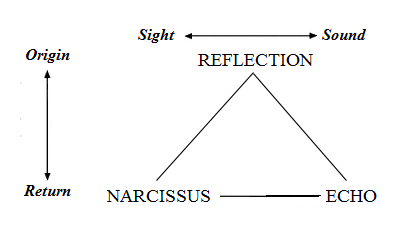
    My own style of thinking leans more to the atemporal or synchronic, which in turn is closer to the logical-algebraic-geometric-graphical mode of visual expression. Thus, for me, the “myth of Narcissus” is not a story-line but a geometry, a narrative formulation of the concept of reflection, or “bouncing back”. To adapt the Levi-Strauss triangle to the Narcissus narrative, then, we have:

    Reflection triangle

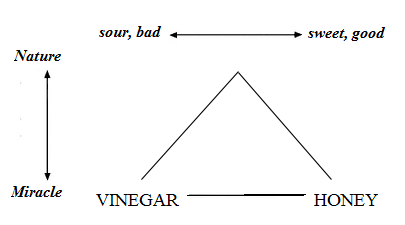
    while the two Azzam miracle tales in my DoubleQuote at the top of this post give us:

    Azzam triangle

    This in turn can become a square if we allow the four coordinates to be wine (intoxicant, bad), water (sobriety, good), vinegar (sour, bad) and honey (sweet, good). We notice here that water (sobriety, good) is the fourth which hovers unmentioned over the twin tales, just as Jung argued the dogma of the Assumption of the Virgin into heaven was the “fourth” which “completed” — nb, this is from a psychological perspective — the celestial Trinity of Father, Son, and Holy Spirit.

    It remains for Jalaluddin Rumi to transcend the duality of the halal (sobriety) and the haram (intoxication) in his praise of his master, Shams of Tabriz:

    In Shams al-Din-i Tabrizi you will discover a heart which is at once intoxicated and very sober.

    **

    In what sense or senses are Azzam’s two tales two, and in what sense are they one and the same?

    Sources & suggested further readings include:

  • The Raw and the Cooked: Mythologiques, Volume 1
  • Anthropology for Beginners
  • Structure, Sign, and Play in the Discourse of the Human Sciences
  • The Dual and the Real
  • Semiotics for Beginners
  • Semiotics and Language
  • Visual Memory (handbags!)
  • Punctualization: Law and Greimas
  • Square of Opposition
  • Visualizing knowledge
  • Signs of Ar-Rahman
  • Mystical Poems of Rumi

  • Switch to our mobile site