zenpundit.com » social science

Archive for the ‘social science’ Category

Octavian Manea interviews MIT’s Roger D. Peterson

Friday, April 19th, 2013

Another installment of Octavian Manea’s excellent COIN interview series at SWJ. This one focuses on social science and varieties of insurgency:

Breaking Down “Hearts and Minds”: The Power of Individual Causal Mechanisms in an Insurgency 

….OM: In your research you pointed out to a spectrum of conceivable individual roles in an insurgency. What is the methodology behind this typology?

RDP: This methodology comes from my 2001 book (Resistance and Rebellion: Lessons from Eastern Europe) which focused on Lithuanian resistance to Soviets in the 1940’s. Insurgency is a complex phenomenon, especially in how violent organization and networks are created and sustained, and the methodology of that book involved breaking down this complexity into component parts and then building back up into a coherent whole. At the base of this process is the way individuals position themselves relative to the dramatic and violent events of insurgency. Most people may wish to remain neutral and just take care of their families but events push significant numbers of individuals into roles of unarmed support of insurgents, or local armed position of a militia, membership in a mobile non-local organization, or equivalent positions in support of the government.  Furthermore, individuals may move back and forth along this spectrum of roles. If one is skeptical of broad and vague theories at a high level of aggregation, as I am, then you need to get down and observe dynamics at a basic level. Observing movement along this spectrum of roles is one way to do that. 

…..Is it FM 3-24 and the whole contemporary Western COIN discourse too narrow, too much focused on rational, cost/benefit models of decision-making? Is it too restrictive when making this inventory of driving motivations or causal mechanisms?

RDP: I think there is a tendency in the Western academic analysis to focus on rational theories. Those theories are straightforward.  But they also might be too straightforward, too simple.  In Iraq, the coalition did not plan on the emotion of resentment stemming from a status reversal affecting Sunni calculations in the beginning stages of the conflict. We did not understand the revenge norms that exist in some of the places. We did not fully understand the social norms that helped to produce the tribal militias in Anbar province.  We did not understand the psychological mechanisms underlying the Sunni view of the new world they were living in. 

The last part is a curious lacuna.

The incompetence of the planning for the occupation of Iraq has been amply recorded – the high level disdain of General Tommy Franks and Secretary Rumsfeld for what befell the day after victory, the keeping of professional Arabists at arms length in preference for Beltway contractors and college kids with AEI connections, the haplessness of Jay Garner and the political obtuseness of Paul Bremer ad so on. This is not what I mean about lacuna.

I mean something more fundamental, in terms of understanding human nature as the root of political behavior and therefore political violence. We are all familiar with the Clausewitzian trinity (or should be) but less attention is paid to the motivational factors that make men decide to stand, fight and die or stand aside. Thucydides also had a trinity that did not attempt to capture the nature of war but rather explain why wars happened and it seems to me to be of particular use for evaluating the decision in small wars to pick up a gun or not, to side with the government or join the rebellion:

“Surely, Lacedaemonians, neither by the patriotism that we displayed at that crisis, nor by the wisdom of our counsels, do we merit our extreme unpopularity with the Hellenes, not at least unpopularity for our empire. That empire we acquired by no violent means, but because you were unwilling to prosecute to its conclusion the war against the barbarian, and because the allies attached themselves to us and spontaneously asked us to assume the command. And the nature of the case first compelled us to advance our empire to its present height; fear being our principal motive, though honour and interest afterwards came in. And at last, when almost all hated us, when some had already revolted and had been subdued, when you had ceased to be the friends that you once were, and had become objects of suspicion and dislike, it appeared no longer safe to give up our empire; especially as all who left us would fall to you. And no one can quarrel with a people for making, in matters of tremendous risk, the best provision that it can for its interest. 

Fear, honor and interest are ever present in “calculation” both by men and by the political communities they compose and the factions that threaten to tear them apart. All the more so in a defeated and broken country divided by ethnicity and sect where all parties were uneasily eyeing the conqueror. No special knowledge of Arab culture should have been required to anticipate that Iraqi men, if made desperate by uncertainty and circumstance, might have at least seen it in their interest to achieve some measure of security with the gun and to enact policies of carrots and sticks a priori to discourage that, before the insurgency gained critical mass.

Awareness of the universality of the Thucydidean trinity would not have in itself guaranteed success in Iraq but knowing it is a rudimentary minimum of political competence upon which you can at least build.

Elkus on Policy Relevance

Monday, February 18th, 2013

Intriguing and vigorously argued piece by Adam over at Abu Muqawama

Relevant to Policy?

Are we in a 1914 scenario in East Asia? How often do guerrillas succeed? Did counterterrorism law erode national sovereignty? These are just a few of the important questions that political science has some bearing on. Yet barely a couple months goes by without an op-ed decrying political science’s alleged lack of relevance to the outside world.

Political scientists are frequently told their research is too arcane, mathematical, and self-involved to be of possible value to anyone in Washington dealing with real-world policy problems. There’s a grain of truth here. As international political economy whiz Kindred Winecoff observes, political scientists need to make a better “elevator pitch.” But here’s the problem: at the end of the day, there is a difference between what Max Weber dubbed science as a vocation and the subjective policy lessons we can take from our study. Part of that gap is reflected in the difficulties that people with purely policy interests inevitably encounter in PhD programs.

From my own (minor) experience so far, it is grueling, necessitates the assimilation of difficult methodologies, and involves having to think about intellectual questions that many people would regard as hopelessly arcane. Even a good PhD program that directly tackles policy questions will likely demand the student grapple with questions of esoteric theory and method. And not all research that tackles highly abstract questions is policy-irrelevant. Highly technical analysis of game theory and economics generated useful policy applications form the World War II convoy system to nuclear strategy and wargaming.

All of these advances began from the desire to grapple with difficult questions to produce knowledge, something many critics of political science research do not acknowledge. Take Greg Ferenstein, who penned an article supporting Eric Cantor’s call to defund the NSF. His gripe is familiar. Political science is obscuratist, hyper-mathematical, and disconnected from the policy world. Political scientists don’t do enough to make their research accessible to policymakers. Ferenstein wants a political science that his mother-in-law can understand, and he thinks starving academia of resources will motivate hungry researchers to do better. So is modern political science irrelevant to policy needs?

Contra Ferenstein, policymakers have thrown substantial $$ at the kind of research he regards as navel-gazing arcana. The RAND Corporation got a lot of mileage using what Ferenstein derides as “clever mathematical models” during the Cold War.  I’m not sure that Jay Ulfelder, who worked for the intelligence community-funded Political Instability Task Force, would agree that his quantitative forecasting methodologies must pass a mother-in-law test to be valuable. And when New York University’s game theory guru Bruce Bueno De Mesquita speaks, the CIA listens. Drew Conway, a man that could easily teach a computer programming course just as well as poli-sci 101, gives invited talks at West Point on analyzing terrorist networks. I don’t think Ulfelder, Mesquita, or Conway have sleepless nights pondering the relevance of their research to the govermment!

Read the rest here 

As an aside, I have found Ulfelder’s posts on his research or comments on the field at Dart Throwing Chimp to be very useful and worth reading.


Robb on the Networked Age

Saturday, February 16th, 2013

John is en fuego today:

Life in a Networked Age

.….In the last thirty years, we’ve seen a shift in the technological substrate.  This new susbstrate is increasingly a family of technologies related to information networks.

As this new substrate begins to take control, we’re going to need new management forms.  Both bureaucratic and market systems are proving insuffient solutions to the challenges of a networked age.  

In both cases, the emergence of a global network is eroding the efficacy of bureaucracy and markets as solutions.  How?  One reason is scale.  

A global network is too large and complex for a bureaucracy to manage.  It would be too slow, expensive, and inefficient to be of value.  Further, even if one could be built, it would be impossible to apply market dyanmics (via democratic elections) to selecting the leaders of that bureaucracy.  The diversity in the views of the 7 billion of us on this planet are too vast.  

In terms of markets, a global marketplace is too unstable.   Interlinked, and tightly coupled markets are prone to frequent and disasterous failures.  Additionally, a global marketplace is easy for insiders to corrupt and rig, as we saw with the 2008 financial melt-down.   Given instability and unmitigated corruption, markets will fail as a decision making mechanism.  

So, what’s going to replace bureaucracy and markets?

Read the rest here.

In very strong agreement with John. I like markets and think they produce efficient and optimized results for many things ( not all things) but free markets currently face massive (and sadly bipartisan) efforts to rig them by the oligarchy here at home, much less in autocratic states where the  practice of state socialism, kleptocracy and government by mafia or tribal/sectarian minority is the norm.  People will seek work-around structures to adapt, thrive and evade extortionate schemes by elites that have hijacked the state.

Hat tip to Lexington Green

The Controversial CTC Report

Friday, January 25th, 2013

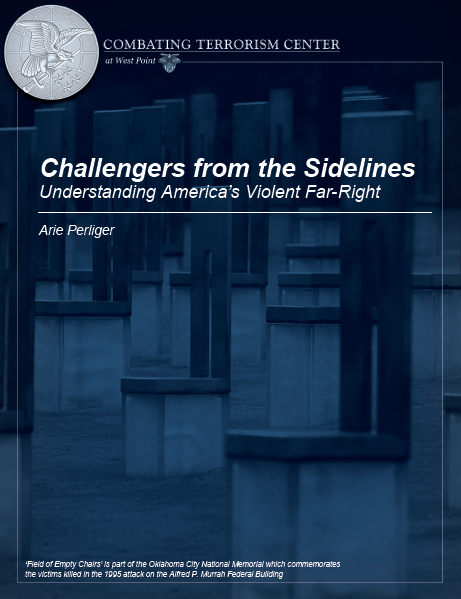
The Center for Combating Terrorism at West Point released a report on domestic terrorism that raised hackles for a number of reasons. Despite the dismissals of liberal political pundits, the reasons for objections to the CTC report are legitimate but they did not need to arise in the first place and might have been avoided with a slightly different editorial approach or appropriate caveats (I just finished reading the report, which is primarily focused on the usual suspects). Here’s why I think the normally well-regarded CTC stumbled into a hornet’s nest:

First, in this foray into domestic terrorism analysis, the center chose to concentrate only on the threat of violence of the Far Right while ignoring other threats coming from the Far Left, infiltration by criminal insurgent networks from Mexico, notably the ultraviolent Zetas whose reach has stirred gang violence in Chicago and Islamist terrorism, either homegrown “lone wolves” or from foreign infiltration or subversion. In itself, this is understandable if the CTC plans a series of reports with a separate focus on different domestic threats; but without that context, it is a myopic analytic perspective, particularly given the demonstrated capabilities of various AQ affiliates or just south of the border, the criminalinsurgency of  the narco-cartels. Had all of these been addressed in one omnibus report, any complaints from conservatives were likely to have been muted or nonexistent. This is not to say that the radical American Far Right does not have a violent threat potential of it’s own worth studying; it does and it is real. But available evidence indicates it to be the least organized, least operationally active and least professionally competent in terms of terrorist “tradecraft” of the three.

The second and most problematic aspect of the report is an intellectually sloppy definition of a dangerous “antifederalist movement”  where noxious concepts like “white supremacy” and wacko conspiracy theories are casually associated with very mainstream conservative (or even traditionally bipartisan !) political ideas – coincidentally, some of the same ideas that contemporary “big government” liberal elites tend to find irritating, objectionable or critical of their preferred policies. Part of the equation here is that American politics are evolvng into a very bitterly partisan, “low trust” environment, but even on the merits of critical analysis,  these two passages are ill-considered and are largely responsible for most of the recent public criticism of the CTC:

….The antifederalist rationale is multifaceted, and includes the beliefs that the American political system and its proxies were hijacked by external forces interested in promoting a “New World Order” (NWO) in which the United States will be absorbed into the United Nations or another version of global government.  They also espouse strong convictions regarding the federal government, believing it to be corrupt and tyrannical, with a natural tendency to intrude on individuals’ civil and constitutional rights.  Finally, they support civil activism, individual freedoms, and self government

….In contrast to the relatively long tradition of the white supremacy racist movement, the anti-federalist movement appeared in full force only in the early to mid-1990s, with the emergence of groups such as the  Militia of Montana and the Michigan Militia. Antifederalism is normally identified in the literature as the “Militia” or “Patriot” movement. Anti-federalist and anti-government sentiments were present in American society before the 1990s in diverse movements and ideological associations promoting anti-taxation, gun rights, survivalist  practices,and libertarian ideas 

This is taxonomic incoherence, or at least could have used some bright-line specifics ( like “Posse Commitatus” qualifying what was meant by “anti-taxation” activists) though in some cases, such as “libertarian ideas” and “civil activism”, I’m at a loss to know who or what violent actors they were implying, despite being fairly well informed on such matters.

By the standard used in the first paragraph, Glenn Greenwald, Ralph Nader and the ACLU would also be considered “far right antifederalists”. By the standards of the second, we might be in physical danger from Grover Norquist,  Congressman John Dingell and Penn Jillette. No one who opposed the recent increases in income tax rates, dislikes gun-control or thought the DOJ may have abused it’s power in the prosecution of Aaron Swartz or in their stubborn refusal to prosecute Bankster racketeering is likely to welcome a report under the auspices of West Point that juxtaposes such normal and perfectly valid American political beliefs with neo-Nazism. A move that is simply going to – and quite frankly, did – gratuitously irritate a large number of people, including many in the defense and national security communities who are a natural “customer base” for CTC reports.

As I said previously, this could easily have been completely avoided with more careful use of language, given that 99% the report has nothing to do with mainstream politics and is concerned with actors and orgs with often extensive track records of violence. As the CTC, despite it’s independence, is associated so strongly with an official U.S. Army institution, it needs to go the extra mile in explaining it’s analysis when examining domestic terrorism subjects that are or, appear to be, connected to perfectly legitimate participation in the political process. This is the case whether the subject is on the Left or Right – few activists on the Left, for example, have forgotten the days of COINTELPRO and are currently aggrieved by the activities of Project Vigilant.

I might make a few other criticisms of the report, such as the need for a better informed historical perspective, but that is hardly what the recent uproar was about.

“The Galula Doctrine”

Wednesday, January 23rd, 2013

Small Wars Journal has published another edition of the excellent COIN interview series conducted by Octavian Manea. Here he interviews A.A. Cohen, author of Galula: The Life and Writings of the French Officer who Defined the Art of Counterinsurgency 

The Galula Doctrine: An Interview with Galula’s Biographer A.A. Cohen

OM: Which were the role of Mao and the exposure to Chinese civil war in Galula’s story? It seems to be his decisive formative lab experience like Russia was for George Kennan.

AAC: Unquestionably, of all the influences exerted on Galula’s treatise, Mao and the Chinese Civil were the greatest. Galula had a strong intellectual admiration for Maoist revolutionaries, despite being very opposed to what they stood for. Before the Chinese Civil War, Galula had no interest in insurgency or counterinsurgency. He had not fought as a Partisan during WW2; he had no experience or interest in these fields until he was exposed to China as of late 1945, in the thick of its civil war. There, his analytical penchant led him to see himself as the decipherer of Mao, intent on getting to the bottom of what the revolutionaries were fundamentally about. Galula cut through the egalitarian propaganda and all that surrounding the People’s revolution. Above all, he wanted to understand why these guys were gaining momentum as they were despite the unfavorable odds. When he figured it out, he reverse-engineered their methods to arrive at a counter-process to revolution and insurgency. His embrace of Chinese dialectics, and with these, the notion of unity of opposites or yin and yang, was helpful in achieving this.

Is counterinsurgency to Galula more of a strategy or  more of a technique and a methodology?

What Galula offers, first and foremost, is a doctrine – not a strategy. His doctrine is underpinned by an important theory about people and what motivates them to take up arms, or to side with those who do. The theory goes that in times of danger (war), the majority of people will be motivated primarily by a fundamental need for security. Galula is adamant about this. But he also recognizes that there will be a minority of people – the instigators at the core of a movement – that will be ideologically, or even fanatically motivated. These are the true believers. He makes no qualms about prescribing that this is the group that the counterinsurgent or counterterrorist will need to find and neutralize, while protecting the rest of the population that aspires to a normal, if not better life. If you buy into this theory, Galula’s doctrine offers a multi-step framework for operations; in other words, a method to counterinsurgency. His famous eight steps are there to provide some logical linearity to what is otherwise a very nonlinear form of warfare. Within that framework, you have the flexibility to formulate your strategy and to conduct your operations to achieve your objectives.

Read the rest here.

I agree that Galula was not offering a strategy. Even more strongly, I think Cohen is correct about the historical importance of China’s long period of disorder, from the overthrow of the Q’ing dynasty to Mao ZeDong’s declaration of the People’s Republic, for Galula. However, not just for him but for anyone interested in questions of war and statecraft where insurgency, warlordism, state failure, state-building, foreign intervention, balance-of-power politics, ideological mass-movements, 4GW, revolution and total war coexisted and co-evolved.

The best comparison in our lifetime to China in this period would have been Lebanon  in the 1980’s, except that China’s polycentric conflict was even more complex and on an epic scale.


Switch to our mobile site
