zenpundit.com » social science

Archive for the ‘social science’ Category

Apocalyptic Vision: Guest Post by Charles Cameron

Thursday, August 27th, 2009

I am pleased to have as a guest-blogger, Charles Cameron, who is the former Senior Analyst with The Arlington Institute and Principal Researcher with the Center for Millennial Studies at Boston University. He specializes in forensic theology, with a deep interest in millennial, eschatological and apocalyptic religious sects of all stripes.

MAHDISM IN THE NEWS

by Charles Cameron

I.

What’s this about the Mahdi and a call for Islamic mobilization?

Al-Arabiya carried what seems to me to be a significant article about the Mahdi, Islam’s end-times savior on August 17th. The report stated that the personal representative of the Supreme Leader was calling on Iran’s neighboring states “to mobilize their forces in preparation for the coming of the savior of Islam”.

Ayatollah Ali Khamenei’s spokesman, Ali Saeedi, said countries like Turkey, Iraq, Lebanon, Pakistan and Afghanistan should gather together all their forces in order to make drastic changes to prepare for the coming of al-Mahdi al-Montazar, Arabic for “the awaited guided one.”

“We still have a long way to go in order to achieve this. We have to train honest forces that can stop the obstacles that may hinder the coming of the Mahdi like the United States and Israel,” Saeedi said in statement posted by the Iranian Labor News Agency (ILNA).

Muslims must unite for Islam’s Savior: Iran, Al-Arabiya, Monday, 17 August 2009

That’s a call to arms, put out by a Shi’ite nation state, and addressed to Sunni and Shi’ite alike — and it drew almost no attention in the western press.We can safely disregard it, right? After all, Mahdism is a Shi’ite phenomenon, and whereas Iran has a conservative rearguard that expects the Mahdi’s soon-coming along with President Ahmadinejad, the Sunni world has no time for that kind of thing.

Except that bin Laden seems to share the apocalyptic expectation, if not the exclusively Shi’ite details — the view that the Mahdi has already been born once, into a Shi’ite family, and is presently in occultation prior to his soon return.

So I am not arguing that we should worry too much about Turkey, Iraq, Lebanon, Pakistan and Afghanistan all deciding to join forces with the Iranian Republican Guard any time soon. But I am arguing that we should be alert to Mahdism — and more generally, Messianism — as a contemporary driver.

II.

It so happens that Steve Coll was on the radio again this week, in a rebroadcast of a talk he gave in April, and here’s some of what he had to say on the subject of Osama bin Laden:

It’s a mistake to see him entirely as a political, or even to some extent mostly, as a political leader. He has a purchase on these grievances and he understands them and I’m sure he feels them — but he’s also a millenarian: he believes that he’s been called by God to wage a war that will only conclude at the end of time. He hasn’t built a political movement, he doesn’t offer any social services, he doesn’t build a hospital — he thinks he’s fighting until the end of time, that he’s carrying out a narrative that’s pre-ordained, and that his role is to awaken God’s followers to their righteous role so that they can pass to the next phase. And so there is this interaction of millenarian, apocalyptic thinking on the one hand — which justifies all violence — and this sort of terrestrial political critique on the other. And what happens when you read his statements in the west is that, well, everyone can understand the political critique, so that gets all the attention — and people’s eyes glaze over at the rest because it’s a little bit hard to digest. But when you read it in full it’s a very, very important aspect of why he’s doing what he’s doing and who he thinks he is.

Steve Coll, talking about his book The Bin Ladens for the World Affairs Council.

Should that surprise us?

Not if we noted Bin Laden’s quotation of the “Gharqad tree hadith” — which specifies the nature of the end times conflict:

Doomsday shall not come until Muslims fight Jews. A Jew would be hiding behind a tree or a stone. The tree or the stone would say, O Muslim, O subject of God, there is a Jew behind me come and kill him. The only exception is [Gharqad] tree is a tree that belongs to Jews.

and his comment:

Whoever claims that there is lasting peace with the Jews is a disbeliever of what the prophet, may the peace and blessings of God upon him, said. Our conflict with the enemies of Islam will continue until Doomsday.

No definite timeline is given, and bin Laden also remarks that his father waited forty years for the Mahdi — and indeed set aside $12 million to support him on his arrival — but the appeal is to end-times expectation,

FWIW, this isn’t the only time bin Laden has quoted the Gharqad tree hadith, and it is also quoted in the Charter of the Hamas — for more on the topic, see Anne Marie Oliver and Paul Steinberg, The Road to Martyrs’ Square, pp 19-21, and watch this chilling MEMRI video from of Sheikh Muhammad Al-Arifi, speaking on Al Aqsa TV, September 2008.

III.

Why is eschatological or apocalyptic rhetoric significant?

It is an accelerant. Simply put, it is a force-multiplier, acting on morale via the sphere of religion, by providing divine sanction for violence — zeal with a deadline.
.
Apocalyptic expectation is in part the expectation that “all the injustices of the old world will be put right” very soon, as Damian Thompson noted, and it creates “an especially potent form of charismatic authority, one that rubs off on ordinary believers as well as the prophet.” This extraordinary empowerment of the individual believer comes about because “foreknowledge about one of the most important subjects imaginable — the fate of the planet — creates a special, even intimate, bond between those who share it”:

In every case, the most striking feature of the millennial theodicy is the contrast between present misery and the glory to come: the latter justifies and makes tolerable the formed.

It may also justify and make tolerable the use of violence in the lead-up to apocalypse, as it clearly does in both the Shi’ite call to arms and the Sunni hadith quoted above. And furthermore, in all these cases the misery is the fruit of sin, whereas the glory is the glory of God.

The nature of millennial expectation is conditioned by culture, yet cross-cultural in its basic patterns, and transcendent in its authority. Thompson goes on to note that “the anticipation of violence does not constitute a cost of millenarianism, since the blood being shed will be that of the unsaved” — and Kerry Noble put the point quite succinctly in his retrospective account of a Christian millenarian movement he later left:

I was not looking forward to the coming war, but I was looking forward to the Kingdom of God that was to follow. That’s how many of us rationalized being soldiers of God. We wanted peace, but if purging had to precede peace, then let the purging begin.

Ahmadinejad or bin Laden might say much the same.

IV.

Who is awake to this pervasive strand of eschatological thinking, among the Shi’a, among the Sunni, and among ourselves?

I cannot speak for the intelligence community, except to say that a rational, secular analyst monitoring these matters is liable to note the “blips” of open source intel but miss the fire that underlies them. Or again, as Steve Coll put it,

people’s eyes glaze over at the rest because it’s a little bit hard to digest.

That’s not a feature — that’s a bug.

Some on the Christian right get it, because they live in the apocalyptic realm themselves. The two Joels, Rosenberg (author of Epicenter) and Richardson (author of The Islamic Antichrist), were among the few to blog Ali Saeedi’s comments, with Joel Rosenberg picking up on a piece on WND that quotes Joel Richardson, whose own blog,  Joel’s Trumpet, monitors Islamic apocalyptic closely from a Christian apocalyptic perspective.

But short of actual apocalyptic belief of one’s own — which will generally cause one to disparage if not dismiss the equivalent apocalypses of others — it takes an ear open to the whisperings of myth and dream, a mind open to the logic of music and poetry to understand such thinking, such imaginings.

Michael Vlahos of Johns Hopkins, the author of  Fighting Identity: Sacred War and World Change, certainly gets it, noting that 9/11 was the work of Holy Warriors “passionately steeped in ancient Muslim apocalyptic” — and that we responded “with out own brand of American apocalyptic”. Daniel Benjamin and Steven Simon, senior members of Clinton’s National Security Council get it — noting in their book, The Age of Sacred Terror, that “so much of what was heard from al-Qaeda after the attacks sounded to Americans like gibberish that many chords of the apocalypse were missed.”

Ali Allawi knows it, and dedicated his 2007 talk at the Jamestown Foundation to noting the “under the radar” existence and significance of Mahdist millennialism in Iraq.

But who else?

V.

When the overtly millennial year two thousand CE was approaching, Boston University hosted the Center or Millennial Studies, brainchild of Richard Landes of BU and Stephen O’Leary of USC, and for almost a decade scholars gathered for conferences to share the commonalities and differences between millennial movements from before the birth of Christ to the coming century and beyond.

When the roll-over to 2000 passed without major apocalyptic incident, the Center closed — but the millennial season was not over, it has only just begun.

Just this month I saw a “birther” — someone who believes President Obama was born in Kenya, and is thus not eligible to be president of the United States — tying that position in with Joel Richardson’s “middle eastern” antichrist: apocalyptic fervor once again enhancing a political stance. There will be more…

We will keep seeing millennial outpourings of zeal — and perhaps, though not always, violence — at least until 2012, when Mayan calendar enthusiasts (and apparently some readers of the jihadist online magazine, Jihad Recollections, issue 3) expect apocalyptic changes. And if the world staggers through to 2013 then at least to 2033, when many Christians will no doubt wish to celebrate the 2000th anniversary of the crucifixion and resurrection of their Savior. And should that not suffice for an ending of an age, at least till the turn of the next Islamic century in 1500 AH or 2076 CE and arrival of that century’s mujaddid or “reformer”. Or indeed the climactic battle between Islam (represented by the Mahdi) and Buddhism, predicted, curiously enough, in one of the Dalai Lama’s preferred texts — the Kalachakra or Wheel of Time Tantra — to take place in 2424 CE..

VI.

Perhaps we should take a hint from the Kalachakra, which in addition to positing an end times war, suggests that this is no more than a “a metaphor for the inner battle of deep blissful awareness … against unawareness and destructive behavior”. Gandhi said much the same about the battle of Kurukshetra in the Bhagavad Gita.

One might wish that all apocalyptic believers felt that way: they don’t.

Three Short Reviews

Wednesday, August 26th, 2009


Emergence: The Connected Lives of Ants, Brains, Cities, and Software by Steven Johnson

This classic popular text from 2001 still holds up well as an introduction into the phenomena of emergence and the nature of self-organizing systems. Johnsaon uses a rich array of analogies and historical anecdotes to bring the reader to an understanding how bottom-up, “blind”, systems work and the principles behind them. Highly readable and next to no jargon. Probably due soon for an updated edition though, given the scientific advances in research in network and complexity studies.

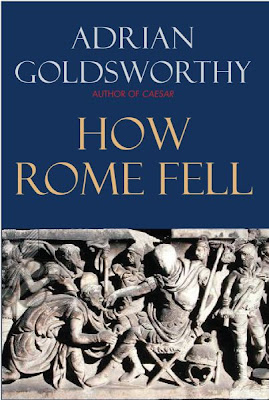
How Rome Fell: Death of a Superpower by Adrian Goldsworthy

Superb overview of the decline and fall of Rome with a rejection of the traditional assertions of causations for the end of the Roman empire ( Barbarians, Christianity etc.). Goldsworthy also sharply criticizes the popular idea among postmodern classicists today that the Roman Empire was “really” as strong during the fourth and fifth centuries as it was during the golden age of philosopher-warrior-emperor Marcus Aurelius. Or that there was no fall of the empire at all, just a gentle “transformation” into something new. Goldsworthy discusses the likelihood of Late antquity  “paper legions” of Roman armies which, in any event, scarcely resembled in elan, tactics or fighting strength the ones that Julius Caesar wielded in Gaul.  A tour de force marred only by a weird epilogue that ranges from pedestrian to ( in it’s last sentences) truly awful – was it it tacked on as an afterthought? Did the editor of the rest of the book die before it was completed? Regardless, How Rome Fell is a worthy addition to an collection of popular ancient histories.

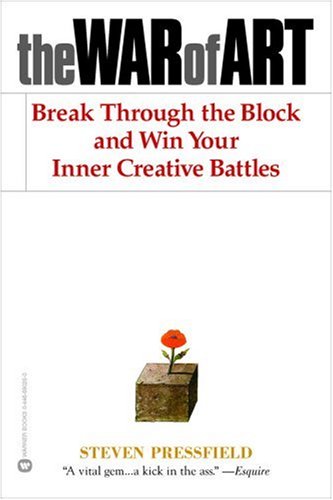
The War of Art: Break Through the Blocks and Win Your Inner Creative Battles by Steven Pressfield

A rare, nonfiction book by novelist and blogger Steven Pressfield. The War of Art is a book that I strongly recommend to aspiring writers ( which includes most bloggers) and other people pursuing dreams, not because it is brilliant but because it is profound. Utilizing select personal vignettes and other anecdotes, Pressfield distills in everyday language the essence of what creative people need to understand if they are to succeed – concepts of “resistance”, which seductively undermine your efforts,  and being a “professional”, which is the mindset that will get you there.

Most of the readers of this blog are interested in military affairs to some extent so I will use this reference to explain why I read The War of Art from cover to cover. Pressfield captures the difference in what Col. John Boyd called the question of “To be or to do. Which way will you go?”.  By Boyd’s definition, Pressfield is a doer.

Steven Pressfield blogs on The War of Art of writing every Wednesday.

The First Genocide?

Thursday, July 23rd, 2009

Or perhaps the analogy of Cain and Abel?

Remains Show Human Killed Neanderthal

Newly analyzed remains suggest that a modern human killed a Neanderthal man in what is now Iraq between 50,000 and 75,000 years ago. The finding is scant but tantalizing evidence for a theory that modern humans helped to kill off the Neanderthals. The probable weapon of choice: A thrown spear.

The evidence: A lethal wound on the remains of a Neanderthal skeleton. The victim: A 40- to 50-year-old male, now called Shanidar 3, with signs of arthritis and a sharp, deep slice in his left ninth rib. “What we’ve got is a rib injury, with any number of scenarios that could explain it,” said study researcher Steven Churchill, an associate professor of evolutionary anthropology at Duke University in North Carolina. “We’re not suggesting there was a blitzkrieg, with modern humans marching across the land and executing the Neandertals [aka Neanderthals]. I want to say that loud and clear.” But he added, “We think the best explanation for this injury is a projectile weapon, and given who had those and who didn’t, that implies at least one act of inter-species aggression.”

What is interesting about the disappearance of the Neanderthal is that it is hard to explain simply in terms of competition for resources with early Homo Sapiens, given that the global human population was astronomically low. The Neanderthal too, would have had many physical advantages, given their more robust physiology, over their evolutionary cousins. Speculation has ranged from climate change, to immunological differences to the cognitive and cultural.

Could a key cultural difference have been a propensity of Homo Sapiens to make war? To seek out, rather than avoid conflict?

Guest Post at It’s the Tribes, Stupid!

Thursday, July 16th, 2009

Novelist Steven Pressfield invited me to do a guest-post at his new blog giving my take on the polarized debate regarding his high profile, vblogging, presentation on tribalism. Here is a small snippet:

The Learning Curve

….There was enthusiastic praise for ‘Tribes”, naturally, but the criticism was equally as strong because Pressfield’s theme of tribalism as a general explanatory model is a powerfully attractive one. Too attractive, in the view of subject matter experts (SME) who drill down to a very granular level of detail and see all of the particularistic caveats or limitations of tribalism that exist in a given society. Tribalism among the ancient Gauls was not a carbon copy of 21st century Afghanistan, the artificial kinship network of the Yakuza or Shaka Zulu’s Impi formations. Yet, some similarities or congruencies remain even among such historically diverse examples because a tribe is a durable social network. In terms of resilience, a tribe may be the most adaptive and secure social structure of all.

Read the rest here.

RESPONSE to NATHAN of REGISTAN:

Nathan Hamm, the founder of Registan.net asked some critical questions of me at It’s the Tribes Stupid! and for whatever reason, I have tried multiple times to post a reply and my comment does not appear. Therefore, I emailed it to Nathan and I am replying here so those interested in following the discussion can see it. My apologies for the inconvenience. Here’s the reply, Nathan’s questions are in bold text:

Hi Nathan,

Alexander’s armies had quite a few Persians…..but they were probably shiny, moreso than the Macedonians toward the end.

Good to have you here. For Steve’s readers who may not be familiar with Mr. Hamm or Registan, Nathan has been an important voice on Central Asian affairs in the blogosphere for years on a number of respected regional sites and has extensive experience living in the region.
Let me try to address your concerns in reverse order:

“Mark, so what? This is a huge pet peeve of mine. I know I fall into that category, but from where I sit, I see neither interest nor inclination to engage or respond to these criticisms”.

The latter statement has to be addressed by Steven Pressfield rather than me. On the other part, as a learning aspect, when SME are writing to the uninitiated, there’s often a too large assumption about what the laymen know and a tendency to bring an overloading amount of complexity to the discussion. I am guilty of this myself at times when teaching or writing about my research interests. Pressfield is probably not writing for a typical reader at Registan but his readers may become interested enough in Afghanistan or tribalism that they may start reading articles, books and sites like yours as a result. Where you see a static end-state, I see a gateway or a hook.

“Coincidentally, some colleagues and I were recently trying to turn up academics who specialize in Afghanistan who say that tribe is the critical or even very useful factor for understanding how Afghan society organizes and behaves”

Richard Tapper has written on the negotiation of identity, with one of the major components being “qaum”, which if I recall has (or can have) a loose “tribal” meaning. I’m not qualified to rate experts in your field Nathan, but Nojumi describes the Parcham-Khalq Communists in Kabul thinking the tribes were important enough to warrant sending out the meddling Marxist officials to their villages ( incidentally, the Soviet advisers had cautioned the Taraki regime against it). Flipping through Ewans’ Afghanistan: A Short history, the tribes are present as at least a background political factor from Ahmed Shah Durrani to the fall of the Taliban. Here’s an analysis of warlordism and tribes in Afghanistan by Antonio Giustozzi and Noor Ullah (2006):

http://66.102.1.104/scholar?q=cache:_-hFB7AFp5gJ:scholar.google.com/&hl=en

I suppose point in the argument hinges on what you mean by “critical” or “useful”. That Afghanistan (or any society) is far more complex than one variable, is something I’ll agree with but for an “unimportant” factor, tribal structures in Afghanistan seem to enjoy considerable longevity.

“If we say in COIN theory that we should know the population, we shouldn’t stop halfway with a nice theory that doesn’t have sufficient predictive or explanatory power because of an aversion to academic particularism”

First I am not suggesting we stop halfway. I think that you and Josh fear that will happen with some readers. It will happen with some of them, you’re right. I’m more interested in those readers who are inspired to go further and keep learning.

I think also, on a methodological point regarding Social Science. “Predictive” is a high bar more suitable for hard science that can have appropriate experimental controls. For SS, I’d use “descriptive”, “speculative” and perhaps at best “probabilistic” analysis.

“At best, I understand this to be a descriptive model, and one that is hopelessly broad…and that “tribe” probably describes informal networks all humans create to deal with insecurity and uncertainty and that there is probably an inverse relationship between security in society outside the netowrk and the strength of bonds in these networks”

Tribes are a type of network structure and they can be artificial (social, legal, political) as well as being based on lineage. Most historical lineage tribes had provisions for adopting new members who were unrelated by means other than marriage ( though that was the most convenient device). Within sufficiently large tribes you can have both weak and strong ties or even other kinds of network structures present ( modular, hierarchy, scale-free etc). Network analysis is a useful tool for examining how people seek security and advantage within a group.

Being a long time advocate of horizontal thinking, I like broad comparisons and recognition of patterns and congruencies. They give us data that compartmentalizing, isolating and drilling down often does not ( those are useful tools as well. Granularity is a good thing -it is just not the only thing).

RESPONSE to JOSH FOUST of REGISTAN:

Hi Josh,

Regarding Tapper, in my view, he seems to be very interested in the construction and negotiation of identity and critical of how previous generations of scholars categorized peoples in ethnographic studies. I believe you that he wrote tribes were not important in understanding Afghanistan because his analysis of identity in Afghanistan used three categories including sect and “qaum” sort of a familial/traditional designation which are understood in a fluid sense. Well, ok but for a guy who dismisses tribalism as a variable, the existence of tribes seems to run through Tapper’s academic work on Afghanistan and Iran. Which makes me wonder if Tapper’s framing of identity and downgrading of the tribe is not in part an intellectual reaction to what is and is not acceptable in the modern academic culture of his field? If they are unimportant, why have the tribes of Afghanistan not faded into historical memory? Endurance as a social structure is incompatible with arguing that they do not matter in terms of identity – they seem to matter to some Afghans or they would have all gladly joined the Communist Party or become urban bourgeoisie or cab drivers or emigres or whatever.

Regarding tribal identity being only one part of a whole identity though, I agree with you on that. The level of nuances are often complex with people who move between traditional and modern roles as many Afghans do. However, jumping into that sort of high level complexity and minute detail right off of the bat is a sure-fire guarantee to go over the heads of most people approaching the subject for the first time and makes it probable that they may never come back to the subject a second time. A basic category, be it ethnicity, tribe, language or religion is a good starting point for a novice. Not a stopping point but a place to begin

Strategic Communication, Science, Technology

Wednesday, July 8th, 2009

Blogfriend Matt Armstrong had an important post regarding The Strategic Communication Science and Technology Plan, April 2009. An excerpt:

The plan describes current efforts within the Department of Defense, the military services, the combatant commands and other agencies on SC. In total, these efforts could be linked together to form the foundation of an S&T thrust area for strategic communication. The report also includes a macro-analysis of capability gaps not being addressed by ongoing initiatives and lays out potential areas for future S&T investment.

While the request for the plan itself represents recognition from Congress that SC plays a critical role in the public and private response to current and emerging threats, it also highlights that there is much research and development already underway and many tools available to increase the government’s effectiveness in global engagement. The rub today is the need for strong leadership and coordination to ensure: 1) awareness of the long list of capabilities; 2) incorporating these capabilities into plans; and 3) participation by stakeholders across the US government, NGO’s, industry, and private citizens.

The S&T plan sorts current efforts into the following categories:

  • Infrastructure: Enabling and facilitating access to information from news to markets to vocational
  • Social Media: Knowledge Management, Social Media, and Virtual Worlds
  • Discourse: Analysis of radical and counter-radical messages and ideas
  • Modeling and Forecasting: Gaming and anticipating adversarial messages and ideas as well as our counters and pre-emptive measures
  • Collaboration: Increasing collaboration and training across and beyond Government
  • First Three Feet: Empowering, Equipping, Educating, and Encouraging media and others to exist and freely report on events for what they really are
  • Understanding: Develop country, culture, and regional expertise, including polling
  • Psychological Defense: Planning and capacity building for dealing with critical strains on society in peacetime and wartime

The interesting thing here for me is that “strong leadership” is lacking because the people spread across and outside government who have the shared awareness of technology, social media and national security at a level of sophistication where they could actually craft a strategic communication policy, are usually many levels removed from the appointee policy deciders for whom these variables are (usually) fuzzily understood.

To use an analogy, the chefs are valet parking cars outside while trying to get the manager of the restaurant to acknowledge their recipes. Or, maybe that there should be cooking going on in the kitchen if they want to have any customers. Or that the business is, in fact, a restaurant and not a nicely organized room full of tables.


Switch to our mobile site