zenpundit.com » Patterns

Archive for the ‘Patterns’ Category

Close reading, Synoptic- and Sembl-style, for parallels, patterns

Monday, March 25th, 2013

[ by Charles Cameron — if we omit all mention of the Qur’an, will the jihad perhaps disappear, you think? ]
.

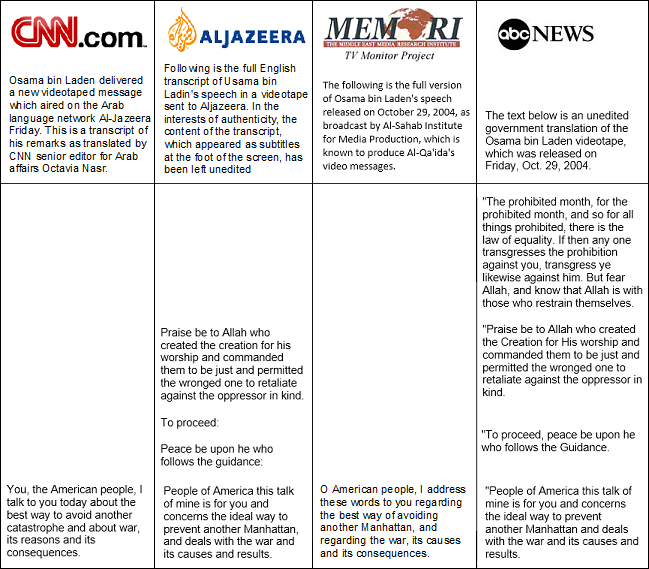
On Friday, Oct. 29, 2004, just before the 2004 US Presidential Election, a videotaped speech by Osama bin Laden was released online and variously reported:
.

.

Being a theologian at heart, I’ve formatted these versions in the style used in comparisons of the Synoptic Gospels, to give you an immediate sense of the differences I’ll be discussing…

**

Just how important was this particular speech by bin Laden?

It was important to bin Laden himself, as it was his first statement after his invitation to the US to convert to Islam. As I have noted before — quoting Michael Scheuer‘s Al-Qaeda’s Completed Warning Cycle – Ready to attack? — bin Laden had been criticized for failing to issue such an invitation:

After 9/11, bin Laden received sharp criticisms from Islamist scholars that dealt with the al-Qaeda chief’s failure to satisfy several religious requirements pertinent to waging war. The critique focused on three items: (1) insufficient warning; (2) failure to offer Americans a chance to convert to Islam; and (3) inadequate religious authorization to kill so many people. Bin Laden accepted these criticisms and in mid-2002 began a series of speeches and actions to remedy the shortcomings and satisfy his Islamist critics before again attacking in the United States.

MEMRI picks up the story here:

The Islamist website Al-Islah explains: “Some people ask ‘what’s new in this tape?’ [The answer is that] this tape is the second of its kind, after the previous tape of the Sheikh [Osama bin Laden], in which he offered a truce to the Europeans a few months ago, and it is a completion of this move, and it brings together the complementary elements of politics and religion, political savvy and force, the sword and justice. The Sheikh reminds the West in this tape of the great Islamic civilization and pure Islamic religion, and of Islamic justice…”

This video is also a significant “first” for bin Laden. In Raymond Ibrahim‘s words in his The Al Qaeda Reader:

This message also marks the first time bin Laden publicly acknowledged his role in the 9/11 strikes; previously he had insisted that he was merely an “inciter” and that it was the Muslim umma in general who had retaliated in defense of their faith.

It was important to the US because of the election four days later. The following exchange occurred on NBCNews’ Meet the Press, Jan 30th, 2005:

MR. RUSSERT: At the Clinton Library dedication on November 18, a few weeks after the election, you were quoted as saying, “It was the Osama bin Laden tape. It scared the voters,” the tape that appeared just a day before the election here. Do you believe that tape is the reason you lost the race?

SEN. KERRY: I believe that 9/11 was the central deciding issue in this race. And the tape–we were rising in the polls up until the last day when the tape appeared. We flat-lined the day the tape appeared and went down on Monday. I think it had an impact

The speech was important, in sum, both to bin Laden himself and to the US electorate: it deserves a close reading.

**

Sadly, however…

Posted, translated transcripts of Al Qaida and other jihadist materials often leave out the salutation and envoi (or other choice bits such as quotes from the Qur’an or Hadith) because they’re too religious or perhaps too Muslim — but when these same pieces of the puzzle are added back into the text, the whole document may cohere to a degree that is otherwise unapparent.

We tend not to “get” religious language. What do Daniel Benjamin and Steven Simon tell us in their book The Age of Sacred Terror?

So much of what was heard from al-Qaeda after the attacks sounded to Americans like gibberish that many chords of the apocalypse were missed.

Our prejudice against alien religious sentiment, or the assumption that it is ritualistic and hence irrelevant, or even worse, “babble” — the term FBI agents used to describe David Koresh‘s religious interpretation of events during the Waco siege — can blindside us to its very real discursive and exegetical power.

That’s the reason I’m offering you this post — years later — as a counter-example of the power of “Sembl thinking” — essentially, the power of pattern recognition as a key to understanding.

**

I read three versions of bin Laden’s videotaped speech of Oct. 29, 2004 at the time: those provided by CNN, MEMRI, and Al Jazeera — one “western secular” source, one with some degree of Israeli association, and one with roots in the Arabic cultures.

CNN cited al-Jazeera as having aired the video, and posted “a transcript of his remarks as translated by CNN senior editor for Arab affairs Octavia Nasr” which, as you can see above or at the link, began, “You, the American people, I talk to you today… “ MEMRI offered The Full Version of Osama bin Laden’s Speech followed by a transcript which began, “O American people, I address these words to you…” And Al Jazeera posted “the full English transcript of Usama bin Ladin’s speech in a videotape sent to Aljazeera” and noted, “In the interests of authenticity, the content of the transcript, which appeared as subtitles at the foot of the screen, has been left unedited” – above a transcript that began:

Praise be to Allah who created the creation for his worship and commanded them to be just and permitted the wronged one to retaliate against the oppressor in kind. To proceed: Peace be upon he who follows the guidance: People of America this talk of mine is for you…

That in itself is interesting — Al-Jazeera has two sentences with religious significance, one of them saying that God “permitted the wronged one to retaliate against the oppressor in kind” — with no mention of them in the MEMRI and CNN accounts.

**

As I read the Al Jazeera version, which seemed to me to be the one most likely to be accurate to bin Laden’s meaning, I came across the phrase:

We want to restore freedom to our Nation and just as you lay waste to our Nation, so shall we lay waste to yours.

There were several other parts of the speech which seemed to make (rhetorical) use of symmetry. There were the comments about “punishing the oppressor in kind” by destroying towers in the US, since towers in the Lebanon had been destroyed (which seems a pretty literal-minded reading of “in like manner”):

And as I looked at those demolished towers in Lebanon, it entered my mind that we should punish the oppressor in kind and that we should destroy towers in America in order that they taste some of what we tasted and so that they be deterred from killing our women and children.

There was a passage pointing up analogies between the Bush dynastic presidencies and similar dynastic rulerships in “our countries”:

… we have found it difficult to deal with the Bush administration in light of the resemblance it bears to the regimes in our countries, half of which are ruled by the military and the other half which are ruled by the sons of kings and presidents. Our experience with them in lengthy and both types are replete with those who are characterized by pride, arrogance, greed and a misappropriation of wealth.

And there was the comment translated in the CNN version:

Your security is not in the hands of [Democratic presidential nominee John] Kerry or Bush or al Qaeda. Your security is in your own hands. Any nation that does not attack us will not be attacked.

Each of these excerpts is couched in an analogical, symmetrical format, but it was the first one that really rang a bell for me — that phrase “just as you lay waste to our Nation, so shall we lay waste to yours” reminded me very strongly of one verse from the Qur’an, which contains the phrase, “And one who attacketh you, attack him in like manner as he attacked you” — the whole verse, Qur’an 2.194, has also been translated thus:

For the prohibited month, and so for all things prohibited, there is the law of equality. If then any one transgresses the prohibition against you, transgress ye likewise against him. But fear Allah, and know that Allah is with those who restrain themselves.

**

Okay, I’d read three versions of bin Laden’s text, and made a mental leap to a Quranic verse — and then I finally ran across ABC’s transcript, which opens with the very verse from the Quran my mind had leaped to.

Here’s where you can find the entire text, which ABC describes as “an unedited government translation of the Osama bin Laden videotape” – presumably from the Foreign Broadcast Information Service (then the FBIS, now the Open Source Center). It is certainly the most complete version I’ve seen:

Full Transcript of Bin Laden Video: ABC News Obtains Complete Text of Bin Laden’s Oct. 29 Video.

I don’t know for sure whether bin Laden used that verse himself (although I’d bet on it), or whether it was “framing matter” added by in the studio by Al-Jazeera (I very much doubt it) — either way, it confirmed my association, and reading the whole speech as a sermonette on that scriptural text gives it, in my view, notable added coherence.

**

Here’s what I wrote after I read the ABC transcript:

I’m particularly interested to note that bin Laden “opens” with the Qur’anic verse which says “for the prohibited month, and so for all things prohibited, there is the law of equality. If then any one transgresses the prohibition against you, transgress ye likewise against him. But fear Allah, and know that Allah is with those who restrain themselves” [Baqara 194].

That’s the central statement of the Islamic view of symmetrical morality in warfare, and prior to reading your full text, I thought I’d detected echoes of it in the OBL text in question — my own analytic process leans heavily on analogy and symmetry — and specifically in the passages I’ve quoted above…

The analogical, symmetrical format is present in each of these excerpts, and indicates how deeply the Qur’anic process runs in bin Laden, even here in a speech which attempts to present that very Qur’anic insight in secular terms to a western audience — explaining the first of the four excerpts above, for instance, with these following words:

No one except a dumb thief plays with the security of others and then makes himself believe he will be secure whereas thinking people when disaster strikes make it their priority to look for its causes in order to prevent it happening again.

and saying again, towards the end of the speech:

you may recall that for every action, there is a reaction.

We do indeed recall that phrase: in its complete form, as given in Isaac Newton‘s memorable Third Law of Motion:

For every action, there is an equal and opposite reaction.

**

For what it’s worth, the Qur’anic verse in question is not present in either Ibrahim’s Al Qaeda Reader, nor in Bruce Lawrence, Messages to the World: the Statements of Osama bin Laden. Ibrahim opens his version with the words, “Praise be to Allah, who created the worlds for his worship…” and Lawrence with, “Peace be upon those who are rightly guided. People of America…”

But no mention of Qur’an 2.194. It has just vanished. Gone. It has been ignored.

Isn’t that pretty much the definition of ignorance?

Words fail me.

America the Home of the Brave?

Sunday, February 3rd, 2013

An excellent op-ed in the Washington Post by Small Wars Journal editor and author of War, Welfare and Democracy,  Peter J. Munson 

An America Cramped by Defensiveness by Peter J. Munson 

….Since I returned home, a darkness has grown in me as both I and our nation have failed to live up to the sacrifices of these young men and women. I had no expectation of “victory” in Afghanistan or Iraq, whatever that would mean. Nor did I expect some epiphany of strategic insight or remorse from the nation’s brain trust.

I just found that I could not square the negativity, pettiness and paranoia in the discourse of our country’s elders with the nobility and dedication of the men and women I had seen and served with in Afghanistan.

Over time, as I listened to the squabbling, I realized that about the only thing Americans agree on these days is gratitude bordering on reverence for our military. It troubled me that the sum total of consensus in our discourse is deference toward the defenders of our nation.

Eventually, it dawned on me that the focus on defense was the root of our problem.

After the Sept. 11, 2001, attacks, the United States sent its military off to war and fretted about post-traumatic stress disorder — but paid little attention to the fact that America itself was traumatized. Americans became angry and withdrawn. We are fearful and paranoid because after a strike on our nation we chose to focus on defense rather than the resilience and vitality that made America great. In our defensive mind-set, we bristle at every change in a world undergoing an epochal transformation.

We have little reason to be so negative. Certainly the rest of the world is gaining on us, but this represents the success of explicit U.S. policies. After World War II, the United States sought to create a world of economic interdependence and prosperity, hoping to banish the malaise that helped precipitate a global conflict. The prospect of rapid growth in the developing world was not viewed as a threat but rather offered the promise of robust markets for American goods and ingenuity. We were confident and focused on the positive tasks of expanding our economy rather than fearing change…..

If you go back and look at news coverage of September 11, you will be struck by the calmness of ordinary citizens in New York in the face of carnage, their lack of panic and firm determination to help. The bravery and sacrifice of firefighters, EMT and police, the dogged resolution of rescue workers digging for victims, the sheer heroism of the passengers of  United Airlines Flight 93 who, led by Todd Beamer, stopped the al Qaida hijackers from ramming another plane into another skyscraper or perhaps the Capitol Building.

All of the security theater, the attacks on liberty, the surveillance state machinations, creeping normalization of government thuggery, bureaucratization, centralization and paternalism that have since been justified in the name of 9/11 were not needed on that day nor wanted by the overwhelming mass of American citizens afterwards.  It was wanted by our “leaders” – who were largely irrelevant to events on September, 11 – because it conformed to their worldview and overweening personal need for “control” of a democratic citizenry they would prefer to be less autonomous and more passive, docile, compliant and disengaged.

We need to revive the American spirit and the first steps are rolling back much of the illiberalism of the past decade.

Madness, Mass Shootings and an Open Society

Monday, December 17th, 2012


Everyone in America has seen the latest results of another dangerously mentally ill loner with family members who were in denial about the severity of his condition or disconnected from him. The killer, Adam Lanza, shot shot his own mother in the face before slaughtering twenty elementary school children and the heroic teachers and their principal who had sought to protect them, belonged in an institutional setting. The same can be said for homicidal schizophrenic Jared Loughner who shot Congresswoman Gabby Giffords, James Holmes, the Colorado shooter, has a gag order on his murder trial but his defense lawyers have already disclosed that their client is mentally ill in blocking access to his diaries under physician-client privilege. Seung-Hui Cho, who committed the Virginia Tech massacre, had previously stalked women, made suicidal threats and been ruled “an imminent danger to himself and others” was set free and unwell to be treated on “an outpatient basis” that never happened.

Predictably, a debate about gun control has erupted in the aftermath of senseless deaths. However, other countries are as heavily armed as the United States (in a few cases, more so). These countries also have severely mentally ill people, yet they don’t have the mass shootings that have become a dark cultural phenomenon we see here in America.  Or when on the rare occasions they do, the shooter is likely not to be insane, but a professional terrorist.

There have also been calls for improved school security ( the Obama administration and Congress cut school security grant funds in 2010 and 2011), stationing policemen in schools and even arming teachers, citing the example of Israeli schools and the Pearl High School shooter who was stopped by an assistant principal with a .45.  While more security is a reasonable precaution and a good idea, short of turning our schools into windowless, prison-like, fortresses and giving the staff AK-47’s,  anybody utterly willing to die in order to kill someone else stands a pretty good chance of success. If all guns vanished tomorrow, the crazies will use car bombs and IEDs instead; mass shootings are a “motivated crazy person” (or terrorist) problem – criminals with economic motives do not carry out these kinds of attacks.

There is no perfect answer here, but here are a few suggestions:

  • We need to revise our attitude toward mental illness with greater public education and access to mental health treatment, especially emergency treatment. Most mentally ill people are NOT dangerous but the warning signs of psychotic breakdown should become as widely recognized as the dangers of cigarette smoking.
  • For the very few people who are mentally ill and violent, we need to have public heath authorities accept that some degree of active supervision is required to ensure they receive treatment and take their medication if they are to live independently, and if they refuse, to institutionalize them temporarily until they do so. The key variable here is *violence* not just mental illness and strong due process safeguards must be in place to protect the individual and ensure they receive appropriate treatment with dignity.
  • Schools need much better training and planning for “active shooter” situations. At present, most schools have safety plans that emphasize locking students in enclosed rooms from which there seldom are any escape routes and the staff passively waiting for instructions from higher school authorities or police. While these plans may be good for unarmed intruders of unknown intent, they are dangerously counterproductive for heavily armed active shooters. Schools generally lack  enough secure rooms with doors that can delay such intruders for more than a few seconds and the standard emergency plan emphasis on “sitting tight” discourages the staff from engaging in reasonable risks to quickly evacuate students when the intruder is elsewhere in the building, or if possible, tactics to evade or if need be, resist, the shooter.

New Book: The Violent Image by Neville Bolt

Friday, December 14th, 2012

The Violent Image by Neville Bolt 

Columbia University Press just sent me a review copy of The Violent Image, by Dr. Neville Bolt of King’s College vaunted War Studies Department.  Initially, I was amused by the colorful book jacket, but flipping through, it belies a very weighty, heavily footnoted, academic exploration of the iterative relationship between propagandistic imagery and insurgency. Even a casual perusal indicates that The Violent Image is a book many readers of ZP will  like to  get their hands on.

From the jacket:

….Neville Bolt investigates how today’s revolutionaries have rejuvenated the nineteenth century “ptopaganda of the deed” so that terrorism no longer simply goads states into overreacting, thereby losing legitimacy. Instead the deed has become a tool to highlight the underlying grievances of communities

A small sampling of some of the section titles:

Strategic Communications:the State
Strategic Communications: the Insurgent
Networks in Real and Virtual Worlds
Images as Weapons
POTD as Insurgent Concept of Operations
Anonymity and Leaderless Revolutions
The Arab Uprisings and Liberation Technology
POTD as Metaphor

Endnotes run slightly over 90 pages and the bibliography tips the scales at 50, for those interested in such things.

Looking forward to reading this and seeing how Bolt presents his case.

Two Cheers for the State?

Wednesday, December 12th, 2012

An excellent post from Adam Elkus – strongly recommended!

The State Problem In National Security Policy

….The report makes a lot of comments about the rise of individual autonomy, the empowering of regional network-cities, and technology’s acceleration of the power of non-state actors. Wired interpreted part of this as signaling a decline of the statewhich has been a popular theme since Martin van Creveld’s work on theTransformation of War. I think that is an accurate characterization of the parts of the 2030 report that talk about the empowerment of non-state actors and the rise of international networks. I’m less interested in the report, though, than in the general narrative of state decline in national security policy discourse.

We’ve heard that states are in decline, and both benign and malign networks and private actors are on the rise. This isn’t a new theme—if you look back a few decades the rise of multinational corporations and the multilaterals prompted a similar debate about sovereignty and power in the modern world. The state-centric defense practitioner is enjoined to move beyond caring about states and embrace a new reality.

…. What we have been dealing with, however, is an unfortunate tendency to write the non-state actor and transnational network out of the last few centuries of history. But he (or she) stubbornly refuses to go away. We can talk about some of the reasons why this might be the case in the international environment but it is also worth talking about why we often assume much more coherence and cohesion in our domestic environment than reality may justify.

….In Charles Tilly’s book Democracy, he argues that four processes are necessary to create and sustain a democratic state: the growth of state capacity by suppressing alternative sources of power, the reduction of categorical inequalities, and the integration of strong tie-based trust networks into public life. Warlords and kingpins that predate make it difficult for rights to be guaranteed. Categorical inequality lessens the ability of the people to meaningfully control their own destiny. And strong trust networks that cannot express themselves in political and social life also have the potential for predation and the erosion of state authority. Tilly casts these processes as never-ending in scope, and states are capable of backsliding on any one of them.

Very rich food for thought.

Trust networks are an interesting way to look at broader social networks and discern, at times, the presence of modularity (and therefore specialized skills, capacities, knowledge etc.) within a looser network structure (weak ties and links vs. highly interconnected sets of hubs with strong ties). We tend to graph these things in simple diagrams, like concentric circles with “al Qaida hard core” in the center, but really, they are more akin to clumping or clotting or uneven aggregation within a less dense field of connections.

Adam is also right that the irregular, the illegal, the tribal, the secret society, the rebellious peasant was largely ignored by nationalistic  historians in the late 19th and early to mid 20th century – and when they came back in vogue in the 1960’s with revisionist, labor, social, cultural etc. schools of historians, they tended to groan under the heavy yoke of dogmatic Marxist class analysis and then later the radical academic obsessions with race, gender and sexual orientation “oppression”. Too seldom, were these people and their doings found to be interesting in themselves so much as puppets for a very tortured, abstract passion play to exorcise demons and pursue petty grudges against other scholars.

In any event, Adam is worth reading in full.


Switch to our mobile site