zenpundit.com » literature

Archive for the ‘literature’ Category

The best war game is a library of windows

Tuesday, July 3rd, 2012

[ by Charles Cameron — Escher, Borges, simulating the future, wargames, A Pattern Language, Sembl ]
.

MC Escher, Relativity

.
Ridiculous phrase, a library of windows. Unless you think, as I do, of books as windows onto different worlds, in which case it makes a whole lot of sense, and a decent library has more windows onto more profoundly different worlds than any physical room — and here we are getting into the territory of Jorge Luis Borges (links to Library of Babel) and Maurits Escher (image above).

And let me just state for the record that Godel Escher Bach could just as well have been Escher Carroll Borges, and that a comparison between the logics of Escher and Borges is one of the desiderata of our times.

That’s a Sembl move.

**

Let’s expand the concept of window to include the sort of inter-worldview glimpse that Haaretz describes today here:

Last week, in a small beit midrash (study hall) named after Rabbi Meir Kahane in Jerusalem’s Shmuel Hanavi neighborhood, an emergency meeting was convened to discuss instigating freedom of religion and worship on the Temple Mount. It was a closed meeting attended by representatives of the Temple Institute, HaTenu’ah LeChinun HaMikdash (the Movement to Rebuild the Holy Temple) and the Temple Mount Faithful, as well as two representatives of Women for the Mikdash, and others. The activists met to try to understand how they could overcome the authorities, who they believe are plotting against them, and return to the Temple Mount. At this meeting, Haaretz was offered a rare behind-the-scenes glimpse of the most ardent activists in the battle to Judaize the Temple Mount.

**

Here’s the meat of the post, as yet uncooked. Back in 2005, but brought to my attention today by Rex Brynen at Paxsims, is this piece from Strategy Page:

After eight years of effort, and spending over $300 million, the U.S. Army has officially received its new wargame (WARSIM) for training battalion, brigade, division, and as big as you want to get, commanders, and their staffs. Now even the most elaborate commercial wargame would not get $300 million for development, and eight years to create the system. But wargames for professional soldiers have different requirements, and a troublesome Department of Defense bureaucracy to deal with. First, the requirements. Commercial wargames shield the player from all the boring stuff (support functions, especially logistics.) But professional wargames must deal with these support activities, because in a real war, these are the things commanders spend most of their time tending too. …

WARSIM covers a lot of complex activities that a commander must deal with to achieve battlefield success. Besides logistics, there’s intelligence. Trying to figure out what the enemy is up to is, next to logistics, the commanders most time consuming chore.

— which in turn was referenced by Michael Peck writing in a Kotaku piece today titled Why It’s So Hard to Make a Game Out of the 21st Century:

Let’s build a game. Let’s make it a strategy game. We will realistically simulate global politics in the 2030s. Perhaps a sort of Civ or Supreme Ruler 2020-type system.

Where shall we start? How about something easy, like choosing the nations in the game? It’s simple enough to consult an atlas. We’ll start with Britain…but wait! Scotland is on the brink of declaring independence from the United Kingdom. Should Britain be a single power, or should England and Scotland be depicted as a separate nation? What about Belgium splitting into Flemish and Walloon states? And these are old, established European nations. How will states like Syria and Nigeria look in two decades? It was only a bit over 20 years ago that the Soviet Union appeared to be a unshakeable superpower that controlled Eastern Europe and Central Asia.

**

Let’s cook that meat, let’s make a meal of it.

Peck’s piece goes into many other ways in which predictive gaming isn’t terribly productive.

But it left me asking the question, what would I do with a game-sized budget, if my aim was to push military and intelligence towards greater insight.

And my answer would be to embed information in walls. In corridors…

To build windows at sparse and irregular intervals into the internal corridors that connect any given office in the Pentagon or three-letter agency — or my local preference (hush, I know it’s the Glorious Fourth tomorrow) MI-5 and -6 — through which analysts and decision makers can glimpse snippets of information.

Which can then fall into the deep well of memory.

It is deep within that well of half-forgotten knowledge, ST Coleridge tells us, that the “hooks-and-eyes of memory” link one thought with another to build a creative third.

**

A wall, then. I would build a wall embedded with facts and fancies, maps and illustrations, graphs and stats, film clips and news clips, anecdotes and quotes — even, perhaps, tiny alcoves here and there with books free for the taking, music CDs, DVDs of movies, old, new, celebrated, strange…

And I would be constantly shifting and rearranging the “views” from my windows, so that what was seen yesterday would not be what would be seen tomorrow — yet with a powerful index of words, topics, themes, memes, image contents, names of actors, newscasters, authors and so forth, so that what was once seem and dimly recalled could be recaptured.

**

The concept here is pretty much the exact opposite of having a huge black poster proclaiming Creativity Matters!

Don’t get me wrong, creativity does matter (get that poster and others here), but it “works in mysterious ways its wonders to perform” — and the way to entice it is to see things out of the corner of the eye…

The windows I’m looking for, therefore, offer glimpses you wouldn’t necessarily notice if you were deep in thought or conversation, and conversely, wouldn’t see twice and grow so familiarized to that they’d become irrelevant by repetition. They’d be glimpsed in passing, their esthetic would be that of Christopher Alexander’s Zen View, pattern 134 in his brilliant work — the closest we have to a Western I ChingPattern Language:

The idea, then, is to seed the memory with half-conscious concepts, patterns, facts and images, carefully selected and randomly presented — so that those hooks and eyes have the maximum chance of connecting some scrap of curious information with a pressing problem.

Which is how creativity tends to work.

**

That way each corridor becomes a game-board — but it is in the analyst’s focused mind that the game is played and won.

What you’d get, in effect, would be community-wide, ongoing free-form gameplay in complete alignment with the web-based game we’re currently developing at Sembl. Games of this genre will also have powerful application in conflict resolution.

And peace.

When Does Conflict Become “War”?

Tuesday, May 22nd, 2012

When does mere conflict end and war begin?

Great philosophers of strategy and statecraft did not treat all conflict as war but regarded war as a discernably distinct phenomenon, different from both peace and other kinds of conflict. War had a special status and unique character, glorious and terrible:

“Hence to fight and conquer in all your battles is not supreme excellence; supreme excellence consists in breaking the enemy’s resistance without fighting. “

    -Sun Tzu

“When the Corcyraeans heard of their preparations they came to Corinth with envoys from Lacedaemon and Sicyon, whom they persuaded to accompany them, and bade her recall the garrison and settlers, as she had nothing to do with Epidamnus. If, however, she had any claims to make, they were willing to submit the matter to the arbitration of such of the cities in Peloponnese as should be chosen by mutual agreement, and that the colony should remain with the city to whom the arbitrators might assign it. They were also willing to refer the matter to the oracle at Delphi. If, in defiance of their protestations, war was appealed to, they should be themselves compelled by this violence to seek friends in quarters where they had no desire to seek them, and to make even old ties give way to the necessity of assistance. The answer they got from Corinth was that, if they would withdraw their fleet and the barbarians from Epidamnus, negotiation might be possible; but, while the town was still being besieged, going before arbitrators was out of the question. The Corcyraeans retorted that if Corinth would withdraw her troops from Epidamnus they would withdraw theirs, or they were ready to let both parties remain in statu quo, an armistice being concluded till judgment could be given. “

-Thucydides 

“Thus, therefore, the political object, as the original motive of the war, will be the standard for determining both the aim of the military force, and also the amount of effort to be made. This it cannot be in itself; but it is so in relation to both the belligerent states, because we are concerned with realities, not with mere abstractions. One and the same political object may produce totally different effects upon different people, or even upon the same people at different times; we can, therefore, only admit the political object as the measure, by considering it in its effects upon those masses which it is to move, and consequently the nature of those masses also comes into consideration. It is easy to see that thus the result may be very different according as these masses are animated with a spirit which will infuse vigour into the action or otherwise.”

– Carl von Clausewitz 

We see from the above that war was not regarded as the same as either the political conflict which precipitated it or even, in the case of the Corcyraeans, the violence done against their interests in Epidamnus by the Corinthians, which did not yet rise to be considered war in the eyes of either Corcyra or Corinth. Instead the occupation of Epidamnus was something we would recognize today as coercion.  Like war itself, coercion operates by a calculus that is only partially rational; not only is the psychological pressure of coercion subject to passions of the moment, our reactions to the threat of violence -and willingness to engage in it – may be rooted in evolutionary adaptations going back to the dawn of mankind. Coercion, or resistance to it, usually is the midwife of war.

Prehistoric man lived a life that archaeology increasingly indicates, contrary to philosophical myth-making, was endemic in it’s violent brutality. Whether the violence between or within tiny paleolithic hunter-gatherer bands constituted private murder or warfare is a matter of debate, but the existence of the violence itself is not. Earliest firm evidence of a possible large skirmish or massacre dates back to 14,000 BC and definitive evidence for large-scale, organized battle dates to the end of the Neolithic period and dawn of the Bronze Age in 3500 BC.  Lawrence Keeley, in War Before Civilization, describes primitive man as being hyperviolent in comparison with those noted pacifists, the ancient Romans:

….For example, during a five and a half month period, the Dugum Dani tribesmen of New Guinea were observed to participate in seven full battles and nine raids. One Yanomamo village in South America was raided twenty-five times over a fifteen month period…. 

The high frequencies of prestate warfare contrast with those of even the most aggressive ancient and modern civilized states. The early Roman Republic (510-121 BC) initiated war or was attacked only about once every twenty years. During the late Republic and early Empire (118 BC -211 AD), wars started about once every six or seven years, most being civil wars and provincial revolts. Only a few of these later Roman wars involved any general mobilization of resources, and all were fought by the state’s small (relative to the size of the population) long-service, professional forces supported by normal taxation, localized food levies and plunder. In other words, most inhabitants of the Roman Empire were rarely directly involved in warfare and most experienced the Pax Romana unmolested over many generations. [Keeley,33] 

Simple, prestate societies probably waged “war” – a violent and deliberate conflict with rival groups and in alliance with rival groups against more distant interlopers – but the degree to which archaic and prehistoric humans culturally differentiated between this and their everyday, casual, homicidal violence remains unknown. Moreover, many academics would not accept the thesis of neolithic societies being “warlike”, much less, waging “war” as we understand the term until they rose to levels of social and political complexity generally denoted as chiefdoms, kingdoms and empires (“political” societies).

There’s something to that argument; a certain element of cultural identity is required to see the world in distinctly  “us vs. them” terms instead of an atomized Hobbesian “all vs. all” but I suspect it is far more basic a level of communal identification than the level of cultural identity typical of sophisticated chiefdoms like Cahokia or ancient Hawaii. Cultural and communal identity would tend to focus violence toward outsiders while increasingly complex political and social organization could “shape” how violence took place, molding it into recognizable patterns by regulation, ritual, taboo and command of authority. Once there is enough societal complexity for a leadership to organize and direct mass violence with some crude degree of rational choice and control, not only is war possible but strategy is as well.

Once a society is sophisticated enough to employ violence or the threat of violence purposefully for diplomacy or warfare, it is making a political decision to separate mundane and nearly chronic “conflict” and “war” into different categories. This would appear to be a primitive form of economic calculation distinguishing between conflict that generates acceptable costs and manageable risks and those conflicts that pose unacceptable costs or existential risks. This would give the relationship between primitive tribes the character of bargaining, an ongoing negotiation where the common currencies were violence and propitiation, until one party vacated the area or ceased to exist, most wars then having an innate tendency to escalate toward genocide (our current limitations on warfare, such as they are, derive from greater social complexity and political control over the use of violence).

If an economic calculus is indeed the root of the political decision to recognize some conflicts as “war”, that raises some interesting questions about modernity and advanced  states. What happens  when a conflict occurs with a state sufficiently complex that the ruling elite see their class interests as distinct and superceding those of the state? The calculus and what is considered “acceptable” costs or risks in a conflict vice those mandating “war” shift dramatically away from what might be considered “rational” state interest.

In a society at such an end-state, seemingly intolerable conflict might be tolerated indefinitely while full-fledged wars could be waged over what would appear to be mere trivialities to the national interest.

ADDENDUM:

In addition to some already excellent and extensive comments in the thread, I would like to turn your attention to an interview post at The Last Word on Nothing recommended byZack Beauchamp:

Horgan, Hayden, and the Last Word on Warfare 

Ann:  I understand both of you have written authoritative and charming books on war — John’s, just out, is called The End of War; and Tom’s is Sex and War — and that you’vediscussed these matters before.  I also understand you disagree about war.  How could you not agree?   I mean, war is just nasty stuff and we shouldn’t do it, right?

Tom: Ann, you’re poking the hornet’s nest right off the bat! I don’t think John and I disagree about war, but rather about peace. Don’t get me wrong: we both prefer the latter to the former, by a wide margin. And there are many things we do agree on, I think, such as the substantial observed decrease in the frequency and lethality of war over the past several centuries, and the idea that culture is an important part of the balance between war and peace. But I think we do have a difference of opinion about the attainability of peace (John) versus the inevitability of war (me). I think this makes John a better person than me, and certainly a more optimistic one. And I really, really hope he’s right. In my mind it comes down to an argument about human nature, and whether the impulses and behaviors of war are inborn or acquired. Or at least, that’s my take. John, what’s yours? [….]

Carlos Fuentes (1928 – 2012)

Wednesday, May 16th, 2012

[ by Charles Cameron — in memory of Carlos Fuentes, requiescat in pace ]
.


.

Carlos Fuentes‘ great novel, Terra Nostra, opens with these words:

Incredible the first animal that dreamed of another animal.

It’s a sentence to stop you in your tracks, a sentence to give pause to time itself, circling back on itself like the serpent that eats its own tail, a dream of a sentence, a dream sentence.

Fuentes continues:

Monstrous the first vertebrate that succeeded in standing on two feet and thus spread terror among the beasts still normally and happily crawling close to the ground through the slime of creation. Astounding the first telephone call, the first boiling water, the first song, the first loincloth.

How does a mind move so agilely among these many and diverse firsts — the sleeping, the archeo-anthropological, the technical, the musical, the shameful or sinful or perhaps decorative, even erotic? In a single paragraph — the first in a book that will run 890 pages and not tire?

And Fuentes continues:

About four o’clock in the morning one fourteenth of July, Pollo Phoibee, asleep in his high garret room, door and windows flung wide, dreamed these things, and prepared to answer them himself.

Pollo Phoibee dreamed these things, Carlos Fuentes dreamed Pollo Phoibee…

And we are in Paris, Paris of the artists, of the garret, and yet a Paris where the Seine is boiling, where the Louvre has become crystalline, the black eyes of the gargoyles of Notre Dame see “a much vaster panorama”…

*

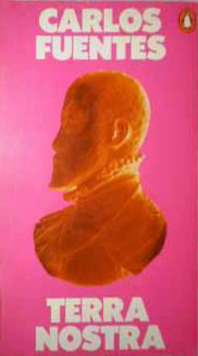
Carlos Fuentes died today, and I am saddened — remembering him signing my short, fat British Penguin paperback of Terra Nostra (its fondly remembered cover image above) and commenting that it was his preferred English edition, since one could slip it into one’s pocket…

And Terra Nostra was special to me, both as a great and tumultuous fiction, and as a fiction that quoted Norman Cohn‘s In Pursuit of the Millenniun, the book that back in my Oxford days introduced me to the history of apocalyptic thought… a fiction also familiar with Frances Yates, another scholar I greatly admire, and her writings on the Memory Theater

Carlos Fuentes, the imagination that conceived Terra Nostra, is no longer with us.

*

He had been a diplomat, this great imagination. Born into a diplo family, he had served as Mexican ambassador to Paris — Paris of the diplomatic banquets, but also of the artist’s garret, of this New World imagination spanning continents and centuries as though they were a playground, the playground of a single, multiple, cosmopolitan and erudite mind.

The poet Paul Claudel, French ambassador to Japan, was reproved by the Surrealists in 1925 with the words:

One cannot be both ambassador for France and poet!

The poet Saint-John Perse was secretary to the French Embassy in Peking, and later General Secretary of the French Foreign Office. The poet Giorgos Seferis was Royal Greek Ambassador to the United Kingdom. The poet Pablo Neruda was Chilean ambassador to France… The poet Octavio Paz, Mexico’s ambassador to India.

Among novelists, it was Lawrence Durrell — an Englishman born in India with what he described as “a Tibetan mentality” — one who found life in England itself “like an autopsy … so, so dreary” — who was British press attaché in Alexandria, Egypt, during World War II, where as they say:

Ostensibly working, Durrell was in reality closely observing the assortment of sights, sensations, and people that wartime Alexandria, a crossroads of the East and West, had to offer.

The result was his masterpiece, The Alexandria Quartet.

*

Fuentes is heir to many lineages: of Mexico, of the world, of literature, of diplomacy, of the imagination.

In honoring him today, my researches turned up this apposite quote from Aldo Matteucci at the Reflections on Diplomacy blog:

To survive, a diplomat needs poetry. Filed amidst the many layers of the brief, the short poem will refresh the bleary mind. Poetry brings distance – hence perspective and insight. Poetry reminds the diplomat that the best professional is the amateur.

Most deeply – poetry is truth.

Carlos Fuentes survives us all.

Of the real and the imaginal

Monday, April 9th, 2012

[ by Charles Cameron — from sight to vision? ]
.

*

Which of these two images — the photo above, the MC Escher print below — calls you closer? Which takes you deeper?

*

And which draws you closer here — the MC Escher print above, or the Tenniel illustration for Alice, below? Which carries you deeper?

Where does the realistic end, and the imaginal begin?

*

Marina Warner writes in the introduction to her recently reviewed book, Stranger Magic:

The faculties of imagination — dream, projection, fantasy — are bound up with the faculties of reasoning and essential to making the leap beyond the known into the unknown. At one pole (myth), magic is associated with poetic truth, at another (the history of science) with inquiry and speculation. It was bound up with understanding physical forces in nature and led to technical ingenuity and discoveries. Magical thinking structures the processes of imagination, and imagining something can and sometimes must precede the fact or the act; it has shaped many features of Western civilization. But its influence has been constantly disavowed since the Enlightenment and its action and effects consequently misunderstood.

*

For the brilliant juxtaposition of images in the upper pair, I am grateful to http://www.giovis.com/atrani.htm, with an h/t to http://www.log24.com.

One for Madhu — A Meditation in Time of War

Friday, March 23rd, 2012

[ by Charles Cameron — a poem of mine, with continuing exploration of Koestler’s notion of creativity at the intersection of fields, showing how three thoughts are braided in a single polyphony ]
.

A Meditation in Time of War
.

It is for the artist to see skeleton behind flesh
when depicting war, tho’ beauty too
deserves a hint of her inevitable decay,
flesh being heir to dust and dust its progeny:

nothing is so mechanical visioned in paint
as the tubing that supplies a gas mask with air,
yet the throat is no different, constricted
by an urgency to breathe as breath snuffs out:

gone, gone, paragon, quintessence of dust, svaha!

.

William Butler Yeats has a well-known poem with the same title, so I am borrowing from, flattering, and wondering whether I might sneak under the same mantle as a member of the illustrious departed here.

And Madhu, friend and friend of this blog, encouraged me some while back to post poems here on occasion, so this one is for her by way of a response.

I also wanted to post this particular poem here, though, because its last line nicely illustrates the same notion of overlapping or juxtaposed elements that Koestler claims lies at the heart of the creative process which I have been exploring in my recent posts on Klimt, on Nancy Fouts, and constellational thinking.

Because yes, I now have a book project under way, and it concerns the development of a new style of multifaceted, complex / simplex thinking.

*

The first lines of my poem were triggered by one of those fleeting glances at a blog logo — in this case, the logo of the Kings of War blog from London, which I’ve shaved down a bit to give you a taste of here:
.


.

It’s impressive, eye-catching — and then you get used to it.

So a couple of nights ago when I glimpsed it, I slowed down enough to take a quick but deliberate look, came away with an impression — not necessarily accurate as to detail, but giving me my emotional response to the piece — and worked and played to get it into words, making this what I believe is technically called an ekphrastic poem, a poem about a painting.

The original painting is a mural — José Clemente Orozco‘s Catharsis (1934), from the Museo Palacio de Bellas Artes in Mexico City.

So that, with a little wandering of the mind, is what gives us the first eight lines. It’s the ninth and last line I want to comment on, here.

*

That last line reads:

gone, gone, paragon, quintessence of dust, svaha!

And what’s happening here that delights me, and that gives the poem either a perplexing close or a powerful one, depending on the associations which the reader brings to bear on it, “happens” as follows:

I am letting two, or you might say three, streams of language that are very dear to me braid together in that last line.

There’s the mantra that sums up the entire Prajnaparamita or Perfection of Wisdom literature — a major strand in Buddhist teachings — at the end of the Heart Sutra:

Gate, gate, paragate, parasamgate, bodhi, svaha!

There’s the English translation of the same, which Thich Nhat Hanh explains thus:

Gate means gone. Gone from suffering to the liberation of suffering. Gone from forgetfulness to mindfulness. Gone from duality into non-duality. Gate gate means gone, gone. Paragate means gone all the way to the other shore. So this mantra is said in a very strong way. Gone, gone, gone all the way over. In Parasamgate sam means everyone, the sangha, the entire community of beings. Everyone gone over to the other shore. Bodhi is the light inside, enlightenment, or awakening. You see it and the vision of reality liberates you. And svaha is a cry of joy or excitement, like “Welcome!” or “Hallelujah!” “Gone, gone, gone all the way over, everyone gone to the other shore, enlightenment, svaha!”

— and which I remember from my days at Oxford in Edward Conze‘s much earlier English version:

Gone, gone, gone beyond, gone altogether beyond…

And there’s this, from Hamlet, Act 2 scene 2:

What a piece of work is a man! how noble in reason! how infinite in faculty! in form and moving how express and admirable! in action how like an angel! in apprehension how like a god! the beauty of the world! the paragon of animals! And yet, to me, what is this quintessence of dust?

*

So “gate, gate, paragate” gives me “gone, gone, paragon…” — and “paragon” brings me to “paragon of animals … quintessence of dust”.

If you have all three of these utterances in mind — and each one of them is memorable the way a passage in Isaiah or Job, or some great Churchillian speech, or phrase in Melville or Dickens can be memorable — they will all three be present, braided together as a single music, a polyphony, a constellation of meanings, in that one last line.

Roll them on your tongue, taste the beauty in each one of them, the nobility, the evanescence of this human life. And now read the poem through again.


Switch to our mobile site