[ by Charles Cameron — just one photo among many, or a defining display of power? ]
.
My friend Tom Parsons made what I thought was an insightful comment on the photo above:
the serious hit was seeing the accompanying picture of Trump again showing simian dominance as the alpha male, and getting a submissive smile and pose from Jeb. That’s scary because I’m not finding online discussion of the simian dominance game that seems so clearly to me to be the foundation stone of Trump’s campaign.
**
Tom’s not exactly right about there being no discussion of the Trump / Bush body language, as these two headlines [1, 2] show:
— but “wimp” is pretty mild pop-psych for “simian submission”, and Tom’s language emphasizes the biological roots of Trump’s apparent dominance.
**
See what I mean?
**
When you come down to it, ain’t biology everything?
There’s the height factor to consider, too. Hey, in Fahrenheit 451, Ray Bradbury has one of his characters claim:
You just don’t go running a little short man like that against a tall man.
— and Abraham Lincoln stood tall at six foot four.
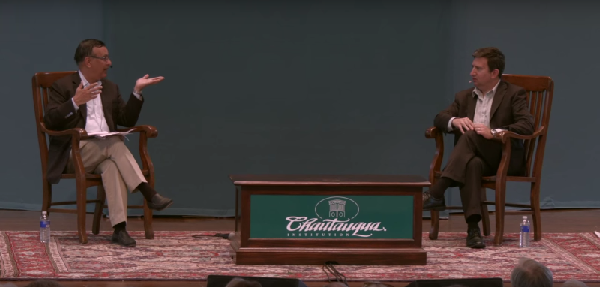
[ by Charles Cameron — Ambassador Husain Haqqani and Daveed Gartenstein-Ross at Chautauqua ]
.
**
From the outset, when cheers went up for Daveed’s birthplace, Ashland, Oregon, and Ambassador Haqqani’s, Karachi — and for the brilliant meeting of the minds that is Chautauqua — it was clear that we were in the presence of two gracious, witty and informed intelligences, and the seriousness of the conversation between them that followed did nothing to reduce our pleasure in the event. Daveed called it “easily the best experience I have ever had as a speaker.”
I’ll highlight some quotes from each speaker, with the occasional comment:
**
Amb. Haqqani:
None of the countries except Egypt, Turkey and Iran, none of the countries of the Middle East are in borders that are historic, or that have evolved through a historic process. And that’s why you see the borders a straight lines. Straight lines are always drawn by cartographers or politicians, the real maps in history are always convoluted because of some historic factor or the other, or some river or some mountains.
And now that whole structure, the contrived structure, is coming apart.
Then most important part of it is, that this crisis of identity – who are we? are we Muslims trying to recreate the past under the principles of the caliphate .. or are we Arabs, trying to unify everybody based on one language, or are we these states that are contrived, or are we our ethnic group, or are we our tribe, or are we our sect? And this is not only in the region, it’s also overlapping into the Muslim communities in the diaspora..
**
If Amb. Haqqani emphasized the multiple identities in play in the Arabic, Islamic, Sunni, Shia, Sufi, and tribal worlds in his opening, Daveed’s emphasis was on the failure of the post-Westphalian concept of the nation state.
Daveed G-R:
In the economic sphere there’s this thing that is often called “legacy industries” – industries that fit for another time, but are kind of out of place today. Think of Blockbuster Video, once a massive, massive corporation.. that’s a legacy industry. So when Ambassador Haqqani talks about how it’s not just in the Middle East that we have this crisis of identity, I think the broader trend is that the Westphalian state that he spoke about, the kind of state that was encoded after the Peace of Westphalia, looks to a lot of people who are in this generation of the internet where ideas flow freely, it looks like a legacy industry.
Why do you need this as a form of political organizing? And what ISIS has shown is that a violent non-state actor, even a jihadist group that is genocidal and implements as brutal a form of Islamic law as you could possibly see, it can hold territory the size of Great Britain, and it can withstand the advance of a coalition that includes the world’s most powerful countries including the United States. And what that suggests is that alternative forms of political organization can now compete with the nation state.
**
The Ambassador then turned to the lessons we should take from 1919’s US King–Crane Commission, reporting on the break-up of the Ottoman Empire — they concluded that it gave us
a great opportunity — not likely to return — to build .. a Near East State on the modern basis of full religious liberty, deliberately including various religious faiths, and especially guarding the rights of minorities
— down to our own times.
Amb. Haqqani:
What we can be sure of is that the current situation is something that will not be dealt with without understanding the texture of these societies. So for example, when the United States went into Iraq without full understanding of its sectarian and tribal composition, and assumed that, all we are doing is deposing a dictator, Saddam Hussein, and then we will hold elections and now a nice new guy will get elected, and things will be all right -– that that is certainly not the recipe. So what we can say with certainty in 2015 is .. over the last century what we have learnt is: outsiders, based on their interests, determining borders is not a good idea, and should certainly not be repeated. Assuming that others are anxious to embrace your culture in totality is also an unrealistic idea.
The sentence that follows was a stunner from the Ambassador, gently delivered — a single sentence that could just as easily have been the title for this post as the remark by Daveed with which I have in fact titled it:
Let me just say that, look, he ideological battle, in the Muslim world, will have to be fought by the likes of me.
Spot on — and we are fortunate the Ambassador and his like are among us.
**
Daveed then turned to another topic I have freqently emphasized myself.
Daveed G-R:
The power of ideas – we as Americans tend not to recognize this when it falls outside of ideas that are familiar to us. So one thing that the US has been slow to acknowledge is the role of the ideology that our friend and ally Saudi Arabia has been promulgating globally, in fomenting jihadist organizations.
And one of the reasons we have been slow to recognize that. I mean one reason is obvious, which is oil. .. But another reason has been – we tend to think of ideas that are rooted in religion – as a very post-Christian country – we tend to think of them as not being real – as ideas which express an ideology which is alien to us –as basically being a pretext, with some underlying motivation which is more familiar to us. That it must be economics, or it must be political anger. I’m not saying those are irrelevant, they’re not – but when Al-Qaida or ISIS explains themselves, taking their explanation seriously and understanding where they’re coming from – not as representatives of Islam as a whole, but as representatives of the particular ideology that they claim to stand for – we need to take that seriously. Because they certainly do.
**
Amb. Haqqani:
The world is not a problem for Americans to solve, it’s a situation for them to understand.
Life is not a problem to be solved but a mystery to be lived.
**
Toward the end of the discussion, Daveed touched on some ideas of recurrent interest to Zenpundit readers..
Daveed G-R:
Looking at the US Government, questions that I ask a lot are: Why are we so bad at strategy? Why are we so bad at analysis? Why do we take such a short term view and negate the long term?
He then freturned to the issue of legacy industries and nation-states:
Blockbuster is a legacy industry. And the reason why legacy industries have so much trouble competing against start-up firms, is because start-ups are smaller, it’s more easy for them to change course, to implement innovative policies, to make resolute decisions – they can out-manoeuver larger companies. And so larger companies that do well adapt themselves to this new environment where they have start-up competitors. Nation-state governments are legacy industries. Violent non-state actors are start-up compoetitors.
— and had the final, pointed word:
We’re a legacy industry ina world of start-up competitors.
**
Having offered you these tastes, at this point I can only encourage you to watch the whole hour and a quarter, filled to the brim with incisive and articulately-stated insights:
Things change. Beliefs don’t. Facing change, belief clings to the agreeable and resists the disagreeable. Current fashion names this reflex “confirmation bias” and frames it as the enemy of truth. Closer truth names this reflex “concentration of force” and portrays it as the friend of victory.
The notion that discovery of truth is an individual effort persists. By this notion’s curiously resilient lights, the only truthful mind is a blank mind. Purge existing beliefs. Capture change free of entanglements. Embrace blindness to see clearly. Above all, lean neither one way nor the other. Only then, after much trial, with the last mental debris bulldozed away, will light come.
No one thinks like this. Despite the occasional brave try, everyone reflexively favors things that fortify belief over things that undermine belief. If truth is a self-help exercise, the existence of confirmation bias means the mind is inescapably flawed. If truth is trial by self-improvement, the only cure for mind flaws is constant reinforcement of what human history suggests is impossible. And if reinforcing the impossible only leads to more impossibility, at least it leads to an impossibility redeemed by its righteous aggression.
And so it would be, if leaving a vacuum and calling it truth is truth. But if truth comes from group contortion rather than individual self-flagellation, confirmation bias is a feature, not a bug. Then the mind is not flawed, at least not in that way. If the mind was guilty of chronic confirmation bias, it would only be guilty of operating to spec.
Those who insist on convening a symposium for a full and frank exchange of views every time they come under fire rarely need a good retirement plan. Because of this, to enforce effectiveness under fire, Darwin decrees that the mind comes preloaded and then preloaded with live ammunition, not blanks. Beyond this, freedom to arbitrarily switch the caliber of mental ammunition mid-stream is sacrificed for clarity of supply: mind yields measured in thoughts per calorie rise when ideas are bought in bulk following spec, especially amid uncertainty in the field.
Because buying ideas in bulk creates economies of scale, if confirmation bias is bias confirmed then it is bias shared. At the tribal scale, where human routine plays out, bias shared is indistinguishable from agreement. It too is guilty of operating to spec: Agreement reduces friction. Reduced friction lets group efforts prioritize targets. Prioritized targets let group effort selectively focus. Selective focus creates opportunities for local asymmetries. Local asymmetries can be exploited to further the tribe.
This makes confirmation bias concentration of force. Concentration of force is biased, first in favor being very strong and then at the decisive point. But it is confirmed only when being very strong and then at the decisive point yields victory. Local superiority in strength at a decisive point is neither constant nor guaranteed: it is only guaranteed to not be constant. So the mind must stay on target: it earns its keep by concentrating for victory, not emptying for truth.
This explains why what humans experience as “me” is a social loop: it is a argument simulator for forging chatter into weapons through endless drill of imagined conversations. It’s a display device, not a thinking machine. The thinking machine lies deep in the mind: real thought emerges from offline processing, especially during sleep. Conscious “me” is suited to rehearsing if small variations in action lead to opportunity through asymmetry. These variations are what gets flung at others as weaponized chatter. Some variations stick, leading to victory. Some miss, leading to defeat. Some should only be flung if clearly labelled FOR ENTERTAINMENT PURPOSES ONLY.
Truth emerges from accumulations of such victories piled on mass burials of such defeats. It is an unintended byproduct, not an intended end product. But its emergence reaches back to shape its source. Generation by generation, the mind is doomed to more and more bias in favor of weaponized thought measured in victories confirmed, always subject to how well they fit, however haltingly, what is true.
So things change while beliefs don’t. Confirmed truth is biased toward victory and victory is biased toward agreements with friends to win something with something rather than lonely pursuit of nothing through nothing.
Zenpundit is a blog dedicated to exploring the intersections of foreign policy, history, military theory, national security,strategic thinking, futurism, cognition and a number of other esoteric pursuits.