Archive for the ‘complexity’ Category
Monday, January 11th, 2010
John Hagel is in a small category of thinkers who manage to routinely be thinking ahead of the curve ( he calls his blog, where he features longer but more infrequent posts than is typical, Edge Perspectives). I want to draw attention to the core conclusion of his latest:
Challenging Mindsets: From Reverse Innovation to Innovation Blowback
Innovation blowback
Five years ago, John Seely Brown and I wrote an article for the McKinsey Quarterly entitled “Innovation Blowback: Disruptive Management Practices from Asia.” In that article, we described a series of innovations emerging in Asia that were much more fundamental than isolated product or service innovations. We drew attention to a different form of innovation – institutional innovation. In arenas as diverse as motorcycles, apparel, turbine engines and consumer electronics, we detected a much more disruptive form of innovation.
In these very diverse industries, we saw entrepreneurs re-thinking institutional arrangements across very large  numbers of enterprises, offering all participants an opportunity to learn faster and innovate more effectively by working together. While Western companies were lured into various forms of financial leverage, these entrepreneurs were developing sophisticated approaches to capability leverage in scalable business networks that could generate not just one product innovation, but an accelerating stream of product and service innovations.
…. Institutional innovation is different – it defines new ways of working together, ways that can scale much more effectively across large numbers of very diverse enterprises. It provides ways to flexibly reconfigure capability while at the same time building long-term trust based relationships that help participants to learn faster. That’s a key breakthrough – arrangements that support scalable trust building, flexibility and learning at the same time. Yet this breakthrough is occurring largely under the radar of most Western executives, prisoners of mindsets that prevent them from seeing these radical changes.
Read the whole thing here.
Hagel is describing a mindset that is decentralized and adaptive with a minimum of barriers to entry that block participation or information flow. One that should be very familiar to readers who are aware of John Boyd’s OODA Loop, the stochastic/stigmergic innovation model of John Robb’s Open Source Warfare, Don Vandergriff’s Adaptive Leadership methodology and so on. It’s a vital paradigm to grasp in order to navigate and thrive in the 21st century.
Western executives (think CEO) may be having difficulty grasping the changes that Hagel describes because they run counter to cultural trends emerging among this generation of transnational elites ( not just big business). Increasingly, formerly quasi-meritocratic and democratic Western elites in their late thirties to early sixties are quietly embracing oligarchic social stratification and use political or institutional power to “lock in” the comparative advantages they currently enjoy by crafting double standards through opaque, unaccountable authorities issuing complex and contradictory regulations, special exemptions and insulating ( isolating) themselves socially and physically from the rest of society. It’s a careerism on steroids reminiscient of the corrupt nomenklatura of the late Soviet period.
As the elite cream off resources and access for themselves they are increasingly cutting off the middle-class from the tools of social mobility and legal equality through policies that drive up barriers to entry and participation in the system. Such a worldview is inherently zero-sum and cannot be expected to notice or value non-zero sum innovations.
In all probability, as an emergent class of rentiers, they fear such innovations when they recognize them. If allowed to solidify their position into a permanent, transnational, governing class, they will take Western society in a terminal downward spiral.
Posted in 21st century, America, analytic, capitalism, complexity, conspiracy, corporations, criminals, culture, democracy, dystopia, economics, futurism, global guerillas, government, hagel, hierarchy, ideas, innovation, intellectuals, john boyd, john robb, leadership, legitimacy, liberty, markets, networks, non-state actors, Oligarchy, open-source, organizations, politics, rule-sets, society, stochastic, theory, vandergriff | 10 Comments »
Wednesday, September 23rd, 2009
At SWJ Blog.
The Army wants your comments on its new Capstone Concept
by Robert Haddick
Brigadier General H.R. McMaster has sent to Small Wars Journal the latest draft of Army Capstone Concept version 2.7. McMaster leads a team at TRADOC that is charged with revising the Capstone Concept, which provides fundamental guidance to the Army’s doctrine and training efforts.
By December, McMaster and his team will complete their work on the Capstone Concept. Between now and then, he  wants to hear from you. So please open this file, read it, and provide your comments, either here or at the Capstone Concept comment thread at Small Wars Council. McMaster and his team will read these comments and use them to improve this important document.
(You will note that the Capstone Concept draft we received is marked “For Official Use Only.” I assure you that we received this document openly from the Army and for the purposes explained above. McMaster and his colleagues at TRADOC want Small Wars Journal‘s readers to help them improve the Capstone Concept.)
Ok. Mil/intel/strategy/national security/COIN bloggers. We’ve been blogging on the “future of warfare” for five or six or more years. Some of us have also written books and journal articles, spoken at conferences and done op-eds. Along the way, there has been periodic lamentation (i.e. whining) that the powers that be don’t “get it” and no one pays attention anyway. Well HR McMaster is asking for input on shaping official military policy. A “put up or shut up” moment for the bloggers.
I’m in! Who else is joining the party?
Posted in 21st century, America, army, blogosphere, complexity, fun, futurism, government, historians, horizontal thinking, ideas, innovation, intellectuals, military, military reform, national security, open-source, radical transparency, reform, small wars council, small wars journal, social networks, strategy, Strategy and War, swj blog, theory, uncertainty, war, warriors, web 2.0 | 11 Comments »
Saturday, August 29th, 2009
Posted in 21st century, cognitive goods, Collaboration, complexity, computers, connectivity, creativity, critt jarvis, culture, fun, ideas, innovation, markets, media, network theory, networks, Perception, psychology, revolution, social networks, society, tech, theory, web 2.0, youtube | 12 Comments »
Wednesday, August 26th, 2009


Emergence: The Connected Lives of Ants, Brains, Cities, and Software by Steven Johnson
This classic popular text from 2001 still holds up well as an introduction into the phenomena of emergence and the nature of self-organizing systems. Johnsaon uses a rich array of analogies and historical anecdotes to bring  the reader to an understanding how bottom-up, “blind”, systems work and the principles behind them. Highly readable and next to no jargon. Probably due soon for an updated edition though, given the scientific advances in research in network and complexity studies.
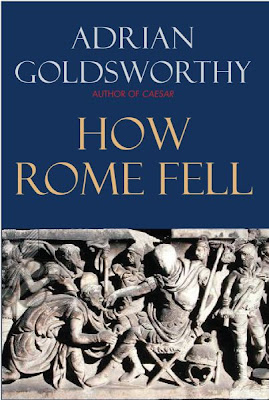
How Rome Fell: Death of a Superpower by Adrian Goldsworthy
Superb overview of the decline and fall of Rome with a rejection of the traditional assertions of causations for the end of the Roman empire ( Barbarians, Christianity etc.). Goldsworthy also sharply criticizes the popular idea among postmodern classicists today that the Roman Empire was “really” as strong during the fourth and fifth  centuries as it was during the golden age of philosopher-warrior-emperor Marcus Aurelius. Or that there was no fall of the empire at all, just a gentle “transformation” into something new. Goldsworthy discusses the likelihood of Late antquity “paper legions” of Roman armies which, in any event, scarcely resembled in elan, tactics or fighting strength the ones that Julius Caesar wielded in Gaul. A tour de force marred only by a weird epilogue that ranges from pedestrian to ( in it’s last sentences) truly awful – was it it tacked on as an afterthought? Did the editor of the rest of the book die before it was completed? Regardless, How Rome Fell is a worthy addition to an collection of popular ancient histories.
The War of Art: Break Through the Blocks and Win Your Inner Creative Battles by Steven Pressfield
A rare, nonfiction book by novelist and blogger Steven Pressfield. The War of Art is a book that I strongly recommend to aspiring writers ( which includes most bloggers) and other people pursuing dreams, not because it  is brilliant but because it is profound. Utilizing select personal vignettes and other anecdotes, Pressfield distills in everyday language the essence of what creative people need to understand if they are to succeed – concepts of “resistance”, which seductively undermine your efforts, and being a “professional”, which is the mindset that will get you there.
Most of the readers of this blog are interested in military affairs to some extent so I will use this reference to explain why I read The War of Art from cover to cover. Pressfield captures the difference in what Col. John Boyd called the question of “To be or to do. Which way will you go?”. By Boyd’s definition, Pressfield is a doer.
Steven Pressfield blogs on The War of Art of writing every Wednesday.
Posted in ancient history, art, authors, book, byzantium, complex systems, complexity, creativity, empire, historians, historiography, history, ideas, intellectuals, military history, network theory, networks, open-source, organizations, panarchy, power laws, reading, science, social networks, social science, society, synthesis, theory, Uncategorized | 2 Comments »
Sunday, July 5th, 2009
Jamais Cascio of Open the Future has a piece on possible extrinsic, pharmaceutical and evolutionary modifications to human intelligence in The Atlantic Monthly ( I read it on my Kindle ):
):
….Our present century may not be quite as perilous for the human race as an ice age in the aftermath of a super-volcano eruption, but the next few decades will pose enormous hurdles that go beyond the climate crisis. The end of the fossil-fuel era, the fragility of the global food web, growing population density, and the spread of pandemics, as well as the emergence of radically transformative bio- and nanotechnologies-each of these threatens us with broad disruption or even devastation. And as good as our brains have become at planning ahead, we’re still biased toward looking for near-term, simple threats. Subtle, long-term risks, particularly those involving complex, global processes, remain devilishly hard for us to manage.
But here’s an optimistic scenario for you: if the next several decades are as bad as some of us fear they could be, we can respond, and survive, the way our species has done time and again: by getting smarter. But this time, we don’t have to rely solely on natural evolutionary processes to boost our intelligence. We can do it ourselves.
….Yet in one sense, the age of the cyborg and the super-genius has already arrived. It just involves external information and communication devices instead of implants and genetic modification. The bioethicist James Hughes of Trinity College refers to all of this as “exocortical technology,” but you can just think of it as “stuff you already own.” Increasingly, we buttress our cognitive functions with our computing systems, no matter that the connections are mediated by simple typing and pointing. These tools enable our brains to do things that would once have been almost unimaginable:
- powerful simulations and massive data sets allow physicists to visualize, understand, and debate models of an 11?dimension universe;
- real-time data from satellites, global environmental databases, and high-resolution models allow geophysicists to recognize the subtle signs of long-term changes to the planet;
- cross-connected scheduling systems allow anyone to assemble, with a few clicks, a complex, multimodal travel itinerary that would have taken a human travel agent days to create.
If that last example sounds prosaic, it simply reflects how embedded these kinds of augmentation have become. Not much more than a decade ago, such a tool was outrageously impressive-and it destroyed the travel-agent industry.
That industry won’t be the last one to go. Any occupation requiring pattern-matching and the ability to find obscure connections will quickly morph from the domain of experts to that of ordinary people whose intelligence has been augmented by cheap digital tools. Humans won’t be taken out of the loop-in fact, many, many more humans will have the capacity to do something that was once limited to a hermetic priesthood. Intelligence augmentation decreases the need for specialization and increases participatory complexity.
Posted in 21st century, authors, cognition, complexity, connectivity, culture, cyberpunk, Evolution, futurism, society, tech, web 2.0 | Comments Off on Get Smarter Futurism


