zenpundit.com » 2010

Archive for 2010

Simplification for Strategic Leverage

Sunday, December 5th, 2010

Remember this much ridiculed visual monstrosity?:

Excessively complex representations, much less the bureaucratic systems in practice, are poor vehicles for efficient communication of strategic conceptualizations to the uninformed – such as those downstream who must labor to execute such designs. Or those targeted by them for help or harm.  In addition to the difficulty in ascertaining prioritization, the unnaturally rigid complexity of the bureaucracy generally prevents an efficient focus of the system’s resources and latent power. The system gets in it’s own way while eating ever growing amounts of resources to produce less and less, leading to paralysis and collapse.

Does it have to?

Here’s an interesting, very brief take on analytical simplification from a natural scientist and network theorist Dr. Eric Berlow on how to cull simplification – and thus an advantage – out of complex systems by applying an ecological paradigm.

Cognitive simplification will be a critical strategic tool in the 21st century.

A draft of what’s on my mind lately

Sunday, December 5th, 2010

by Charles Cameron
[ cross-posted from ChicagoBoyz ]

I’ve been thinking…

*

Reports, overstatements and underestimates

There are factual reports of violence and threats of violence, which are within the proper province of journalism and intelligence gathering.

There are also overstatements of such reports, generally resulting from paranoia, hatred, recruitment, or the desire to increase sales of advertising or munitions.

And there are understatements of such reports, generally resulting from sheer ignorance or a desire to be diplomatic.

*

Religious sanctions for violence

Similarly, there are factual reports of sanctions for violence in the scriptures, hagiographies and histories of various religions.

There are also overstatements of such reports, attributing to entire religions the beliefs and or activities of a significant subsection or outlier group of that religion

And there are understatements of such reports, avoiding the attribution of violence to religious beliefs regardless of whether the religious correlation is a “cover” for other motives or a sanction powerfully affecting the actions of those who respond to it.

*

Proportional and disproportionate responses

There are actions which represent a balanced and proportional response to threats or acts of violence, whether they be made at home or abroad, by the military or law enforcement, for reasons of just war or of security.

There are actions which present an unbalanced and disproportionate heightened response to acts of violence, into which category I would place both over-reactive military responses and over-reactive domestic security measures.

And there are inactions which are no less unbalanced as responses to acts or threats of violence, as with political wool-gathering or appeasement, bureaucratic failures to implement realistic information sharing and dot-connection within the IC, or public aversion to factual news or intelligent, nuanced analysis.

*

Ideals, kumbaya and skepticism

There are honest statements of aspiration for peaceable outcomes to current and future conflicts.

There are versions of such aspirations which naively overlook the very real correlations between religious sanctions and violence.

And there are skeptical aversions to such aspirations, which no less naively overlook the very real differences which are present between the most angry, the most terrified, the most politically driven, the most financially interested and the most generous members of any and every religious and irreligious viewpoint.

*

Let’s talk…

It is useful to bear these distinctions of category in mind, and to make accurate appraisals of one’s information inputs in terms of which categories they fall under, and how much trust one should therefore place in them.

There: it was on my mind and I have said it.

This is, as my title indicates, a first draft. I hope it will spark some interesting conversations, and lead to further insight and refinement…


A brief fugue on the graphics of coexistence

Saturday, December 4th, 2010

by Charles Cameron
[ cross-posted from ChicagoBoyz ]

A great many people will have seen (or designed) some variant of the “coexist” bumper-sticker / tee-shirt design:

Coexist

— the first of which can be found on acsapple‘s photobucket — and hey, the “aum” sign for “oe” is a brilliant bit of graphic substitution! – while I nabbed the second here.

What with a thousand flowers blooming, the importance of preserving memetic variations, peaceful coexistence and all, it’s only natural that some will have different takes on the matter —

coexist variants

— the first of these comes from the blog of a gun-toting political refugee from the People’s Progressive Republic of Massachusetts, while the second is a tee-shirt design by Matt Lussier, and you can get your tee-shirt here

*

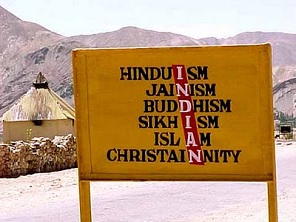
As for myself, I have fond memories of India, and was accordingly heartened to see this on an Indian Muslim site

india calling-religious unity

which is what set me thinking about “coexistence” graphics in the first place.

*

Did I ever tell you about the sign I saw over a shop in Delhi, advertising the sale of mythelated spirits?

I frequently feel just a tad mythelated myself.

Update: Wikileaks and Cryptographic Mythology

Saturday, December 4th, 2010

[ by Charles Cameron ]

It seems my intuition of a Lovecraft connection with WikiLeaks was right, as was Jean’s suggestion that the MARUTUKKU quote is “more specific and extensive and ‘mythological'” than the translations of Enuma Elish she’d found on the net. I dropped Anders Sandberg a line letting him know I’d quoted him in my earlier post, and he graciously responded with this clarification of the mystery:

I think the MARUTUKKU name/description is from the Simon Necronomicon, which did its best to shoehorn mythology into the mythos, and might explain the different translation. Of course, one might argue that that book is a real, a hoax posing as real, real posing as a hoax, or both at the same time.

Anders, currently a staff member with the Future of Humanity Institute at Oxford (which name strikingly reminds me of the Bright Futures Institute in Qom, Oxford’s parallel in the Iranian universe), is also known for his writings on Mage: the Ascension and other role-playing games — see for instance this account of the Asatru in M:tA.

*

Bryan Alexander Steve Burnett

The bearded, theremin-wielding mage Steve Burnett [left] also noted the origin of the MARUTUKKU quote in the Simon Necronomicon in his comment on my no-less-bearded mage-friend [right] Bryan Alexander‘s blog Infocult — which features a rich vein of gothic imaginings and runs with the subtitle “We haunt every medium we make”.

Delighted to find an excuse to post that photo, btw. My warm regards to all…

A DoubleQuote for Anders

Friday, December 3rd, 2010

[ by Charles Cameron ]

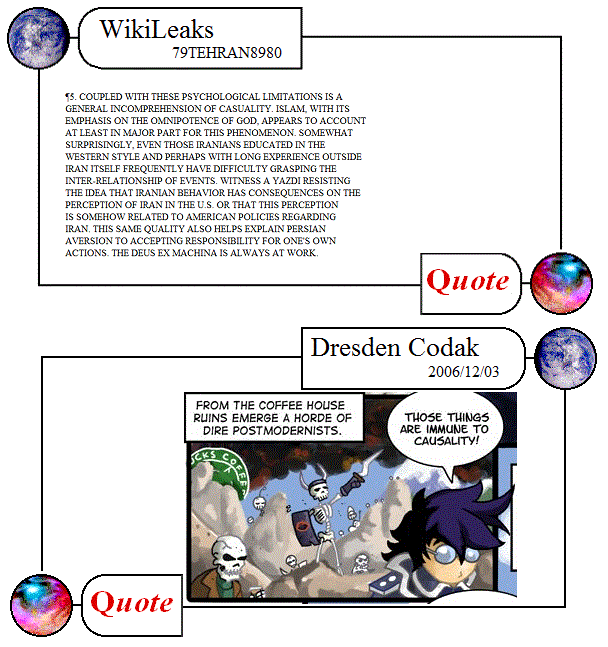
One of my hobbies is finding apposite quotes to juxtapose — I call them DoubleQuotes and think of them as twin pebbles dropped into the mind-pool for the pleasure of watching the ripples…

And I particulartly enjoy it when one of my DoubleQuotes manages to span different sensory streams — aural, visual, verbal, numerical, cinematic — as here, with text and image.

This one’s for Anders Sandberg.

QUOAcausal

I’d been carrying around the quote from WikiLeaks for a few days, but it was running across the Dresden Codak via Anders’ Andart blog today that gave me the second “dot” to connect with the first.


Switch to our mobile site