zenpundit.com » 2012 » October

Archive for October, 2012

On Super Mario Brothers and mental parcours games

Wednesday, October 3rd, 2012

[ by Charles Cameron — cross-posted from Sembl, side-scrollers for the mind, light but deep ]
.

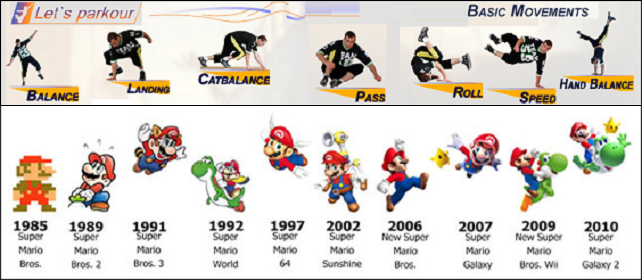
According to 25 Years of Super Mario Bros: A Look Back Through Mushroom Kingdom History, from which I grabbed the Mario Bros portion of the graphic at the foot of this page, “Since 1985’s release of the second-most selling console game of all-time, over 200 Nintendo titles have featured the eponymous Mario Bros” — on which I’ve played perhaps three or four levels of one or two early versions.

The Super Mario Bros side-scrollers (image above, left) are the work of the brilliant Shigeru Miyamoto, and part of what I find so fascinating about them is the way in which they resemble the mind-blowing practice known as Parcours (image, right), which apparently developed from the work of one David Belle, born in 1973 — who would have been 12 when the first Super Mario Bros game came out.

Let’s take a look at Super Mario Bros and Parcours, and then move on to the issue of parcours for the adventuring mind.

**

First, for those of you who don’t remember them, here’s what the early Mario Bros games were like…

I don’t think there’s much doubt that the Super Mario Bros games are essentially digital versions of Parcours, and you can see by comparing the video above with this next one:

Finally, this video from Jesse La Flair confirms the comnnection, at least in the mind of one top flight traceur:

**

My own question is: what would a mental parcours game look like?

I was thinking for a while last week about what a Mario-like side-scrolling game of mental parcours would be like. We already have the “creative leap” side pretty well covered with the various variants of Sembl we’ll be developing, so I thought about other types of mental agility, and what a game might look like if it incorporated a bunch of them — induction? deduction? causality? the sorts of pattern skills that go into IQ tests? — in a side-scroller with playful graphics…

Two things:

One: my friend Derek Robinson pretty quickly informed me that the actual build of such a game would be enormously complex — I resisted him, saying I wasn’t aiming to build the entire game, just to get the idea down on paper to see whether we could get the initial phases funded…

And two: I ran across Lumosity:

Let’s just say Lumosity seems to have a variety of cognitive skills well in hand, which leaves me free once again to concentrate on what Derek calls the mind’s opposable thumb.

**

That’s a brilliant concept, I think, and gets to the heart of what we’re working on with Sembl.

The various other conceptual skills that essentially add up to linear thinking — Zen calls it vertical thinking, see this helpful diagram — are important, and well-studied. They work best where what you are talking about is quantifiable and amenable to logic and cause and effect analysis, and is explored within fields, not across them.

But lo, that approach may help you quantify the trees and evaluate them as board feet of lumber, but consistently misses the forest, the greater context, the big picture –the combined systemic impact of many tiny details, insects, mosses, the tree as ecosystem within an ecosystem, and the ecosystems within that – the time scale, the slow growth, the root system, the transformation of mulch into nourishment, the sudden spurt of tiny leaves in spring, the photosynthesis — and the human wonder — the glory, dappled sunlight on fallen leaves, the shelter afforded to lovers by a weeping willow (I’m thinking of one willow in an Oxford college garden, but I’m time-traveling and I digress) – the poetry, of beech and birch, copper beech and silver birch, the trees, the words, the metals…

Context, quality, complexity, systems, dynamics, process, simplicity, value, passion, poetry – these are the things linear thinking has problems with. Poetry, passion, value, simplicity, process, dynamics, systems, complexity, quality, context – these are the things horizontal thinking does best.

**

That’s it.

Oh, and hey — just because I like the tiny antics they’re getting up to in the graphics:
On Eric Hobsbawm

Wednesday, October 3rd, 2012

I was going to comment on the death of the famed historian who was the Soviet Union’s most venerable and shameless apologist, but I was beaten to it in a brilliant piece by British blogger and fellow Chicago Boyz member, Helen Szamuely:

A great Communist crime denier dies

On my way to and from Manchester yesterday and today I read Anne Applebaum’s latest book Iron Curtain about the subjugation of Eastern Europe between 1944 and 1956. Ms Applebaum’s knowledge and understanding of the European Union is not quite what it ought to be, given that she usually appears in the guise of one of our leading political commentators but she does know the history of Communism and what it did to the countries and peoples who, for various reasons, found themselves under its rule. The first few chapters describe in some detail the brutality, violence, whole scale looting and widespread rapine that marked the Red Army’s route across Eastern and Central Europe, regardless of whether they were in enemy or friendly countries, with soldiers or civilians, men or women, adults or children, friend or foe. And then came the NKVD and the organized violence and looting. How many people know, for instance, that several of the Nazi camps, Auschwitz and Buchenwald included, were reopened by the Soviets for their own purposes? Not a few of the people they imprisoned there had been liberated only a few weeks previously.

As I was reading this horrible tale I got a text message from somebody who saw on the news that Professor Eric Hobsbawm, the best known apologist for Stalin and denier of Communist crimes, has died. We are entering a period of unrestrained mourning for this man who has on various occasions been described as the greatest living historian and one of the most influential ones. Sadly, the last part of it is true. He has been influential.

While Holocaust deniers are rightly excoriated Professor Hobsbawm has been treated in life and will be in death with the greatest adulation. Channel 4 lists some of the misguided souls who are pronouncing sorrowfully on the demise of this supposedly great man and asks rather disingenuously whether he was an apologist for tyranny.

Well, yes, as a matter of fact, he was….

Read the rest here.


Games of telephone and counter-telephone?

Wednesday, October 3rd, 2012

[ by Charles Cameron — embassy or consulate — a minor detail for an editor, perhaps, but all the difference in the world for Ambassador J Christopher Stevens ]
.

Here’s a screen grab of a piece posted on the Atlantic site today:


.

The article itself is worth your time, and I’ll get back to the screen grab later. Here’s the text para that interests me:

In the famous “Bin Ladin Determined to Strike in US” Presidential Daily Brief of August 6, 2001, one of the major analytic points was that “Al-Qa’ida members — including some who are US citizens — have resided in or traveled to the US for years, and the group apparently maintains a support structure that could aid attacks” (emphasis added). Notice that this analysis uses two hedges in a single sentence. Given the lack of certainty on the issue, such linguistic dodging made sense — as it does in report after report where individuals are discussing information below the level of actionable intelligence.

Leah Farrall has been tweeting about the way this characteristically cautious phrasing used by analysts gets lost as “the higher up the food chain an analytical report goes the greater the tendency for bosses in [the] food chain to add their two cents worth” — so that by the time it reaches the politicians, “there is absolutely WMD.”

The shift from “apparently” to “absolutely” is an interesting one.

**

The 2007 National Intelligence Estimate featured a section on the nomenclature of such distinctions, which I trust and imagine was directed more at its readers than towards the analysts who produced it:

What We Mean When We Say: An Explanation of Estimative Language

When we use words such as “we judge” or “we assess”—terms we use synonymously — as well as “we estimate,” “likely” or “indicate,” we are trying to convey an analytical assessment or judgment. These assessments, which are based on incomplete or at times fragmentary information are not a fact, proof, or knowledge. Some analytical judgments are based directly on collected information; others rest on previous judgments, which serve as building blocks. In either type of judgment, we do not have “evidence” that shows something to be a fact or that definitively links two items or issues.

Intelligence judgments pertaining to likelihood are intended to reflect the Community’s sense of the probability of a development or event. Assigning precise numerical ratings to such judgments would imply more rigor than we intend. The chart below provides a rough idea of the relationship of terms to each other.

We do not intend the term “unlikely” to imply an event will not happen. We use “probably” and “likely” to indicate there is a greater than even chance. We use words such as “we cannot dismiss,” “we cannot rule out,” and “we cannot discount” to reflect an unlikely—or even remote—event whose consequences are such it warrants mentioning. Words such as “may be” and “suggest” are used to reflect situations in which we are unable to assess the likelihood generally because relevant information is nonexistent, sketchy, or fragmented.

In addition to using words within a judgment to convey degrees of likelihood, we also ascribe “high,” “moderate,” or “low” confidence levels based on the scope and quality of information supporting our judgments.

• “High confidence” generally indicates our judgments are based on high-quality information and/or the nature of the issue makes it possible to render a solid judgment.
• “Moderate confidence” generally means the information is interpreted in various ways, we have alternative views, or the information is credible and plausible but not corroborated sufficiently to warrant a higher level of confidence.
• “Low confidence” generally means the information is scant, questionable, or very fragmented and it is difficult to make solid analytic inferences, or we have significant concerns or problems with the sources.

**

You could think of these as counter-telephone measures — attempts to avoid the distortions and corruptions that tend to arise when a message is passed from one person to another, And that’s important a fortiori when an ascending food-chain of transmitters may wish (or be persuaded) to formulate a message that will assure them the favorable attention of their superiors — but also because the higher the report goes, the closer it gets to decision-time..

As the Atlantic article says, this kind of “linguistic dodging” (aka attention to nuance) makes sense “in report after report where individuals are discussing information below the level of actionable intelligence.”

Inevitably there’s a shift in tempo between contemplation and action.

**

Anyway, messages tend to get distorted as they’re passed along.

Consider, for instance, the caption to the photograph that graces the Atlantic piece at the top of this post:

The U.S Embassy in Benghazi burns following an attack in September. (Reuters)

There’s only one problem there. The US didn’t have an Embassy in Benghazi — they had a Consulate — and that’s not a distinction that lacks a consequence. Whatever else may be the case, Ambassador Stevens would certainly have been better guarded had he been back in Tripoli in his embassy.

Whoever wrote that caption wasn’t as deeply immersed in the situation as the former CIA analyst who write the article. And when you’re not deeply immersed, it is perilously easy to get minor but important details wrong.

Let not thy left hand know what thy right hand doeth

Tuesday, October 2nd, 2012

[ by Charles Cameron — this post is about comparisons — what you make of them, and what they make of you, death calculus, and Handel ]
.


.

Scraped from my morning read, these two quotes — a tweeted headline from Breitbart and a gobbit of the Jerusalem Post — neatly illustrate a paradox I’ve been wrestling with, the way more profound souls wrestle with angels [link is to Rilke].

It’s the paradox of comparison.

**

On the one hand, I can barely imagine what it would be like to build — with, say, enough funds for a latter-day Manhattan Project — a Department whose job it was to monitor all activities and ensure even-handedness in the allocation of resources.

So that not ever would a Presidential aide on vacation receive a security detail until each and every ambassador had an equivalent force of marines around them at any given moment, in embassy or out.

I mean, what about consuls, or CIA heads of station — are they ambassadorial enough? Members of the cabinet on vacation? Members of the National Security Council? How far do we need to go with our even-handedness? Is Benghazi different from London? Londonistan?

How would one possibly assure oneself that no “hand” of government, left, right, center, upper, lower, or oblique to all of the above, ever arranged things in a way that compared foolishly with the way some other “hand” of government had arranged something more or less similar?

**

Let’s go to what my friend Bryan Alexander calls the death calculus. Since we’re interested in terrorism here, I’ll pull quotes from a couple of pieces that you can read in full if this topic interests you. Two paras from TomDispatch:

In 2008, 14,180 Americans were murdered, according to the FBI. In that year, there were 34,017 fatal vehicle crashes in the U.S. and, so the U.S. Fire Administration tells us, 3,320 deaths by fire. More than 11,000 Americans died of the swine flu between April and mid-December 2009, according to the Centers for Disease Control and Prevention; on average, a staggering 443,600 Americans die yearly of illnesses related to tobacco use, reports the American Cancer Society;5,000 Americans die annually from food-borne diseases; an estimated 1,760children died from abuse or neglect in 2007; and the next year, 560 Americans died of weather-related conditions, according to the National Weather Service, including 126 from tornadoes, 67 from rip tides, 58 from flash floods, 27 from lightning, 27 from avalanches, and 1 from a dust devil.

and:

The now-infamous Northwest Airlines Flight 253, carrying Umar Farouk Abdulmutallab and his bomb-laden underwear toward Detroit on Christmas Day 2009, had 290 passengers and crew, all of whom survived. Had the inept Abdulmutallab actually succeeded, the death toll would not have equaled the 324 traffic fatalities in Nevada in 2008; while the destruction of four Flight 253s from terrorism would not have equaled New York State’s 2008 traffic death toll of1,231, 341 of whom, or 51 more than those on Flight 253, were classified as “alcohol-impaired fatalities.”

Two paras from a Salon piece [copied here sans links and emphases]:

“The number of people worldwide who are killed by Muslim-type terrorists, Al Qaeda wannabes, is maybe a few hundred outside of war zones. It’s basically the same number of people who die drowning in the bathtub each year,” said John Mueller, an Ohio State University professor who has written extensively about the balance between threat and expenditures in fighting terrorism.

Last year, McClatchy characterized this threat in similar terms: “undoubtedly more American citizens died overseas from traffic accidents or intestinal illnesses than from terrorism.” The March, 2011, Harper’s Index expressed the point this way: “Number of American civilians who died worldwide in terrorist attacks last year: 8 — Minimum number who died after being struck by lightning: 29.” That’s the threat in the name of which a vast domestic Security State is constructed, wars and other attacks are and continue to be launched, and trillions of dollars are transferred to the private security and defense contracting industry at exactly the time that Americans — even as they face massive wealth inequality — are told that they must sacrifice basic economic security because of budgetary constraints.

**

My points?

On the one hand, that the world is far too complex to avoid disparities that can draw mockery down on the heads of those one might wish to mock.

And on the other, that comparisons also have an invaluable role to play in giving us a sense of the relative peaks and valleys of the terrain we live in — and may be literally or metaphorically mountaintop removal / valley fill coal mining in preparation for our children’s children…

**

Here’s a “DoubleQuote” for you:

Or for the musically inclined:

Now there’s a fascinating comparison (between the mining and the music) that doesn’t tell you much. Or does it?

**

Onwards to the issue of that sacred plateau in Jerusalem, featured as my second “reading for the day” at the top of this post.

It appears that you can be arrested for carrying a concealed knife on the Noble Sanctuary — or tallit or tefillin on Temple Mount — same place, different perspective.

That’s the sort of comparison that makes me catch my breath with wonder.

As the Famous Thinkers School might ask, giving you a pencil and a blank sheet of paper: can you draw this conclusion?

**

The full text of Matthew 6.3 reads in the KJV:

But when thou doest alms, let not thy left hand know what thy right hand doeth:

Marangolo P and associates uses a significant variant of that verse in the title of a learned paper: Let not thy left hand know what thy right hand knoweth. The case of a patient with an infarct involving the callosal pathways.

Brain malfunctions (and brain surgeries) can provide windows of considerable interest on our human condition, as the writings of Oliver Sacks so eloquently demonstrate.

An Insurgency Coming to a Place Near You?

Tuesday, October 2nd, 2012

Mayor Rahm Emanuel has taken criticism for Chicago’s skyrocketing homicide rate which stands this year at a shocking 19.4 per 100,000 residents. This is roughly triple the murder rate in New York City, is worse than in perennially crime-ridden Oakland and is within shouting distance of  war-torn Afghanistan and Mexico, which are fighting vicious insurgencies. Even for Chicago, the current level of street violence is unusually brazen.

Chicago has always taken an ambivalent attitude toward it’s enormous, 100,000 strong, network of rival street gangs. Traditionally, part of the social fabric of Chicago’s ethnically divided wards, Chicago’s street gangs were far better organized and more ruthlessly disciplined than street gangs elsewhere, which allowed them a limited entree into participation in local politics. The Chicago Outfit from Al Capone’s day on controlled the votes in the old 1st Ward, ran several near suburbs like Cicero and recruited especially brutal sociopaths from the Forty-Two gang; the legendary Mayor Richard J. Daley in his youth had been a thug for the Hamburg Athletic Club, the Democratic Party’s election-time enforcers in the 11th Ward. In more recent decades, the Black P. Stone Nation/El Rukns were Federal grantees and a number of powerful street gangs today use the Black United Voters of Chicago as a front group and cut-out to make deals with local politicians and swing aldermanic races.

However disturbing the status quo may have been in Chicago, it is potentially changing for the worse. Much worse.

DEA BOSS: MEXICAN DRUG CARTELS ARE SO DEEPLY EMBEDDED IN CHICAGO, WE HAVE TO OPERATE LIKE WE‘RE ’ON THE BORDER’ 

The city may be nearly 2,000 miles from Mexico, but the country’s drug cartels are so deeply embedded in Chicago that local and federal law enforcement are forced to operate as if they are “on the border,” according to Jack Riley, special agent in charge for the Chicago Field Division of the Drug Enforcement Administration (DEA).

Because of Chicago’s location in the heart of the United States, its large Mexican population and its abundance of street gang activity, drug cartels have designated the city as one of its main hubs of operation in America, Riley told TheBlaze in an exclusive interview. Inevitably, the increasing presence of cartels has also contributed to the Windy City’s skyrocketing violent crime rates, the DEA boss revealed.

“My opinion is, right now, a number of the Mexican cartels are probably the most organized, well-funded, vicious criminal organizations that we’ve ever seen,” said Riley.

Right now, at least three major Mexican cartels are fighting for control of billions of dollars worth of marijuana, cocaine and heroin in Chicago. That includes the ruthless Zetas and the powerful Sinaloa cartel, run by Joaquin “El Chapo” Guzman, arguably the most wanted man in North America, and perhaps the entire world….

….“If I pitted the Italian organized crime groups against for instance, ‘Chapo’ Guzman and the Sinaloa Cartel, it wouldn’t be a fight,” he told TheBlaze. “In my opinion, Chapo Guzman is the new Al Capone or Scarface to Chicago. His ability to corrupt, his ability to enforce his sanctions and to really do with an endless supply of revenue is in my opinion far greater than older Italian organized crime.”

….The drug trafficking organizations are based in Mexico but, he explained, they have operatives in various cities across the nation. In Chicago, local gangs are used by cartels as a means to get their products onto the streets without putting their operations at risk, all the while raking in massive profits from drug sales. Cartels move every drug you can think of, including cocaine, marijuana, heroin and methamphetamines.

Overall, police records indicate Chicago’s murder rate is up 31 percent from 2011. Further, Mayor Rahm Emanuel in August requested federal assistance to combat violence and drugs. The Chicago Sun-Times reported on Aug. 31 that at least 82 people were injured or killed in shootings within a one week period, 10 in one night alone. Additionally, as of Aug. 23, there had been 351 shooting deaths so far in 2012….

Read the rest here.

The vast profit margin in illegal drug sales and the formidable manpower of Chicago street gangs have led the Mexican cartels to make a strategic choice to stay in the background, as hegemonic partners with local gangbanger street crews and not make the kind of flamboyantly ghoulish “narcocultas” attacks or DIY militarization typical of the Mexican criminal insurgency.  Sharing profits and letting locals run the major risks with law enforcement is a cartel strategy to avoid antagonizing the Federal government into treating their drug operations as ” international terrorism” with the draconian response that would imply, here, inside Mexico and further abroad. The same reason the cartels do not try to kill large numbers of American tourists or assassinate prominent Americans in Mexico, which they could easily do.

However, the cartels could shift from transnational organized crime activities to exporting narco-insurgency to America under a number of scenarios:

  •  Cartel vs. Cartel – a cartel losing to rivals in Mexico breaks the informal rule against high profile attacks inside the US by striking it’s enemies here, inviting a cycle of severe retaliation and drawing in local allies – Mexican Mafia, MS-13 etc.
  • Federal Squeeze – law enforcement gets really serious about systemically destroying a particular cartel, rooting out it’s illicit money stashed in the US banking system and legal investments and jailing everyone in sight under RICO and extraditing everyone else from Mexico. The narcos will employ “silver or lead” tactics to intimidate and co-opt local officials and whole communities and then escalate into symbolic terrorism.
  • US Intervention – American assistance to the government of Mexico against the cartels tips the balance in Mexico’s civil war to what the cartels see as an existential threat ( i.e. drone targeted killings) and the narcos respond with furious attacks against American soft targets intending to create high body count events.

There is nothing magical about the US-Mexican border that prevents the ghastly violence in Mexico from occurring here – it is a rational calculation by cartel leaders that such behavior is not worth the risk of a stand-up fight with the US military and intelligence agencies – the cartels are only just holding their own against the lesser capabilities of the government of Mexico However, if cornered and desperate, the cartels are capable of rapidly escalating the violence in specific American communities to 2006 -2007 Iraq insurgency levels – in places like Chicago. It could happen faster than anyone believes possible.

The political effect of this will be a riptide – and none of it to the good.


Switch to our mobile site