Metaphors, more iv, featuring Oliver Roeder & Chris Cillizza
Wednesday, August 1st, 2018[ by Charles Cameron — others besides david ronfeldt who find game & sports metaphors valuable — or should that be invaluable? ]
.
I’m making this post a “special” because Ron Hale-Evans pointed me to a trove of articles variously about or touching on game metaphors for politics, geo or otherwise.
**
This was the start:
What game is President Trump playing? By that I mean what actual game is he playing?
Trump’s political performance, in seriousness and in jest, has often been likened to chess. Even to three-, four-, eight-, 10- and 12-dimensional chess. His proponents argue he’s a grandmaster,1 and his detractors argue he’s a patzer. CNN’s Chris Cillizza has written two different articles accusing Trump of playing “zero-dimensional chess,” whatever that means. Even Garry Kasparov, probably the greatest actual chess player of all time, has weighed in, inveighing against the use of this gaming cliche via Politico.
In my job here at FiveThirtyEight, I spend a lot of time thinking about games — board games, video games, chess tournaments, math puzzles, the game theory of international affairs. So I understand that “playing chess” is easy shorthand for “doing strategy” or “being smart” or whatever. But I think we can do better. I humbly propose to you that Trump is not playing chess (of any dimension), but rather something called “ultimate tic-tac-toe.” It’s time to update your tropes.
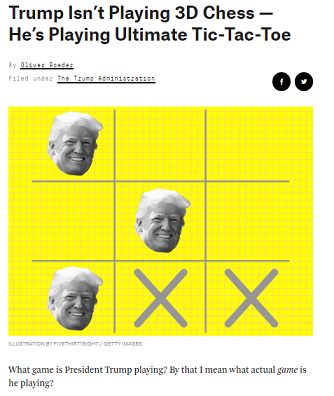
It’s a good day when I find an entire article dedicated to game or sports metaphors for politics, but this one had some great links..
Instances:
**
The second thing this Corker episode makes clear is that, strategically speaking, Trump is playing zero-dimensional chess. As in, the only strategy is that there is no strategy.
In the wake of Trump’s absolutely stunning 2016 victory, the conventional wisdom — in political circles — was that Trump was a strategic genius, always seeing five moves ahead. He was playing three-dimensional chess while the media was still trying to figure out which way pawns could move. The reason no one thought Trump could win was because “we” didn’t see the whole board the way he did. No one else saw it that way. Trump was a genius. An unconventional genius but a genius nonetheless.
There, incidentally, is the definition of zero-dimensional chess:
Trump is playing zero-dimensional chess. As in, the only strategy is that there is no strategy.
And:
**
The key part is when he concludes Flake will be a “no” on the tax reform package in the Senate because, well, his political career is “toast” — or something.
I submit this as yet another piece of evidence that Trump is playing zero-dimensional chess.
What do I mean? Simply this: When Trump won the White House — against all odds — the working assumption was that he had executed a plan so brilliant and so complex that only he (and the few advisers he let in on the plan) could see it. He was playing three-dimensional chess while the media, the Clinton campaign and virtually everyone else was still playing checkers.
But as his first year in the White House has progressed, there’s mounting evidence that Trump may not be playing three-dimensional chess. In fact, he might just be playing zero-dimensional chess. As in, the only strategy Trump is pursuing is no strategy at all.

From a game-policy metaphor angle, this doesn’t take us much further, although you can read the whole post for details of the Trump-Flake business..
And..
**
Chess? That’s not what Garry Kasparov sees Donald Trump or Vladimir Putin playing—three-dimensional or any other kind. But if they did sit down for a game, the former grandmaster believes the Russian president would obviously win.
“Both of them despise playing by the rules, so it’s who will cheat first,” Kasparov told me in an interview for POLITICO’s Off Message podcast. “But in any game of wits, I would bet on Putin, unfortunately.”

Kasparov gets into some interesting details, not entirely uncritical of Obama, and even GW Bush, but flicking Trump off the board with a flick of his cultivated fingernail..
I think I’vetheis referenced the Kasparov article once before, but hey, this is a rich harvest..
Next:
**
Shall we play a game?
Imagine that a crisp $100 bill lies on a table between us. We both want it, of course, but there’s no chance of splitting it — our wallets are empty. So we vie for it according to a few simple rules. We’ll each write down a secret number — between 0 and 100 — and stick that number in an envelope. When we’re both done, we’ll open the envelopes. Whichever of us wrote down the higher number pockets the $100. But here’s the catch: There’s a percentage chance that we’ll each have to burn $10,000 of our own money, and that chance is equal to the lower of the two numbers.
So, for example, if you wrote down 10 and I wrote down 20, I’d win the $100 … but then we’d both run a 10 percent risk of losing $10,000. This is a competition in which, no matter what, we both end up paying a price — the risk of disaster.
What number would you write down?

In the 538 post, the game’s available for interactive play.. And later in the same piece, too..
Now imagine that you’re playing the same game, but for much more than $100. You’re a head of state facing off against another, and the risk you run is a small chance of nuclear war
That was instructive, I think, though my mind is artificially dimmed at present..
And finally:
**

This one revolved around a tweet in which Trump had said
:When a country (USA) is losing many billions of dollars on trade with virtually every country it does business with, trade wars are good, and easy to win. Example, when we are down $100 billion with a certain country and they get cute, don’t trade anymore-we win big. It’s easy!
How easy? was this post’s response:
But how easy? And how exactly do you win them? (Also, what’s a trade war?)
Let’s find out. You (Yes, you!) have just been elected president of your very own country. Congratulations! Now it’s time to get to work. There is another country out there that has goods you can buy, and you have goods it may want to buy. Your job is to choose your foreign economic policy — which you’ll do in the little game we’ve prepared for you below.
The rules go like this: You can cooperate with the other country, allowing the free flow of its goods into your country. Or you can defect, imposing tariffs on the foreign goods. And because you will trade with the same country over and over again, you have to decide whether to stick with a single strategy no matter what or whether to change course in response to your opponent. The other country faces the same choice, but you can’t know in advance what plan they’ve chosen. Free trade helps both countries, generating big windfalls for both sides. But it’s possible for a single country to improve its own situation at the other’s expense — you both have a selfish incentive to defect, taxing the imports from the other country and helping only yourself. However, if you both defect, you both wind up isolated, cutting yourselves off from the market and reducing earnings on both sides.
Again, the game is available for interactive play.
We’ve simplified trade dramatically: You’re engaging in 100 rounds of trade with a randomly chosen FiveThirtyEight reader. In each round, you and your trade partner can either cooperate (allow free trade) or defect (impose a tariff). Your goal is to pick a strategy that earns you as much as possible.
The game mechanics here were interesting (and “gave the game away” where the game is game theory a la Prisoners Dilemma):

Well..
Was there a trade war? Was it good? Did you win it?
Tariffs are the weapons of a trade war
The game you just played took a little game theory — the formal, mathematical study of strategy — and retrofitted it to the world of international relations. (Of course, our simulation is extremely simplified, and it runs in a very controlled little world that ignores alliances, trade deals, political histories, other countries, and hundreds of other factors.)
**
Memory slippage — lest we forget, there was one last game ref today:
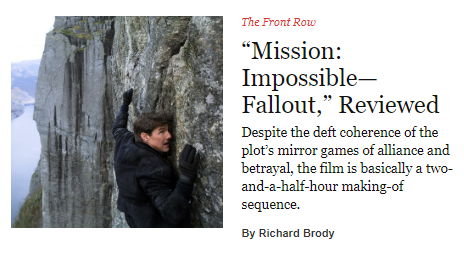
It’s the NYorker‘s film criticism of the latest impossible Mission, and the game sentence in the piece itself reads:
Despite the deft coherence of the plot’s mirror games of alliance and betrayal, which provide the illusion of a developed drama, the movie almost totally deprives its characters of inner life or complex motives.
Mirroring’s one of the patterns I love to collect, and game thinking here might note the Kierkegaardian note:
In his 1846 essay “The Present Age,” Søren Kierkegaard decried the widespread tendency of the time -— which he summed up as an age “without passion” —- to “transform daring and enthusiasm into a feat of skill.”
The continuum from “daring and enthusiasm to “feat of skill” is an interesting one for game designers to place their games on — before and after design, and when player feedback is in.
A rich day indeed.
**
Sources:
FiveThirtyEight, Trump Isn’t Playing 3D Chess CNN Politics, Donald Trump is playing zero-dimensional chess CNN POlitics, Donald Trump is playing zero-dimensional chess (again) Politico, Garry Kasparov Would Like You to Stop Saying ‘Trump Is Playing 4-D Chess’ FiveThirtyEight, How To Win A Nuclear Standoff FiveThirtyEight, How To Win A Trade War Trump on Twitter, trade wars are good, and easy to win New Yorker, Mission: Impossible -— Fallout
**
Some other posts in this series
And I emphasize Some, previous posts in the game & sports metaphor series, as somewhat randomly collected, and Likelky not in sequential order:
ZP post, http://zenpundit.com/?p=57435 ZP post, http://zenpundit.com/?p=59988 ZP post, http://zenpundit.com/?p=59082 ZP post, http://zenpundit.com/?p=58644 ZP post, http://zenpundit.com/?p=57908 ZP post, http://zenpundit.com/?p=59678 ZP post, http://zenpundit.com/?p=57493 ZP post, http://zenpundit.com/?p=59496 ZP post, http://zenpundit.com/?p=60193
With any luck, some of these will have links to yet others in the series..
**
And dammit, pwned by another one before my head hit the pillow..
Excellent reporting by ?@SuneEngel? on how the return of Syria’s refugees became a bargaining chip – and the very real and present threat of danger that many could face if they do go home. https://t.co/nie6YdWf9r
— Louisa Loveluck (@leloveluck) July 30, 2018
Pawn, yes. Pwn?