January 25th, 2013
[ by Charles Cameron — mostly for the fun of it, though students of social media may want to explore further ]
.

.
Two stories from opposite ends (arguably) of the spectrum:
First, how social media can subvert respect for the “virtue police” in Saudi Arabia (h/t Sana Issa):
A lady in Dammam, the hub of the oil industry on the kingdom’s Gulf coast, tweeted a complaint from a local shopping mall. Agents of the Committee for the Promotion of Virtue and Prevention of Vice (CPVPV), she said, were causing an unpleasant scene. The government-salaried vigilantes, a bearded auxiliary police force familiarly known to Saudis as the Hayaa, had marched officiously into an educational exhibit featuring plaster models of dinosaurs, turned off the lights and ordered everyone out, frightening children and alarming their parents.
[ … ]
Within minutes of the incident, a freshly minted Arabic Twitter hashtag, #Dammam-Hayaa-Closes-Dinosaur-Show, was generating scores of theories about their motives.
Perhaps, suggested one, there was a danger that citizens might start worshipping dinosaur statues instead of God.
Maybe it was just a temporary measure, said another, until the Hayaa can separate male and female dinosaurs and put them in separate rooms.
Surely, declared a third, one of the lady dinosaurs had been caught in public without a male guardian.
A fourth announced an all-points police alert for Barney the Dinosaur, while
another suggested it was too early to judge until it was clear what the dinosaurs were wearing.
There’s more, but I’m too prudish to post it…
**
Second, and more seriously – but wittily too, hey! — here’s how social media can impact the egos of “so-called” Vajrayana [ Buddhist tantra ] practitioners, together with sage advice from a noted film-maker Rinpoche, Dzongsar Jamyang Khyentse:
Don’t post tantric images: If you think posting provocative tantric images (such as images of deities with multiple arms, animal heads, those in union, and wrathful deities) makes you important, you probably don’t understand their meaning
Don’t post mantras and seed syllables: If you think mantras and seed syllables should be posted on Facebook as mood enhancement and self-improvement aids, a makeover or haircut might do a better job.
Don’t talk about your empowerments: If you think images from your weekend Vajrayana empowerment are worthy of being posted up next to photos of your cat on Facebook, you should send your cat to Nepal for enthronement.
Vajrayana Buddhism? Here’s a quick overview:
In contrast to the approaches of conventional religion, tantra does not attempt to soothe the turmoil of existence with consoling promises of heaven and salvation. The tantric practitioner chooses to confront the bewildering and chaotic forces of fear, aggression, desire, and pride, and to work with them in such a way that they are channeled into creative expression, loving relationships, and wisely engaged forms of life.
**
And then there’s Benedict XVI, tweeting as @pontifex. His 1,458,557-and-counting followers have thus far received 27 tweets from the Holy Father since December 12th — no “Friday Follows” and no “Retweets”.
He does, however, follow himself in 8 languages besides English.
Posted in Buddhism, Charles Cameron, christianity, Islam, social media, twitter, Uncategorized | Comments Off on Social media and religion: from Benedict via Barney to Vajrayana
January 25th, 2013
The Center for Combating Terrorism at West Point released a report on domestic terrorism that raised hackles for a number of reasons. Despite the dismissals of liberal political pundits, the reasons for objections to the CTC report are legitimate but they did not need to arise in the first place and might have been avoided with a slightly different editorial approach or appropriate caveats (I just finished reading the report, which is primarily focused on the usual suspects). Here’s why I think the normally well-regarded CTC stumbled into a hornet’s nest:
First, in this foray into domestic terrorism analysis, the center chose to concentrate only on the threat of violence of the Far Right while ignoring other threats coming from the Far Left, infiltration by criminal insurgent networks from Mexico, notably the ultraviolent Zetas whose reach has stirred gang violence in Chicago and Islamist terrorism, either homegrown “lone wolves” or from foreign infiltration or subversion. In itself, this is understandable if the CTC plans a series of reports with a separate focus on different domestic threats; but without that context, it is a myopic analytic perspective, particularly given the demonstrated capabilities of various AQ affiliates or just south of the border, the criminal–insurgency of the narco-cartels. Had all of these been addressed in one omnibus report, any complaints from conservatives were likely to have been muted or nonexistent. This is not to say that the radical American Far Right does not have a violent threat potential of it’s own worth studying; it does and it is real. But available evidence indicates it to be the least organized, least operationally active and least professionally competent in terms of terrorist “tradecraft” of the three.
The second and most problematic aspect of the report is an intellectually sloppy definition of a dangerous “antifederalist movement” where noxious concepts like “white supremacy” and wacko conspiracy theories are casually associated with very mainstream conservative (or even traditionally bipartisan !) political ideas – coincidentally, some of the same ideas that contemporary “big government” liberal elites tend to find irritating, objectionable or critical of their preferred policies. Part of the equation here is that American politics are evolvng into a very bitterly partisan, “low trust” environment, but even on the merits of critical analysis, these two passages are ill-considered and are largely responsible for most of the recent public criticism of the CTC:
….The antifederalist rationale is multifaceted, and includes the beliefs that the American political system and its proxies were hijacked by external forces interested in promoting a “New World Order” (NWO) in which the United States will be absorbed into the United Nations or another version of global government. They also espouse strong convictions regarding the federal government, believing it to be corrupt and tyrannical, with a natural tendency to intrude on individuals’ civil and constitutional rights. Finally, they support civil activism, individual freedoms, and self government
….In contrast to the relatively long tradition of the white supremacy racist movement, the anti-federalist movement appeared in full force only in the early to mid-1990s, with the emergence of groups such as the Militia of Montana and the Michigan Militia. Antifederalism is normally identified in the literature as the “Militia” or “Patriot” movement. Anti-federalist and anti-government sentiments were present in American society before the 1990s in diverse movements and ideological associations promoting anti-taxation, gun rights, survivalist practices,and libertarian ideas
This is taxonomic incoherence, or at least could have used some bright-line specifics ( like “Posse Commitatus” qualifying what was meant by “anti-taxation” activists) though in some cases, such as “libertarian ideas” and “civil activism”, I’m at a loss to know who or what violent actors they were implying, despite being fairly well informed on such matters.
By the standard used in the first paragraph, Glenn Greenwald, Ralph Nader and the ACLU would also be considered “far right antifederalists”. By the standards of the second, we might be in physical danger from Grover Norquist, Congressman John Dingell and Penn Jillette. No one who opposed the recent increases in income tax rates, dislikes gun-control or thought the DOJ may have abused it’s power in the prosecution of Aaron Swartz or in their stubborn refusal to prosecute Bankster racketeering is likely to welcome a report under the auspices of West Point that juxtaposes such normal and perfectly valid American political beliefs with neo-Nazism. A move that is simply going to – and quite frankly, did – gratuitously irritate a large number of people, including many in the defense and national security communities who are a natural “customer base” for CTC reports.
As I said previously, this could easily have been completely avoided with more careful use of language, given that 99% the report has nothing to do with mainstream politics and is concerned with actors and orgs with often extensive track records of violence. As the CTC, despite it’s independence, is associated so strongly with an official U.S. Army institution, it needs to go the extra mile in explaining it’s analysis when examining domestic terrorism subjects that are or, appear to be, connected to perfectly legitimate participation in the political process. This is the case whether the subject is on the Left or Right – few activists on the Left, for example, have forgotten the days of COINTELPRO and are currently aggrieved by the activities of Project Vigilant.
I might make a few other criticisms of the report, such as the need for a better informed historical perspective, but that is hardly what the recent uproar was about.
Posted in #FAIL, 3 gen gangs, 4GW, 5GW, academia, al qaida, America, analytic, army, bias, conservativism, conspiracy, counterpoint, counterterrorism, criminals, critical thinking, cultural intelligence, defense, democracy, Epistemology, extremists, fisking, gangs, government, ideas, insurgency, intellectuals, law enforcement, Liberalism, liberty, military, narcoterror, national security, networks, non-state actors, organizations, OSINT, Perception, politics, protest, radicalization, reading, risk, scenario, security, social networks, social science, society, terrorism, theory, think tanks, threat, transnational criminal organization | 15 Comments »
January 24th, 2013
[ by Charles Cameron — wondering whether it can ever be possible to expect the unexpected, and if so, what exactly that might mean? Libya & Mali ]
.
.
Alex Thurston at Sahel Blog: Covering Politics and Religion in the Sahel and the Horn of Africa posted Libya and Mali, Part I today. The topic is one I am not qualified to comment on, although I’m trying to learn from those (such as AT) who are — but this sentence caught my eye and got me writing:
A failure to soberly consider the possible unexpected consequences of intervention and transition has helped chaos to develop in post-Qadhafi Libya.
I wonder if that’s a koan?
**
Is it ever possible to “soberly consider the possible unexpected consequences” of anything? Consider Donald Rumsfeld‘s remark:
There are known knowns. These are things we know that we know. There are known unknowns. That is to say, there are things that we know we don’t know. But there are also unknown unknowns. There are things we don’t know we don’t know.
Throw in the missing fourth category, supplied by somebody for Wikipedia:
Moreover, one may criticize Rumsfeld statement for omitting the most dangerous type of unknown: the “unknown known”. That is, as Mark Twain famously expressed it, “It ain’t what you don’t know that gets you into trouble. It’s what you think you know that just ain’t so”. Indeed, Rumsfeld was really discussing an “unknown known” which provided faulty justification for the war — members of the Bush administration claimed that the Iraqi government possessed weapons of mass destruction (see Rationale_for_the_Iraq_War), but it just wasn’t so.
**
Now allow for what you might call informed guess-work, what CS Peirce called abduction — I’m just now introducing my elder son to Eco & Sebeok‘s magnificent book, The Sign of Three: Dupin, Holmes, Peirce — and “non-predictive” attempts to lay out a spread of possible outcomes by means of scenario-planning, as Tom Barnett wrote in his Year 2000 International Security Dimension Project Final Report:
By “decision scenario approach,” we mean using credible scenarios to create awareness among relevant decision-makers regarding the sort of strategic issues and choices they are likely to face if the more stressing pathways envisioned come to pass.
and:
Again, none of our material here is meant to be predictive in the sense of providing a step-by-step “cookbook” approach to Y2K and Millennial Date Change crisis management. Our fundamental goal in collecting and synthesizing this analysis is to avoid any situation where US military decision makers and/or operational commanders would find themselves in seemingly uncharted territory and declare, “I had no idea . . ..”
We (myself at times included) seem to be busily employed making non-predictive predictions.
**
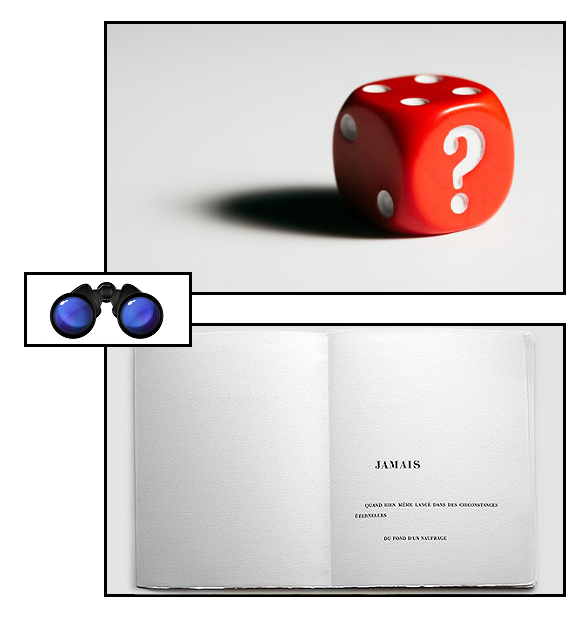
Black swans… Nassim Nicholas Taleb may have been the one who most recently crept up behind us and clapped loudly to alert us to the unexpected, but Stéphane Mallarmé was there first in 1897 with the great graphical poem Un coup de dés jamais n’abolira le hasard, featured in the lower image of the pair at the top of this post.
My own “zen telegram” version, for those who neither know the poem nor read French:
A ROLL OF THE DICE
NEVER
not even when tossed sub specie aeternitatis from the depth of a shipwreck
WILL NEVER EVER ABOLISH
CHANCE
— now there’s a koan for our times — and always.
**
Listen to the poets…
Hear the voice of the Bard!
Who Present, Past, & Future, sees;
Whose ears have heard
The Holy Word
That walk’d among the ancient trees…
**
Sources and links:
Un Coup de Dés Jamais N’Abolira Le Hasard from Wikipedia
le début de la typographie moderne by Étienne Mineur with page images
Un coup de dés, French original and English translation, by AS Kline
See that voice of the Bard, William Blake…
Posted in africa, black swans, blindspots, britain, Charles Cameron, france, Libya, poetry, Uncategorized, uncertainty | 8 Comments »
January 23rd, 2013

Small Wars Journal has published another edition of the excellent COIN interview series conducted by Octavian Manea. Here he interviews A.A. Cohen, author of Galula: The Life and Writings of the French Officer who Defined the Art of Counterinsurgency
OM: Which were the role of Mao and the exposure to Chinese civil war in Galula’s story? It seems to be his decisive formative lab experience like Russia was for George Kennan.
AAC: Unquestionably, of all the influences exerted on Galula’s treatise, Mao and the Chinese Civil were the greatest. Galula had a strong intellectual admiration for Maoist revolutionaries, despite being very opposed to what they stood for. Before the Chinese Civil War, Galula had no interest in insurgency or counterinsurgency. He had not fought as a Partisan during WW2; he had no experience or interest in these fields until he was exposed to China as of late 1945, in the thick of its civil war. There, his analytical penchant led him to see himself as the decipherer of Mao, intent on getting to the bottom of what the revolutionaries were fundamentally about. Galula cut through the egalitarian propaganda and all that surrounding the People’s revolution. Above all, he wanted to understand why these guys were gaining momentum as they were despite the unfavorable odds. When he figured it out, he reverse-engineered their methods to arrive at a counter-process to revolution and insurgency. His embrace of Chinese dialectics, and with these, the notion of unity of opposites or yin and yang, was helpful in achieving this.
Is counterinsurgency to Galula more of a strategy or more of a technique and a methodology?
What Galula offers, first and foremost, is a doctrine – not a strategy. His doctrine is underpinned by an important theory about people and what motivates them to take up arms, or to side with those who do. The theory goes that in times of danger (war), the majority of people will be motivated primarily by a fundamental need for security. Galula is adamant about this. But he also recognizes that there will be a minority of people – the instigators at the core of a movement – that will be ideologically, or even fanatically motivated. These are the true believers. He makes no qualms about prescribing that this is the group that the counterinsurgent or counterterrorist will need to find and neutralize, while protecting the rest of the population that aspires to a normal, if not better life. If you buy into this theory, Galula’s doctrine offers a multi-step framework for operations; in other words, a method to counterinsurgency. His famous eight steps are there to provide some logical linearity to what is otherwise a very nonlinear form of warfare. Within that framework, you have the flexibility to formulate your strategy and to conduct your operations to achieve your objectives.
Read the rest here.
I agree that Galula was not offering a strategy. Even more strongly, I think Cohen is correct about the historical importance of China’s long period of disorder, from the overthrow of the Q’ing dynasty to Mao ZeDong’s declaration of the People’s Republic, for Galula. However, not just for him but for anyone interested in questions of war and statecraft where insurgency, warlordism, state failure, state-building, foreign intervention, balance-of-power politics, ideological mass-movements, 4GW, revolution and total war coexisted and co-evolved.
The best comparison in our lifetime to China in this period would have been Lebanon in the 1980’s, except that China’s polycentric conflict was even more complex and on an epic scale.
Posted in 4GW, academia, army, china, COIN, counterinsurgency, Failed State, Hybrid War, ideas, insurgency, intellectuals, Mao ZeDong, military, military history, model, politics, psychology, revolution, security, small wars journal, social science, state failure, theory, war | 3 Comments »
January 22nd, 2013
[ By Charles Cameron — cross-tagging some useful resources from natsec bloggers with another from a bright historian friend ]
.

.
Daveed Gartenstein-Ross‘s Globe and Mail piece The War’s in Mali, But the Danger is International from almost a week ago gave a global context to the conflict, while his more recent Al Qaeda in the Islamic Maghreb and Al Qaeda’s Senior Leadership on Gunpowder & Lead addresses the issue of relations between AQIM and AQ senior leadership.
Zeroing in, we have a 4-part series on the jihadist actors in Mali from Andrew Lebovich, posting on Jihadica:
Primer on Jihadi Players in Algeria and Mali, Pt. 1: AQIM
Primer on Jihadi Players in Algeria and Mali, Pt. 2: Belmokhtar & Those Who Sign with Blood
Primer on Jihadi Players in Algeria and Mali, Pt. 3: Movement for Tawhid and Jihad in West Africa
— and there’s one more in the series still to come which has now been posted:
Primer on Jihadi Players in Algeria and Mali, Pt. 4 (Final): Ansar al-Din
**
And by way of cross-fertilization of immediacy with history, here’s the key Mali para from The Slightly-More-Longue Duree by my friend, Swarthmore historian Tim Burke, on Easily Distracted:
I would never for a moment want to fall back on a pure restatement of ibn Khaldun’s famous interpretation of the history of northern Africa (and the world) and say, “See, this is just pastoralist nomads versus settled agriculturalists and city-dwellers”. But there is a much more specific history that has considerable depth and antiquity to it that involves relationships between Berber-speaking Tuareg pastoralists, Fulani pastoralists, and the settled agricultural societies of the Niger River; between North African states and Sahelian states; between cities and their rural hinterlands; between Islamic cultures and non-Islamic ones. That all matters not just as contemporary sociology but as deep and structurally recurrent history, as a series of patterns and concepts that can be consciously recited by contemporary combatants but that also can be the structural priors of how they mobilize for and imagine conflicts.
Tim’s conclusion:
To talk about deeper histories is not to explain current conflicts as destiny, or to put aside a whole host of material, economic, geopolitical and cultural issues with much more immediate explanatory weight. But somehow I feel as if we have to give people struggling to understand what’s happening (and what to do about it) the permission to consider all of the history, as well as the guidance to help them to weigh its importance in context.
Posted in africa, analytic, blog-friends, blogosphere, Charles Cameron, historians, historiography, history, islam.insurgency, national security, Uncategorized | Comments Off on Mali: the wider context, the right now and the longue durée


