zenpundit.com » theory

Archive for the ‘theory’ Category

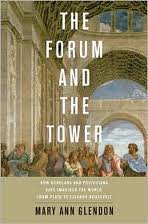
The Forum and The Tower, a review

Sunday, November 20th, 2011

[by J. Scott Shipman]

the-forum-and-the-tower.jpeg

The Forum and The Tower by Mary Ann Glendon

“The relationship between politics and the academy has been marked by mutual fascination and wariness since the time of Plato.”

The first sentence on the flap of the dust jacket of this very good and informative small book. Professor Glendon, who is the Learned Hand Professor of Law at Harvard Law school, set out to write a book for her students that would answer ageless questions such as:

“Is politics such a dirty business, or are conditions so unfavorable, that couldn’t make a difference? What kinds of compromises can one make for the sake of getting and keeping a position from which one might be able to have influence on the course of events? What kinds of compromises can one make for the sake of achieving a higher political goal? When does prudent accommodation become pandering? When should one speak truth to power no matter what the risk, and when is it acceptable, as Burke put it, to speak the truth with measure that one may speak it longer? When does one reach the point at which one concludes, as Plato finally did, that circumstances are so unfavorable that only the reasonable course of action is to “keep quiet and offer up prayers for one’s own welfare and for that of one’s country”?”

Professor Glendon answers these questions and more through brief examinations of the lives and works of some of history’s most important figures:

Plato

Cicero

Justinian, Tribonian, and Irnerius

Machiavelli

Thomas Hobbs and Edward Coke

John Locke

Jean-Jacques Rousseau

Edmund Burke

Tocqueville

Max Weber

Oliver Wendell Holmes

Eleanor Roosevelt and Charles Malik

All in all, I believe Professor Glendon has provided a uniquely valuable book to help her students and other readers to answers those questions. In short but focused chapters of about 20 pages each, she provides mini-biographies of the subjects above and how they answered the some of the questions both in their lives and in their philosophy. Some of her subjects were thinkers lacking the abilities for the public square, Plato, for instance, but were enormously influential just the same. Rare were those like Cicero and Burke who were equally comfortable in the political arena or the academy.

My favorite chapters were on Plato, Cicero, Machiavelli, and Burke—mostly because I’ve read a respectable amount of their work. That said, I have not read Plato’s The Laws—and Professor Glendon suggests it is much better than The Republic—which I have read and did not much enjoy. Not surprisingly, The Laws will be on my list for this winter.

The inclusion of Eleanor Roosevelt and Charles Malik was something of a surprise, but Professor Glendon is weaving a sub-story through each chapter and illustrating how Roosevelt and Malik’s work on the Universal Declaration of Human Rights was something of culmination and extension of over 2,000 years of thinking and political action—not in the context of human progress towards a utopia of sorts, which she wisely rejects,  but rather a reflection the common threads of political thought throughout history.

While this is not criticism, I would have liked to have seen a chapter on John Adams and Thomas Jefferson, and a chapter on Karl Marx, whom she frequently mentions.

This is a book that is approachable and readable, and in our tumultuous domestic and global political climate, important.

She closes with this illuminating sentence:

“If one message emerges from the stories collected here, it is that just because one does not see the results of one’s best efforts in one’s own lifetime does not mean those efforts were in vain.”

Professor Glendon is to be commended for a job “well done!”

The book comes with my highest recommendation and may be the best book I’ve read this calendar year. Add this book to your must read list.

.
Referenced works you may find of interest (some of these works are out of print and expensive—for simplicity I’ve used Amazon links): 

The Laws of Plato, translated by Thomas Pangle

Cicero: The Life and Times of Rome’s Greatest Politician, by Anthony Everitt

Cicero, A Portrait, by Elizabeth Rawson (Glendon praised this book.)

A Panorama of the World’s Legal Systems, John Henry Wigmore

The Life of Nicolo Machiavelli, Roberto Ridolfi

The Prince, translated by Harvy Mansfield

Machiavelli, by Quentin Skinner

The Lion and the Throne, Catherine Drinker Bowen

The Spirit of Modern Republicanism, by Thomas Pangle

Statesmanship and Party Government, by Harvy Mansfield

The Great Melody, A Thematic biography of Edmund Burke, by Conor Cruise O’Brien (I read this wonderful book in 1992 when it was released: highly recommended.)

Hoover on Charles Hill and Hill on Grand Strategy

Tuesday, November 8th, 2011

Lexington Green sent this extended profile/interview with Charles Hill by Emily Esfahani Smith. The tone of the article is somewhat hagiographic because Hill is a fellow at the Hoover Institution and….well…. this is in Hoover’s journal 😉  If you can get past that, it is a worthwhile read about a deep thinker and scholar of grand strategy.

Profile in Strategy: Charles Hill

….In diplomacy, literature is relied upon because, as he writes in “Grand Strategies,” “The international world of states and their modern system is a literary realm; it is where the greatest issues of the human condition are played out.” That is why Alexander the Great carried the Iliad with him on his conquests, and why Queen Elizabeth studied Cicero in the evenings. It is why Abraham Lincoln read, and was profoundly influenced by, Walt Whitman’s “Leaves of Grass,” and why Paul Nitze paged through Shakespeare on his flights to Moscow as America’s chief arms negotiator.

Hill, for his part, has always kept the “History of the Peloponnesian War” in his mind as the “manual of statecraft.”

Why Thucydides? He explains: “When you read the Peloponnesian War, you realize that Thucydides is moving from one set of problems to another, and you have to deal with them all-rhetorical problems, material problems, and moral problems. That’s the closest literary work related to statecraft that I can imagine.”

To understand world order-and those who manipulate it for their own aims-requires a literary education, the kind students were once able to find at such places as Yale, where Hill now teaches the humanities to freshman undergraduates.

This is a departure from his days at the State Department, where he helped orchestrate monumental events in the grand strategy of the Cold War. One of his first memories as a diplomat was of being seated behind Adlai Stevenson at the UN during the Cuban missile crisis, characteristically scribbling notes-in grand strategy, no detail can be lost. Later, Hill was a “China watcher” during that country’s Cultural Revolution. And when the Iran-Contra scandal nearly brought down the Reagan administration, Hill’s meticulous notes played an influential role in the Congressional investigations by shedding light on the chronology of then-Secretary of State George Shultz’s knowledge of the arms sale. Over the years, Hill has also served as confidante to Secretaries of State. For Henry Kissinger, Hill was speechwriter and policy analyst. For Shultz, Hill was an executive aide and trusted ally.

These days, Hill embodies grand strategy in a different way. After a long and distinguished career as a diplomat, Hill is now a heralded figure in academia. Beyond his appointment as a research fellow at the Hoover Institution, he is the Brady-Johnson Distinguished Fellow in Grand Strategy, a Senior Lecturer in Humanities, and a Senior Lecturer in International Studies at Yale. Alongside historians John Gaddis and John Kennedy [ sic] , he teaches one of Yale’s most legendary courses to a select group of elite students-future statesmen-the Grand Strategies course.

And yet, Hill tells me stoically, “There is no grand strategy in our time.” Turning his attention to the turmoil in the Middle East, Hill provides an example. “America’s lack of strategic outlook responding to the Arab Spring is really distressing.”

Hill retains the diplomat’s gift for understatement.

Read the rest here.

ADDENDUM:

Book Review: Grand Strategies by Charles Hill 

Trial of a Thousand Years, by Charles Hill-a review

On War as an Unfinished Symphony

Thursday, November 3rd, 2011

cvcforming.jpg

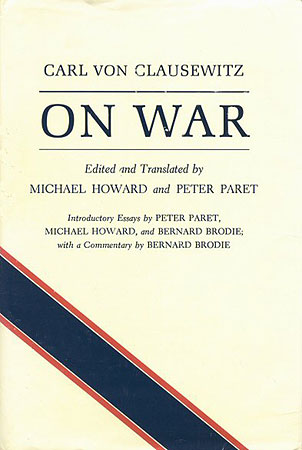
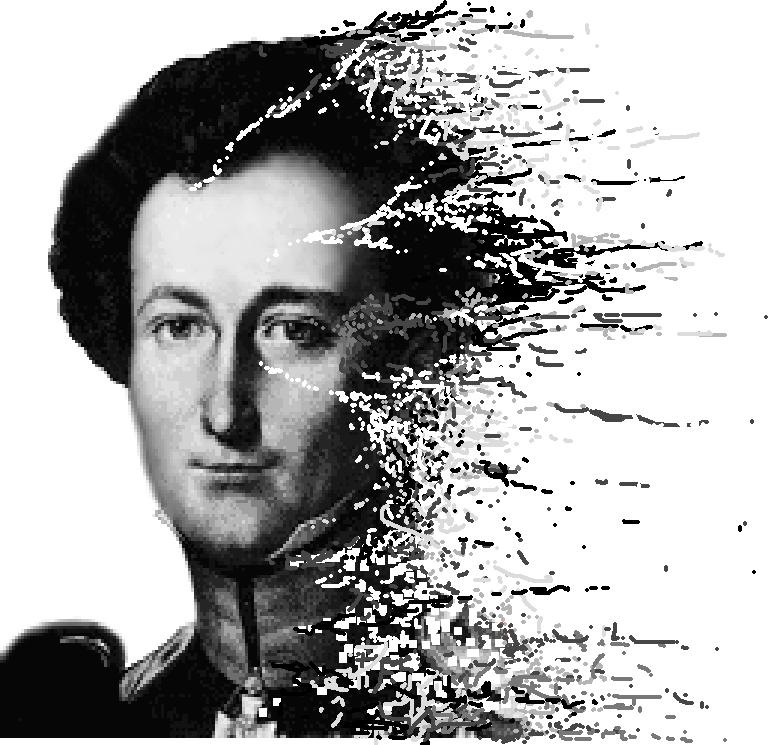
On War by Carl von Clausewitz has been the most influential book on strategy and war of all time.

We can say this because On War is the standard by which all other works of strategy are measured and only a few compared – notably Sun Tzu’s Art of War and The Peloponnesian War by Thucydides. The odd thing is that we can say this despite the fact that On War is more frequently shelved, cited or understood secondhand rather than read, even by military professionals. And furthermore, within the narrow demographic that reads Clausewitz seriously and critically, there can be heated dispute over what he meant, due to the difficulty of the text. Then there are the secondary effects, historical and military, of Clausewitz having been misunderstood, forgotten, ignored or at times, his strategic philosphy consciously rejected.

The shadow cast by On War is all the more remarkable given it’s circumstances of publication. Clausewitz died in 1831, at fifty-one, of cholera, having finally risen to a military post his talents merited. He had been writing On War since 1816 and it was far from completed or refined to his satisfaction and it is highly unlikely, in my view, that Clausewitz would have consented to it’s publication in the condition in which he left it. His determined and intellectually formidible widow, Marie von Clausewitz, further shaped the manuscript of On War, guided by her intimate knowledge of her husband’s ideas and was likely the best editor Clausewitz could have posthumously had.


Nevertheless, to my mind On War remains a magnificent unfinished symphony.

What would On War have looked like if Clausewitz had lived another twenty-five or thirty some years? Assuming continued good health, Clausewitz would have seen, perhaps commanded in, the First Schleswig War and at least studied the Crimean War from afar. He would have had another quarter-century of reading and mature reflection on his subject. Clausewitz, who had a keen understanding of history, would have also witnessed the grand European upheaval of liberal revolution in 1848 that rocked the Hohenzollern monarchy to it’s core. What new insights might Clausewitz have gleaned or expanded upon? Would his later chapters On War have evolved to equal the first?

Having outlived Marie (who died in 1836), would Clausewitz have become a deeply changed man?

What I find it difficult to believe is that Clausewitz, with his creatively driven and philosophically exacting mind,  would have been content to let the manuscript of On War rest where it stood in 1831. Or that we read today what Carl von Clausewitz ultimately intended.

Request for Information from the Readership

Thursday, October 27th, 2011

Need some help with a project at work. 

Looking to assemble a fast-and-dirty reading list for laymen that deals with the following topics:

Social intelligence, Emotional self-regulation, Emotion and learning, De-escalation of conflict, Attention, Self-Efficacy

Interested in both academic (for reference) and middlebrow (for distribution) titles, particularly those that contain interpersonal strategies and organizational culture angles. Links to journal or magazine articles or whatever else you deem useful will also be appreciated.

Fire away, the more the better.

A Multi-Disciplinary Approach?: Coerr’s The Eagle and the Bear Outline

Thursday, October 20th, 2011

Here is something for the learned readership to chew on.

As you are probably all aware, in the hard sciences it is common for research papers to be the product of large, multidiciplinary, teams with, for example, biochemists working with physicists, geneticists, bioinformatics experts, mathematicians and so on. In the social sciences and humanities, not so much. Traditional disciplinary boundaries and methodological conservatism often prevail or are even frequently the subject of heated disputes when someone begins to test the limits of academic culture

I’m not sure why this has to be so for any of us not punching the clock in an ivory tower.

The organizer of the Boyd & Beyond II Conference, Stan Coerr, a GS-15 Marine Corps, Colonel Marine Corps Reserve and Iraq combat veteran, several years ago, developed a very intriguing analytical outline of thirty years of Afghan War, which I recommend that you take a look at:

The Eagle and the Bear: First World Armies in Fourth World Insurgencies by Stan Coerr

the-eagle-and-the-bear-11.pdf

There are many potential verges for collaboration in this outline – by my count, useful insights can be drawn by from the following fields:

Military History
Strategic Studies
Security Studies
COIN Theory
Operational Design
Diplomatic History
Soviet Studies
Intelligence History
International Relations
Anthropology
Ethnography
Area Studies
Islamic Studies
Economics
Geopolitics
Military Geography
Network Theory

I’m sure that I have missed a few.

It would be interesting to crowdsource this doc a little and get a discussion started. Before I go off on a riff about our unlamented Soviet friends, take a look and opine on any section or the whole in the comments section.


Switch to our mobile site