zenpundit.com » national security

Archive for the ‘national security’ Category

Book Review: Narcos Over the Border by Robert J. Bunker (Ed.)

Tuesday, April 5th, 2011

Narcos Over the Border: Gangs, Cartels and Mercenaries by Dr. Robert J. Bunker (Ed.)I just finished my review copy of Narcos Over the Border. It is one of the more disturbing academic works recently published in the national security field, not excluding even those monographs dealing with Islamist terrorism and Pakistan. If the authors of this granular examination of Mexico’s immense problems with warring narco-cartels, mercenary assassins, systemic corruption, 3rd generation gangs and emerging “Narcocultas”of Santa Muerte are correct – and I suspect they are – Mexico’s creeping path toward state failure reprsents a threat to American national security of the first order.

The 237 page, heavily footnoted, book is organized into three sections: Organization and Technology Use by the narcos networks, Silver or Lead on their carrot and stick infiltration/intimidation of civil society and the state apparatus, and Response Strategies for the opponents of the cartels. Bunker’s co-authors Matt Begert, Pamela Bunker, Lisa Campbell, Paul Kan, Alberto Melis, Luz Nagle, John Sullivan, Graham Turbiville, Jr., Phil Wiliams and Sarah Womer bring an array of critical perspectives to the table from academia, law enforcement, intelligence, defense and security fields as researchers and practitioners. The effort to blend disciplinary approaches in Narcos Over the Border is both an intentional and commendable effort to break down academic and policy silos and bureaucratic “turf” perspectives that prevent analyzing Mexico’s security dilemmas as an interrelated threat increasingly resembling a full-fledged insurgency (albeit not on the classic Maoist Model).Some impressions I gained from reading Narcos Over the Border include:

  • The Narco-Cartels and the Zetas, which fight each other as well as Mexico’s military ( Mexican police generally are infiltrated, intimidated, outgunned and seriously outclassed by the Cartel gunmen, Zetas and Guatemalan Kaibiles) are better armed and better trained than are the Taliban. The deadly and efficient Zetas and Kaibiles are superior to regular Mexican military forces and have established safe haven training camps in Central America.
  • Narco-cartels are properly speaking, no longer narco-cartels but transnational criminal syndicates involved in a wider array of revenue generating activities, but with professional intelligence and military capabilities, and increasingly, political, social and religious agendas that are functionally reminiscient of Hezbollah and HAMAS.
  • The Mexican state is severely hampered in it’s response to the threat presented by the cartels by it’s own strategic use of corruption as a cost saving measure and a tool for sustaining elite control of Mexican politics, as well as a method of personal enrichment by members of Mexico’s ruling class.
  • The eschewing of the extreme violence by the cartels North of the border appears to be more of a sign of a strategic policy by cartel and Zeta bosses than a lack of capacity or evidence of a lack of infiltration into American society. To the contrary, Mexican cartel links to acutely dangerous American prison and street gangs such as the Mexican Mafia and MS-13 are significant and well documented.
  • The cartels are global, not regional or local operators.
  • The culture of the Narco-cartels, which draws on some romantic Mexican social and religious underground traditions, particularly the hybrid cartel La Familia , is morphing into a very dangerous “Narcocultas”, a neo-pagan, folk religion featuring ritualistic violence, beheadings and torture-murders carried out for reasons other than economic competition.
  • Mexico has departed the realm of having a serious law enforcement problem and has graduated to a significant counterinsurgency war against the cartels in which the Mexican state is treading water or making progress against some cartels (possibly displacing their activities to weaker states in Central America).

The authors do not assume the worst case scenario, state collapse, for Mexico but rather an insidious “hollowing out” of the state by the cartels and a mutation of Mexico’s native culture to host a 4GW nightmare. As Robert Bunker writes:

What is proposed here is that Mexico is not on it’s way to becoming a “rotting corpse” but potentially something far worse – akin to a body infected by a malicious virus. Already, wide swaths of Mexico have been lost to the corrupting forces and violence generated by local gangs, cartels and mercenaries. Such narco-corruption faced few bariers given the fertile ground already existing in Mexico derived from endemic governmental corruption at all levels of society and in some ways, it even further aided the ‘virus’ spreading through Mexican society from this new infection. Among it’s other symptoms, it spreads values at variance with traditional society, including those:

….conceivably derived from norms based on slaveholding, illicit drug use, sexual activity with minors and their exploitation in prostitution, torture and beheadings, the farming of humans for body parts, the killing of innocents for political gain and personal gratification and the desecration of the dead.

While meticulous, Narcos Over the Border is not all-encompassing in scope.  A fundamentally Mexico-centric collection of scholarly articles, it does not deal extensively with American policy makers involved in Mexico’s narco-insurgency, the intricacies of cartel financial operations or undertake case studies of narco activities in Mexican-American communities, though the authors do track narco-cartel and gang presence in cyberspace. Narcos Over the Borders represents a starting point for deeper investigation of narco-insurgency and for a national security comunity that has thus far treated Mexico as a third tier problem, a policy call to arms.Strongly recommended.

Burning scriptures and human lives

Tuesday, April 5th, 2011

[ by Charles Cameron ]

*

Which is more sacred? You own life? Or an ideal you would be willing to die for?

I ask this, because we often think, act and speak as though one human life, any human life, is automatically more sacred, more to be preserved, than any idea – or book.

We make allowances, to be sure, and “thou shalt not murder” is no doubt closer to the Hebrew than “thou shalt not kill” – but we tend to think of human life as a paramount value, and in this we have the support both of our legal code (“murder one”) and of many scriptures, including the Qur’an, which declares, “whoso saveth the life of one, it shall be as if he had saved the life of all mankind” (for details, see below).

And I also ask this because Martin Luther King said, “If a man hasn’t discovered something that he will die for, he isn’t fit to live” — and even if I find MLK’s exact phrasing a little strange, I think I know what he’s getting at.

Somehow, then, I think we can agree that there may at times be good reasons to value something that’s not a human life but an ideal of some sort more than one’s own life itself, but that in general, a human life, any human life, is of comparable worth to one’s own.

.

One:

Which brings me to this thought experiment – a list of rhetorical questions designed to elicit thought, not to be answered like a questionnaire…

how-sacred-is.gif

.

Two:

These are rhetorical questions, and I’m asking them for specific reasons.

Under Islamic theology, for instance, the Qur’an cannot be destroyed, since it says of itself (Sura 82, al-Buruj, 21-22:

Surely this is a Glorious Qur’an, inscribed on an Imperishable Tablet.

It is physically possible to burn a physical “copy” [mushaf] of the Qur’an in book form— one particularly obnoxious pastor in Florida has recently done so, although he had been warned in advance by GEN Petraeus:

the safety of our soldiers and civilians would be put in jeopardy and accomplishment of the mission would be made more difficult.

— and the Muslims who recently bombed a Sufi shrine in the Punjab no doubt burned more than one such copy / mushaf, hence my final question in the list above.

.

Three:

I could add many other questions to the list — for instance:

  • For Protestants: How precious is the Saving Blood?
  • For Catholics: If someone bombs a church in which the Mass is being celebrated, does that destroy the Marriage Feast of the Lamb of which every Eucharist is a foretaste?
  • And if someone assassinates the priest while he is “in persona Christi” (in the person of Christ) celebrating Mass, does that kill Christ (again)?

That last, I should add, did in fact happen, not only more recently to Archbishop Romero in El Salvador, but also, several centuries ago, in the little parish church of the village of Brightwell-cum-Sotwell near Oxford where I was raised — and is commemorated there by a brass which reads:

Here lyeth the body of Master John Scoeffyld who died on the 15th day of the month of May in the year of our Lord 1507, on whose soul may God have mercy, Amen

So you see, I have a personal interest in these things…

.

Four:

As to the value of a human life, opinions vary…

Some humans feel the need to hold ethical discussions before wantonly taking other human lives:

For weeks, they had weighed the ethics of bagging “savages” and debated the probability of getting caught. Some of them agonized over the idea; others were gung-ho from the start. But not long after the New Year, as winter descended on the arid plains of Kandahar Province, they agreed to stop talking and actually pull the trigger.

Mark Boal, The Kill Team, Rolling Stone, March 27, 2011

Around two percent of the human race is psychopathic, I’ve read, and most of us can be strongly tugged and swayed by peer-pressure, this was wartime — the pressure-cooker of souls — and whatever got into those men could very likely get inside me, too.

Who’s to say I wouldn’t buckle under pressure like that?

.

Five:

But I’m at peace, here, philosophizing.

One could perhaps be forgiven for thinking the US values the loss of “two sons, two daughters and one grandchild” to an Afghan villager in Gardez at two sheep, because that’s all the payment that’s mentioned in a 2-page ABC News article about VADM William McRaven‘s visit to the village, in which he offered to sacrifice one of the sheep at the door by way of asking for forgiveness, as is customary among the Pashtun. That ABC report, however, was based on and cited a first-hand report in the London Times, which mentions also that the Afghan generals present “gave the family a wad of cash wrapped in a handkerchief. Relatives said there was almost $30,000 (£19,000).” The ABC version omitted that part… That’s a bit better than a couple of sheep – but even so, two sons, two daughters and a grandchild?

Look, that’s better than what the German Bundeswehr is willing to pay for the victims of an admitted bombing error in Afghanistan that killed a hundred or so people, perhaps five of whom were Taliban. From another ABC News report, worth reading in its entirety:

Now the Bundeswehr will be paying $5,000 — not for each life that was lost, but to each family of a victim or multiple victims. In other words, all families will receive the same compensation, no matter how many of their members were killed in the Kunduz bombing.

.

Six:

But, you know – no mention there of the sacred, except perhaps in VADM McRaven’s exemplary gesture.

So let’s go back to some religious authorities…

There is the Mishnah (Sanhedrin 4) teaching:

Therefore man was created alone to teach you that whoever destroys a single life from Israel, is considered by Scripture as though he destroyed an entire world; and whoever preserves a single life from Israel, is considered by Scripture as though he had preserved an entire world.

Some would argue that the qualification, “from Israel” renders this passage less than universal in its implications — yet the same passage goes on to say, without making any distinction between Jew and Gentile:

the Supreme King of kings, the Holy One, Blessed is He, fashioned each man in the mold of the first man, yet not one of them resembles another. Therefore, every single person is obliged to say: The world was created for my sake.

That would appear to cover every created human being… and that is clearly the sense of the Qur’an, in Sura 5, al-Maeda, 32:

We decreed for the Children of Israel that whosoever killeth a human being for other than manslaughter or corruption in the earth, it shall be as if he had killed all mankind, and whoso saveth the life of one, it shall be as if he had saved the life of all mankind.

Less generous and more specific, alas, is the Shafi’i jurist Ahmad ibn Naqib al-Misri, who writes in his Reliance of the Traveler:

The indemnity for the death or injury of a woman is one-half the indemnity paid for a man. The indemnity paid for a Jew or Christian is one-third of the indemnity paid for a Muslim. The indemnity paid of a Zoroastrian is one-fifteenth of that a Muslim

.

Seven:

I’ve already admitted that if the pressure were sufficient I might buckle – what about inspiration, how strong could I be if need be, how high do I reach?

So.

I ask myself: how much suffering am I ready to take on myself, to save the life of a child dying of leukemia in some country far from my home? And if my actions to date are anything to go by, my answer must be: not much.

That’s my walk.  Here’s the talk I talk.

Life is infinitely complex and rich in nuance — dappled, as Hopkins says, with swift, slow; sweet, sour; adazzle, dim

The value of one human life is the value of the world. The Qur’an is indestructible. It is deeply inadvisable to threaten, attempt or facilitate the destruction of man, world, or book:

He fathers-forth whose beauty is past change: Praise him.

Soon soon coming of the Mahdi?

Monday, March 28th, 2011

[ by Charles Cameron ]

*

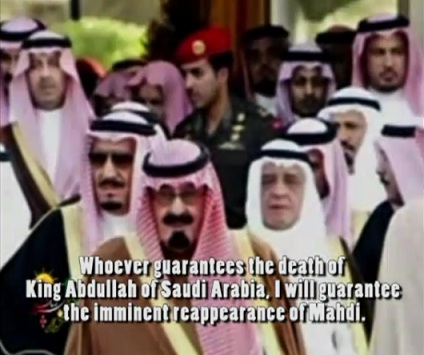
Okay, I’d say things are heating up. Here’s a screen grab from what we are led to believe is a recent video from Iran, made with government backing as described below the fold.

death-of-abdullah-sign-of-mahdi.jpg

This does not bode well…

*

The Christian thriller novelist Joel Rosenberg (author of The Twelfth Imam) has a new blog post up, in which he cites a Christian Broadcasting Network story — which in turn refers to a video posted with some introductory materials on his blog by Reza Kahlili (author of A Time to Betray: The Astonishing Double Life of a CIA Agent Inside the Revolutionary Guards of Iran).

According to Kahlili, who has also posted the full video to YouTube, it is a half-hour long program sponsored by the Basij militia and the Office of the President of Iran, affirming the soon-return of the Mahdi.

And containing “inflammatory language” about King Abdullah of Saudi Arabia (see subtitle above)?  Can I say that?

For what it’s worth, the supposed “hadith” about the death of King Abdullah is discussed in some detail at The Wake-Up Project, so it’s definitely “in the air” — but I don’t recall seeing any references to it in Abbas Amanat, Abdulazziz Sachedina, or any of the lists of Signs of the Coming I’ve read, so my suspicion is that this is an opportunistic addition to the corpus rather than a reliable hadith.

Which brings me to my last point:

I am not posting these materials to encourage panic — that’s what terrorism strives for, and it is the very opposite of what I would wish to see.  If anything, these stirrings of Mahdist sentiment should make us more careful and attentive to the serious scholarly work that has been done in this area.  Jean-Pierre Filiu‘s book Apocalypse in Islam, which I reviewed for Jihadology, would be an excellent place to start.

*

There are plenty of other things going on that I would love to track, blog about or comment on these days, but for the next while I shall try to restrain myself and focus in on this particular issue and its ramifications:

  • Contemporary Shi’ite Mahdist expectation
  • The Iranian nuclear program in the light of Mahdist expectation
  • Iranian attempts to use Mahdism to unite Sunni and Shi’a
  • Mahdism and jihad
  • The role of Khorasan in Mahdist rhetoric
  • Christian apocalyptic responses to Mahdist stirrings
  • Joel Rosenberg‘s book, The Twelfth Imam
  • Joel Richardson‘s book, The Islamic Antichrist
  • Glenn Beck‘s increasing focus on Iranian Mahdism
  • The increasing influence of Islamic and Christian apocalyptic on geopolitics

This is a pretty complex and potent mix of topics, and while I’ll post some individual pieces of the puzzle as I see it, I shall also try to put together a “bigger picture” piece with the whole mosaic laid out.

*

Apart from that, I remain deeply committed to questions of chivalry and peace-making, and will continue to monitor developments and write what I can on those topics as time allows…

Corn’s Caliphates in Wonderland

Saturday, March 26th, 2011


They Just Don’t Make Caliphates Like They Used To….

SWJ Blog featured a lengthy (30 page) essay by Dr. Tony Corn on….well….many things. Corn begins with caliphates and then sort of takes off much like a blown up balloon abruptly released by a child prior to tying a knot in the end.

The Clash of the Caliphates: Understanding the Real War of Ideas by Dr. Tony Corn

….For one thing, within the global umma, there appears to be as many conceptions of the ideal Caliphate as there are Muslims. This grass-roots longing for a symbol of unity should be heard with the proverbial Freudian -third ear,?? and seen for what it really is, i.e., a symptom rather than a disease. For another, by agreeing to establish diplomatic relations with the 57-member Organization of the Islamic Conference (OIC), America and Europe have, in essence, already granted the OIC the status of a Quasi-Caliphate.

More important still, it is time for Western policy-makers to realize that the ideological rivalry between Saudi Arabia and Iran that has been going on since 1979 constitutes nothing less than a Clash of the Caliphates. Through a soft power strategy blurring the distinction between -public diplomacy?? and -political warfare,?? -humanitarian aid?? and -religious propaganda,?? the two states have been the main drivers of the re-Islamization process throughout the Muslim world. The one-upmanship dynamic generated by the rivalry between these two fundamentalist regimes is the main reason why, from the Balkans to Pakistan, the re-Islamization of the global umma has taken a radical, rather than moderate, dimension.

Ok, “caliphates” as a metaphor/analogy for geopolitical rivalry of Muslim states works but it is not really what Islamists or normal Muslims would mean by the term. It is a very odd usage. I’m not overly bothered by that because I tend to like analogies but Corn’s device here is apt to make the heads of area studies and Islamic history scholars explode. The whole essay is in this meandering, idiosyncratic, vein.

Now that is not to suggest that you should not read the piece. Dr. Corn held my attention all the way through and he has a number of excellent observations on many, loosely related, subjects. For example, after discussing the pernicious effects of Saudi donations and Edward Said’s agitprop theory of “Orientalism” on the intellectual objectivity of academia, Corn writes:

…The combined effect of the House of Saud and the House of Said is the first reason why the Ivory Tower has done such a poor job identifying the nature of Muslim Exceptionalism. A more indirect, yet more insidious, reason is that, unlike in the early days of the Cold War, American academics across the board today are trained in social sciences rather than educated in the humanities. For social scientists, Explanation (erklaren) and -theory-building?? take precedence over Understanding (verstehen) and -policy-making. The victory of the -numerates over the -literates in the 1970s has produced a generation of scholars who show a certain virtuosity when it comes to -research design, but display an amazing lack, not just of historical literacy, but of -historical empathy as well. Not to make too fine a point: the Long War is being waged by a generation of policy-makers who, however articulate, never learned anything about history in their college years

Corn is spot on here. Not only is it spot on, it is likely to get much worse. After a brief qualitative “bump” from Iraq-Afghan war  language trained vets, diplos, analysts and spooks peters out, we will have the Gen Y kids with K-12 educations scrubbed free of history, foreign languages and science graduating from college with communication and marketing degrees and entering government service. Hang on to your hat when that happens.

What Corn really requires to vault his essays to the next level are the services of an experienced editor because less would be more. The man is erudite and insightful. He writes forcefully and raises a number of points that are important and with which I agree. Corn, commendably, also makes more of an effort to connect the dots than most. But maybe, if you have an essay that references David Kilcullen, Trotsky, neo-Ottomanism, lawfare, Sam Huntington, neo-COIN, Nasser, Vatican II, the Comintern, the Hapsburgs, Ataturk, public diplomacy, al- Qaradawi, social media, Fascism, Marc Lynch, Youtube, network theory, the UN, hybrid wars and the Protestant Reformation, it might be time to up the Ritalin dosage a notch. Jesus, there’s either a book proposal or four different articles in that kitchen sink of an op-ed!

Read it and take what is useful.

Systemic Curricular Choices Shape National Cognitive Traits

Thursday, March 10th, 2011

A brief point.

AFJ has a feature article by General Martin Dempsey on the need for the Army in it’s professional military education system to build future leaders who are critical thinkers:

Building Critical Thinkers

….The Army Leader Development Strategy identifies three critical leadership attributes for all Army leaders: character, presence and intellect. In addition to those three foundational attributes, we assert that strategic leaders must be inquisitive and open-minded. They must be able to think critically and be capable of developing creative solutions to complex problems. They must be historically minded; that is, they must be able to see and articulate issues in historical context. Possessed of a strong personal and professional ethic, strategic leaders must be able to navigate successfully in ethical “gray zones,” where absolutes may be elusive. Similarly, they must be comfortable with ambiguity and able to provide advice and make decisions with less, not more, information. While all leaders need these qualities, the complexity of problems will increase over the course of an officer’s career and require strategic leaders to develop greater sophistication of thought….

Read the rest here.

The nation is currently undergoing a debate about public education, of sorts. I say “of sorts” because the debate has largely been very dishonest on the part of proponents of certain kinds of “reforms” in which they hope to have a future financial interest, if radical changes can be legislatively imposed that will a) drastically lower labor costs and b) permit a “scalable” curriculum, to use the grammar of certain equity investor CEOs and lobbyists. The former does not concern this topic as much as the second, though the two will work in unison to create a profitable business model for a for-profit management company desiring to contract with local and state governments to run school systems.

“Scalability” builds upon Bush era NCLB legislation that emphasized standardized testing in basic math and reading skills, with punitive accountability measures for schools and districts failing to make “adequate yearly progress”. Due to the penalties and escalating standards, public schools have frequently narrowed their curriculums considerably, reducing instructional time for history, science, complex literature and the arts to put greater emphasis on basic skill drill instruction in just two subjects.

The net effect is that American public school students, roughly 88 % of all school children, spend a greater proportion of their day at concrete level cognitive activities than they did five or ten years ago and far less time on higher-level “critical thinking” like analysis or synthesis, making evaluative judgments, inquiry based learning or problem solving.

 “Scalability” means expanding on this dreary and unstimulating paradigm with digitally delivered, worksheet-like exercises to comprise the largest percentage of the instructional time for the largest number of children possible. It will be a low-cost, high-profit system of remedial education for would-be contractors, provided students are not able to “opt out”, except by leaving the public system entirely.

But only if their parents can afford it.

The US military relies upon the public schools to deliver the initial k-12 education of the overwhelming majority of their officer corps, to say nothing of the enlisted ranks. The soldiers, sailors, marines and airmen who went to Andover or similar private institutions before enlisting are very, very few. Today some public schools are excellent, some are failing and the rest are in-between. Most make an effort to challenge students of all ability levels, from those needing extra help to those in AP courses and gifted programs. There is systemic resiliency in a diversity of experiences.

What will be the effect on  the military leadership in the future if critical thought is methodically removed from public education by a nationally imposed, remedially oriented, uniform, “scalable” curriculum that is effectively free of science, history, literature and the arts? What kind of cognitive culture will we be creating primarily to financially benefit a small cadre of highly politically connected, billionaire-backed, would-be contractors?

Can inculcating critical thinking really be left entirely to universities and, in the case of the military, mid-career education?

What kind of thinkers will that system produce?

Better?

Or worse?

“What we think, we become” – Buddha


Switch to our mobile site