zenpundit.com » intellectuals

Archive for the ‘intellectuals’ Category

America the Home of the Brave?

Sunday, February 3rd, 2013

An excellent op-ed in the Washington Post by Small Wars Journal editor and author of War, Welfare and Democracy,  Peter J. Munson 

An America Cramped by Defensiveness by Peter J. Munson 

….Since I returned home, a darkness has grown in me as both I and our nation have failed to live up to the sacrifices of these young men and women. I had no expectation of “victory” in Afghanistan or Iraq, whatever that would mean. Nor did I expect some epiphany of strategic insight or remorse from the nation’s brain trust.

I just found that I could not square the negativity, pettiness and paranoia in the discourse of our country’s elders with the nobility and dedication of the men and women I had seen and served with in Afghanistan.

Over time, as I listened to the squabbling, I realized that about the only thing Americans agree on these days is gratitude bordering on reverence for our military. It troubled me that the sum total of consensus in our discourse is deference toward the defenders of our nation.

Eventually, it dawned on me that the focus on defense was the root of our problem.

After the Sept. 11, 2001, attacks, the United States sent its military off to war and fretted about post-traumatic stress disorder — but paid little attention to the fact that America itself was traumatized. Americans became angry and withdrawn. We are fearful and paranoid because after a strike on our nation we chose to focus on defense rather than the resilience and vitality that made America great. In our defensive mind-set, we bristle at every change in a world undergoing an epochal transformation.

We have little reason to be so negative. Certainly the rest of the world is gaining on us, but this represents the success of explicit U.S. policies. After World War II, the United States sought to create a world of economic interdependence and prosperity, hoping to banish the malaise that helped precipitate a global conflict. The prospect of rapid growth in the developing world was not viewed as a threat but rather offered the promise of robust markets for American goods and ingenuity. We were confident and focused on the positive tasks of expanding our economy rather than fearing change…..

If you go back and look at news coverage of September 11, you will be struck by the calmness of ordinary citizens in New York in the face of carnage, their lack of panic and firm determination to help. The bravery and sacrifice of firefighters, EMT and police, the dogged resolution of rescue workers digging for victims, the sheer heroism of the passengers of  United Airlines Flight 93 who, led by Todd Beamer, stopped the al Qaida hijackers from ramming another plane into another skyscraper or perhaps the Capitol Building.

All of the security theater, the attacks on liberty, the surveillance state machinations, creeping normalization of government thuggery, bureaucratization, centralization and paternalism that have since been justified in the name of 9/11 were not needed on that day nor wanted by the overwhelming mass of American citizens afterwards.  It was wanted by our “leaders” – who were largely irrelevant to events on September, 11 – because it conformed to their worldview and overweening personal need for “control” of a democratic citizenry they would prefer to be less autonomous and more passive, docile, compliant and disengaged.

We need to revive the American spirit and the first steps are rolling back much of the illiberalism of the past decade.
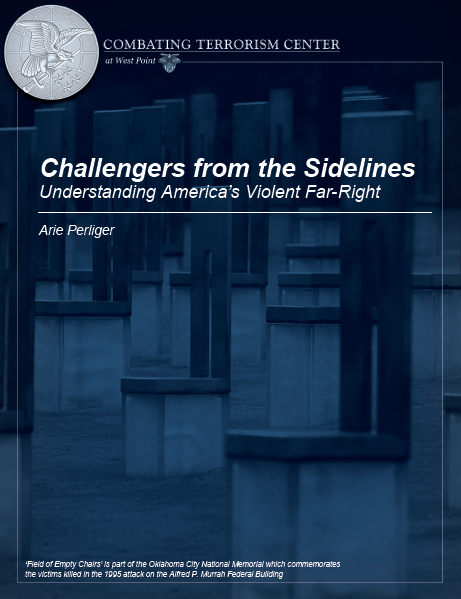
The Controversial CTC Report

Friday, January 25th, 2013

The Center for Combating Terrorism at West Point released a report on domestic terrorism that raised hackles for a number of reasons. Despite the dismissals of liberal political pundits, the reasons for objections to the CTC report are legitimate but they did not need to arise in the first place and might have been avoided with a slightly different editorial approach or appropriate caveats (I just finished reading the report, which is primarily focused on the usual suspects). Here’s why I think the normally well-regarded CTC stumbled into a hornet’s nest:

First, in this foray into domestic terrorism analysis, the center chose to concentrate only on the threat of violence of the Far Right while ignoring other threats coming from the Far Left, infiltration by criminal insurgent networks from Mexico, notably the ultraviolent Zetas whose reach has stirred gang violence in Chicago and Islamist terrorism, either homegrown “lone wolves” or from foreign infiltration or subversion. In itself, this is understandable if the CTC plans a series of reports with a separate focus on different domestic threats; but without that context, it is a myopic analytic perspective, particularly given the demonstrated capabilities of various AQ affiliates or just south of the border, the criminalinsurgency of  the narco-cartels. Had all of these been addressed in one omnibus report, any complaints from conservatives were likely to have been muted or nonexistent. This is not to say that the radical American Far Right does not have a violent threat potential of it’s own worth studying; it does and it is real. But available evidence indicates it to be the least organized, least operationally active and least professionally competent in terms of terrorist “tradecraft” of the three.

The second and most problematic aspect of the report is an intellectually sloppy definition of a dangerous “antifederalist movement”  where noxious concepts like “white supremacy” and wacko conspiracy theories are casually associated with very mainstream conservative (or even traditionally bipartisan !) political ideas – coincidentally, some of the same ideas that contemporary “big government” liberal elites tend to find irritating, objectionable or critical of their preferred policies. Part of the equation here is that American politics are evolvng into a very bitterly partisan, “low trust” environment, but even on the merits of critical analysis,  these two passages are ill-considered and are largely responsible for most of the recent public criticism of the CTC:

….The antifederalist rationale is multifaceted, and includes the beliefs that the American political system and its proxies were hijacked by external forces interested in promoting a “New World Order” (NWO) in which the United States will be absorbed into the United Nations or another version of global government.  They also espouse strong convictions regarding the federal government, believing it to be corrupt and tyrannical, with a natural tendency to intrude on individuals’ civil and constitutional rights.  Finally, they support civil activism, individual freedoms, and self government

….In contrast to the relatively long tradition of the white supremacy racist movement, the anti-federalist movement appeared in full force only in the early to mid-1990s, with the emergence of groups such as the  Militia of Montana and the Michigan Militia. Antifederalism is normally identified in the literature as the “Militia” or “Patriot” movement. Anti-federalist and anti-government sentiments were present in American society before the 1990s in diverse movements and ideological associations promoting anti-taxation, gun rights, survivalist  practices,and libertarian ideas 

This is taxonomic incoherence, or at least could have used some bright-line specifics ( like “Posse Commitatus” qualifying what was meant by “anti-taxation” activists) though in some cases, such as “libertarian ideas” and “civil activism”, I’m at a loss to know who or what violent actors they were implying, despite being fairly well informed on such matters.

By the standard used in the first paragraph, Glenn Greenwald, Ralph Nader and the ACLU would also be considered “far right antifederalists”. By the standards of the second, we might be in physical danger from Grover Norquist,  Congressman John Dingell and Penn Jillette. No one who opposed the recent increases in income tax rates, dislikes gun-control or thought the DOJ may have abused it’s power in the prosecution of Aaron Swartz or in their stubborn refusal to prosecute Bankster racketeering is likely to welcome a report under the auspices of West Point that juxtaposes such normal and perfectly valid American political beliefs with neo-Nazism. A move that is simply going to – and quite frankly, did – gratuitously irritate a large number of people, including many in the defense and national security communities who are a natural “customer base” for CTC reports.

As I said previously, this could easily have been completely avoided with more careful use of language, given that 99% the report has nothing to do with mainstream politics and is concerned with actors and orgs with often extensive track records of violence. As the CTC, despite it’s independence, is associated so strongly with an official U.S. Army institution, it needs to go the extra mile in explaining it’s analysis when examining domestic terrorism subjects that are or, appear to be, connected to perfectly legitimate participation in the political process. This is the case whether the subject is on the Left or Right – few activists on the Left, for example, have forgotten the days of COINTELPRO and are currently aggrieved by the activities of Project Vigilant.

I might make a few other criticisms of the report, such as the need for a better informed historical perspective, but that is hardly what the recent uproar was about.

“The Galula Doctrine”

Wednesday, January 23rd, 2013

Small Wars Journal has published another edition of the excellent COIN interview series conducted by Octavian Manea. Here he interviews A.A. Cohen, author of Galula: The Life and Writings of the French Officer who Defined the Art of Counterinsurgency 

The Galula Doctrine: An Interview with Galula’s Biographer A.A. Cohen

OM: Which were the role of Mao and the exposure to Chinese civil war in Galula’s story? It seems to be his decisive formative lab experience like Russia was for George Kennan.

AAC: Unquestionably, of all the influences exerted on Galula’s treatise, Mao and the Chinese Civil were the greatest. Galula had a strong intellectual admiration for Maoist revolutionaries, despite being very opposed to what they stood for. Before the Chinese Civil War, Galula had no interest in insurgency or counterinsurgency. He had not fought as a Partisan during WW2; he had no experience or interest in these fields until he was exposed to China as of late 1945, in the thick of its civil war. There, his analytical penchant led him to see himself as the decipherer of Mao, intent on getting to the bottom of what the revolutionaries were fundamentally about. Galula cut through the egalitarian propaganda and all that surrounding the People’s revolution. Above all, he wanted to understand why these guys were gaining momentum as they were despite the unfavorable odds. When he figured it out, he reverse-engineered their methods to arrive at a counter-process to revolution and insurgency. His embrace of Chinese dialectics, and with these, the notion of unity of opposites or yin and yang, was helpful in achieving this.

Is counterinsurgency to Galula more of a strategy or  more of a technique and a methodology?

What Galula offers, first and foremost, is a doctrine – not a strategy. His doctrine is underpinned by an important theory about people and what motivates them to take up arms, or to side with those who do. The theory goes that in times of danger (war), the majority of people will be motivated primarily by a fundamental need for security. Galula is adamant about this. But he also recognizes that there will be a minority of people – the instigators at the core of a movement – that will be ideologically, or even fanatically motivated. These are the true believers. He makes no qualms about prescribing that this is the group that the counterinsurgent or counterterrorist will need to find and neutralize, while protecting the rest of the population that aspires to a normal, if not better life. If you buy into this theory, Galula’s doctrine offers a multi-step framework for operations; in other words, a method to counterinsurgency. His famous eight steps are there to provide some logical linearity to what is otherwise a very nonlinear form of warfare. Within that framework, you have the flexibility to formulate your strategy and to conduct your operations to achieve your objectives.

Read the rest here.

I agree that Galula was not offering a strategy. Even more strongly, I think Cohen is correct about the historical importance of China’s long period of disorder, from the overthrow of the Q’ing dynasty to Mao ZeDong’s declaration of the People’s Republic, for Galula. However, not just for him but for anyone interested in questions of war and statecraft where insurgency, warlordism, state failure, state-building, foreign intervention, balance-of-power politics, ideological mass-movements, 4GW, revolution and total war coexisted and co-evolved.

The best comparison in our lifetime to China in this period would have been Lebanon  in the 1980’s, except that China’s polycentric conflict was even more complex and on an epic scale.

Mindlessness and Mindfulness

Tuesday, January 22nd, 2013

In the midst of writing a lengthy post, it may eventually become my longest, about Socrates.

There’s no assurance that volume will equate with importance – most likely, the opposite. The post began as a book review and then grew to two books, then I reversed course and started over; it has been unusually slow going because the subject matter has forced me to stop periodically and uncomfortably rethink my assumptions – and then pick up new books. In one sense, there’s no hurry. After all, Socrates will still be just as relevant or not when I finish blogging about him than when I began. On the other hand, the spirit of our times calls out for Socrates’ techne logon, his “craftsmanship of reason”, so I keep plugging away at it.

The flip side to this intense focus has been an increasing desire for a little mindless entertainment. So, I started watching Sons of Anarchy of my iPad, Season One. So far, It’s fun:

The theme and setting is interesting and the characters and plot are generally more credulity-stretching than even The Soprano’s in their twilight seasons, but Sons of Anarchy fills the bill in terms of entertainment.Boardwalk Empire, is also supposed to be very good, even better, but one at a time.

What do you use as a diversion?

Empirical Studies of Conflict Site

Monday, January 21st, 2013

For those studying war, insurgency, irregulars or terrorism ESOC will be extremely useful – and depending on your area of research, possibly invaluable – as a resource.

Small Wars Journal had this to say about ESOC:

.…ESOC identifies, compiles, and analyzes micro-level conflict data and information on insurgency, civil war, and other sources of politically motivated violence worldwide. ESOC was established in 2008 by practitioners and scholars concerned by the significant barriers and upfront costs that challenge efforts to conduct careful sub-national research on conflict. The ESOC website is designed to help overcome these obstacles and to empower the quality of research needed to inform better policy and enhance security and good governance around the world.

The ESOC team includes about forty researchers (current and former) and is led by six members: Eli Berman, James D. Fearon, Joseph H. Felter, David Laitin, Jacob N. Shapiro, and Jeremy M. Weinstein.

The website is organized by countries and research themes. The six country pages are: Afghanistan, Colombia, Iraq, Pakistan, the Philippines, and Vietnam. The content is structured according to five themes: Demographic/Socioeconomic, Geography, Infrastructure, Public Opinion, and Violence. The website currently hosts about 45 ESOC data files, over 35 ESOC peer-reviewed publications (with replication data), and ten working papers. The ESOC team has also posted links to many external data repositories and external readings that have proven useful for analysis. The website will be regularly updated with new micro-level conflict data and contextual information, as it is compiled and submitted by ESOC researchers.

One caution: based on my source who was one of the folks gathering data for part of this project, as with all quantitative method research, there are hidden qualitative decisions in who did the counting, how and by what yardstick. If you are drawing conclusions about big picture trends in insurgency or irregular warfare across periods of time you are good to go. If your research is sharply confined to a specific and narrowly defined historical case study (say one campaign, a battle, one district – whatever), then drill down into ESOC’s data and methodology to the granular level before drawing a conclusion vice your sources and data outside ESOC.


Switch to our mobile site

