Archive for the ‘capitalism’ Category
Thursday, January 21st, 2010


Complicit: How Greed and Collusion Made the Credit Crisis Unstoppable by Mark Gilbert
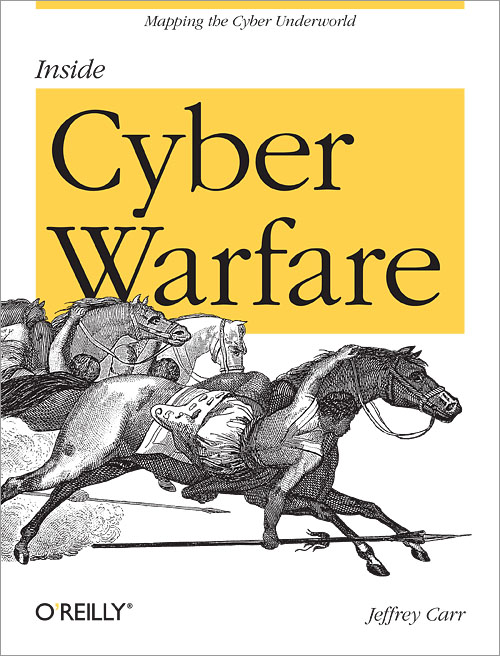
Inside Cyber Warfare: Mapping the Cyber Underworld by Jeffrey Carr
Received courtesy review copies of two books that will serve to “stretch” my knowledge base and increase my cognitive map.
Mark Gilbert is a financial columnist and bureau chief for Bloomberg News in London and he has written a hard hitting deconstruction of  the great credit collapse and crisis bail-out of 2008-2009. Gilbert is telling a story of breathtaking risk assumption, regulatory capture, academic hubris, central bankers as naked emperors and unrepentant banksters who have learned nothing and forgotten nothing from the crisis. My personal background in credit issues is rooted solidly in the dustily agrarian economic history of the 19th century and the painful transition from yeoman “book debt” to gold standard dollars, so I look forward to broadening my understanding of modern financial systems from reading Complicit.
I will probably review Complicit in a cross-blog conjunction with Lexington Green, who also has a copy in his possession.
Jeffrey Carr is the CEO of GreyLogic and a researcher, presenter and consultant on issues related to cybersecurity, hacking, cyberterrorism and asymmetric conflicts in virtual domains. Carr offers a cohesive and compact look at the major problems and players in the uncertain crossroads of national security and cyberspace. Non-geeks (like myself) will appreciate Carr’s focus in Inside Cyber Warfare on the connection to the worlds of intelligence, law enforcement, international law and military operations and doctrine. As an added bonus, the foreword is by Lewis Shepherd, another blogfriend and the former Senior Technology Officer of the DIA.
Originally, I had wanted to review Inside Cyber Warfare before last Christmas, so now that I have the book, I will move it to the top of my titanic reading pile.
Posted in 21st century, analytic, authors, book, business, capitalism, complex systems, complexity, computers, connectivity, corporations, criminals, Cyberwar, economics, government, IC, ideas, IntelFusion, intellectuals, intelligence, international law, national security, networks, non-state actors, OSINT, reading, security, society, strategy, terrorism, theory, transnational criminal organization, Viral, virtual states, war, web 2.0 | 9 Comments »
Monday, January 11th, 2010
John Hagel is in a small category of thinkers who manage to routinely be thinking ahead of the curve ( he calls his blog, where he features longer but more infrequent posts than is typical, Edge Perspectives). I want to draw attention to the core conclusion of his latest:
Challenging Mindsets: From Reverse Innovation to Innovation Blowback
Innovation blowback
Five years ago, John Seely Brown and I wrote an article for the McKinsey Quarterly entitled “Innovation Blowback: Disruptive Management Practices from Asia.” In that article, we described a series of innovations emerging in Asia that were much more fundamental than isolated product or service innovations. We drew attention to a different form of innovation – institutional innovation. In arenas as diverse as motorcycles, apparel, turbine engines and consumer electronics, we detected a much more disruptive form of innovation.
In these very diverse industries, we saw entrepreneurs re-thinking institutional arrangements across very large  numbers of enterprises, offering all participants an opportunity to learn faster and innovate more effectively by working together. While Western companies were lured into various forms of financial leverage, these entrepreneurs were developing sophisticated approaches to capability leverage in scalable business networks that could generate not just one product innovation, but an accelerating stream of product and service innovations.
…. Institutional innovation is different – it defines new ways of working together, ways that can scale much more effectively across large numbers of very diverse enterprises. It provides ways to flexibly reconfigure capability while at the same time building long-term trust based relationships that help participants to learn faster. That’s a key breakthrough – arrangements that support scalable trust building, flexibility and learning at the same time. Yet this breakthrough is occurring largely under the radar of most Western executives, prisoners of mindsets that prevent them from seeing these radical changes.
Read the whole thing here.
Hagel is describing a mindset that is decentralized and adaptive with a minimum of barriers to entry that block participation or information flow. One that should be very familiar to readers who are aware of John Boyd’s OODA Loop, the stochastic/stigmergic innovation model of John Robb’s Open Source Warfare, Don Vandergriff’s Adaptive Leadership methodology and so on. It’s a vital paradigm to grasp in order to navigate and thrive in the 21st century.
Western executives (think CEO) may be having difficulty grasping the changes that Hagel describes because they run counter to cultural trends emerging among this generation of transnational elites ( not just big business). Increasingly, formerly quasi-meritocratic and democratic Western elites in their late thirties to early sixties are quietly embracing oligarchic social stratification and use political or institutional power to “lock in” the comparative advantages they currently enjoy by crafting double standards through opaque, unaccountable authorities issuing complex and contradictory regulations, special exemptions and insulating ( isolating) themselves socially and physically from the rest of society. It’s a careerism on steroids reminiscient of the corrupt nomenklatura of the late Soviet period.
As the elite cream off resources and access for themselves they are increasingly cutting off the middle-class from the tools of social mobility and legal equality through policies that drive up barriers to entry and participation in the system. Such a worldview is inherently zero-sum and cannot be expected to notice or value non-zero sum innovations.
In all probability, as an emergent class of rentiers, they fear such innovations when they recognize them. If allowed to solidify their position into a permanent, transnational, governing class, they will take Western society in a terminal downward spiral.
Posted in 21st century, America, analytic, capitalism, complexity, conspiracy, corporations, criminals, culture, democracy, dystopia, economics, futurism, global guerillas, government, hagel, hierarchy, ideas, innovation, intellectuals, john boyd, john robb, leadership, legitimacy, liberty, markets, networks, non-state actors, Oligarchy, open-source, organizations, politics, rule-sets, society, stochastic, theory, vandergriff | 10 Comments »
Saturday, December 12th, 2009
In a burst of raw self-interest – and also a little love for my blogfriends – these books make nifty gifts for any war nerd or deep thinker on your Christmas list:
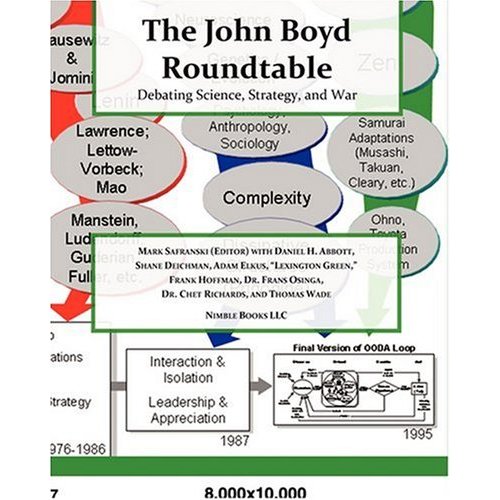
The John Boyd Roundtable: Debating Science, Strategy, and War – Mark Safranski (Ed.)
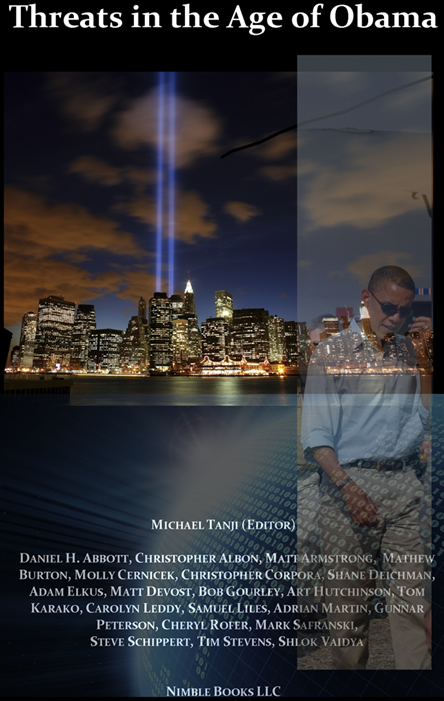



Threats in the Age of Obama – Michael Tanji (Ed.)
Great Powers: America and the World After Bush – Thomas P.M. Barnett
Brave New War: The Next Stage of Terrorism and the End of Globalization – John Robb
Science, Strategy and War: The Strategic Theory of John Boyd – Frans Osinga



The Genius of the Beast: A Radical Re-Vision of Capitalism by Howard Bloom
Intelligence and How to Get It: Why Schools and Cultures Count by Richard Nisbett
Inside Cyber Warfare: Mapping the Cyber Underworld by Jeffrey Carr
This Is for the Mara Salvatrucha: Inside the MS-13, America’s Most Violent Gang by Samuel Logan
Full Disclosure:
In copmpliance with new Federal regulations of dubious Constitutional merit, I hearby declare ZP does not accept money for publishing reviews or any paid advertising. Courtesy review copies were extended to me by authors or publishers acting on behalf of Sam Logan, Tom Barnett and Jeff Carr. I edited the first book in this post and was a contributing author to the second one. All of the books, with the exception of Cyber Warfare have been the subject of prior reviews or posts at ZP.
Posted in 3 gen gangs, 4GW, authors, barnett, book, brave new war, capitalism, cognition, Cyberwar, defense, foreign policy, futurism, gangs, gap, geopolitics, global guerillas, globalization, government, ideas, intellectuals, intelligence, metacognition, military, military reform, national security, non-state actors, PNM, politics, primary loyalties, psychology, recommended reading, robb, sociobiology, soft power, state building, state failure, state terrorism, strategy, Strategy and War, terrorism, theory, Threats in the Age of Obama, war, warriors | 6 Comments »
Tuesday, November 24th, 2009
Were it not for guest posts, November would have seemed like I went on hiatus 🙂 Normal blogging will resume in a few weeks.
I did find time to pick up a few new books to read in the late hours of the night, one of which will be the subject of a book review by a new guest poster.


The Genius of the Beast: A Radical Re-Vision of Capitalism by Howard Bloom
The Shia Revival: How Conflicts within Islam Will Shape the Future by Vali Nasr
Nixonland: The Rise of a President and the Fracturing of America by Rick Perlstein
The only thing these three tomes have in common is that the authors have a penchant for contradicting conventional wisdom, at least to a degree.
Howard Bloom is an offbeat, pop science to pop culture master of horizontal thinking whose earlier work, Global Brain, I very much enjoyed and highly recommend. Bloom’s intellectual reach is first rate and he is one of the few writers who can take very difficult concepts from wildly disparate fields and tie them together for a lay audience with comprehensible analogies and anecdotes .
I put Vali Nasr’s The Shia Revival on my list back after the high praise Thomas P.M. Barnett gave Nasr in his book, Great Powers – in my experience, Tom does not hand out comments of “brilliant” all that often ( Great Powers, BTW, is also a “must read” book for those interested in strategy and geoeconomics). I am approximately 80 pages in to The Shia Revival and I will say that as a writer, Nasr does not waste time getting to key points in explaining his subject – concise but not simplified.
Rick Perlstein, while far to the Left, has the uncommon quality among leftwingers of working very, very hard at the scholarship of attempting to understand conservatism and leading conservatives ( must be a legacy of attending the University of Chicago). Much like Orangemen in Ulster, eavesdropping on a Catholic mass, I suspect the essence of conservatism eludes Perlstein, but at least he takes the ideas seriously. That Richard Nixon is Perlstein’s subject is an added draw, since Nixon’s foreign policy was an area of historical research for me. Very interested to see how Perlstein’s take on Richard Nixon compares to that of Robert Dallek and Richard Reeves.
“Let me make one thing perfectly clear….”
Posted in academia, authors, biography, book, capitalism, culture, economics, globalization, historians, history, horizontal thinking, howard bloom, ideas, intellectuals, islamic world, nixon, politics, primary loyalties, Religion, rick perlstein, science, shia, social science, society, synthesis, Theology, vali nasr | 5 Comments »


