Evolution of Information
Monday, May 31st, 2010This is good. Perfect for non-geeks who nevertheless need to know the ripple effects of coming down the pike:
The History of Information, by David Siegel from dsiegel on Vimeo.
Hat tip to Dave Davison.
This is good. Perfect for non-geeks who nevertheless need to know the ripple effects of coming down the pike:
The History of Information, by David Siegel from dsiegel on Vimeo.
Hat tip to Dave Davison.
Pamela L. Bunker and Dr. Robert J. Bunker at SWJ Blog
The Spiritual Significance of ¿Plata O Plomo?
Conventional wisdom holds that narco gang and drug cartel violence in Mexico is primarily secular in nature. This viewpoint has been recently challenged by the activities of the La Familia cartel and some Los Zetas, Gulfo, and other cartel adherents of the cult of Santa Muerte (Saint Death) by means of religious tenets of ‘divine justice’ and instances of tortured victims and ritual human sacrifice offered up to a dark deity, respectively. Severed heads thrown onto a disco floor in Michoacan in 2005 and burnt skull imprints in a clearing in a ranch in the Yucatán Peninsula in 2008 only serve to highlight the number of such incidents which have now taken place. Whereas the infamous ‘black cauldron’ incident in Matamoros in 1989, where American college student Mark Kilroy’s brain was found in a ritual nganga belonging to a local narco gang, was the rare exception, such spiritual-like activities have now become far more frequent.
These activities only serve to further elaborate concerns amongst scholars, including Sullivan, Elkus, Brands, Manwaring, and the authors, over societal warfare breaking out across the Americas. This warfare- manifesting itself in ‘criminal insurgencies’ derived from groups of gang, cartel, and mercenary networks- promotes new forms of state organization drawn from criminally based social and political norms and behaviors. These include a value system derived from illicit narcotics use, killing for sport and pleasure, human trafficking and slavery, dysfunctional perspectives on women and family life, and a habitual orientation to violence and total disregard for modern civil society and democratic freedoms. This harkens back to Peter’s thoughts concerning the emergence of a ‘new warrior class’ and, before that, van Creveld’s ‘non-trinitarian warfare’ projections.
Cultural evolution in action, accelerated by extreme violence.
This looks highly informative. Hat tip to Wings Over Iraq.
I regret the light posting and lack of attention to the superb comments. I am buried at work and will be until early next week. Will be posting short items until then
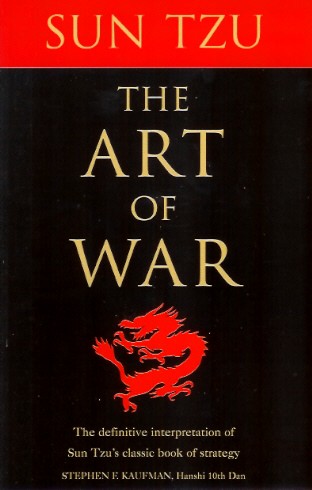
The Art of War by Sun Tzu
A BBC podcast on Sun Tzu’s classic The Art of War. Perhaps the most sublime work on strategy of all time ( Hat tip to The Warlord)
Next, and unrelated:
Via blogfriend Robert Paterson, a new talk by educational and creativity thought leader, Sir Ken Robinson. The ritual TED bowing to Al Gore notwithstanding, if you are interested in education issues, this is a must see video.

“Welcome to the Desert of the Real….”
Dr. Thomas Rid, at the excellent Kings of War blog, had a sharp historical observation:
Who produced the greatest strategists of all time, dead and alive? America or Europe?
Before wading into that minefield, we need some criteria, some points of orientation. The key should be a body of strategic theory, writings of general nature. Just making history or writing about it doesn’t count here. That excludes two sets of people who might otherwise be considered strategists or military writers: great military historians – like Hans Delbrück or Douglas Porch – and exceptionally gifted commanders, such as Napoleon or perhaps Petraeus.
First the old strategists of Europe. Most would go by one name only: Clausewitz, Jomini, Ardant du Picq, Hubert Lyautey, Joseph-Simon Gallieni, Thomas-Robert Bugeaud, Frank Kitson, Basil Liddell Hart, Robert Thompson, C.E.
Callwell, Roger Trinquier, André Beaufre, David Galula, T.E. Lawrence, Giulio Douhet, Gerhard von Scharnhorst, Helmuth von Moltke, Engels, Lenin – to be fair in this little contest, we should not include those thinkers who predate the United States, such as Thucydides or Machiavelli.
Contrast this with America’s greatest classic writers of strategy: Alfred Thayer Mahan, Albert Wohlstetter, Herman Kahn, Bernard Brodie, and Samuel Huntington. (I hesitate to count John Boyd; he really didn’t write enough.)
….So how about living strategists? Given that America eclipsed Europe in terms of geostrategic weight some time in the first half of the 20th century, and given that the United States attracts the best brains in all fields, you would expect strategic tomes adorned with stars and stripes all over the place. But no.
….But whatever the metric, Europe is doing pretty well, then and now. Although it clearly seems we’re past our prime. The same cannot be said about the United States, which is probably still near the height of its power. For that, the strategic record is surprisingly thin
Let’s set aside the question of Sun-Tzu, Musashi, Kautilya and other Asian strategists. Also the subject of John Boyd as Col. Boyd did not lack for kind words in the KoW comments section. We’ll just concentrate on Rid’s query of “Why so few American strategists of great stature?”. It’s a very good historical question.
I think there are a number of possibilities:
What other reasons do you see ?

Zenpundit is a blog dedicated to exploring the intersections of foreign policy, history, military theory, national security,strategic thinking, futurism, cognition and a number of other esoteric pursuits.
Customized Web Site & Blog Design