zenpundit.com » national security

Archive for the ‘national security’ Category

Only Amateurs Negotiate in Public

Friday, April 26th, 2013

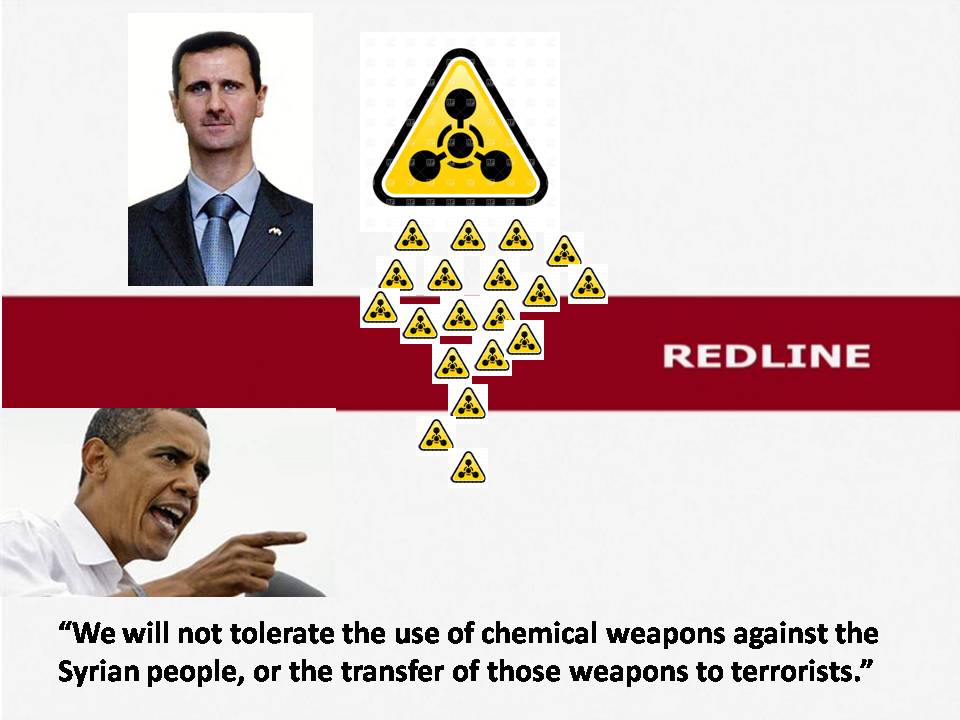
There is much buzz right now about whether the cruel Syrian Baathist-Alawite regime of Bashar Assad, struggling to hold on to power in the midst of civil war against rebel Sunni forces, crossed   President Obama’s “red line” by using Sarin gas, a war crime. That is not really the important point for Americans. There are two things to consider here.

First, specifically how would intervening militarily in Syria’s awful civil war be in American national interest?

It is important to get a clear cut answer here because everyone arguing that Assad has “crossed a red line” that we will “not tolerate” is making a de facto argument for some kind of intervention on our part. Maybe if no one can define such an interest it is because there isn’t any and intervening will bring the US nothing but costs in blood and treasure without gaining anything of strategic value. I’m not against intervention per se but there really ought to be a coherent reason so we can rationally measure it against the potential costs which, from where I sit, look rather large.

Secondly, in important matters of state, you don’t negotiate in public with a potential adversary if you really hope to gain a concession from them and if you reach the point of issuing a public ultimatum, you don’t bluff.

The people who have advised President Obama to make these “red line” statements to Syria through the media instead of quietly through diplomatic channels are either professionally incompetent at statecraft or they were hoping to manipulate the President by getting him to back himself into a corner with tough rhetoric so that if Assad did not blink then Obama would have the choice of looking weak and foolish or of approving some kind of action against Syria. Either way, the President was poorly served by this advice. Maybe he needs some new foreign policy and national security advisers who actually know something more about the world than domestic politics and being lawyer-lobbyists.

As a result that the President never really had any intentions of, say, invading Syria this year, we are now being treated to nervously asserted, lawyerly parsing of what really counts as “red lines” and what technical level of Sarin gas particulates constitutes “use”. It is an embarrassing climb down for the administration but also for the United States that never needed to happen. Empty posturing is not a substitute for a policy. Saying “Do something!” is not a strategy.

This is no brief for Assad’s regime. He’s definitely a bad actor and runs a nasty and now democidal police state he inherited from his mass-murdering father, Hafez Assad. I’m open to hearing why the US should aid in a regime change because the outcome will be in our interests in some concrete and definable way. Oh, yeah, and it might help if the person making the pitch knew something about Syria and regional geopolitics, or was at least consulted about it.

Let’s think long and hard this time.

Elkus on Policy Relevance

Monday, February 18th, 2013

Intriguing and vigorously argued piece by Adam over at Abu Muqawama

Relevant to Policy?

Are we in a 1914 scenario in East Asia? How often do guerrillas succeed? Did counterterrorism law erode national sovereignty? These are just a few of the important questions that political science has some bearing on. Yet barely a couple months goes by without an op-ed decrying political science’s alleged lack of relevance to the outside world.

Political scientists are frequently told their research is too arcane, mathematical, and self-involved to be of possible value to anyone in Washington dealing with real-world policy problems. There’s a grain of truth here. As international political economy whiz Kindred Winecoff observes, political scientists need to make a better “elevator pitch.” But here’s the problem: at the end of the day, there is a difference between what Max Weber dubbed science as a vocation and the subjective policy lessons we can take from our study. Part of that gap is reflected in the difficulties that people with purely policy interests inevitably encounter in PhD programs.

From my own (minor) experience so far, it is grueling, necessitates the assimilation of difficult methodologies, and involves having to think about intellectual questions that many people would regard as hopelessly arcane. Even a good PhD program that directly tackles policy questions will likely demand the student grapple with questions of esoteric theory and method. And not all research that tackles highly abstract questions is policy-irrelevant. Highly technical analysis of game theory and economics generated useful policy applications form the World War II convoy system to nuclear strategy and wargaming.

All of these advances began from the desire to grapple with difficult questions to produce knowledge, something many critics of political science research do not acknowledge. Take Greg Ferenstein, who penned an article supporting Eric Cantor’s call to defund the NSF. His gripe is familiar. Political science is obscuratist, hyper-mathematical, and disconnected from the policy world. Political scientists don’t do enough to make their research accessible to policymakers. Ferenstein wants a political science that his mother-in-law can understand, and he thinks starving academia of resources will motivate hungry researchers to do better. So is modern political science irrelevant to policy needs?

Contra Ferenstein, policymakers have thrown substantial $$ at the kind of research he regards as navel-gazing arcana. The RAND Corporation got a lot of mileage using what Ferenstein derides as “clever mathematical models” during the Cold War.  I’m not sure that Jay Ulfelder, who worked for the intelligence community-funded Political Instability Task Force, would agree that his quantitative forecasting methodologies must pass a mother-in-law test to be valuable. And when New York University’s game theory guru Bruce Bueno De Mesquita speaks, the CIA listens. Drew Conway, a man that could easily teach a computer programming course just as well as poli-sci 101, gives invited talks at West Point on analyzing terrorist networks. I don’t think Ulfelder, Mesquita, or Conway have sleepless nights pondering the relevance of their research to the govermment!

Read the rest here 

As an aside, I have found Ulfelder’s posts on his research or comments on the field at Dart Throwing Chimp to be very useful and worth reading.


The White Paper and its Critics

Monday, February 11th, 2013

Someone for reasons unknown last week leaked the classified Department of JusticeWhite Paper” on targeting with drone attacks the numerically tiny number of US citizens overseas who have joined al Qaida or affiliated groups. The leak set off an outburst of public debate, much of it ill-informed by people who did not bother to read the white paper and some of it intentionally misleading by those who had and, frankly, know better.

Generally, I’m a harsh critic of the Holder DOJ, but their white paper, though not without some minor flaws of reasoning and one point of policy, is – unlike some of the critics – solidly in compliance with the laws of war, broader questions of international law and the major SCOTUS decisions on war powers. It was a political error to classify this document in the first place rather than properly share it with the relevant Congressional committees conducting oversight

Here it is and I encourage you to read it for yourself:

Lawfulness of Lethal Operation Directed Against a US Citizen Who is a Senior Operational Leader of al-Qa’ida

Much of this white paper debate has been over a legitimate policy dispute (“Is it a good idea if we use drones to kill AQ terrorists, including American ones?”) intentionally being mischaracterized by opponents of the policy (or the war) as a legal or constitutional question. It is not. The law is fairly settled as is the question if the conflict with AQ rises to a state of armed conflict, which SCOTUS dealt with as recently as Hamdi and for which there are ample precedents from previous wars and prior SCOTUS decisions to build upon. At best, framed as a legal dispute, the opponents of the drone policy would have a very long uphill climb with the Supreme Court. So why do it?

The reason, as I discern it, is substituting a legalistic argument and judicial process (“FISA court to decide drone killings”) to conceal what is really a debate over American war policy   and the President’s war powers in order to accrue domestic political advantage or at least avoid paying the costs of advocating a potentially unpopular position. Otherwise, opponents have to argue on the merits that the US should not as a matter of policy kill al Qaida terrorists sheltered by Pakistan or beyond the reach of government control in Yemen. Or that we are not “really” at war or that Federal judges are better suited for picking bombing targets than Air Force and CIA analysts and that “due process” should apply to enemy combatants on the battlefield. Many of these arguments are valid ones to raise and debate but are unlikely to be persuasive to the public or Congress; if they were, they would have prevailed in 2010 (drones) or 2001 (“are we at war?).

A straightforward legal analysis begins and stops with ascertaining whether or not we are in a state of armed conflict with al Qaida. The white paper used a “kitchen sink” approach to try and cover all legal bases, perhaps to create a basis for a later freewheeling peacetime use of armed drones – which incidentally, I am not in favor of – but it is not required here and actually distracts from the strongest legal argument – the administration is lawfully fighting an enemy in an armed conflict declared by Congress.
.
If we are in an armed conflict under international law with al Qaida – and the evidence appears here in fact, legislative action, context, historical and legal precedent to be overwhelming – renders most of the other justifications cited in the white paper for the policy regarding due process as well as nearly all of the criticisms of it moot, at least in terms of legality. Wartime enemy combatants are in a qualitatively different legal status vis-a-vis the United States government acting as a belligerent than are non-combatants or are civilians in peacetime (even civilians who commit criminal acts). No American citizen has a right to pick up arms and join an enemy army or armed group during a war, period. Or a subsequent right to be treated as anything but a combatant if they do. Combatant status is not determined by nationality under international law but by behavior and adherence to a belligerent party’s military forces and their physical disposition ( hors d’ combat, in the act of surrender etc.).
.
American citizens fought in enemy armies, notably the Wehrmacht and Waffen-SS, against the United States in WWII and a handful defected to the enemy in the Korean and Vietnam Wars. While some of these men were tried for treason after these wars ended, others were treated as enemy POWs or simply allowed to come home at a later date, but none were accorded judicial due process *during* the conflict as potential targets of an American military attack. Only after capture, as with the saboteurs in the Ex Parte Quirin case, did judicial review and due process come in to play.. We see a similar phenomena with the Civil War where, even under the Lincolnian theory that the Confederacy merely represented “Combinations too powerful to be suppressed” (i.e. a private insurrectionist conspiracy and not the states themselves as corporate, legal, sovereign entities in rebellion), we do not see SCOTUS insisting on normal, civilian, judicial due process in Ex Parte Milligan except where “civil courts are in operation” (i.e. away from the battlefield). This was to prevent the application of martial law in civilian areas in the North, not to stop martial law in theater or occupational zones.
.
Had this issue of due process for active enemy combatants been raised during WWII or even Vietnam, it would have been likely (and properly) regarded by US officials as ludicrous; if true, the logic would imply that enemy units could immunize themselves from attack (or substantially delay them)  by recruiting American citizens into their ranks. It would also beg the question why the US could lawfully bomb enemy targets and risk killing American POWs via collateral damage, but not directly target enemy fighters who happened to be American citizens. It would further beg the question why it would be lawful to indirectly target an American citizen in a group of enemy fighters with, say, artillery or gravity bombs from 52,000 feet but be an unlawful violation of due process to aim at him directly with a drone missile or a sniper rifle. Is a Marine rifleman who happens upon Adam Gadahn in Afghanistan and kills him therefore an “assassin” (to use Glenn Greenwald’s description of targeted killings) to be charged with murder?
.
Even as a matter of “due process” (!) – never mind fighting a war – how could this legal argument possibly make any sense? What precedent under military law or international law from prior conflicts supports it?
.
How would inserting judicial review – even SCOTUS – over operational planning and target selection as a step in the President’s exercise of his Constitutional authority as Commander-in-Chief likely to affect the Separation of Powers? This is not a trivial question – in military terms it is analogous to the judiciary usurping the position of the Rules Committee in the House of Representatives over legislative matters. How would this innovation impact our ability to fight our next war or wars?
.
Much like the white paper’s lengthy, but entirely irrelevant discourse into the nature of threat “imminence” and “breadth”, this argument is sheer invention if a state of armed conflict with al Qaida exists. Most criticisms and not a few of the white paper’s own legal justifications consist of novel restraints alien to the historical practice of states prosecuting an armed conflict that we would be extremely unwise to adopt and sanctify as precedents for waging future wars.
.
Let us take one of the more intellectually serious and responsible expert critics as an example, Steve Vladeck of American University. Not everything he has to say in his lengthy post is wrong and I even agree with some of his points, but things like this strike me as specious, or at least a very weak reed upon which to rest an argument that alters the constitutional balance:
.

….First, many of us who argue for at least some judicial review in this context specifically don’t argue for ex ante review for the precise reasons the white paper suggests. Instead, we argue for ex postreview–in the form of damages actions after the fact, in which liability would only attach if the government both (1) exceeded its authority; and (2) did so in a way that violated clearly established law. Whatever else might be said about such damages suits, they simply don’t raise the interference concerns articulated in the white paper, and so one would have expected some distinct explanation for why that kind of judicial review shouldn’t be available in this context. All the white paper offers, though, is its more general allusion to the political question doctrine. Which brings me to…

.

Second, and in any event, the suggestion that lawsuits arising out of targeted killing operations against U.S. citizens raise a nonjusticiable political question is almost laughable–and is the one part of this white paper that really does hearken back to the good ole’ days of the Bush Administration (I’m less sold on any analogy based upon the rest of the paper). Even before last Term’s Zivotofsky decision, in which the Supreme Court went out of its way to remind everyone (especially the D.C. Circuit) of just how limited the political question doctrine really should be, it should’ve followed that uses of military force against U.S. citizens neither “turn on standards that defy the judicial application,” nor “involve the exercise of a discretion demonstrably committed to the executive or legislature.” Indeed, in the context of the Guantánamo habeas litigation, courts routinely inquire into the very questions that might well arise in such a damages suit, e.g., whether there is sufficient evidence to support the government’s conclusion that the target is/was a senior operational leader of al Qaeda or one of its affiliates…

My first criticism would be that Vladeck’s premise that the question of a targeting decision of an American citizen who is a senior leader of al Qaida during a state of armed conflict who is active outside the territory of the United States is a matter for adjudication by US courts is incorrect. He is essentially arguing that the political question doctrine does not cover the exercise of the Constitutionally specified war-making powers of the executive and legislative branches during a war. I am highly skeptical this is an argument any Supreme Court would entertain lightly, much less the Roberts Court.
.
My second criticism is more practical – that Vladeck in seeking judicial review of the decision process by which an American citizen is determined to be senior or not senior leader in al Qaida leadership is a distinction without a difference from a court having a priori judicial review of the larger military operation in wartime but with the added detriment of exposing the intelligence process, to discovery. Targeting decisions involve assessment of intel about the target from a variety of perspectives – confidence, effect, probability of success/costs and the “fusion” of (usually) USAF and IC in a targeteering shop. Why  judicial scrutiny should apply only to drone strikes targeting a specific US citizen among other al Qaida operatives in wartime vice simply bombing an al Qaida safe house in which a US citizen might be employs a legal reasoning that is obscure to me. If a US citizen being a potential casualty is the critical constitutional variable here, then not also judicial review of a bayonet charge?
.
The proposal for judicial review of potential attacks during an armed conflict (not peacetime) is rife with a host of counterproductive second and third order constitutional and military effects. It represents a sweeping change in our political order by a technical legal fiat. It would also be an exceedingly dumb way to run a war. It might test our powers of imagination, but somehow, we faced down Hitler and the Imperial Japanese without Federal judges running our strategic bombing campaigns.
.
This preference for legalistic arguments is partly a product of over representation of lawyers among the American political elite. Highly competent attorneys are very skilled at framing arguments on behalf of clients so that they begin litigation not only from a favorable explicitly stated position but, where possible, with several layers of one-sided implicit premises built in that you accept uncritically only at your peril. When a lawyer comes into a public policy debate saying that a political question is a legal question, he is making a political argument to remove a political dispute in a democratic polity to the courts where the matter will be decided under very different procedures and will remain as a legal question thereafter.
.
Sometimes, this is the constitutionally correct thing to do; more often, it is simply an expedient thing to do that diminishes democratic accountability while rendering policy and process needlessly more complex and adversarial than even open public debate. It is also a self-aggrandizing feedback loop for lawyers as a class – when all political questions are legal questions, then should we not all defer to their superior expertise and training? It is the road to technocracy and the rule of law becoming “rule by lawyers”.
.
Does that mean the critics have no point whatsoever regarding the use of drones in “targeted killings”? No. The idea that targeting American citizens is bad *policy* because it might, for example, be poorly employed against innocent people by mistake or, in slippery slope fashion, lead to a normalization and extension of the practice of targeted killing outside of an officially recognized armed conflict is a completely valid *political* argument. It is even, in my view, a very wise caution. It just does not hold water as a legal argument on behalf American citizens who go overseas and pick up arms and wage war against the US by joining al Qaida.
.
More importantly, there are better, simpler remedies to a “slippery slope” with drone attacks that can be employed legislatively and through vigorous oversight that can be enacted that will strengthen rather than undermine and confuse our constitutional system of governance. First, the Obama administration, for it’s part, should allay critics fears by removing “targeted killings” from the arbitrary hands of unnamed “senior officials” (code for the President? The National Security Adviser? A random White House lawyer?) and either return to a more traditional Pentagon target assessment procedure or use the NSC process with a PDD/NSDD and a properly and timely “finding” being presented to Congress.
.
Secondly, the proper body to review the judgement of the administration in tactics, operations, and strategy is not the judicial branch, but the legislative, which has done so in prior conflicts and holds the power of the purse to control the extent of campaigns and the raising of armies. The Joint Committee on the Conduct of the War was the oversight mechanism the Congress employed during the Civil War to review and influence the actions of the Lincoln administration. I would argue that the US Congress is more than sufficient to do the same task today with a far less existential conflict, if it chose to do so. Congress could, if it wished, forbid these operations or cease funding them. Quite pointedly, they have done neither.
.
If Congress does not engage in rigorous oversight, it does not follow that a Federal Court is the appropriate constitutional substitute for Congress abdicating it’s wartime responsibilities. Targeted killings of enemy combatants during a declared armed conflict is a question of war policy, not due process, and is the purview of the political branches, not the judiciary
.
Thirdly, the “slippery slope” danger is genuine and should be interdicted with legislation prohibiting or severely restricting the use of armed drones at home or forbidding their use against civilians resident in the territory of the United States entirely. A definition from Congress of under which circumstances that terrorism is a matter for law enforcement or military action is something that is likewise years overdue.
.
Congress should be taking up it’s weighty responsibilities in war policy and not punting them to the executive or the judiciary, so that the actions of the US government in a matter of extreme gravity like a war are constitutionally clothed in democratic consent.
US Foreign Policy, Egypt and the Muslim Brotherhood

Wednesday, January 30th, 2013

The Obama administration, though they would not characterize it as such nor have much desire to acknowledge it at all, have attempted  a strategic detente with the “moderate” elements of political Islam.

This policy has not been entirely consistent; Syria, for example, is a quagmire the administration has wisely refrained from wading directly into despite the best efforts of R2P advocates to drag us there.  But more importantly, under President Obama the US supported the broad-based Arab Spring popular revolt against US ally, dictator Hosni Mubarak, and pushed the subsequent ascendancy of the Muslim Brotherhood in Egypt and the Libyan revolution against the entirely mad Colonel Gaddafi. These appear to be geopolitical “moves” upon which the Obama administration hopes to build.

I would like to emphasize that there is one legitimate and valid strategic pro to this sub rosa policy; namely, if everything went well, it would provide the United States with powerful triangulation against revolutionary, apocalyptic, radical Islamism as expressed by al Qaida and various Salafi extremist movements. There are reasons, rooted in takfirism, strategy and the politics of lunacy that our terrorist enemies frequently hate and revile the Brotherhood as traitors, apostates or whatever. Isolating the most actively dangerous and violent revolutionary enemies from a large mass of potential allies is, at least, a good strategic goal.

It is also my view, that this “outreach” is as politically sensitive  to the Obama administration as was the China Opening was to Nixon and about which they have been equally opaque and misleading for fear of a domestic backlash. The weird, foot-dragging, dissembling, embittered, kabuki drama inside the Beltway about public statements and intelligence on whether Benghazi was caused by obscure crackpot Islamophobic film makers or a well-orchestrated terrorist attack  is in my view due to a major foreign policy strategy never having been framed in public for what it is. I’m sure people will differ strongly with me on this (which is fine), but I would characterize detente with Islamists as a strategic shift on par with the “Pivot to Asia”.

The downside here is that first, things are not likely to come out well at all, as unfinished revolutions tend to give birth to monsters; and secondly, any detente with “moderate” political Islam is an uncertain gamble based on certain exceptionally optimistic conceptions of not only what the Brotherhood might do, but about it’s very nature.

While the removal of Arab dictators resonated with American values , it was questionable realpolitik while the administration’s de facto support of  Egypt’s Muslim Brotherhood faction over poorly organized secular liberal modernists was an act of realpolitik that required a compromise of the democratic values so recently invoked to justify abandoning Mubarak. This was cynical diplomatic flexibility worthy of Talleyrand.

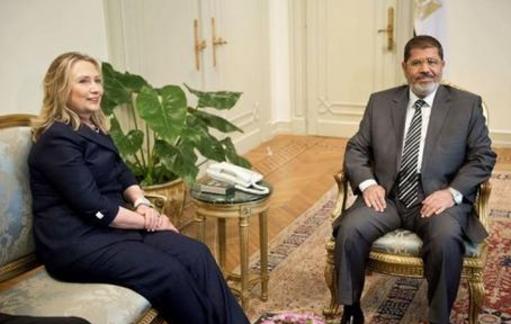
Unfortunately, the most democratic thing – perhaps the only thing – about Mr. Morsi and his Brotherhood supporters was his election.

The Egyptian people who are subjected now to thuggery from both Morsi’s Islamist stormtroopers and from the security forces of the Egyptian military are less sanguine than are the Brotherhood’s cheerleaders inside the administration. The Egyptian people, in fact, seem to be in revolt against domination by the Muslim Brotherhood’s shadow government.

The first question to ask in assessing if the Obama administration policy here is wise would be “What is the nature of the Muslim Brotherhood?” Americans love to personalize foreign policy, but if  Morsi were to be toppled or die, the Brotherhood will remain what it currently is, the best organized political force in Egypt and one widely influential throughout the Arab world and the West itself.

I am not an expert on the Muslim Brotherhood, nor am I an Arabist by education. Most of us aren’t – a group that I fear includes most of the Obama administration officials involved in shaping this policy. Almost fifty years after King Faisal determined to export Wahhabism, more than thirty years since Khomeini’s Revolution and more than ten years since 9/11 the USG still has less in-house expertise related to Islam than it did about the Soviet Union and Communism a decade after the Berlin Blockade.

Perhaps we all should begin learning more?

Here is an analysis from FPRI; it is extremely critical but it touches on organizational aspects of the Muslim Brotherhood that I have not seen elsewhere (hat tip to David Ronfeldt). Feel free to suggest others, both for and against. The Brotherhood is a very large group with a long history that includes violence , terrorism and subversion on one hand and peacefully representing expressions of pious, middle-class, social conservatism in other places and times:

Lecture Transcript: What Every American Should Know about Egypt’s Muslim Brotherhood, Delivered by Eric Trager 

….Two years ago when I was doing my dissertation fieldwork in Cairo, I sought out interviews with leaders from the Muslim Brotherhood, and I was referred to a man named Muhammad Morsi, now the President of Egypt. At the time, President Mubarak was ill and had gone off to Europe for operations amid a lot of mystery surrounding his health. I asked Muhammad Morsi whether the Muslim Brotherhood would run a presidential candidate if Mubarak died tomorrow. Here is what he said:

[From an audio file played by Trager]

Eric Trager: You don’t see the Muslim Brotherhood nominating a presidential candidate [if Mubarak dies tomorrow]?

Muhammad Morsi: No… because society is not ready… Our society is not ready yet to really defend its worth. We want a society to carry on its responsibilities, and we are part of this society. Another thing, if we are rushing things, then I don’t think that leads to a real stable position.

When he made that statement, I don’t think he was lying, and I don’t think he was being coy. I think that he didn’t expect that he would be faced with this reality in a mere six months. He did not expect that Mubarak would step down six months later and, to be completely honest with you, neither did I. My dissertation was entitled “Egypt: Durable Authoritarianism”—until the revolution.

What did Morsi mean when he said that the Brotherhood was trying to build a society? Let me give you some background on the Muslim Brotherhood. It was founded in 1928 by Hassan al-Banna, who was a schoolteacher in Ismailia. The Muslim Brotherhood’s goal was then—and remains now—to establish an Islamic state in Egypt. The way it pursues this goal is by trying to Islamize Egyptian society. Through social services, education, and the mosque, it sought to make Egyptians more religious and more Islamic as a grassroots strategy for building an Islamic state. That’s very, very different from a strategy that says, “We’re going to run for president, run for the Parliament, and use that power to transform society.” Rather, the Brotherhood says, in effect, “We’re going to Islamize society to build towards power.” It was a long-term strategy; it took them 84 years before they ran for and won the presidency. So Morsi told me in 2010 that the Muslim Brotherhood was not going to run for the presidency because it was not done Islamizing Egyptian society….

Read the rest here.

The Controversial CTC Report

Friday, January 25th, 2013

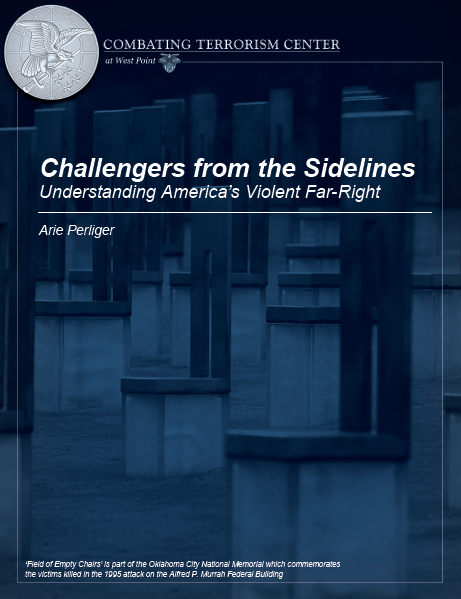
The Center for Combating Terrorism at West Point released a report on domestic terrorism that raised hackles for a number of reasons. Despite the dismissals of liberal political pundits, the reasons for objections to the CTC report are legitimate but they did not need to arise in the first place and might have been avoided with a slightly different editorial approach or appropriate caveats (I just finished reading the report, which is primarily focused on the usual suspects). Here’s why I think the normally well-regarded CTC stumbled into a hornet’s nest:

First, in this foray into domestic terrorism analysis, the center chose to concentrate only on the threat of violence of the Far Right while ignoring other threats coming from the Far Left, infiltration by criminal insurgent networks from Mexico, notably the ultraviolent Zetas whose reach has stirred gang violence in Chicago and Islamist terrorism, either homegrown “lone wolves” or from foreign infiltration or subversion. In itself, this is understandable if the CTC plans a series of reports with a separate focus on different domestic threats; but without that context, it is a myopic analytic perspective, particularly given the demonstrated capabilities of various AQ affiliates or just south of the border, the criminalinsurgency of  the narco-cartels. Had all of these been addressed in one omnibus report, any complaints from conservatives were likely to have been muted or nonexistent. This is not to say that the radical American Far Right does not have a violent threat potential of it’s own worth studying; it does and it is real. But available evidence indicates it to be the least organized, least operationally active and least professionally competent in terms of terrorist “tradecraft” of the three.

The second and most problematic aspect of the report is an intellectually sloppy definition of a dangerous “antifederalist movement”  where noxious concepts like “white supremacy” and wacko conspiracy theories are casually associated with very mainstream conservative (or even traditionally bipartisan !) political ideas – coincidentally, some of the same ideas that contemporary “big government” liberal elites tend to find irritating, objectionable or critical of their preferred policies. Part of the equation here is that American politics are evolvng into a very bitterly partisan, “low trust” environment, but even on the merits of critical analysis,  these two passages are ill-considered and are largely responsible for most of the recent public criticism of the CTC:

….The antifederalist rationale is multifaceted, and includes the beliefs that the American political system and its proxies were hijacked by external forces interested in promoting a “New World Order” (NWO) in which the United States will be absorbed into the United Nations or another version of global government.  They also espouse strong convictions regarding the federal government, believing it to be corrupt and tyrannical, with a natural tendency to intrude on individuals’ civil and constitutional rights.  Finally, they support civil activism, individual freedoms, and self government

….In contrast to the relatively long tradition of the white supremacy racist movement, the anti-federalist movement appeared in full force only in the early to mid-1990s, with the emergence of groups such as the  Militia of Montana and the Michigan Militia. Antifederalism is normally identified in the literature as the “Militia” or “Patriot” movement. Anti-federalist and anti-government sentiments were present in American society before the 1990s in diverse movements and ideological associations promoting anti-taxation, gun rights, survivalist  practices,and libertarian ideas 

This is taxonomic incoherence, or at least could have used some bright-line specifics ( like “Posse Commitatus” qualifying what was meant by “anti-taxation” activists) though in some cases, such as “libertarian ideas” and “civil activism”, I’m at a loss to know who or what violent actors they were implying, despite being fairly well informed on such matters.

By the standard used in the first paragraph, Glenn Greenwald, Ralph Nader and the ACLU would also be considered “far right antifederalists”. By the standards of the second, we might be in physical danger from Grover Norquist,  Congressman John Dingell and Penn Jillette. No one who opposed the recent increases in income tax rates, dislikes gun-control or thought the DOJ may have abused it’s power in the prosecution of Aaron Swartz or in their stubborn refusal to prosecute Bankster racketeering is likely to welcome a report under the auspices of West Point that juxtaposes such normal and perfectly valid American political beliefs with neo-Nazism. A move that is simply going to – and quite frankly, did – gratuitously irritate a large number of people, including many in the defense and national security communities who are a natural “customer base” for CTC reports.

As I said previously, this could easily have been completely avoided with more careful use of language, given that 99% the report has nothing to do with mainstream politics and is concerned with actors and orgs with often extensive track records of violence. As the CTC, despite it’s independence, is associated so strongly with an official U.S. Army institution, it needs to go the extra mile in explaining it’s analysis when examining domestic terrorism subjects that are or, appear to be, connected to perfectly legitimate participation in the political process. This is the case whether the subject is on the Left or Right – few activists on the Left, for example, have forgotten the days of COINTELPRO and are currently aggrieved by the activities of Project Vigilant.

I might make a few other criticisms of the report, such as the need for a better informed historical perspective, but that is hardly what the recent uproar was about.


Switch to our mobile site