zenpundit.com » 21st century

Archive for the ‘21st century’ Category

The Freikorps Revival

Monday, September 14th, 2015

[by Mark Safranski, a.k.a. “zen”]

One of the signs that the Westphalian state system was approaching its zenith was the gradual extinction of legal private warfare in Europe (and in America , east of the frontier). While this trend predated the French Revolution with divine right absolutism monarchs taxing and regulating their nobles once formidable feudal armies into harmless personal bodyguards and ceremonial companies, it was enforced in earnest after the Napoleonic wars by now bureaucratic nation-states. To the sovereign power of the state jealously guarding its monopoly on the legal use of force, in the late 19th century were added the weight of international law.

While once it was commonplace for heavily armed “Free Companies” to roam Europe’s battlefields, hiring themselves out or pillaging on their own, neither the Lieber Code nor the Hague Convention took an indulgent view of the professional mercenary or the provincial partisan, proscribing their historic role in warfare and condemning them along with spies and saboteurs to death. By the time of the First World War with the exception of Tsarist Russia, which still had vestiges of pre-modern feudalism in their Cossack hosts that supplemented the Russian Army, all of the great and middle powers entered WWI with national armies based upon mass conscription, run by a professional officer corps. Even America saw its long established military tradition of locally raised volunteer units of the States abolished by President Wilson, who instituted a draft. Wilson it seems, feared the political effects of an aging Teddy Roosevelt leading a new band of Rough Riders on the Western Front.

This situation shifted dramatically in the aftermath of the Great War. Communist revolution and civil war in Russia, Hungary and Bavaria spawned a rebirth of private militarism; right-wing and nationalist “white” paramilitaries composed of ex-soldiers  battled anarchist and Bolshevik “Red guards” made up of factory workers and party militants. In defeated Germany, a vigorous and heavily armed “Freikorps” movement of embittered veterans led by charismatic officers arose and fought engagements in the Baltic states, in Polish and Czech borderlands, in the Ruhr and in Bavaria, where they crushed a short-lived Soviet republic.

Partially suppressed by the weak Weimar state, partially covertly subsidized and organized by the leadership of the German Army which saw the Friekorps as a “Black Reichswehr” strategic reserve against French attack, the Freikorps degenerated, pillaged, mutated into terrorist  organizations and gradually merged with and militarized Germany’s extreme nationalist and volkisch (racialist) political factions, including the nascent National Socialist German Workers Party. Ex-Freikorps fighters became the backbone of the Nazi SA and nationalist Stahlhelm armies of brawlers, thugs and hooligans. They even had their own newspapers, sports clubs, artists and writers, among whom Ernst Junger was a favorite of that generation.

The reason for this long historical prologue is that it is happening again. The fascinating article below from VICE gives evidence of what should be called a Freikorps Revival. Note the connection to the French Foreign Legion veterans with the Azov Regiment; the Legion once welcomed almost as many German Freikorps men as did the Nazi Party.

Meet the European Fighters Who Have Gone to War in Ukraine

….”I spent all day with a pistol in one hand and a grenade in the other, wondering how I was going to kill myself and how many [separatists] I could take with me,” said Chris “Swampy” Garrett, a British citizen and a member of the squad of Europeans fighting in Eastern Ukraine for Azov Regiment.

Garrett had just returned to Kiev after a failed mission behind enemy lines in the small village of Shyrokyne. His team had been surrounded and cut off from Ukrainian positions before the men fled. He spent over 14 hours trapped behind an enemy advance, fighting in close quarters and taking shelter from friendly artillery fire, before sneaking out of the village under the cover of darkness.

For Garrett, who has served in the British army and done humanitarian de-mining work in the Karen State on the Thai/Myanmar border, the decision to join the Azov Battalion was a simple one: “One day they posted up on the [Azov Battalion] Facebook site, asking, ‘We need people who have any kind of knowledge with first aid, volunteering, with basic military skills, de-mining, anything. If you have any skills at all, to any level, can you come and help?’ So I kind of saw that as my route in, even if I didn’t stay with the [Azov] Battalion. [It was] my surest way to get into the country—get into the east and then be able to see the bigger picture from there.”

….Garrett is not the only member of the group of European soldiers who came to defend Ukrainian sovereignty. But while some came to protect Ukraine, others here came to fight for conservative and nationalist politics in Ukraine’s relatively open political space. For Harley, a 42-year-old from France who served in the French navy and later in the private security industry, involvement was two-sided: he came “to help Ukraine against Russia” and wears a “Fuck U Putin” bracelet on his wrist, but joined Azov because its politics were similar to his own: “Azov,” he said, propagated a political agenda that “was closer to my idea.” 

Azov’s politics have drawn fire for being far-right to the point of neo-Nazism; “If you want to find Nazis, [Azov] is the place to come,” one soldier told me on the way to the frontline. And yet, the political reality of Azov is much more complicated than that. One soldier in the European group told me he estimates that around 20 percent of the battalion could be considered neo-Nazis, while David Eriksson—a 48-year-old Swede who owns real estate and marketing businesses—said: “I think almost 100 percent of foreigners—it used to be maybe 90 percent of foreigners—are not Nazis. They are here to fight.”

Read the rest here.

This may be a meta-trend. Everywhere, rootless young (and some not so young) men are turning their backs on civilized existence and seeking out answers to life or a quick death in lawless conflict zones. Third generation European Muslims who leave families and communities to join ISIS in Syria while American and Dutch motorcycle gang members show up to fight with the Kurdish Peshmerga. Russian outlaw bikers by contrast are Putin’s Cossacks in the Crimea and Donbass while in Pakistan the ISI has made funneling angry young men into terrorist groups and militias something of a cottage industry

Some of these men will never return, but most will. If the lessons of history are to be reckoned, this bodes poorly for the future. They will bring a Darwinian outlook and a politics of the gun.


Lexington Green Interviewed on Against the Current

Thursday, September 10th, 2015

[by Mark Safranski, a.k.a. “zen“]

America 3.0 : Rebooting Prosperity in the 21st Century by James C. Bennett and Michael Lotus

Lexington Green” of Chicago Boyz blog, a.k.a Michael Lotus, co-author of America 3.0 was interviewed recently by Chicago talk radio host and TV commentator Dan   Proft, on Proft’s video podcast, Against the Current.

I heartily approve of the cigars.

Tune in for approximately fifty minutes of conversation regarding national and local politics, futurism, economics and political philosophy through the analytic prism of America 3.0 (a book I warmly endorse):


Is Islam in need of a Reformation?

Saturday, September 5th, 2015

[ by Charles Cameron — perhaps it’s not Wittenberg but Westphalia we should be praying for ]
.

Reformation Qn

**

Ayaan Hirsi Ali clearly believes we need an Islamic Reformation, and she’s not alone. That much Mehdi Hasan concedes in a Guardian piece titled Why Islam doesn’t need a reformation:

In recent months, cliched calls for reform of Islam, a 1,400-year-old faith, have intensified. “We need a Muslim reformation,” announced Newsweek. “Islam needs reformation from within,” said the Huffington Post. Following January’s massacre in Paris, the Financial Times nodded to those in the west who believe the secular Egyptian president, Abdel Fattah el-Sisi, “could emerge as the Martin Luther of the Muslim world”.

Hasan’s piece was evidently written in answer to the Guardian’s take on Hirsi Ali’s latest book, Heretic: Why Islam Needs a Reformation Now by Ayaan Hirsi Ali – review, and is subtitled, Those who are calling for a ‘Muslim Martin Luther’ should be careful what they wish for. His reason?

Martin Luther..

Luther did not merely nail 95 theses to the door of the Castle church in Wittenberg in 1517, denouncing clerical abuses within the Catholic church. He also demanded that German peasants revolting against their feudal overlords be “struck dead”, comparing them to “mad dogs”, and authored On the Jews and Their Lies in 1543, in which he referred to Jews as “the devil’s people” and called for the destruction of Jewish homes and synagogues.

**

On the other hand..

William Polk proposes what seems a powerful analogy in his December 2013 piece, Sayyid Qutub’s Fundamentalism and Abu Bakr Naji’s Jihadism:

I have described elsewhere the movements of “purification” inspired by such men as the Arabian Ahmad ibn Abdul Wahhab, the Algerian/Libyan Muhammad bin Ali al-Sanusi, the Sudanese Muhammad Ahmad al-Mahdi, the Iranian activist Jamal ad-Din al-Afghani and the Egyptian theologian Muhammad Abduh. In a fundamental aspect, their teachings and movements resembled those set off in northern Europe by Luther and Calvin. These Christians and Muslims shared a belief in the absolute authority of the unalterable word of God as set out in the original texts. Their task was to go back to discover the “pure” message and lead their followers to implement it. However much they differed, both the Muslims and the Protestants were in this sense salafis.

To my mind, that’s a far more persuasive analysis.

Perhaps what we’re seeing today is an Islamic version of the European Wars of Religion, following a Salafist “Reformation”?

In which case it might be time to work and pray for an Islamic Peace of Westphalia.

We’re a legacy industry in a world of start-up competitors

Wednesday, August 26th, 2015

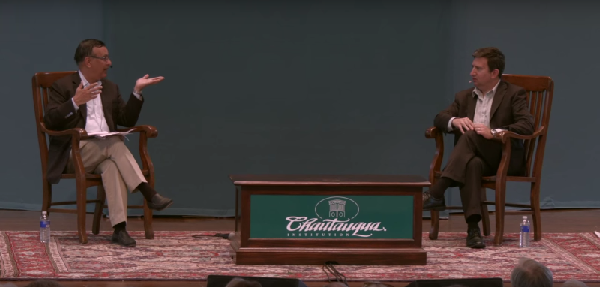
[ by Charles Cameron — Ambassador Husain Haqqani and Daveed Gartenstein-Ross at Chautauqua ]
.

chautauqua haqqani daveed

**

From the outset, when cheers went up for Daveed’s birthplace, Ashland, Oregon, and Ambassador Haqqani’s, Karachi — and for the brilliant meeting of the minds that is Chautauqua — it was clear that we were in the presence of two gracious, witty and informed intelligences, and the seriousness of the conversation between them that followed did nothing to reduce our pleasure in the event. Daveed called it “easily the best experience I have ever had as a speaker.”

I’ll highlight some quotes from each speaker, with the occasional comment:
**

Amb. Haqqani:

None of the countries except Egypt, Turkey and Iran, none of the countries of the Middle East are in borders that are historic, or that have evolved through a historic process. And that’s why you see the borders a straight lines. Straight lines are always drawn by cartographers or politicians, the real maps in history are always convoluted because of some historic factor or the other, or some river or some mountains.

You’ll see how neatly this fits with my recent post on borders, No man’s land, one man’s real estate, everyone’s dream?

And now that whole structure, the contrived structure, is coming apart.

Then most important part of it is, that this crisis of identity – who are we? are we Muslims trying to recreate the past under the principles of the caliphate .. or are we Arabs, trying to unify everybody based on one language, or are we these states that are contrived, or are we our ethnic group, or are we our tribe, or are we our sect? And this is not only in the region, it’s also overlapping into the Muslim communities in the diaspora..

**

If Amb. Haqqani emphasized the multiple identities in play in the Arabic, Islamic, Sunni, Shia, Sufi, and tribal worlds in his opening, Daveed’s emphasis was on the failure of the post-Westphalian concept of the nation state.

Daveed G-R:

In the economic sphere there’s this thing that is often called “legacy industries” – industries that fit for another time, but are kind of out of place today. Think of Blockbuster Video, once a massive, massive corporation.. that’s a legacy industry. So when Ambassador Haqqani talks about how it’s not just in the Middle East that we have this crisis of identity, I think the broader trend is that the Westphalian state that he spoke about, the kind of state that was encoded after the Peace of Westphalia, looks to a lot of people who are in this generation of the internet where ideas flow freely, it looks like a legacy industry.

Why do you need this as a form of political organizing? And what ISIS has shown is that a violent non-state actor, even a jihadist group that is genocidal and implements as brutal a form of Islamic law as you could possibly see, it can hold territory the size of Great Britain, and it can withstand the advance of a coalition that includes the world’s most powerful countries including the United States. And what that suggests is that alternative forms of political organization can now compete with the nation state.

**

The Ambassador then turned to the lessons we should take from 1919’s US King–Crane Commission, reporting on the break-up of the Ottoman Empire — they concluded that it gave us

a great opportunity — not likely to return — to build .. a Near East State on the modern basis of full religious liberty, deliberately including various religious faiths, and especially guarding the rights of minorities

— down to our own times.

Amb. Haqqani:

What we can be sure of is that the current situation is something that will not be dealt with without understanding the texture of these societies. So for example, when the United States went into Iraq without full understanding of its sectarian and tribal composition, and assumed that, all we are doing is deposing a dictator, Saddam Hussein, and then we will hold elections and now a nice new guy will get elected, and things will be all right -– that that is certainly not the recipe. So what we can say with certainty in 2015 is .. over the last century what we have learnt is: outsiders, based on their interests, determining borders is not a good idea, and should certainly not be repeated. Assuming that others are anxious to embrace your culture in totality is also an unrealistic idea.

The sentence that follows was a stunner from the Ambassador, gently delivered — a single sentence that could just as easily have been the title for this post as the remark by Daveed with which I have in fact titled it:

Let me just say that, look, he ideological battle, in the Muslim world, will have to be fought by the likes of me.

Spot on — and we are fortunate the Ambassador and his like are among us.

**

Daveed then turned to another topic I have freqently emphasized myself.

Daveed G-R:

The power of ideas – we as Americans tend not to recognize this when it falls outside of ideas that are familiar to us. So one thing that the US has been slow to acknowledge is the role of the ideology that our friend and ally Saudi Arabia has been promulgating globally, in fomenting jihadist organizations.

And one of the reasons we have been slow to recognize that. I mean one reason is obvious, which is oil. .. But another reason has been – we tend to think of ideas that are rooted in religion – as a very post-Christian country – we tend to think of them as not being real – as ideas which express an ideology which is alien to us –as basically being a pretext, with some underlying motivation which is more familiar to us. That it must be economics, or it must be political anger. I’m not saying those are irrelevant, they’re not – but when Al-Qaida or ISIS explains themselves, taking their explanation seriously and understanding where they’re coming from – not as representatives of Islam as a whole, but as representatives of the particular ideology that they claim to stand for – we need to take that seriously. Because they certainly do.

**

Amb. Haqqani:

The world is not a problem for Americans to solve, it’s a situation for them to understand.

This makes a nice DoubleQuote with Gabriel Marcel‘s more general aphorism:

Life is not a problem to be solved but a mystery to be lived.

**

Toward the end of the discussion, Daveed touched on some ideas of recurrent interest to Zenpundit readers..

Daveed G-R:

Looking at the US Government, questions that I ask a lot are: Why are we so bad at strategy? Why are we so bad at analysis? Why do we take such a short term view and negate the long term?

He then freturned to the issue of legacy industries and nation-states:

Blockbuster is a legacy industry. And the reason why legacy industries have so much trouble competing against start-up firms, is because start-ups are smaller, it’s more easy for them to change course, to implement innovative policies, to make resolute decisions – they can out-manoeuver larger companies. And so larger companies that do well adapt themselves to this new environment where they have start-up competitors. Nation-state governments are legacy industries. Violent non-state actors are start-up compoetitors.

— and had the final, pointed word:

We’re a legacy industry ina world of start-up competitors.

**

Having offered you these tastes, at this point I can only encourage you to watch the whole hour and a quarter, filled to the brim with incisive and articulately-stated insights:

Manea Interviews Galeotti on Hybrid War at SWJ

Sunday, August 23rd, 2015

[by Mark Safranski, a.k.a “zen“]

Dr. Mark Galeotti

Octavian Manea has another excellent installment of his interviews with warriors and scholars of war over at Small Wars Journal. In this case, Russian security and transnational crime expert, Professor Mark Galeotti of NYU and In Moscow’s Shadows blog.

Hybrid War as a War on Governance

 As Clausewitz emphasized, we first need to understand exactly the nature of the war/threat that we are confronted with. What are the core features of this Russian approach on hybrid warfare?

I like to use the term non-linear warfare, in part because it means nearly nothing, and doesn’t come with the intellectual baggage of a term like hybrid warfare which, after all, it is a term that was designed to discuss how insurgents fight modern armies. We don’t have yet a proper vocabulary. The key thing is to realize the extent to which we all need to return to the essential – almost Clausewitzian – notion of war. In this context, war is a political instrument. War is one means of making the other side do what you want it to do, such as simply to remain part of your sphere of influence. What this approach is really about, in a way, is about placing kinetic military operations back in the toolbox. For a long time we thought them as entirely separate: diplomacy and politics on the one hand and warfare in the other. In some ways, warfare happens when the other things fail. What this doctrine is saying is no, let’s just appreciate that in fact we are talking about a whole spectrum of capabilities that can range from soft power suasion, to economic pressure, to increasingly tough diplomatic lines to a whole gradation of military operations that can range from sending 10 people into blocking a bridge, to sending a hundred people to help foment a local insurrection, to sending 10.000 people in a full-scale war. These instruments can and should be used together rather than as entirely separate pieces. In a way, the point of non-linear war is to bring war back in to the spectrum of modern statecraft, to appreciate that it is an acceptable instrument in Russian eyes and to make sure that policy-makers and policy executors realize the importance of the political impact. It is not about metrics of casualties inflicted, how many bombing raids you manage to launch, all the things that we often see replacing actual military success as an indicator. It comes back to the political effect and the use of the military as a political instrument.

Is NATO’s Eastern Flank vulnerable to non-linear warfare?

Here is the key thing: if we look at what is going on, none of the current uses of the Russian military power should be considered the standard blueprint. If they do anything direct in the Baltic States – and I don’t actually think that they will – it will not be Crimea 2.0 or Donbass 2.0, but something that will be tailored to the situation there, to their perception of the threats and to what they actually want to achieve.

Let’s look at the three current uses of the military force. In Crimea the role of the military was to create a fait accompli. The forces were there to act as symbols of Russian statehood. In Donbass, we have forces being deployed with these manufactured local insurrections to create chaos, not because for one moment the Russians are eager for the post-industrial decaying Donbass, but precisely as a way of putting pressure on Kiev. If we look at the Baltic States, the long-range bombers that Russia is flying there are not intended to actually launch a military attack, but to create a constant political as well logistical stress on NATO. Three very different uses of military forces. The military provides a series of capacities within a highly integrated military, political, economic, social media, intelligence campaign to achieve your ends.

Why this evolution towards comprehensiveness?

It reflects a variety of processes, but the most fundamental one is the extent to which traditional war, especially between the most advanced powers, is almost incomprehensible in terms of actual direct costs, in terms of economic and political costs. There is a low-intensity war between Russia and Ukraine, but at the same time I can take a plane in Moscow and I can fly to Kiev. There is trade crossing the border, both legal and very heavily illegal. We live in a world where the old notion of war, war as a binary process, where you are at war or you are at peace, means increasingly less. So on one hand, traditional warfare is much less a usable tool. On the other hand, there is the fact that all societies now are much more casualty-averse. Even today’s Russia is not Stalin’s Soviet Union, can’t treat people as ammunition. Old traditional warfare is hardly conceivable unless it is essentially civil war where rational calculations tend to go out of the window. This is less of a new way of war so much as a way of fighting a war in a new world. It is the world that it has changed rather than the tactics and the ideas.

It is in this changed context that everyone is talking about the need to interconnect government agencies and apply a whole-of-government approach. The very reason why they are doing that is that the world has become so heavily interconnected. Of course, at the same time one of the pathologies of complex bureaucracies is departmentalization. In this respect, the Russians have an advantage. Not because they don’t have huge monolithic and often deeply competitive bureaucracies – which they do – but precisely because, at the top at least, Russia remains a pretty authoritarian regime. You have a chief executive who can force coordination in a way that is much harder in a democratic society.

Galeotti has a nice observation about the political and military fungibility of organized crime networks in a globalized environment that I would like to highlight:

….Looking at the underworld shows what happens in voids of governance. Organized crime flourishes where governance fails and because no governmental system is perfect there always will be organized crime. But the scale, the size and the depth of criminal operations depend on the scale of the governance failure. Modern war is increasingly determined precisely by how one seeks to impact the other side’s governability (we see this trend particularly in Ukraine) and also how one can exploit the weaknesses of the other side’s governability. This is not new. One could look at WW2, at the campaign in Italy and the deals struck with the Mafia to provide intelligence and assistance in seizing Sicily. What is new is that what was seen as a disagreeable ad-hoc tactic is becoming the way the Russians are approaching full-spectrum warfare. It is just seen as another perfectly viable, legitimate opportunity. If we look at Crimea. when the “little green men” were deployed there, they were complemented by much less professional, much less uniformly uniformed, thuggish local “self-defense groups.” It has become clear that they were the gunmen of the local organized crime groups, pressed into service as auxiliaries. And when you look at the regime installed in Crimea from the premier down, it is very heavily penetrated by people from within the criminal world. The same pattern happened also in Donbass, where organized crime figures have become local warlords. My belief is also that some of the terrorist actions in the rest of Ukraine were carried out not directly by sympathizers of the rebellion or Russian government agents, but actually by organized crime figures paid by the Russians. Russia is ahead of the curve in global organized crime, where you have a political-criminal-business elite, that is not formed by Tony Soprano-like figures, but from businessmen who have a portfolio of interests that ranges from the essentially legitimate through to the grey and then wholly illegal activities. The boundaries between organized crime, intelligence operations, state-operations have become increasingly unclear.

Read the rest here.

Organized crime has as a strategic objective monopoly control over black market activities (or at least an ability to “tax” other criminals who engage in them) through coercion and force. At times, in an effort to protect these illegal monopolies from rivals or the state, organized crime networks will evolve their capabilities into terrorists, insurgents, political actors and hybrids of any of these. The reverse is also true; insurgencies like the Taliban or FARC can become increasingly “criminalized” as their political context changes or the need to raise revenues increases.

The artificial divisions between crime and war and politics is generally a taxonomic preference of the modern West and its Westphalian state myths. East Asia by contrast, have long had examples of “hybrid” criminal groups – the Green Gang, the Triads, the Dark Ocean Society, the Yakuza, the Binh Xuyen  and so on. It was more or less normal for established criminal groups to be involved in politics or military affairs, at least on the local level. Those that could not manage this were simply bandits.


Switch to our mobile site