zenpundit.com » 21st century

Archive for the ‘21st century’ Category

Guest post: A Hipbone Approach to Analysis II.

Friday, October 29th, 2010

 Charles Cameron is the regular guest-blogger at Zenpundit, and has also posted at Small Wars Journal, All Things Counterterrorism, for the Chicago Boyz Afghanistan 2050 roundtable and elsewhere.  Charles read Theology at Christ Church, Oxford, under AE Harvey, and was at one time a Principal Researcher with Boston University’s Center for Millennial Studies and the Senior Analyst with the Arlington Institute:

A Hipbone Approach to Analysis II.

by Charles Cameron

Let’s call this one Hopscotch across the disciplines.

…our intelligence community failed to connect those dots…
        –  President Obama, Remarks on Security Reviews, Jan 05, 2010

I’ve been giving quite some thought over the past fifteen years to this issue of connecting dots.

My internet handle, hipbone, does double duty for me, since it refers to Ezekiel’s apocalyptic prophecy as featured in the lyric, “hip bone connected to you back bone”, in the old spiritual, Dem Bones, Dem Dry Bones. On the one hand it points to apocalyptic, by which I mean the soon expectation of a sudden and complete transformation in world affairs, very possibly accompanied, triggered or accomplished by extreme violence, with the end result being a highly favored “new heaven and new earth” or “new world order” depending on who is doing the expectation. On the other hand, it points directly to the idea of “connecting the dots” itself, since the entire song is about connections. I have been working on both fronts at least since 1995.

1

Connecting the dots is a matter of thinking, and there are two basic strategies of thought available to the human mind: linear thinking, which proceeds via cause and effect along a single track, and which is the major style of thought used within disciplinary silos, and lateral thinking, which skips sideways across silos and disciplines on wings of metaphor and analogy. Machines can crunch numbers and do some of our linear thinking for us: but it’s up to the analysts to cover the lateral front.

2

Let’s go aphoristic:

Expectation is algorithm: there are no algorithms for the unexpected.

I’d like to connect the dots … to blind spots.

Blinds spots are the spots we can’t, or won’t, and in any case don’t see. They fall into the category of the invisible. Visionaries are those who can see the invisible, who peer into our blind spots, into those places where we can’t see the connections between the dots, and can therefore easily be blind-sided. There’s an almost Borgesian thickness to the way things tie into one another here: the unexpected is by definition what we can’t predict, what blunt force thinking can’t predict — but it’s not invisible to those whose practice is to peer into the invisible, to aficionados of the subtler associative / metaphorical strategy…

3

Let’s go mythic.

There are two major strategies in life, two main ways of tackling problems, just as there are two heroes in the ‘Spider Woman” myth, which Joseph Campbell said was the central myth of the Americas. In Navajo terms, these twin heroes are called Monster Slayer and Child Born of Water, and their names may already give us the sense that one represents a brute force approach while the other is cannier, subtler — and able to achieve things his twin could barely imagine.

The Massive Ordnance Penetrator may be able to penetrate 60 feet of concrete, but the Grand Canyon was created by the natural flow of water — and as Lao Tzu said, “Nothing under Heaven is more soft and yielding than water, yet for eroding the hard and strong, nothing can surpass it.”

You can pitch this one-two punch at a variety of levels. The military can be seen as the nation’s Monster Slayer, its intelligence community as the Child Born of Water. You could see Thomas Barnett’s Leviathan as Monster Slayer, his SysAdmin as Child Born of Water. Or within the IC, you could say that software that can “crunch mega amounts of data” takes the Monster Slayer approach — but it requires cognitive skills and insight of a Child Born of Water sort to know when a student’s slightly eccentric interest represents a threat to the lives of three thousand office workers…

4

Let’s go analogic.

I’m thinking of the flight school students who “focused on learning to control the aircraft in flight, but took no interest in takeoffs or landings” — who asked one instructor where they could take lessons on jets without learning to fly smaller planes first, a request he concluded indicated they were “either joking or dreaming”.

In the not-so-terror-conscious atmosphere pre-9/11, a lack of interest in takeoffs and landings might have seemed quirky — but the “connections” weren’t obvious enough for the info to travel all the way up the FBI food-chain to the very top, as it would today. In post-9/11 retrospect, such things look a bit different – but I presume it still took reasoning by analogy for an instructor in a SE Asian diving school to recognize that a student who appeared less interested in the business of avoiding the bends and surfacing safely than in learning underwater swimming might pose a similar threat.

With 20/20 hindsight, this sort of thing seems glaringly obvious: even Monster Slayer could see it.

5

Let’s think about ignorance for a moment.

There’s Rumsfeld’s famous quip about known unknowns and unknown knowns, there are the genres of black swans and unintended consequences, there is what’s obvious and non-obvious, there are blind spots and hidden assumptions — and it’s the non-obvious that blindsides us, right?

We could rephrase the Spider Woman idea to state that Monster Slayer proceeds in terms of the obvious, while Child Born of Water works with the non-obvious. Jami Miscik, at that time Deputy Director for Intelligence at CIA, once remarked, “To truly nurture creativity, you have to cherish your contrarians and give them opportunities to run free”.

Child Born of Water is the contrarian, the maverick, the one whose oblique angle on things provides insight by… making non-obvious connections between the non-visible dots.


Guest Post: Mexico, Africa, Zarqawi?

Thursday, October 28th, 2010

Charles Cameron is the regular guest-blogger at Zenpundit, and has also posted at Small Wars Journal, All Things Counterterrorism, for the Chicago Boyz Afghanistan 2050 roundtable and elsewhere.  Charles read Theology at Christ Church, Oxford, under AE Harvey, and was at one time a Principal Researcher with Boston University’s Center for Millennial Studies and the Senior Analyst with the Arlington Institute:

Zen here – I think Charles has hit upon a primal psychological mechanism that comes into full flower as societies break down and war begins to shade into warlordism. We have seen this repeatedly in history from Tamerlane’s mounds of skulls to Khmer Rouge killing fields. Mad Barons, Dogmeat Generals, Friekorps kapteins and butchers long since forgotten by history- there’s a gravitational pull toward atavistic, symbolic, destruction as social norms erode under the corrosive effects of escalating violence.

Mexico, Africa, Zarqawi?

by Charles Cameron

I’ve been struck by a couple of passages I’ve run across in my reading recently that remind me of what I can only call “brutality with religious overtones”.
1. Mexico

There have been a fair number of articles about the various Mexican cartels, but the excerpt from Ed Vulliamy’s book, Amexica: War Along the Borderline that’s now online at Vanity Fair is the one that caught my eye yesterday.

Here’s Vulliamy’s account of a conversation with Dr. Hiram Muñoz of Tijuana:

He explained his work to me during the first of several visits I have made to his mortuary. “Each different mutilation leaves a message,” he said. “The mutilations have become a kind of folk tradition. If the tongue is cut out, it means the person talked too much—a snitch, or chupro. A man who has informed on the clan has his finger cut off and maybe put in his mouth.” This makes sense: a traitor to a narco-cartel is known as a dedo — a finger. “If you are castrated,” Muñoz continued, “you may have slept with or looked at the woman of another man in the business. Severed arms could mean that you stole from your consignment, severed legs that you tried to walk away from the cartel.”<¶>Earlier this year, 36-year-old Hugo Hernandez was abducted in Sonora; his body turned up a week later in Los Mochis, Sinaloa, but not in a single piece. His torso was in one location, his severed arms and legs (boxed) in another. The face had been cut off. It was found near city hall, sewn to a soccer ball.

That’s the brutality — I haven’t see the book itself yet, but I gather it also gets into the narco-corrida music and the “quasi-Catholic cult of Santíssima Muerte” — which brings me to the second part of my interest – the religious aspect.

As Vulliamy mentions, there’s the cult of Holy Death, to be sure, a sort of shadow or inverse of the Blessed Virgin — a Dark Mother for dark times, or perhaps a revival of the ancient Mictlancihuatl, lady of the Dead? — with her own liturgy, too:

Almighty God: in the name of the Father and of the Son and of the Holy Spirit, we ask for your permission to summon Saint Death. Welcome, White Sister: we find ourselves gathered here at this altar of the Romero Romero family and of each one of us, to offer you a Mass that we hope you will like…

Which brings us to the Robin-Hood-like bandit and folk-saint, Jesus Malverde, to whom prayers such as the following [FBI .pdf, see p. 20] are offered:

Lord Malverde, give your voluntary help to my people in the name of God. Defend me from justice and the jails of those powerful ones. Listen to my prayer and fill my heart with happiness. For you shall make me fortunate.

There are even miracles attributed to him:

Oh Malverde! The Vatican did not believe you to be holy and would not canonize you, but when they brought the Caterpillars to tear down your hood, you broke one machine and nobody could move you away, you broke another, leaving those who disrespect you speechless — and when the third one broke, they said, “Let Malverde’s chapel alone.”

Right beside the syncretistic quasi-Catholicism, there’s also a Protestant angle: La Familia is the group that, in Vulliamy’s words, “made its ‘coming out’ known in a famous episode: bowling five severed heads across the floor of a discotheque.” Time magazine reported on what it termed Mexico’s Evangelical Narcos:

Federal agents seized one copy of La Familia’s Bible in a raid last year. Quoted in local newspapers, the scripture paints an ideology that mixes Evangelical-style self-help with insurgent peasant slogans reminiscent of the Mexican Revolution. “I ask God for strength and he gives me challenges that make me strong; I ask him for wisdom and he gives me problems to resolve; I ask him for prosperity and he gives me brain and muscles to work,” Moreno writes, using terms that could be found in many Christian sermons preached from Mississippi to Brazil. But on the next page, there’s a switch to phrases strikingly similar to those coined by revolutionary Emiliano Zapata. “It is better to be a master of one peso than a slave of two; it is better to die fighting head on than on your knees and humiliated; it is better to be a living dog than a dead lion.”

As I commented on Zenpundit a while back,

What’s troubling here is that there is only one undoubtedly “evangelical” phrase in all those that Time quotes, and it is one of then ones said to resemble the aphorisms of Emilio Zapata. “It is better to be a living dog than a dead lion” is a pretty direct borrowing from Ecclesiastes 9.4 in the King James Version: “To him that is joined to all the living, there is hope: for a living dog is better than a dead lion.”

But that’s not actually all. I didn’t mention it at the time, but “I ask God for strength and he gives me challenges that make me strong; I ask him for wisdom and he gives me problems to resolve; I ask him for prosperity and he gives me brain and muscles to work” is almost word-for-word the same as a poem attributed to Islam — or Judaism for that matter. Indeed, it can be hard to tell who is borrowing from whom – but one final source for the La Familia bible is known – it’s the book Wild at Heart by John Eldredge, the pastor of a ministry in Colorado Springs, who must have been surprised at the uses to which his writings were being put.

In any case, as I said on Zenpundit: These people have a theology, and we should be studying it.
2. Africa

My thoughts turned to Africa when I read another paragraph recently, this one from Johann Hari’s review, The Valley of Taboos, of V.S. Naipaul’s new book, The Masque of Africa: Glimpses of African Belief:

I have stood in a blood-splattered house in Tanzania where an old woman had just been beaten to death for being a “witch” who cast spells on her neighbors. I have stood in battlefields in the Congo where the troops insist with absolute certainty they cannot be killed because they have carried out a magical spell that guarantees, if they are shot, they will turn briefly into a tree, then charge on unharmed. I have been cursed in Ethiopia by a witch-doctor with “impotence, obesity, and then leprosy” for asking insistently why he charged so much to “cure” his patients. (I’m still waiting for the leprosy.) Where do these beliefs come from? What do so many Africans get out of them? Can they be changed? These are questions that are asked in Africa all the time, but we are deaf to the conversation.

That sent me in search of some early military anthropology related to guerrilla warfare I’d come across in earlier readings.

James R Price and Paul Jureidini’s 1964 Witchcraft, Sorcery, Magic, and Other Psychological Phenomena and their Implications on Military and Paramilitary Operations in the Congo, and Roger D Hughes’s 1984 Emergency in Kenya: Kikuyu and the Mau Mau Insurrection are both of considerable interest here — but it is LSB Leakey, the world-class British archaeologist initiated as a boy into the Kikuyu ways, who has written the most provocative summary of the relationship between political and religious violence and ritual that I’m interested in tracking.

I’m quoting here from the chapter on “The Mau Mau Religion” in Maj. Hughes paper:

Leakey’s original hypothesis in Mau Mau and the Kikuyu: “Mau Mau was nothing more than a new expression of the old KCA … a political body that was banned … because it had become wholly subversive.” Furthermore, “Mau Mau was synomomous with the new body called the in school, Kenya African Union…” However, Leakey admits to a reversal of his original hypothesis in Defeating Mau Mau, and goes on to say, “Mau Mau, while to some extent synonymous with these political organizations, was in fact a religion and owed its success to this fact more than to anything else at all.”<¶>He then proceeds to attribute the origin of Mau Mau to an “ideology transfer,” wherein the religious beliefs of the Kikuyu transitioned from their ancient tribal religion to Euro-Christianity to Mau Mau. The first transition took place artificially, as the missionaries stripped away the traditional beliefs and supplanted them with “20th Century Europe’s concept of Christianity.” The second transition was more natural and evolutionary than the first. A reactionary hybrid of the old and the new developed, because the supplanted concepts would not hold up in their society. There were too many contradictions between the old and the new, mainly due to the 20th Century European “add-ons.”

Most of us have a pretty fixed view of what religion is, should be, or isn’t. Some of my readers no doubt hold to a evangelical Christian position, some are Catholic, some perhaps Buddhist, agnostic or atheist, and some perhaps Muslim. Each of us tends to take our own view of a particular religion as normative, but the reality is that the history of each of the great world religions contains sanctions for both peace-making and warfare — and human nature itself encompasses a range of behaviors that run from the kind of atavistic violence described above to the forgiving and compassionate impulse behind the Beatitudes…

And while economic pressures and political frustrations may be enough to power great struggles, when religious rituals, beliefs and feelings are added into the mix, it can quickly become even more lethal.
3. And Zarqawi?

All of which leaves me wondering how close the parallels are between the Mau Mau in LSB Leakey’s account, La Familia and the other Mexican cartels — and the brutalities of jihadists such as Abu Musab al-Zarqawi.

Guest Post: The United States of Islam

Tuesday, October 26th, 2010

 Charles Cameron is the regular guest-blogger at Zenpundit, and has also posted at Small Wars Journal, All Things Counterterrorism, for the Chicago Boyz Afghanistan 2050 roundtable and elsewhere.  Charles read Theology at Christ Church, Oxford, under AE Harvey, and was at one time a Principal Researcher with Boston University’s Center for Millennial Studies and the Senior Analyst with the Arlington Institute:

The United States of Islam Video

by Charles Cameron

[ the first in a series, cross-posted from Chicago Boyz ]

Let’s take a closer look at the United States of Islam video which I mentioned in my post Of Weaponry and Flags.

 USI Films

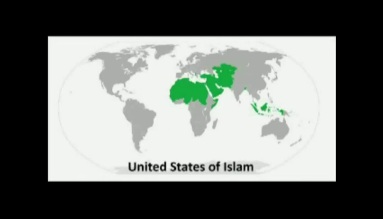
The video announces itself as “an USI Films production”. It then opens with the words “since 911 the world has changed” in white type against black, followed immediately by news clips of the WTC attacks and of President Bush describing them as “evil acts” and declaring “I have directed the full resources of our intelligence and law enforcement communities to find those responsible, and to bring them to justice.” What we shall be seeing, then, is a time-oriented video, presenting a historical context for the present moment with implications for the near future. From here we cut by way of another white on black typed message — “they started this war in afghanistan” – via clips of war footage to another – “but their agenda is much bigger and brutal than that” – and then to another clip of Pres. Bush: “Our war on terror begins with al-Qaida but it does not end there. It will not end until every terrorist group of global reach has been found, stopped, and defeated.” By this point, the background music, which is taken (for reasons both political and musical?) from Vangelis’ 1492 – Conquest of Paradise soundtrack, is swelling. A global map appears, showing much of north Africa, the middle east, Indonesia and Malaysia in green, with Pres. Bush in voice over speaking of the establishment of “a violent political utopia across the middle east which they call a Caliphate where all will be ruled according to their hateful ideology.”

USI world map

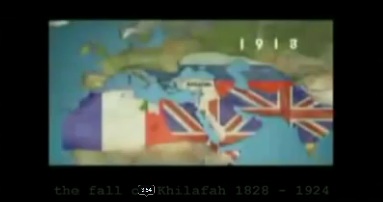
The map is titled United States of Islam. The words “they have done this before” are then followed by a series of film clips showing “the fall of the Khilafa 1828 -1924” and maps showing the slow spread of the British and French flags across north Africa and the middle east, with glimpses of Lawrence of Arabia, the Balfour declaration, and General Allenby, accompanied by the voice-over of someone I’d tentatively identify as Sheikh Imran Nazar Hosein, declaring: The Khilafa was destroyed. Who destroyed it? Why did they destroy it? How did they destroy it? When did they destroy it? What did they replace it with? With what was it replaced? And what is its destiny?

These are awesomely important questions which very few can answer today.

Caliphate divided

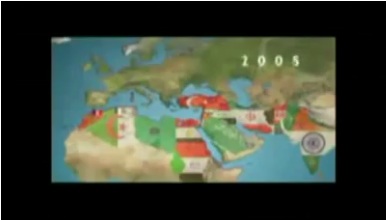
The text then states that (the west) “divided us into 54 states” and the map begins to show the various flags of the Islamic states intowhich the region was more recently divided…

Carved up

ending up in 2006. And what do we want now? You might be forgiven if you haven’t already guessed:

Total Annihilation

Clips then show the toppling of Saddam’s statue in Baghdad, the Israeli army in Gaza with casualties, the October 2009 Pishin attack on the Revolutionary Guard in Iran (which was claimed by Jundullah), and a first mention of the Christmas bomber, Al Qaida and Yemen… a quick mention of Nigeria and Somalia… and “Pakistan from which they fear the most”. A newscaster from, presumably, Pakistan intones “this is called the fourth generation warfare.” That essentially brings us up to the present moment. * We have arrived at the half way point in the 10 minute video and seen the global historical context, laid out in maps and flags. We have focused in on the present from a two-hundred year sweep, and on Pakistan from the distributed ummah. What follows will expound and expand on this present moment, bringing Afghanistan into the picture alongside Pakistan, emphasizing the spiritual significance of Khorasan, and taking the battle variously to India and Jerusalem…

[ to be continued ]

Google’s DARPA of Foreign Policy Cometh?

Wednesday, October 20th, 2010

Interesting. I suggested something like this years ago.

….What the USG desperately needs is a national security equivalent to DARPA that can both engage in deep thinking and have the freedom to run pilot programs to enhance America’s strategic influence that can later be expanded by our traditional power bureaucracies. This would be far more than a just a federally funded think tank – RAND, Brookings, Hoover , Heritage, AEI, CATO, CFR, Carnegie, CSIS and others all do a fine job of policy analysis. They also give statesmen a productive place to hang their hat as an alternative to whoring themselves out as corporate or ideological lobbyists. Another one of those is not what the times require.

What I’m proposing is a lot closer to a cross between a soft-power version of the Institute for Advanced Studies and a clandestine service – one with the objective of developing innovative programs to maximize the influence of American values and promote “Connectivity ” in nations mired in the endemic, isolated, misery of the “Gap”. This is not what the USG normally does. The bias of State and Defense, State in particular, when dealing with foreign policy questions tend to be orientated toward day to day, tactical, crisis management….

Google appears to be trodding down that very path:

Google Grabs State Dept. Star Jared Cohen for Foreign Policy “Think/Do Tank”

Jared Cohen joined Google last week as the director of its newly created Google Ideas “think/do tank”-an entity whose objective is to dream up and try out ideas that address the challenges of counterterrorism, counterradicalism, and nonproliferation, as well as innovations for development and citizen empowerment. He has also landed a side gig as an adjunct fellow at the Council on Foreign Relations, focusing on innovation, technology, and statecraft.

Google has now hired Cohen to set up Google Ideas, which will look for innovative approaches to some of the stickiest international issues of the day. Out of his New York office, Cohen will, he told Foreign Policy, seek to “[build] teams of stakeholders with different resources and perspectives to troubleshoot challenges.” As for why he decided to give this a shot in the private sector, rather than in the public sphere, to which these issues have traditionally belonged, Cohen says there are “things the private sector can do that the U.S. government can’t do.”

The big thing is the resources and the capabilities. There are not a couple hundred [computer] engineers in the State Department that can build things; that’s just not what government does. You don’t necessarily have some of the financial resources to put behind these things. It’s really hard to bring talented young people in; there are not a lot mechanisms to do it. [And] on some topics, it’s very sensitive for government to be the one doing this.

During the Cold War, DARPA was a great success, as government bureaucracies go, partly because secrecy freed it from the normal political and bean counting constraints. The other reason was that DARPA’s focus was primarily upon engineering types of problems. Technically difficult, innovative and exploratory problems to be certain, but generally not the sort of socially constructed or influenced “wicked problems“. Or “intractable ones” ( DARPA delved into technical problems that were, due to the technological level of that earlier era, also intractable, but that is still a different kettle of fish from socioeconomic, perceptually intractable, problems). It would seem that Google Ideas will be tackling the harder set of problems to solve.

Google Ideas is an entity to watch but all the observation will be detrimental to the accomplishment of it’s mission, as the nature of social wicked problems carry with them vested interests determined to defend the dysfunctional status quo from which they derive benefits. In some scenarios, with extreme violence. In others, with political pressure. There’s a reason these problems in the human realm go unsolved – sweet reason and pilot program rational incentives might not appeal to leaders of La Familia or Palestinian Islamic Jihad.

Google might also need a formidible Google PMC.

Hat tip to Larry Dunbar.

More Differing Views on China

Sunday, October 17th, 2010


Good counterpoints to my previous post:

Wiggins, whose orientation toward strategy is Wohlstetterian, offers a critique.

Opposed Systems DesignThe trauma of constrained ascendancy

….Mark correctly identifies a shift in Chinese behavior over the the past year or so. Where Mark’s analysis falls short lies in presuming that incompetence or short-sighted factions are responsible for this shift. The international relations theory of power cycles offers a richer way of understanding China’s position in the international system and how that has produced a change in its behavior.

Briefly, China’s relative rate of growth has begun to slow. After roughly 30 years of (accelerating) relatively faster growth than the major powers in the system, this trend has reversed itself. This is confusing, since in absolute terms China continues to grow and – by these same absolute measures – it came through the global financial crisis much better than the U.S. In tension with these trends, however, are a host of systemic factors that are constraining its growth (including demographic shifts, environmental degradation and inefficient capital allocations). The transition from early to late stage growth (or from labor-intensive to extensive or innovation-based growth) confronts China with new challenges. It becomes harder to accurately discern its place in the system and its trajectory of growth. This leads to more internal dissent among leaders trying to interpret these disparate trends and creates incentives to discard the cautionary policies of Deng (hide brightness, nourish obscurity). Before the first inflection point, time was on China’s side. A post-first inflection point China, on the other hand, begins to feel pressure to realize some of its ambitions before its window of opportunity closes. Hence, we begin to see cracks forming in the implementation of Deng’s strategy.

I have only read one paper on power cycles, recommended to me by Wiggins himself in his non-internet persona, so I am not qualified to comment on it’s theoretical strengths and weaknesses as an evaluative tool ( it would also help if were a quant rather than a qual academic). I will say that, as a rule of thumb, selective relative changes, those that are marginal in nature, are often perceived more acutely in terms of political angst than are absolute changes in real terms.

For example, agrarian populists in 19th century America were absolutely furious about the effects of a deflationary gold standard on crop prices relative to debt, liquidity and access to credit but not so exercised about the increases in purchasing power and access to consumer goods that farmers enjoyed that were unknown a generation earlier. Perhaps somewhere, there is a Chinese William Jennings Bryan in Shaanxi waiting to burst on the scene. 🙂 Or a von Tirpitz.  So there may be merit, in a macro-systemic sense, to Wiggins criticism of my post.

Dr. Thomas P.M. BarnettThe “rising near peer” returns the paranoid favor

….And we wonder why the Chinese military seem to think we’re their number one enemy?  Are we honestly that clueless or has our disingenuity broken through to some higher, slightly irrational plane?

Follow me into this brave, alternative world:

  • Imagine the Chinese navy holding multinational exercises with the Cubans and Venezuelans and Nicaraguans (a silly sight, I know) in the waters around Cuba, while Beijing warns us subtly that their 1979 Cuba Defense Act will be pursued to the ultimate vigor required, including the sale of advanced attack aircraft to the Cuban air force.  
  • Imagine Chinese carriers conducting such operations, sporting aircraft and weaponry that could rain destruction over most of the continental U.S. at a moment’s notice.  
  • Imagine Chinese spy craft patrolling the edge of our local waters and flying around the rim of our airspace.  
  • Imagine the Chinese selling all sorts of missile defense to Venezuela and other allies “scared of rising American militarism.”
  • Imagine weapons purchases throughout Latin America doubling in five years time, with China supplying most of the goods.  
  • Imagine Chinese naval bases and marine barracks doting the Latin American landscape and Caribbean archipelago.
  • Imagine a Cuban missile crisis-like event in the mid-1990s, which led the Chinese military to propose a new evolution in their warfare since.  
  • Imagine the Chinese military conducting regime toppling events in the Middle East, involving countries upon whom our energy dependency is dramatically and permanently rising, while China actually gets the vast bulk of its oil from non-Persian Gulf sources like Canada, Mexico, Latin America, Africa and itself.  
  • Imagine the Chinese government demanding that the Chinese military produce an elaborate report every year detailing the “disturbing” rise of U.S. military power.  
  • Imagine the Chinese military announcing their new military doctrine of attack from the sea and air, with their documents chock full of bombing maps of U.S. military installations that are widely dispersed across the entirety of the continental United States, meaning their new war doctrine has–at its core–the complete destruction of U.S. military assets on our territory as the opening bid.
  • Imagine the U.S. military stating that this new doctrine of attacking the entirety of the U.S. territory is necessary to maintaining the regional balance of power in the Western hemisphere, because the U.S. Navy has–in an “unprovoked” and “provocative” manner, begun significant patrolling operations in the Caribbean Basin, whose waters constitute a “profound” national interest to the Chinese.
  • Imagine this series of developments unfolding over close to two decades, as China, having lost its familiar great-power war foe, the Soviet Union, firmly glommed onto the U.S. as a replacement enemy image.
  • Imagine all that, and then imagine how the U.S. military views the Chinese military.  
  • Imagine if the Chinese military offered military-to-military ties under such conditions.  

What do you think the U.S. Congress would say to that?  Would it be considered “caving in” to Chinese pressure?

In backchannel, .mil circles, Tom is sometimes accused of being a “panda hugger” but I think that is attributable to the poverty of genuine strategic thinking that prevails in our national security community. A prerequisite in constructing a strategy is being able to “see the board” from the perspective of the other fellows shoes. If you can’t do that, you are stuck at the tactical-reactive level of analysis. Seeing another side’s perspective is an iterative advantage, not a weakness or evidence of sympathy. If you can game out their best moves before they can, then you are a strategist who has the ability to wrest maximum concessions at minimum cost to your own side.

We need more of that kind of thinking, not less; we’d make fewer mistakes ( like the kind the Chinese are making of late).


Switch to our mobile site