Guest Post: Sean Meade Reviews The Illiad
Saturday, September 11th, 2010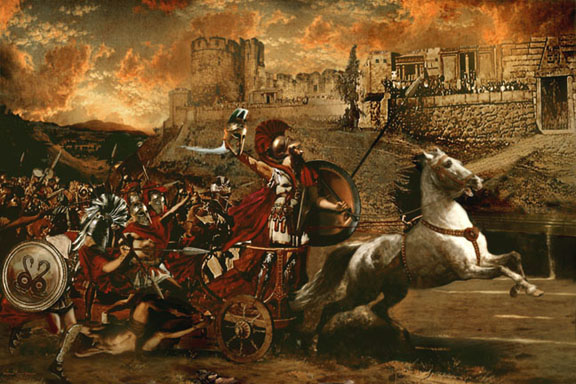
The Illiad by Homer
Sean Meade, in addition to being my good friend, is the Web Editor for Aviation Week’s defense and space content and is the former longtime webmaster/editorial assistant/right-hand of Dr. Thomas P.M. Barnett. Sean blogs at ARES for Aviation Week and at his personal blog, Interact:
ON THE ILLIAD
by Sean Meade
What makes ‘The Iliad’ a classic? Why is it classic?
I think the primary answer is simple: it’s the characters. If you can hang tough through all of the idiosyncratic flourishes and ornaments and repetitions, the characters are compelling: Achilleus, his anger and character; the comparative nobility of Hektor and Patroklos (both of whom we know are doomed); the vagaries of the gods and their adolescent machinations; the supporting cast of Agamemnon, Menelaos the wronged, two very different men named Aias (Ajax), Diomedes, Aeneas, Odysseus, Nestor, Paris, Helen and Priam. Take these characters and others and mix them with an interesting story and you have a classic that reaches out to us from about the eighth century BC (when it was likely ‘composed’ (with heavy use of previous, oral sources) by Homer), maybe from as far back as the 12th century BC (maybe the original setting of what has come down to us as The Trojan War). ‘The Iliad’ still resonates with us today.
One reason ‘The Iliad’ can still move us is that Homer has done a masterful job of relating the ‘accidents’ of life. ‘Time and chance happen to all men’, and people who lived 3000 year ago couldn’t deceive themselves about their ability to control life the way we ‘modern’ people do. Human experience and emotions are often inscrutable. ‘Love’ (baldly called ‘lust’ by Homer) can easily destroy. When it occurs in the most influential levels of society, it can draw whole nations into its whirling vortex. Even the love between men in ‘The Iliad’ can seem illogical (no matter where you come down on the homosexuality question): why does noble Patroklos honor Achilleus literally to the death?
‘The Iliad’, of course, focuses a lot on war in ways that have become shockingly remote for most of us. Nothing is so susceptible to ‘luck’ as war. One ‘good’ soldier gets hit by stray friendly fire and dies instantly. Another ‘bad’ soldier comes through the whole war unscathed. Consider the hazards of love, life and war in ‘The Iliad’. Consider them in our own experience. It makes more sense than many theories to conclude that arbitrary and capricious gods can powerfully affect us.
My final guess (for the purposes of this mini-review) at why ‘The Iliad’ is a classic is that the poetry is timeless. This is, of course, nearly impossible to take in from one read-through in translation. My friend, Jason, listened to the abridged version and talked about its power. The commentators discuss it quite a bit, from what I can tell. Most of us (who aren’t going to pay the price to really test it) are going to have to take this on faith and rate it as we will. Poetry is a dying art, and poetry appreciation is probably in an even worse state.
I wonder what role foreknowledge plays in ‘The Iliad’. Many of us know the broad outline of the story going in. If we don’t, Homer spills it in short order. Does knowing Achilleus dies shortly after this episode in The Trojan War change our view of him? Do we cut him more slack? How does knowing that Hektor and Patroklos die within the bounds of this story affect us? Or that Odysseus lives? Or that Agamemnon will be murdered in his bath by his wife (he had it coming ;-)?
Something else that stands out about ‘The Iliad’ is the graphic war imagery. Homer’s descriptions almost seem gratuitous when he goes into detail about how one soldier killed another, where the spear penetrated and where it came out, what muscles were severed, what happened to the bowels, teeth or brain. It’s probably distasteful to many of us in the 21st century, but I think we can just chalk that up to cultural differences.
My second big question is: what does ‘The Iliad’ mean? I’m very snobbish about exegesis, especially concerning the Bible (my training, as a former pastor), but including any suitably worthy literature (with concomitant training in British Lit and Analytic Philosophy). Exegesis, in principle, is simple: what was the author trying to communicate to the audience? (So why is good exegesis so hard to find? 😉 If we are to make any meaningful connection to the original work, this is where we have to begin. You can deploy your Reader Response Theory on ‘Twilight’ or some such drivel, but keep it off my Homer (I told you I’m a snob ;-).
We come to ‘The Iliad’ at a loss because Homer’s values are very different from ours. His presuppositions are vastly different from ours. I have touched on some of these already. The gods can show up at any time and throw any wrench in the works for almost any imaginable reason. We have to take the role of the gods seriously to take Homer seriously. What did their role say about the responsibility of people? Humans retain some responsibility, almost paradoxically. Helen isn’t completely off the hook for running away with Paris. Achilleus does not get a complete pass for his anger that causes the deaths of so many Achaean comrades. Agamemnon is not excused for his overbearing pride that contributed to the disagreement with Achilleus. And even noble Hektor faces bouts of inaction and cowardice for which he is not wholly exonerated.
Another value we find hard to understand is the ancient Greek concept of nobility. It’s just born there. If you’re a shepherd who’s not the natural-born son of King Priam and Queen Hekabe, that’s all you’ll ever be: a shepherd. The main characters are noble; many are first-generation half-deities and most (all?) have divinity in their bloodline somewhere. From our standpoint, Achilleus behaves like a monster, especially in his repeated attempted-desecration of Hektor’s body (the gods protect Hektor’s body and Achilleus’ ultimate honor by preserving Hektor’s corpse inviolate in almost the perfect proverbial deus ex machina). He’s sacrificed any claim to nobility as far as we’re concerned. Not so for Homer and the ancient Greeks; Achilleus retains his nobility, though it is clouded by sins. He receives partial pardons and rationalizations. From our perspective, we view him as maybe the original anti-hero. Homer’s view is much less ambivalent, and Achilleus gets away with things for which lesser men would go straight to Tartaros without passing ‘Go’. It’s a far cry from our 21st century Western concept of nobility and our love of ‘rags to riches’ fables. It’s only riches to riches here (though maybe no one knew through the rags that you were really rich).
So what is Homer’s message? The conclusion of my barely-better-than-cursory reading is: Given that nobility and greatness are natural, almost literally gifts of fate (the Fates); and that humans are subject to the whims of the gods; it is best to be brave and seek glory (within reason–with a glance forward to Aristotle’s middle-way ethic). How’s that going to help you with your job or family? Not much. It’s fodder for thinking about societal values and a long way from whether or not to stick it out in your mediocre, going-nowhere job. (It might possibly apply to whether or not you should run away with your neighbor’s spouse.)
For most of us, ‘The Iliad’ is probably a test in proper exegesis more than someplace we should or will go to look for meaning. But maybe that’s just my soap box 😉


 by
by  by
by  by
by 
 by
by and I’d like to briefly join them in praising Freedom(TM) as a must-read work of science fiction. One that meshes well with the societal problems covered on today’s front pages while describing an emergent world of
 by
by 

