Archive for the ‘intelligence’ Category
Friday, June 18th, 2010

The Human Factor: Inside the CIA’s Dysfunctional Intelligence Culture by Ishmael Jones
A former clandestine officer of the CIA who operated overseas without benefit of diplomatic cover, “Ishmael Jones” has painted one of the most damning insider accounts of a puportedly self-serving and risk-averse CIA’s management culture that has ever been written. Jones’ description of a mendacious and incompetent CIA headquarters bureaucracy has less in common with critical documents like the 9/11 Commission Report or the legendary Church Committee hearings than it does with the literature produced by Soviet dissidents and defectors during the Cold War.
Jones, who quotes from the iconic 1990’s film Glengarry Glen Ross, yearned to be in an aggressive covert intelligence service whose case officers would “Always Be Closing” . Instead, he finds a Central Intelligence Agency topheavy with career managers averse to approving operational approaches to potential sources, eager to recall effective and productive officers permanently home on the slightest pretexts, comfortable with padding their incomes through familial nepotism and not above lying to Congress or political superiors in the Executive Branch. Jones navigates successfully through three consecutive overseas assignments via a strategy of keeping HQ in the dark about his activities, never becoming known as an “administrative problem” to HQ paper-shufflers and advancing operational costs from his own pocket, with the CIA eventually in arrears to Jones to the tune of $ 200,000.
CIA management in The Human Factor resembles nothing so much as the Soviet nomenklatura crossbred with the Department of Motor Vehicles. Even if we were to allow for exaggeration for humorous effect, or frankly discount 50 % of Jones’ examples outright, the remainder is still a horrifying picture of Langley as an insular bureaucracy that excels far more at Beltway intrigue than at foreign espionage or covert operations. Jones also discusses the tenure of CIA directors George Tenet and Porter Goss, the Valerie Plame story and the post-9/11 intelligence “reforms” that aggravated the CIA management culture’s worst tendencies. Jones concludes by stating flatly that the CIA cannot be fixed and should be abolished, with its useful operational personnel transferred to the Departments of State and Defense.
ADDENDUM:
An excellent – and more detailed – review of The Human Factor by by fellow Chicago Boyz blogger, James McCormick:
Mini-Book Review – Jones – The Human Factor
….Other reviews of this book have proclaimed Human Factor a rather boring recollection of examples of institutional ineptitude and better as a guidebook for potential employees than a useful description of the CIA but I feel this is in fact the most useful book on the CIA’s clandestine service since:
Orrin Deforest and David Chanoff, Slow Burn: The Rise and Bitter Fall of American Intelligence in Vietnam , Simon & Schuster, 1990, 294 pp.
David Atlee Phillips, The Night Watch: 25 Years of Peculiar Service , Atheneum, 1977, 309 pp.
which covered clandestine case officer activities, first person, in Vietnam and Latin America.
Like these two aforementioned titles, Human Factor focuses on the day-to-day challenges of being a covert case officer … the “teeth” in any intelligence organization. It is noteworthy that the Director of Central Intelligence has rarely, if ever, been one of those covert (non-State Department) officers. It’s as if your dentist was being overseen by experts in small-engine mechanics.
Ishmael recounts the minutiae of what reports he needed to write, the porous e-mail systems he had to manipulate, and the permissions he needed to gain. The timing and delays of decisions from Langley … the phrasing and terminology that was necessary to get anyone back in the US to allow any activity whatsoever. As a former stock broker, Jones was entirely comfortable with the challenges of “cold-calling” and dealing with “No” over and over again. But this wasn’t the case for his fellow trainees or for any of his superiors. At every turn, he was able to contrast his experience in the Marines (and military culture), and with Wall Street’s “make the call” ethos, with what he was experiencing as one of the most at-risk members of the Agency
Posted in 21st century, authors, book, CIA, DIME, dystopia, Failed State, government, IC, ideas, intelligence, national security, organizations, politics, reform, security, state failure | 4 Comments »
Friday, June 4th, 2010
My friend and guest-blogger Charles Cameron, a while back, posted a learned essay here at ZP and at Leah Farrall’s All Things Counterterrorism, in response to the unusual dialogue that Farrall, a former Australian counterterrorism official, was having with Abu Walid al-Masri, an Egyptian strategist of jihad, a sometime critic of al Qaida and an adviser to the Taliban. In other words, al-Masri is an influential voice on “the other side” of what COIN theorists like Mackinlay and Kilcullen call the “globalized insurgency”.
After some delay, al-Masri has responded to Charles, as Farrall describes:
Abu Walid al Masri responds to Charles Cameron
Abu Walid has responded a letter from Charles Cameron. Abu Walid’s response to Charles can be found here. You’ll notice when following the link, that he has a new website.
It’s well worth a look. There is also an interesting comment from a reader below Abu Walid’s response to Charles; it’s from “one of the victims of Guantanamo”.
As you’ll see from his website Abu Walid is also engaging in a number of other interesting dialogues at the moment, which I am interested to read as they progress.
Charles wrote his letter in response to the dialogue Abu Walid and I had a little while back. For those of you new to the site, you can find this dialogue to the right in the page links section. The letter from Charles can be found on my blog here.
….These letters may not change anything, but they are important because in mass media sometimes only the most controversial and polarising views tend to make it into the news.
I think person to person contact, especially via mediums like this, can go some way to providing opportunities for all of us to discover or be reminded that there is more than one viewpoint and along with differences there are also similarities. Contact like this humanizes people, and in my book that’s never a bad thing.
Farrall is working up a translation of al-Masri’s post from Arabic ( I used Google which gives a very rough translation). Readers who are fluent are encouraged to read it in full and offer their thoughts. Here is a snippet:
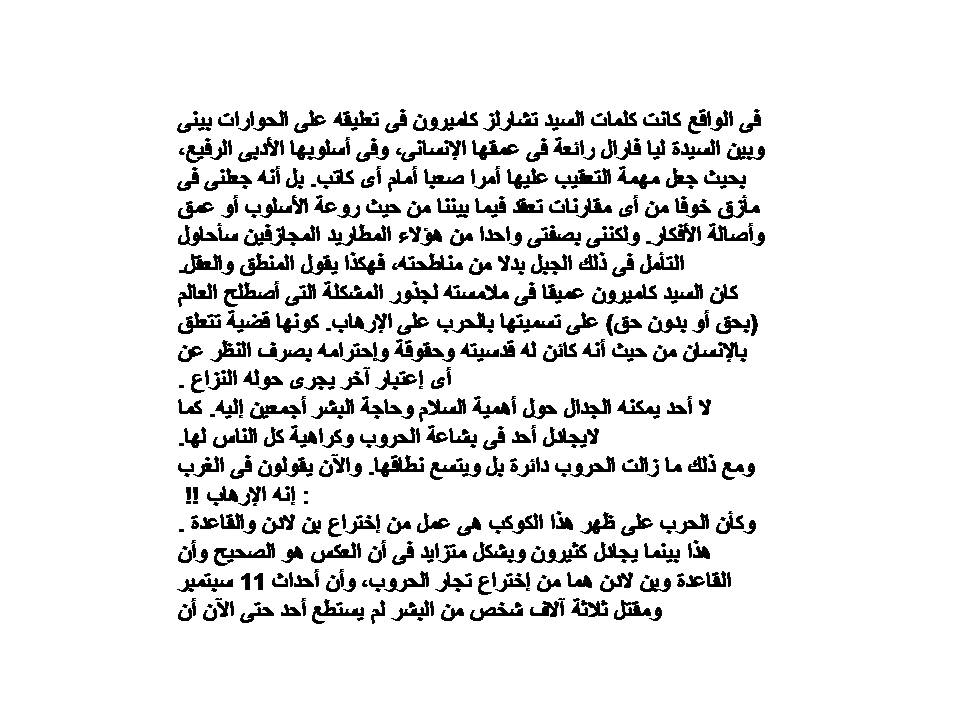
Google translation is fast and dirty but it is not the best source of translation, it garbles many words and phrases that require transliteration, which is how I read al-Masri’s response. With that caveat, my impression was that he did not know quite where to go with Charles’ essay, beyond acknowledging it and then retreating to some talking points. The remarkable aspect was that al-Masri felt the need to respond at all which has sent Charles thoughts bouncing around the radical Islamist online community.
Nice work, Charles!
Posted in 21st century, 4GW, academia, Afghanistan, al qaida, America, arab world, blogging, blogosphere, Charles Cameron, connectivity, cultural intelligence, extremists, feedback, foreign language, foreign policy, ideas, insurgency, intellectuals, intelligence, IO, islam.insurgency, islamic world, islamist, non-state actors, pakistan, politics, public diplomacy, Religion, social science, strategist, terrorism, Theology, war, web 2.0 | Comments Off on Charles Cameron and the Strategist of Jihad
Friday, May 28th, 2010
This looks highly informative. Hat tip to Wings Over Iraq.
I regret the light posting and lack of attention to the superb comments. I am buried at work and will be until early next week. Will be posting short items until then
Posted in 21st century, 3 gen gangs, 4GW, academia, Afghanistan, al qaida, America, COIN, counterinsurgency, cultural intelligence, defense, DIME, Failed State, foreign policy, government, ideas, illegal combatants, insurgency, intellectuals, intelligence, IO, islam.insurgency, islamic world, islamist, military, military history, military intelligence, military reform, national security, non-state actors, social networks, social science, state building, state failure, strategy, Strategy and War, theory, war, warriors | Comments Off on A Pretty Big COIN
Wednesday, May 19th, 2010
Posted in 2010, academia, authors, book, cognition, COIN, cold war, complex systems, complexity, counterinsurgency, counterintuitive, creativity, economics, education, empire, Evolution, historians, history, ideas, illegal combatants, insurgency, intellectuals, intelligence, islam.insurgency, islamic world, islamist, legitimacy, military, military history, public school, readers, reading, reform, scenario, social science, teaching, terrorism, theory, war | 10 Comments »
Monday, May 17th, 2010

Big Brother on the Make….or perhaps, the take….
Outside of specific and targeted investigational contexts for law enforcement and intelligence, the Federal government really does not need to know what products we buy at the grocery store, what books we buy or check out at the library, the magazines to which we subscribe, our car payments, what kind of food we eat, the websites we visit, how we use our credit cards and where. It’s not actually the government’s business, and presumably, the 4th Amendment indicates they need a compelling interest before they are allowed to snoop.
Senator Chris Dodd (D-Conn) is working hard….to make sure the Feds are watching your every move. Unless you are an illegal alien of course.
What passes for Liberalism these days is a strange ideology – American citizens are to be treated as criminals to be kept under continuous government surveillance but if you are a foreigner who enters the country illegally, you should get special dispensations from police questioning. Or unless you are a foreign terrorist overseas or in communication with one. WTF?
Posted in 21st century, America, conspiracy, democratic party, dystopia, freedom, government, IC, intelligence, Liberalism, liberty, Mexico, Oligarchy, politics, reform, Republic, rule-sets, senate, society, state failure, terrorism | 11 Comments »