zenpundit.com » history

Archive for the ‘history’ Category

Every day is Ashura, every place is Kerbala

Wednesday, May 29th, 2013

[ by Charles Cameron — an Ayatollah’s video take-down of the Grand Mufti ]
.

Today’s latest news from the Long War Journal is titled Egyptian jihadists call for attacks in Shiite countries and opens with the paragraph:

Twenty Egyptian jihadists have issued a statement calling upon Sunnis to launch attacks in Shiite-led countries in response to the Assad regime’s offensive in Qusayr, a city in western Syria near Homs. The chief signatory on the statement is Mohammed al Zawahiri, the younger brother of al Qaeda emir Ayman al Zawahiri.

**

**

I’ve been having some conversations on Twitter recently in which I’d been verifying my own sense that Hezbollah‘s ethos and imagery of martyrdom would presumably extend beyond the poppies and doves depicted here to include also the martyrdom of Husayn at Kerbala, and I’m grateful to Phillip Smyth for his confirmation and elaboration on that theme.

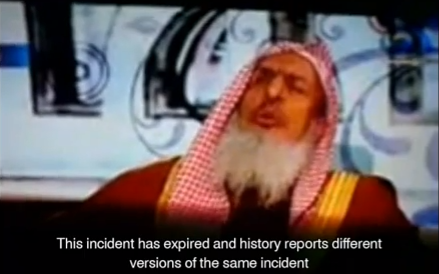
Somehow in my wanderings, I came across this video, in which Ayatollah Sayed Hadi al Modarresi, a senior Shia cleric, bookends his even more senior Sunni counterpart the Grand Mufti of Saudi Arabia, Sheikh Abdul Aziz al-Sheikh, with his own commentary, speaking from the very heart of Shia passion — the shrine of Imam Husayn in Kerbala.

The Ayatollah challenges the Grand Mufti’s assertion that Husayn erred in refusing his oath of obedience to Yazid, thus bringing his own death upon himself at the ensuing battle of Kerbala:

**

Things that impressed me:

The simple but rhetorically effective use of one video quoted within another.

The incredible passion of the crowd in Kerbala, which the poster called to our attention with a note saying:

Keep watching to see the fury of the audience..

The half-accusatory, half-conciliatory way in which the Grand Mufti expressed himself, with phrases that suggested Husayn — may God be pleased with him — was in error, while asking God to forgive him…

and:

and in response, the Ayatollah’s use of the imagery of the “red line”:

**

If the Long War Journal piece shows us an aspect of the current situation, this stunning video offers us a window into the passions such events are poised to arouse.

Is 4GW Dead?: Point-Counterpoint and Commentary

Tuesday, May 28th, 2013

4GW theory has always attracted overenthusiasts and  raging haters ever since the concept emerged way back in 1989, so debates about the merit of 4GW are nothing new; in fact, the arguments became so routine that they had largely gone sterile years ago.  After T.X. Hammes published his excellent  The Sling and the Stone and John Robb  went to the next level with Brave New War , it seemed that  little new was left to be said. In the late 2000’s, intellectual energies shifted to arguing the nuances and flaws of Pop-centric COINwhich proved in time to be even more bitter than those about 4GW.

Generations of War Theory Visualized by Chet Richards

What is different recently is that the person taking the affirmative on the question “Is 4GW dead?” was Dr. Chet Richards, who for years ran the premier but now defunct 4GW site, D-N-I.net, now archived here by the Project on Government Oversight.  Richards is no Clausewitzian true-believer or Big Army MBA with stars, but a former collaborator with John Boyd and a leading thinker of the 4GW school who had written several books with that strategic theme.

Therefore, not a critic to be dismissed lightly. Here’s Chet:

Is 4GW Dead? 

….The first thing to note is that 4GW is an evolution from 3GW, which they equate to maneuver warfare and the blitzkrieg as defined in MCDP 1 and Boyd’s Patterns of Conflict. These are styles of warfare conducted by state armies against other state armies, although the paper does invoke the notion of transnational terrorists near the end.

At some point in the late 1990s, the theory bifurcated. Bill Lind and Martin van Creveld began to emphasize the decline of the state and focus on transnational guerrilla organizations like al-Qa’ida. Tom Barnett called this the “road warrior” model. T. X. Hammes, on the other hand, characterized 4GW as “evolved insurgency” and envisioned the techniques described in the paragraphs above as also useful for state-vs-state conflicts.

….The 9/11 attacks, by a transnational guerrilla movement, seemed to confirm 4GW in both of its forms. In the last few years, however, everything has gone quiet. Transnational insurgencies, “global guerrillas” as John Robb terms them, have not become a significant factor in geopolitics. “Continuing irritation” might best describe them, whose primary function seems to be upholding national security budgets in frightened western democracies. The state system has not noticeably weakened. So it might be fair at this point to conclude that although 4GW was a legitimate theory, well supported by logic and data, the world simply didn’t develop along the lines it proposed.

A prominent critic of 4GW, Antulio J. Echevarria, may have been correct:

What we are really seeing in the war on terror, and the campaign in Iraq and elsewhere, is that the increased “dispersion and democratization of technology, information, and finance” brought about by globalization has given terrorist groups greater mobility and access worldwide. At this point, globalization seems to aid the nonstate actor more than the state, but states still play a central role in the support or defeat of terrorist groups or insurgencies.

Why? I’ll offer this hypothesis, that the primary reason warfare did not evolve a fourth generation is that it didn’t live long enough. The opening of Sir Rupert Smith’s 2005 treatise, The Utility of Force, states the case….

Chet’s post spurred a sharp rebuttal from William Lind, “the Father of Fourth Generation Warfare”:

4GW is Alive and Well 

So “the world simply didn’t develop along the lines it (4GW) proposed”? How do you say that in Syriac?

The basic error in Chet Richards’ piece of April 19, “Is 4GW dead?” is confusing the external and internal worlds. Internally, in the U.S. military and the larger defense and foreign policy establishment, 4GW is dead, as is maneuver warfare and increasingly any connection to the external world. The foreign policy types can only perceive a world of states, in which their job is to promote the Wilsonian nee Jacobin, follies of “democracy” and “universal human rights.” They are in fact, 4GW’s allies, in that their demand for “democracy” undermines states, opening the door for more 4GW.

In most of the world, democracy is not an option. The only real options are tyranny or anarchy, and when you work against tyranny, you are working for anarchy. The ghost of bin Laden sends his heartfelt thanks.

Third Generation doctrine has been abandoned, de facto, if not de jure, by the one service that embraced it, the U.S. Marine Corps. The others never gave it a glance. The U.S. military remains and will remain second generation until it disappears from sheer irrelevance coupled with high cost. That is coming much sooner than any of them think.

….In many of these cases, including Egypt and Pakistan, the only element strong enough to hold the state together is the army. But the “democracy” crowd in Washington immediately threatens aid cut-offs, sanctions, etc., if the army acts. Again, the children now running America’s foreign policy are 4GW’s best allies.

Fourth generation war includes far more than just Islamic “terrorism,” and we see it gaining strength in areas far from the Middle East. Gangs have grown so powerful in Mexico, right on our border, that I predict the state will soon have to make deals with them, as the PRI has done in the past. Invasion by immigrants who do not acculturate is a powerful form of 4GW, more powerful than any terrorism, and that is occurring on a north-south basis (except Australia) literally around the world. Remember, most of the barbarians did not invade the Roman Empire to destroy it. They just wanted to move in. In fact, most were invited in. Sound familiar?

What should concern us most is precisely the disconnect between the internal and external worlds. Externally, 4GW is flourishing, while internally, in the US government and military, it does not exist. This is the kind of chasm into which empires can disappear….

Fabius Maximus – who is a both a pseudonymous blogger and a group blog, also responded:

Update about one of the seldom-discussed trends shaping our world: 4GW 

One of the interesting aspects of recent history is the coincidence of

  1. the collapse of discussion about 4GW in US military and geopolitical circles,
  2. victories by insurgents using 4GW methods over foreign armies in Iraq and Afghanistan, &
  3. most important, the perhaps history-making victory by Bin Laden’s al Qaeda.

The second point is important to us, but the usual outcome since WW2 (after which 4GW became the dominate form of military conflict; see section C below).  The third point is the big one. Based on the available information, one of Bin Laden’s goals was to destabilize the US political regime. Massive increase in military spending (using borrowed funds). The bill of rights being shredded (note yesterday’s House vote to tear another strip from the 4th amendment). Our Courts holding show trials of terrorists — recruited, financed, supported by our security services. Torture and concentration camps.

….We — the Second American Republic — have engaged in a war with nationalistic, Islamic forces using 4GW.  So far we are losing.  For various reasons we are unable to even perceive the nature of the threat. In DoD the hot dot is again procurement of high-tech weapons — new ships, the F-35, the hypersonic cruise missile, etc.  All useless in the wars we’ve fought for the past 50 years, and probably in those of the next 50 years….. 

A few comments.

4GW has been heavily criticized – and accurately so – for making selective use of history, for unsupported maximal claims, for an excessively and ahistorically linear argument and for shifting or vaguely defined terms. Presented rigidly, it is relatively easy for critics to poke holes in it simply by playing “gotcha” (some of the criticism of 4GW did not get beyond ad hominem level garbage, but more intellectually serious detractors made very effective critiques of 4GW’s flaws).

That said, there were a number of useful elements or insights in the body of 4GW writings that retain their utility and I think are worth recalling:

  • Whatever one thinks of 4GW as a whole, the school drew attention to the threat of non-state irregular warfare, failed states and the decline of state vs. state warfare and did so long before it was Pentagon conventional wisdom or trendy Beltway talking head spiels on Sunday morning news programs.
  • While the state is not in decline everywhere in an absolute sense, it sure is failing in some places and has utterly collapsed elsewhere. Failed, failing and hollowed out states are nexus points for geopolitical problems and feature corruption, black globalization, insurgency, tribalism, terrorism, transnational criminal organizations and zones of humanitarian crisis. Whether we call these situations “irregular”, “hybrid”, “decentralized and polycentric”, “LIC”, “4GW” or everyone’s favorite, “complex” matters less than using force to achieve political aims becomes increasingly difficult as the interested parties and observers multiply. Some of the advice offered by the 4GW school regarding “the moral level of war”, de-escalation and the perils of fighting the weak in such a conflict environment are all to the good for reducing friction.
  • The emphasis of the 4GW school on the perspective of the irregular fighter and their motivations not always fitting neatly within state-centric realpolitik, Galula-ish “Maoist Model” insurgency, Clausewitzian best strategic practice or the Western intellectual tradition, were likewise ahead of their time and contrary to S.O.P. Even today, the effort to see the world through the eyes of our enemies is at best, anemic. Red teams are feared more than they are loved. Or utilized.
  • The bitter criticism the 4GW school lodged of the American political elite being allergic to strategic thinking and ignorant of strategy in general was apt; that American strategy since the end of the Cold War has been exceedingly inept in thought and execution is one of the few points on which the most rabid 4GW advocate and diehard Clausewitzian can find themselves in full agreement.

The lessons of 4GW will still be relevant wherever men fight in the rubble of broken societies, atomized communities and failed states.

New Book: America 3.0 is Now Launched!

Tuesday, May 21st, 2013

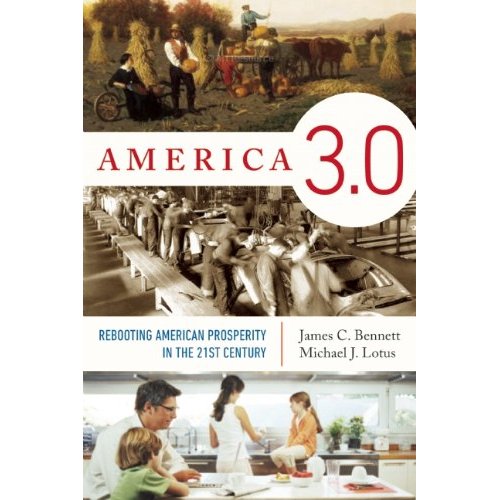
America 3.0: Rebooting American Prosperity in the 21st Century – why America’s Best Days are Yet to Come by James C. Bennett and Michael Lotus

I am confident that this deeply researched and thoughtfully argued book  is going to make a big political splash, especially in conservative circles – and has already garnered a strong endorsement from Michael Barone, Jonah Goldberg, John O’Sullivan and this review from  Glenn Reynolds in USA Today :

Future’s so bright we have to wear shades: Column 

….But serious as these problems are, they’re all short-term things. So while at the moment a lot of our political leaders may be wearing sunglasses so as not to be recognized, there’s a pretty good argument that, over the longer time, our future’s so bright that we have to wear shades.

That’s the thesis of a new book, America 3.0: Rebooting American Prosperity In The 21st Century.The book’s authors, James Bennett and Michael Lotus, argue that things seem rough because we’re in a period of transition, like those after the Civil War and during the New Deal era. Such transitions are necessarily bumpy, but once they’re navigated the country comes back stronger than ever.

America 1.0, in their analysis, was the America of small farmers, Yankee ingenuity, and almost nonexistent national government that prevailed for the first hundred years or so of our nation’s existence. The hallmarks were self-reliance, localism, and free markets.

At the end of the 19th century and the beginning of the 20th, people were getting unhappy. The country was in its fastest-ever period of economic growth, but the wealth was unevenly distributed and the economy was volatile. This led to calls for what became America 2.0: an America based on centralization, technocratic/bureaucratic oversight, and economies of scale. This took off in the Depression and hit its peak in the 1950s and 1960s, when people saw Big Government and Big Corporations as promising safety and stability. You didn’t have to be afraid: There were Top Men on the job, and there were Big Institutions like the FHA, General Motors, and Social Security to serve as shock absorbers against the vicissitudes of fate.

It worked for a while. But in time, the Top Men looked more like those bureaucrats at the end of Raiders Of The Lost Ark, and the Big Institutions . . . well, they’re mostly bankrupt, or close to it. “Bigger is better” doesn’t seem so true anymore.

To me, the leitmotif for the current decade is supplied by Stein’s Law, coined by economist Herb Stein: “Something that can’t go on forever, won’t.” There are a lot of things that can’t go on forever, and, soon enough, they won’t. Chief among them are too-big-to-fail businesses and too-big-to-succeed government.

But as Bennett and Lotus note, the problems of America 2.0 are all soluble, and, in what they call America 3.0, they will be solved. The solutions will be as different from America 2.0 as America 2.0 was from America 1.0. We’ll see a focus on smaller government, nimbler organization, and living within our means — because, frankly, we’ll have no choice. Something that can’t go on forever, won’t. If America 2.0 was a fit for the world of giant steel mills and monolithic corporations, America 3.0 will be fit for the world of consumer choice and Internet speed.

Every so often, a “political” book comes around that has the potential to be a “game changer” in public debate. Bennett and Lotus have not limited themselves to describing or diagnosing America’s ills – instead, they present solutions in a historical framework that stresses the continuity and adaptive resilience of the American idea. If America”s “City on a Hill” today looks too much like post-industrial Detroit they point to the coming renewal; if the Hand of the State is heavy and it’s Eye lately is dangerously creepy, they point to a reinvigorated private sector and robust civil society; if the future for the young looks bleak,  Bennett and Lotus explain why this generation and the next will conquer the world.

Bennett and Lotus bring to the table something Americans have not heard nearly enough from the Right – a positive vision of an American future that works for everyone and a strategy to make it happen.

But don’t take my word for it.

The authors will be guests Tuesday evening on Lou Dobb’s Tonight and you can hear them firsthand and find out why they believe “America’s best days are yet to come

Elkus on Mad Dogs and Military History

Friday, May 10th, 2013

Adam Elkus has a lengthy and meaty post at Abu Muqawama, inspired by General Mattis, one that you should really read in full:

The Mattis Book Club

….But while gaining an understanding of the nature of war is useful, there are a lot of things it won’t do. This becomes most apparent in the section of the email where Mattis makes specific claims. Mattis repeatedly states that nothing is new under the sun, makes comparisons across big temporal zones (Alexander the Great in Persian Iraq vs. 2004 iraq), and advances specific analytical arguments about military theories. He does so on the basis of a sweeping generalization that 5,000 years of warfare tells us in aggregate that war has not changed. While this makes for a rousing line, it is also a fairly problematic statement. How do we really know that the nature of war has not changed in 5,000 years?

We should recognize that this is an isolated quote, and strive to not take out of context what was a heartfelt letter to a colleague in need of guidance. But the argument itself—as the cumulative product of a process of self-education in the nature of warfare, does merit some critical analysis. It is part of a humanistic conception of war that stresses the unity of military experience across the ages, and puts the fighting man’s will first. What Mattis dashed off in an email has been repeated by others in journal articles, blog posts, essays, and books. The military historian Brian McAllister Linn, in his seminal study of the Army’s cultures, dubbed it the “heroic” style of war. Linn constrasts this humanistic style this with technocratic Managers, defensive Guardians, and other military tribes with differing values and approaches.

So what do we know about 5,000 years of constant violence?

Often times the answer is that it depends. As my Fuller and Liddell-Hart examples illustrate, the quality of historical accounts is extremely uneven. Military history as a modern discipline only started with Hans Delbruck, a civilian who did some basic math and discovered that many of the most prominent chroniclers of pre-modern warfare were flat-out wrong about ancient history’s greatest battles and campaigns. Anthropologists still argue today about the nature of violence in the evolutionary state of nature and whether it can be mapped to violence in settled states. Second, it may be true that war is war in the Clausewitzian sense. But while it is technically true that Alexander’s Iraqi opponents and Sadrist mobs are both humans seeking to use force to impose their will, this in and of itself is not very useful. There are fairly prominent shifts in the character of politics, the international system, techology, wealth, and society that matter too.  

What constitutes politics is a very important point.

Take for example, the Romans. There was a definite shift between the Early-Middle Republican eras and the Late Republic in elite politics and the socioeconomic conditions upon which Roman assumptions about war and the organization and supply of Legions rested.  Growing inequality of wealth was making it harder for Plebian citizens to afford to muster for a campaign, the need for longserving “professional” Legates to maintain “institutional memory” of the “arts of war” of the Legions expanded even as the highly coveted opportunities for Patricians to command decreased. These trends clashed with what the Romans liked to  believe about themselves and the friction between advocates of reforms (often necessary and practical) and the upholders of  centuries of honored tradition made Roman politics increasingly bitter, dysfunctional and subsequently lethal. The early Romans would have been horrified by Marius and Sulla, to say nothing of Antony and Octavian.

In the end, the politics of the Romans, along with their battlefield experiences, changed how they organized and manned their Legions, why and how they fought the wars as they did and continued to shape Roman warfare as long as the empire lasted. Julius Caesar would have been as startled by Late Antiquity’s semi-barbarian “Roman” Magister Militiums as his own career would have dismayed Decius Mus.

Adam goes on to have some useful things to say about the need for combining historical and quantitative  social science  methodologies and the limitations of each. Delbruck’s overstated skepticism of the ancients aside, sometimes we moderns do not count any better in war or politics – or at times,  even worse

History doesn’t rhyme — it swears

Friday, May 10th, 2013

[ by Charles Cameron — finding both rhyme and obscenity here, to be honest — San Salvador then, Mexico today ]
.

**

I once had the privilege of hearing Carolyn Forché read her poems.

You can read and hear her reading the prose poem from which that excerpt is taken here — for richer background on her experiences in El Salvador, see her extraordinary essay El Salvador: An Aide-Mémoire in Granta, or find a copy of The American Poetry Review for July/August 1981, pp. 3-7.

Sources:

  • Carolyn Forché, The Country Between Us
  • Sunil S, El Narco and the Jihad in Pragati, illus credit: El cartel de San Luis
  • **

    I know, in the title of this post I’m conflating a quote attributed to Mark Twain, “History doesn’t repeat itself, but it rhymes”, with Bob Dylan‘s “Money doesn’t talk, it swears”. So be it.

    As Dylan also once said: “I said that.”


    Switch to our mobile site