zenpundit.com » social science

Archive for the ‘social science’ Category

Following up on the Strategy Links with….More Strategy! And a Few Comments

Friday, July 2nd, 2010

Wiggins  at Opposed Systems Design responds to Kenneth Payne at CI/ KoW:

On Strategists

….Strategy – thinking about how to achieve goals with one’s given resources (in the face of an opponent), which generally requires one to find asymmetric advantages to exploit because one’s resources are finite – is a distinct activity from managing military operations or storming a building. National security strategy requires a familiarity with the nature of military operations and power, but it is not a simple extrapolation from these activities. It is a distinct skill (perhaps, as Watts argues, at least partially an innate skill that can be developed but not completely taught) and the way the U.S. military is currently structured, civilians may be better positioned to cultivate strategic expertise. To go back to Biddle’s example. He compared his career trajectory to that of a military officer. If he’d been a career officer, Biddle was about the age of an O-6, meaning that he’d have – at best – spent a few years in graduate school and perhaps a tour teaching at a service academy. Let’s say roughly six years where one’s primary task was to think, write and read about the elements of strategy. Much of his time would have been spent in managing increasingly large groupings of military force. Biddle, on the other hand, had spent the entirety of his career studying these dynamics.

I find myself largely in agreement with the salient points of my Wohlstetterian amigo, Wiggins. Or, as Herman Kahn once said ” How many nuclear wars have YOU fought, general?”

I am not knocking military expertise with that quote. Civilian appointees, politicians, newspaper editors, political activists or bloggers who have never heard a shot fired in anger have no business telling active duty military personnel which tactical response they should make in the heat of battle or much of the day to day, nuts and bolts, operational business of planning or running a military campaign. That’s why we have military professionals, unlike civilians, they know what the hell they are doing.

Strategy, in the sense of national objectives is quite another matter.

Military expertise, like all forms of expertise, is by definition, narrowly focused. Military people, from the most part, look at strategy from the perspective of how well a proposed strategy fits with the military’s capabilities and operational/doctrinal/cultural preferences and as they move further away from things military into other aspects of the DIME spectrum, their knowledge becomes less certain, their awareness of geopolitical opportunities and costs more vague or prone to error. I find this to be the case especially with economic implications, which are a crucial component of national power.  Strategy is not supposed to be about what the institutional military likes or understands best, but it is difficult for such a systemic bias not to creep in if a nation leaves its formulation of strategy exclusively to dudes in uniform with stars on their shoulders. Nor is that how a democratic system is supposed to work when existential questions are being entertained.

Strategy, unlike expertise, is broad . It applies to more forms of conflict and competition than war alone and requires an ability to connect a panoramic vision with the drill-down focus of application. More than likely, on average, the best strategists will have some expertise in more than just one narrow field and will know a fair amount about many things and have spent a long time thinking matters through from all angles prior to acting. As a consequence, they will be able to shift cognitive perspectives more easily, a fundamental characteristic of strategic thinking.

The costs of a poorly conceived strategy are likewise broad. If tactics are bad, the soldiers on the batlefield will pay the price; if the strategy is bad, we all may pay the price.

H-Diplo’s Roundtable: On “Politics and Scholarship”

Friday, June 11th, 2010

H-Diplo, the H-Net listserv for Diplomatic History, has an outstanding set of essays by prominent historians and political scientists on the subject of “Politics and Scholarship” (hat tip to Bruce Kesler and the Warlord Loop):

NOTE TO READERS: I am having some difficulty fixing the links, notably to Jervis and Cumings, due to site problems at H-Diplo so I am going with Phil’s suggestion in the comments and posting a link to the PDF VERSION here.

Commissioned for H-Diplo/ISSF by Robert Jervis, Columbia University

….This is a slippery slope, and as academics we should worry about it.  Perhaps the most important thing we can do is to remind ourselves that our policy judgment is likely to be considerably more fallible than our scholarly expertise. Most intelligent people know this, which is why mass letters to the editor by professors protesting or advocating some policy carry so little weight.  By and large, the policy world does not think of professors as being any wiser than any other class, and they are correct to do so.  The ancient distinction between theoretical and prudential wisdom holds as strongly as ever. Humility is not, alas, a common academic virtue, and someone involved in the hurly burly of political discourse should try to make a clear distinction, at least in his or her own mind, about what he knows as a professor, and what he thinks as a citizen or policymaker.  The most troubling area of pseudo-scholarship is likely to be that kind which nominally deals with policy in a scholarly way, but is, in fact, nothing more than a polemic masquerading as something else.

….We are told by many people – for example by Nobel scientist E. O. Wilson in his best-selling book Consilience – that the hard sciences and the social sciences are coalescing in the use of mathematical modeling, computers, game theory, and various other methods to finally get to the bottom of what makes human beings tick. I would argue the exact opposite: both the hard and soft sciences are in crisis. From my point of view the social sciences should have seen this crisis coming long ago (in fact many did – long ago, but they did not redefine the disciplines), but much more significant is the turn toward uncertainty in the hard sciences, as Newtonian mechanics, empiricism, and the scientific method show themselves incapable of comprehending the complexities of the physical world.

Q: Does being in the minority ever annoy you?A: Yes, some aspects of this minority status are annoying.  For instance, it is annoying that my peers presume that I “have an ideology” whereas they do not.  It is very reminiscent of African-Americans in the academy several decades ago; they were presumed to have “race” and “racially tinged views” whereas Caucasians did not.  For that matter, the racial analogy suggests another curious burden: being assigned the role of token on panels.  Some of my peers believe that a balanced panel on foreign policy is one that has a critique of Democrats from the left along with two shades of Democratic perspective, say center-left and center.  However, most recognize that it would be better if they could find just one person, me, to offer the “whacky conservative view” – here they hope I will represent not just my own actual views but also cover, or be held responsible for, everything to the right.  And this leads to my biggest gripe: feeling obligated to defend, or at least explain, the position of anyone to the right of Joe Biden, because if I don’t then no one will.  Because liberals do not have a monopoly on nonsense, there is plenty of bone-headedness from conservatives and Republicans for my colleagues to highlight and go after.  Often the attacks are legitimate and fair, but when they cross over into caricature and canard I am left with a tough choice: do I inject a clarification or do I let it pass?

….Instead of this kind of variation, however, what we typically see is stability both across time and across issues that are at most loosely connected.   For example, during the Cold War, hawks and doves rarely changed their assessment of Soviet motives, which had decisive impacts on their policy prescriptions, with hawks favoring many variations of competitive military and political policies and doves favoring none.  Proponents and opponents of ballistic missile defense have rarely changed their assessments of the feasibility of effective defense: proponents have consistently found significantly greater prospects for technically feasible defenses, which they believe would provide substantial strategic advantages; in contrast, opponents have as regularly found that the prospects for  effective defenses have been poor, and worried that these missile defenses would generate strategic dangers whether or not they were effective.  And Cold War hawks were more likely than doves to believe the effective missile defense were feasible, even though their hawkishness stemmed primarily from assessments of Soviet motives, not technology.  Scholars’ overall assessments of the danger posed by nuclear proliferation appear to be stubbornly constant in the face of evolving circumstances and possibilities, reinforcing their established preferences for adopting more or less costly policies in response. 

….The scholarly critics’ stance is predicated on a crucial, often unacknowledged, assumption (shared by my American students and their parents): that they themselves are non-ideological, personally and in their analysis of events, though they may hold personal ideological beliefs.   This is even true of many self-identified orthodox Marxists, liberals, socialists, political religionists, realists, and other believers with universalist truth claims or political goals: they personally are not ideologists because what they believe is true, not some metaphysical scheme that only the foolish or the dangerous could believe. 

It is my contention that this assumption of non-ideological pragmatism, or presumed normative detachment, in the critics’ point of view is not sustainable upon examination.  Scholars have found that even in the natural sciences certain beliefs can be held or supported largely because they are congruent with ideological norms, e.g., in liberal societies the assumed symmetrical, random distribution of human intelligence.

Presumably Niebuhr would have seen what so many fail to see still today, that by becoming a “science,” DPT-in conjunction with democratic transition theory and liberal international jurisprudence-blinded American policy makers to many dangers they might otherwise have perceived.  In this respect we might recall how the “Washington Consensus,” the package of ideas behind economic globalization that included deregulation, privatization, and openness, contributed to the blindness that allowed the economic crash of 2008 to occur. In each case, the wounds have been self-inflicted; American hubris has been our own worst enemy. How united the American economics profession seemed at the time and indeed for the most part still today, just as political science seems unwilling to recognize the damage its theorizing underwrote. Democratic Peace Theory, like the Washington Consensus, reminds us of the famous words of John Maynard Keynes:The ideas of economists and political philosophers, both when they are right and when they are wrong, are more powerful than is commonly understood.  Indeed the world is ruled by little else.  Practical men, who believe themselves to be quite exempt from any intellectual influence, are usually the slaves of some defunct economist.

Charles Cameron and the Strategist of Jihad

Friday, June 4th, 2010

My friend and guest-blogger Charles Cameron, a while back, posted a learned essay here at ZP and at Leah Farrall’s  All Things Counterterrorism, in response to the unusual dialogue that Farrall, a former Australian counterterrorism official, was having with  Abu Walid al-Masri, an Egyptian strategist of jihad, a sometime critic of al Qaida and an adviser to the Taliban. In other words, al-Masri is an influential voice on “the other side” of what COIN theorists like Mackinlay and Kilcullen call the “globalized insurgency”.

After some delay, al-Masri has responded to Charles, as Farrall describes:

Abu Walid al Masri responds to Charles Cameron

Abu Walid  has responded a letter from Charles Cameron. Abu Walid’s response  to Charles can be found here.  You’ll notice when following the link, that he has a new website.

It’s well worth a look. There is also an interesting comment from a reader below Abu Walid’s response to Charles; it’s from “one of the victims of Guantanamo”.

As you’ll see from his website Abu Walid is also engaging in a number of other interesting dialogues at the moment, which I am interested to read as they progress.

Charles wrote his letter in response to the dialogue Abu Walid and I had a little while back. For those of you new to the site, you can find this dialogue to the right in the page links section.  The letter from Charles can be found on my blog here.

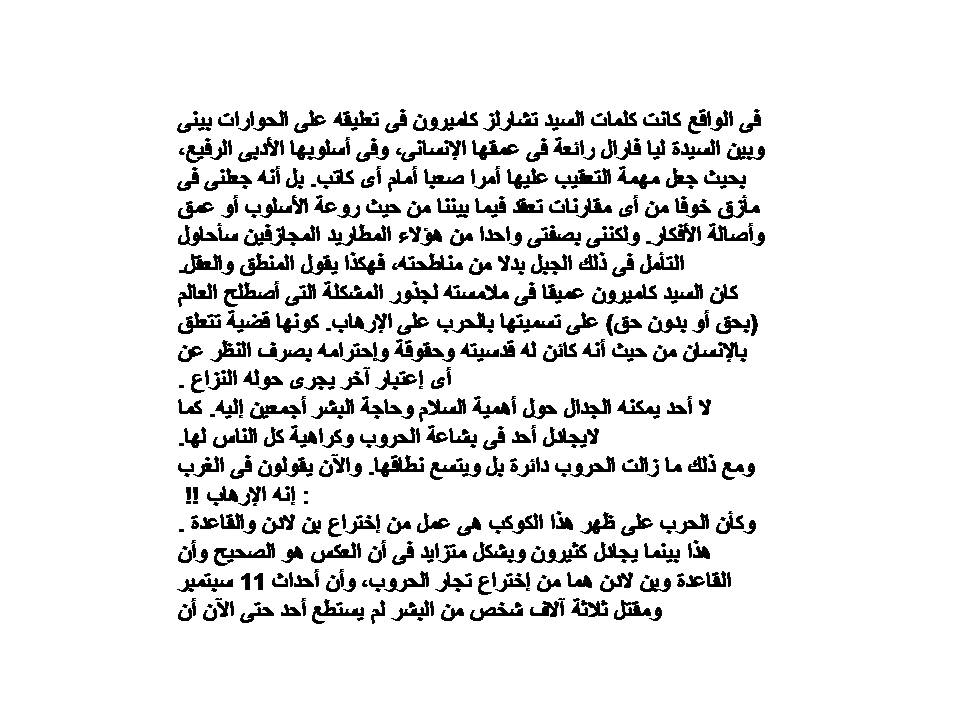
….These letters may not change anything, but they are important because  in mass media sometimes only the most controversial and polarising views tend to make it into the news.

I think person to person contact, especially via mediums like this, can go some way to providing opportunities for all of us to discover or be reminded that there is more than one viewpoint and along with differences there are also similarities. Contact like this humanizes people, and in my book that’s never a bad thing.

Farrall is working up a translation of al-Masri’s post  from Arabic ( I used Google which gives a very rough translation). Readers who are fluent are encouraged to read it in full and offer their thoughts. Here is a snippet:

al-masri.jpg

Google translation is fast and dirty but it is not the best source of translation, it garbles many words and phrases that require transliteration, which is how I read al-Masri’s response. With that caveat, my impression was that he did not know quite where to go with Charles’ essay, beyond acknowledging it and then retreating to some talking points. The remarkable aspect was that al-Masri felt the need to respond at all which has sent Charles thoughts bouncing around the radical Islamist online community.

Nice work, Charles!

Evolution of Information

Monday, May 31st, 2010

This is good. Perfect for non-geeks who nevertheless need to know the ripple effects of coming down the pike:

The History of Information, by David Siegel from dsiegel on Vimeo.

Hat tip to Dave Davison.

Religions of the Chaos Lords

Saturday, May 29th, 2010

 Pamela L. Bunker and Dr. Robert J. Bunker at SWJ Blog

The Spiritual Significance of ¿Plata O Plomo?

Conventional wisdom holds that narco gang and drug cartel violence in Mexico is primarily secular in nature. This viewpoint has been recently challenged by the activities of the La Familia cartel and some Los Zetas, Gulfo, and other cartel adherents of the cult of Santa Muerte (Saint Death) by means of religious tenets of ‘divine justice’ and instances of tortured victims and ritual human sacrifice offered up to a dark deity, respectively. Severed heads thrown onto a disco floor in Michoacan in 2005 and burnt skull imprints in a clearing in a ranch in the Yucatán Peninsula in 2008 only serve to highlight the number of such incidents which have now taken place. Whereas the infamous ‘black cauldron’ incident in Matamoros in 1989, where American college student Mark Kilroy’s brain was found in a ritual nganga belonging to a local narco gang, was the rare exception, such spiritual-like activities have now become far more frequent.

These activities only serve to further elaborate concerns amongst scholars, including Sullivan, Elkus, Brands, Manwaring, and the authors, over societal warfare breaking out across the Americas. This warfare- manifesting itself in ‘criminal insurgencies’ derived from groups of gang, cartel, and mercenary networks- promotes new forms of state organization drawn from criminally based social and political norms and behaviors. These include a value system derived from illicit narcotics use, killing for sport and pleasure, human trafficking and slavery, dysfunctional perspectives on women and family life, and a habitual orientation to violence and total disregard for modern civil society and democratic freedoms. This harkens back to Peter’s thoughts concerning the emergence of a ‘new warrior class’ and, before that, van Creveld’s ‘non-trinitarian warfare’ projections.

Cultural evolution in action, accelerated by extreme violence.


Switch to our mobile site

