zenpundit.com » 2013

Archive for 2013

Concerning the enforcement of morals

Wednesday, January 30th, 2013

[ by Charles Cameron — enforcement of moral codes in the UK, US, Israel and KSA, unofficial and official, worsening, continuing and improving, quite the smörgåsbord ]
.


.

Moral vigilantism appears to be on the rise in parts of London, according to this first-person piece by Jane Kelly, consulting editor of the Salisbury Review, which identifies itself as “seriously right” — ‘I feel like a stranger where I live’ [Telegraph, 29 January 2013]:

“When you go swimming, it’s much healthier to keep your whole body completely covered, you know.” The Muslim lady behind the counter in my local pharmacy has recently started giving me advice like this. It’s kindly meant and I’m always glad to hear her views because she is one of the few people in west London where I live who talks to me.

[ … ]

More worryingly, I feel that public spaces are becoming contested. One food store has recently installed a sign banning alcohol on the premises. Fair enough. But it also says: “No alcohol allowed on the streets near this shop.” I am no fan of street drinking, and rowdy behaviour and loutish individuals are an aspect of modern British ”culture’’ I hate. But I feel uneasy that this shopkeeper wants to control the streets outside his shop. I asked him what he meant by his notice but he just smiled at me wistfully.

Perhaps he and his fellow Muslims want to turn the area into another Tower Hamlets, the east London borough where ”suggestive’’ advertising is banned and last year a woman was refused a job in a pharmacy because she wasn’t veiled.

On the other hand, maybe I should be grateful. At least in Acton there is just a sign in a shop. Since the start of the year there have been several reports from around London of a more aggressive approach. Television news footage last week showed incidents filmed on a mobile phone on a Saturday night, in the borough of Waltham Forest, of men shouting “This is a Muslim area” at white Britons.

The video commentary stated: “From women walking the street dressed like complete naked animals with no self-respect, to drunk people carrying alcohol, we try our best to capture and forbid it all.”

**

It also appears to be present in parts of Brooklyn, according to Modesty in Ultra-Orthodox Brooklyn Is Enforced by Secret Squads, [New York Times, January 29, 2013]:

In the close-knit world of ultra-Orthodox Judaism, community members know the modesty rules as well as Wall Street bankers who show up for work in a Brooks Brothers suit. Women wear long skirts and long-sleeved, high-necked blouses on the street; men do not wear Bermuda shorts in summer. Schools prescribe the color and thickness of girls’ stockings.

The rules are spoken and unspoken, enforced by social pressure but also, in ways that some find increasingly disturbing, by the modesty committees. Their power is evident in the fact that of the half dozen women’s clothing stores along Lee Avenue, only one features mannequins, and those are relatively shapeless, fully clothed torsos.

The groups have long been a part of daily life in the ultra-Orthodox communities that dot Brooklyn and other corners of the Jewish world. But they sprang into public view with the trial of Nechemya Weberman, a prominent member of the Satmar Hasidim in Brooklyn, who last week was sentenced to 103 years in prison after being convicted of sexually abusing a young girl sent to him for counseling.

[… ]

The details were startling: a witness for Mr. Weberman’s defense, Baila Gluck, testified that masked men representing a modesty committee in the Hasidic village of Kiryas Joel, N.Y ., 50 miles northwest of New Y ork City, broke into her bedroom about seven years ago and confiscated her cellphone.

The Brooklyn district attorney, Charles J. Hynes, who prosecuted the Weberman case, has now received allegations that members of a modesty committee forced their way into a home in the borough, confiscating an iPad and computer equipment deemed inappropriate for Orthodox children, officials say.

[ … ]

“They operate like the Mafia,” said Rabbi Allan Nadler, director of the Jewish studies program at Drew University in Madison, N.J.

**

And in Israel — from the same report, although perhaps more widely known? I’ve certainly seen mentions…

In Israel, there have been similar concerns. Though no modesty committee was overtly involved, there has been anger over ultra-Orthodox zealots who spit on and insulted an 8-year-old girl for walking to school through their neighborhood in a dress they considered immodest.

**

Meanwhile, the Saudis seem to be decreasing the scope of their official equivalent, according to Saudi limits powers of the notorious religious police [Al Arabiya, 30 January 2013]:

Saudi Arabia has set new limitations on the powers of its notorious religious police, charged with ensuring compliance with Islamic morality but often accused of abuses, its chief said on Tuesday.

The Commission for the Promotion of Virtue and Prevention of Vice “once had much expanded powers, but with the new system… some of these powers, such as interrogating suspects and pressing charges,” will be restricted to the police and public prosecution, Shaikh Abdul Latif Abdel Aziz Al Shaikh told AFP.

The religious police may still arrest those carrying out “flagrant offences such as harassing women, consuming alcohol and drugs, blackmail and the practice of witchcraft,” Shaikh said of the new law approved by the cabinet.

and:

Relatively moderate Al Shaikh, appointed last year, has raised hopes that a more lenient force will ease draconian social constraints in deeply conservative Islamic country.

Two weeks into his post, Al Shaikh banned volunteers from serving in the commission, which enforces the kingdom’s strict Islamic rules.

H/t John Burgess at Crossroads Arabia.

**

All these articles are worth reading in full, and you’ll be enriched by reading them together, comparatively — food for thought!
US Foreign Policy, Egypt and the Muslim Brotherhood

Wednesday, January 30th, 2013

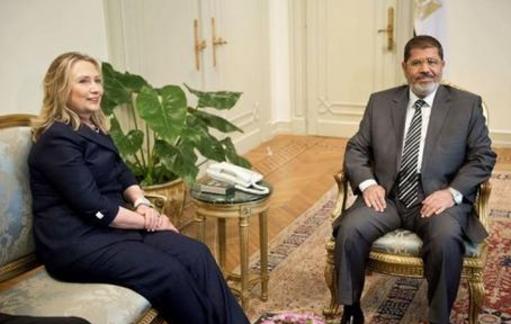
The Obama administration, though they would not characterize it as such nor have much desire to acknowledge it at all, have attempted  a strategic detente with the “moderate” elements of political Islam.

This policy has not been entirely consistent; Syria, for example, is a quagmire the administration has wisely refrained from wading directly into despite the best efforts of R2P advocates to drag us there.  But more importantly, under President Obama the US supported the broad-based Arab Spring popular revolt against US ally, dictator Hosni Mubarak, and pushed the subsequent ascendancy of the Muslim Brotherhood in Egypt and the Libyan revolution against the entirely mad Colonel Gaddafi. These appear to be geopolitical “moves” upon which the Obama administration hopes to build.

I would like to emphasize that there is one legitimate and valid strategic pro to this sub rosa policy; namely, if everything went well, it would provide the United States with powerful triangulation against revolutionary, apocalyptic, radical Islamism as expressed by al Qaida and various Salafi extremist movements. There are reasons, rooted in takfirism, strategy and the politics of lunacy that our terrorist enemies frequently hate and revile the Brotherhood as traitors, apostates or whatever. Isolating the most actively dangerous and violent revolutionary enemies from a large mass of potential allies is, at least, a good strategic goal.

It is also my view, that this “outreach” is as politically sensitive  to the Obama administration as was the China Opening was to Nixon and about which they have been equally opaque and misleading for fear of a domestic backlash. The weird, foot-dragging, dissembling, embittered, kabuki drama inside the Beltway about public statements and intelligence on whether Benghazi was caused by obscure crackpot Islamophobic film makers or a well-orchestrated terrorist attack  is in my view due to a major foreign policy strategy never having been framed in public for what it is. I’m sure people will differ strongly with me on this (which is fine), but I would characterize detente with Islamists as a strategic shift on par with the “Pivot to Asia”.

The downside here is that first, things are not likely to come out well at all, as unfinished revolutions tend to give birth to monsters; and secondly, any detente with “moderate” political Islam is an uncertain gamble based on certain exceptionally optimistic conceptions of not only what the Brotherhood might do, but about it’s very nature.

While the removal of Arab dictators resonated with American values , it was questionable realpolitik while the administration’s de facto support of  Egypt’s Muslim Brotherhood faction over poorly organized secular liberal modernists was an act of realpolitik that required a compromise of the democratic values so recently invoked to justify abandoning Mubarak. This was cynical diplomatic flexibility worthy of Talleyrand.

Unfortunately, the most democratic thing – perhaps the only thing – about Mr. Morsi and his Brotherhood supporters was his election.

The Egyptian people who are subjected now to thuggery from both Morsi’s Islamist stormtroopers and from the security forces of the Egyptian military are less sanguine than are the Brotherhood’s cheerleaders inside the administration. The Egyptian people, in fact, seem to be in revolt against domination by the Muslim Brotherhood’s shadow government.

The first question to ask in assessing if the Obama administration policy here is wise would be “What is the nature of the Muslim Brotherhood?” Americans love to personalize foreign policy, but if  Morsi were to be toppled or die, the Brotherhood will remain what it currently is, the best organized political force in Egypt and one widely influential throughout the Arab world and the West itself.

I am not an expert on the Muslim Brotherhood, nor am I an Arabist by education. Most of us aren’t – a group that I fear includes most of the Obama administration officials involved in shaping this policy. Almost fifty years after King Faisal determined to export Wahhabism, more than thirty years since Khomeini’s Revolution and more than ten years since 9/11 the USG still has less in-house expertise related to Islam than it did about the Soviet Union and Communism a decade after the Berlin Blockade.

Perhaps we all should begin learning more?

Here is an analysis from FPRI; it is extremely critical but it touches on organizational aspects of the Muslim Brotherhood that I have not seen elsewhere (hat tip to David Ronfeldt). Feel free to suggest others, both for and against. The Brotherhood is a very large group with a long history that includes violence , terrorism and subversion on one hand and peacefully representing expressions of pious, middle-class, social conservatism in other places and times:

Lecture Transcript: What Every American Should Know about Egypt’s Muslim Brotherhood, Delivered by Eric Trager 

….Two years ago when I was doing my dissertation fieldwork in Cairo, I sought out interviews with leaders from the Muslim Brotherhood, and I was referred to a man named Muhammad Morsi, now the President of Egypt. At the time, President Mubarak was ill and had gone off to Europe for operations amid a lot of mystery surrounding his health. I asked Muhammad Morsi whether the Muslim Brotherhood would run a presidential candidate if Mubarak died tomorrow. Here is what he said:

[From an audio file played by Trager]

Eric Trager: You don’t see the Muslim Brotherhood nominating a presidential candidate [if Mubarak dies tomorrow]?

Muhammad Morsi: No… because society is not ready… Our society is not ready yet to really defend its worth. We want a society to carry on its responsibilities, and we are part of this society. Another thing, if we are rushing things, then I don’t think that leads to a real stable position.

When he made that statement, I don’t think he was lying, and I don’t think he was being coy. I think that he didn’t expect that he would be faced with this reality in a mere six months. He did not expect that Mubarak would step down six months later and, to be completely honest with you, neither did I. My dissertation was entitled “Egypt: Durable Authoritarianism”—until the revolution.

What did Morsi mean when he said that the Brotherhood was trying to build a society? Let me give you some background on the Muslim Brotherhood. It was founded in 1928 by Hassan al-Banna, who was a schoolteacher in Ismailia. The Muslim Brotherhood’s goal was then—and remains now—to establish an Islamic state in Egypt. The way it pursues this goal is by trying to Islamize Egyptian society. Through social services, education, and the mosque, it sought to make Egyptians more religious and more Islamic as a grassroots strategy for building an Islamic state. That’s very, very different from a strategy that says, “We’re going to run for president, run for the Parliament, and use that power to transform society.” Rather, the Brotherhood says, in effect, “We’re going to Islamize society to build towards power.” It was a long-term strategy; it took them 84 years before they ran for and won the presidency. So Morsi told me in 2010 that the Muslim Brotherhood was not going to run for the presidency because it was not done Islamizing Egyptian society….

Read the rest here.

Recommended Reading

Monday, January 28th, 2013

Top Billing! Zero Hedge  –Taleb On “Skin In The Game” And His Disdain For Public Intellectuals 

Nassim Taleb sits down for a quite extensive interview based around his new book Anti-Fragile. Whether the Black Swan best-seller is philosopher or trader is up to you but the discussion is worth the time as Taleb wonders rigorously from the basic tenets of capitalism – “being more about disincentives that incentives” as failure (he believes) is critical to its success (and is clearly not allowed in our current environment) – to his intellectual influences (and total disdain for the likes of Krugman, Stiglitz, and Friedman – who all espouse grandiose and verbose work with no accountability whatsoever). His fears of large centralized states (such as the US is becoming and Europe is become) being prone to fail along with his libertarianism make for good viewing. However, his fundamental premise that TBTF banks should be nationalized and the critical importance of ‘skin in the game’ for a functioning financial system are all so crucial for the current ‘do no harm’ regime in which we live. Grab a beer (or glass of wine, it is Taleb) and watch…

Via Redmond Weissenberger of the Ludwig von Mises Institute Of Canada,

SWJ Blog Announcing Peter J. Munson’s “War, Welfare & Democracy” and Exemplar, Not Crusader 

….My book is in large part intended to be a corrective to the driving imperative of our foreign policy.

No matter what portion of the ideological spectrum Americans come at world problems from, their views are shaped in a way by the idea of the “end of history.” We think that political development has a single endpoint, that being liberal democracy.

pmcover

I’m not arguing that there’s a better endpoint.

Instead, I’m arguing that America cannot get the world to that endpoint in the near term. America needs to be more humble in its foreign policies, more realistic than its current expectation of instant modernization without any instability, and more cognizant of the significant challenges it faces in getting its own house in order.

In a phrase, I argue that America should focus more on being an exemplar than a crusader.

First, the world is undergoing a massive wave of change, bringing rapid development and modernization to more people than ever before. I show that this change is intensely destabilizing. It took the West centuries to progress from the corrupt rule of warlords to liberal democracy.

There is no reason to believe that America can remake the world—or even a corner of it—in its image in the course of a few years. We are going to face a period of intensifying instability in the developing world and we need to understand that some things just cannot be neatly managed, much less controlled. We can’t bring on the end of history by using war to spread democracy and the welfare state (used in the academic, not pejorative sense).

Dr. Tdaxp –Science is Real. Measurement is Real. Improvement Is Real and This Too Shall Pass 

Longtime blogfriend Dr. Tdaxp has been on an epistemological tear of late.

Duck of Minerva –Podcast No. 19: Interview with Daniel Drezner and   Lifting the Combat Ban for Women: why the policy change is the right choice

Dr. MacKenzie’s post celebrates a change in policy that is going to be extremely difficult to implement once the military moves beyond the very few female soldiers and Marines who can meet minimum PT standards for combat specialties and are highly motivated to join combat arms. Aside from the issue of qualifying standards (two or one or one new “de-gendered”) the women admitted to combat will still have to shoulder a pack and gear that now can tip the scales at an astronomical 120 lbs and then march and fight under that weight. This is three times the weight of the WWII GI’s kit and more than twice the weight of medieval plate armor. We are going to have to either find very tall and athletic women or expect a very high rate of knee, hip and back injuries during sustained campaigns removing female soldiers from their units. There is also the issue of the difference between sporadic combat seen in COIN with shorter stints “outside the wire” where women have made valorous contributions and the day to day, week to week, month to month grind of total war conventional battles like D-Day, Okinawa, the Bulge or Chosin which have a much different actuarial logic than COIN.  Any conflict of that order will require a mass army based on conscription and not a small,  selective, professional AVF and drafting millions of young women into combat is something to be viewed with skepticism

The Glittering Eye – When You’re Rich They Think You Really Know
Dave takes a very different tack on the Bill Gates op-ed and the utility of measurement than Dr. Tdaxp

Thomas P.M. Barnett –China’s future with a only-child society 

China embarked on the greatest demographic social engineering experiment in history. The results are now with us.

That’s it.

Social media and religion: from Benedict via Barney to Vajrayana

Friday, January 25th, 2013

[ by Charles Cameron — mostly for the fun of it, though students of social media may want to explore further ]
.


.

Two stories from opposite ends (arguably) of the spectrum:

First, how social media can subvert respect for the “virtue police” in Saudi Arabia (h/t Sana Issa):

A lady in Dammam, the hub of the oil industry on the kingdom’s Gulf coast, tweeted a complaint from a local shopping mall. Agents of the Committee for the Promotion of Virtue and Prevention of Vice (CPVPV), she said, were causing an unpleasant scene. The government-salaried vigilantes, a bearded auxiliary police force familiarly known to Saudis as the Hayaa, had marched officiously into an educational exhibit featuring plaster models of dinosaurs, turned off the lights and ordered everyone out, frightening children and alarming their parents.

[ … ]

Within minutes of the incident, a freshly minted Arabic Twitter hashtag, #Dammam-Hayaa-Closes-Dinosaur-Show, was generating scores of theories about their motives.

  • Perhaps, suggested one, there was a danger that citizens might start worshipping dinosaur statues instead of God.
  • Maybe it was just a temporary measure, said another, until the Hayaa can separate male and female dinosaurs and put them in separate rooms.
  • Surely, declared a third, one of the lady dinosaurs had been caught in public without a male guardian.
  • A fourth announced an all-points police alert for Barney the Dinosaur, while
  • another suggested it was too early to judge until it was clear what the dinosaurs were wearing.
  • There’s more, but I’m too prudish to post it…

    **

    Second, and more seriously – but wittily too, hey! — here’s how social media can impact the egos of “so-called” Vajrayana [ Buddhist tantra ] practitioners, together with sage advice from a noted film-maker Rinpoche, Dzongsar Jamyang Khyentse:

  • Don’t post tantric images: If you think posting provocative tantric images (such as images of deities with multiple arms, animal heads, those in union, and wrathful deities) makes you important, you probably don’t understand their meaning
  • Don’t post mantras and seed syllables: If you think mantras and seed syllables should be posted on Facebook as mood enhancement and self-improvement aids, a makeover or haircut might do a better job.
  • Don’t talk about your empowerments: If you think images from your weekend Vajrayana empowerment are worthy of being posted up next to photos of your cat on Facebook, you should send your cat to Nepal for enthronement.
  • Vajrayana Buddhism? Here’s a quick overview:

    In contrast to the approaches of conventional religion, tantra does not attempt to soothe the turmoil of existence with consoling promises of heaven and salvation. The tantric practitioner chooses to confront the bewildering and chaotic forces of fear, aggression, desire, and pride, and to work with them in such a way that they are channeled into creative expression, loving relationships, and wisely engaged forms of life.

    **

    And then there’s Benedict XVI, tweeting as @pontifex. His 1,458,557-and-counting followers have thus far received 27 tweets from the Holy Father since December 12th — no “Friday Follows” and no “Retweets”.

    He does, however, follow himself in 8 languages besides English.

    The Controversial CTC Report

    Friday, January 25th, 2013

    The Center for Combating Terrorism at West Point released a report on domestic terrorism that raised hackles for a number of reasons. Despite the dismissals of liberal political pundits, the reasons for objections to the CTC report are legitimate but they did not need to arise in the first place and might have been avoided with a slightly different editorial approach or appropriate caveats (I just finished reading the report, which is primarily focused on the usual suspects). Here’s why I think the normally well-regarded CTC stumbled into a hornet’s nest:

    First, in this foray into domestic terrorism analysis, the center chose to concentrate only on the threat of violence of the Far Right while ignoring other threats coming from the Far Left, infiltration by criminal insurgent networks from Mexico, notably the ultraviolent Zetas whose reach has stirred gang violence in Chicago and Islamist terrorism, either homegrown “lone wolves” or from foreign infiltration or subversion. In itself, this is understandable if the CTC plans a series of reports with a separate focus on different domestic threats; but without that context, it is a myopic analytic perspective, particularly given the demonstrated capabilities of various AQ affiliates or just south of the border, the criminalinsurgency of  the narco-cartels. Had all of these been addressed in one omnibus report, any complaints from conservatives were likely to have been muted or nonexistent. This is not to say that the radical American Far Right does not have a violent threat potential of it’s own worth studying; it does and it is real. But available evidence indicates it to be the least organized, least operationally active and least professionally competent in terms of terrorist “tradecraft” of the three.

    The second and most problematic aspect of the report is an intellectually sloppy definition of a dangerous “antifederalist movement”  where noxious concepts like “white supremacy” and wacko conspiracy theories are casually associated with very mainstream conservative (or even traditionally bipartisan !) political ideas – coincidentally, some of the same ideas that contemporary “big government” liberal elites tend to find irritating, objectionable or critical of their preferred policies. Part of the equation here is that American politics are evolvng into a very bitterly partisan, “low trust” environment, but even on the merits of critical analysis,  these two passages are ill-considered and are largely responsible for most of the recent public criticism of the CTC:

    ….The antifederalist rationale is multifaceted, and includes the beliefs that the American political system and its proxies were hijacked by external forces interested in promoting a “New World Order” (NWO) in which the United States will be absorbed into the United Nations or another version of global government.  They also espouse strong convictions regarding the federal government, believing it to be corrupt and tyrannical, with a natural tendency to intrude on individuals’ civil and constitutional rights.  Finally, they support civil activism, individual freedoms, and self government

    ….In contrast to the relatively long tradition of the white supremacy racist movement, the anti-federalist movement appeared in full force only in the early to mid-1990s, with the emergence of groups such as the  Militia of Montana and the Michigan Militia. Antifederalism is normally identified in the literature as the “Militia” or “Patriot” movement. Anti-federalist and anti-government sentiments were present in American society before the 1990s in diverse movements and ideological associations promoting anti-taxation, gun rights, survivalist  practices,and libertarian ideas 

    This is taxonomic incoherence, or at least could have used some bright-line specifics ( like “Posse Commitatus” qualifying what was meant by “anti-taxation” activists) though in some cases, such as “libertarian ideas” and “civil activism”, I’m at a loss to know who or what violent actors they were implying, despite being fairly well informed on such matters.

    By the standard used in the first paragraph, Glenn Greenwald, Ralph Nader and the ACLU would also be considered “far right antifederalists”. By the standards of the second, we might be in physical danger from Grover Norquist,  Congressman John Dingell and Penn Jillette. No one who opposed the recent increases in income tax rates, dislikes gun-control or thought the DOJ may have abused it’s power in the prosecution of Aaron Swartz or in their stubborn refusal to prosecute Bankster racketeering is likely to welcome a report under the auspices of West Point that juxtaposes such normal and perfectly valid American political beliefs with neo-Nazism. A move that is simply going to – and quite frankly, did – gratuitously irritate a large number of people, including many in the defense and national security communities who are a natural “customer base” for CTC reports.

    As I said previously, this could easily have been completely avoided with more careful use of language, given that 99% the report has nothing to do with mainstream politics and is concerned with actors and orgs with often extensive track records of violence. As the CTC, despite it’s independence, is associated so strongly with an official U.S. Army institution, it needs to go the extra mile in explaining it’s analysis when examining domestic terrorism subjects that are or, appear to be, connected to perfectly legitimate participation in the political process. This is the case whether the subject is on the Left or Right – few activists on the Left, for example, have forgotten the days of COINTELPRO and are currently aggrieved by the activities of Project Vigilant.

    I might make a few other criticisms of the report, such as the need for a better informed historical perspective, but that is hardly what the recent uproar was about.


    Switch to our mobile site