zenpundit.com » IS

Archive for the ‘IS’ Category

When the morning stars sang together, and all the sons of God shouted for joy

Thursday, August 27th, 2015

[ by Charles Cameron — my title is taken from the book of Job — known to Islam as the prophet Ayyub — chapter 38 verse 7 ]
.

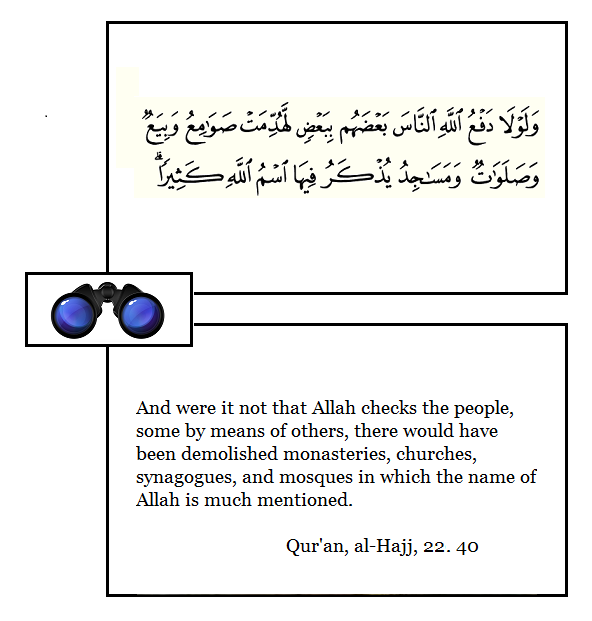
Let’s begin with Qur’an 22. 40:

SPEC Quran 22.40

I can deeply appreciate a perspective as respectful as this.

**

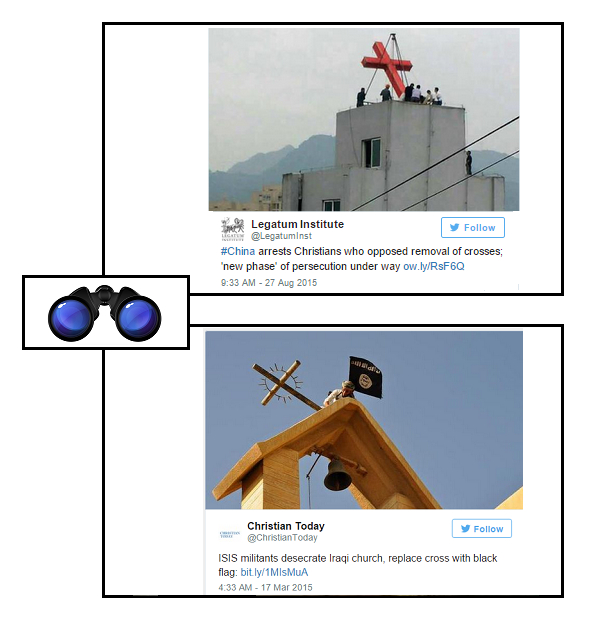
Consequently, I am even more deeply saddened when the Islamic State tears down the crosses atop churches —

SPEC DQ china is

than I am when the Chinese do the same exact thing..

**

And I’d suggest that the phrase “were it not that Allah checks the people, some by means of others, there would have been demolished monasteries, churches, synagogues, and mosques” as indicating that those who check / repel / drive back those others who demolish such places of worship, do so in accordance with the divine will..

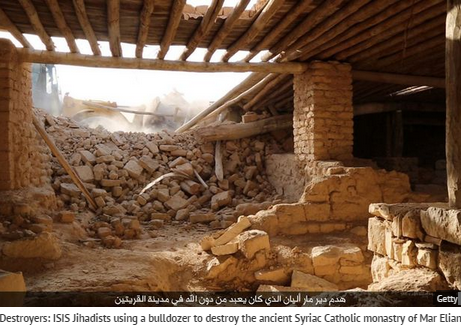
Here, members of the Islamic State bulldoze a monastery..

bulldozing Mar Elian

Such acts, then, should be checked, prevented, surely, by those who honor the Qur’an.

The question that remains is how best to accomplish this.

**

Likewise, there is the phrase about “monasteries, churches, synagogues, and mosques in which the name of Allah is much mentioned”..

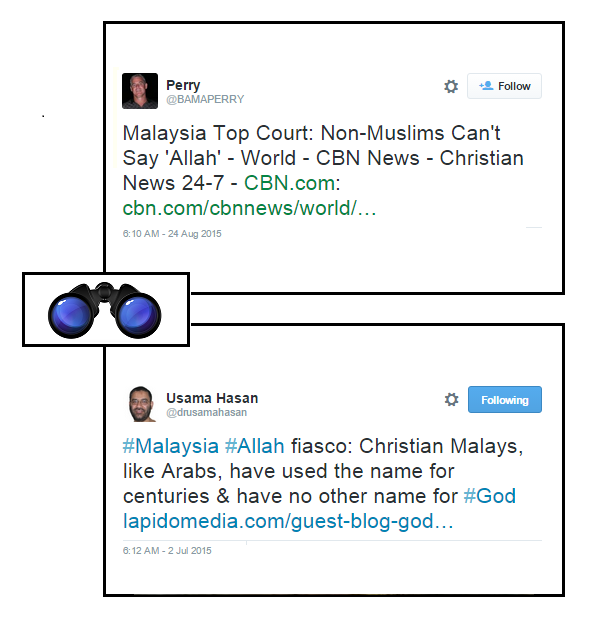
Apparently, the “name of Allah” was “much mentioned” in monasteries and churches at the time of the Prophet, and we may therefore wonder why Malaysian Muslims would wish to ban the use of that name by Christians —

SPEC malaysia

— when as KL Chan pointed out in his recent LapidoMedia post Do Muslims have a monopoly on the word Allah? — even if we ignore the clear evidence of the Qur’an itself,

One of the oldest evidences of Christian use of the word ‘Allah’ can be found in a Bible translation from 1514.

That’s two years after Michaelangelo finished painting the Sistine Chapel ceiling, and three years before Martin Luther posted his 95 Theses to the door of Wittenberg Cathedral.

As Usama Hasan says, it’s a fiasco.

**

Sources:

  • BibleGateway, Job 38.7,
  • Qur’anic Arabic corpus, Qur’an 22.40
  • Legatum Institute, China arrests Christians
  • Christian Today, Isis militants desecrate Iraqi church
  • Daily Mirror, ISIS Jihadists using a bulldozer
  • Perry, Malaysia Top Court
  • Usama Hasan, #Malaysia #Allah fiasco

  • We’re a legacy industry in a world of start-up competitors

    Wednesday, August 26th, 2015

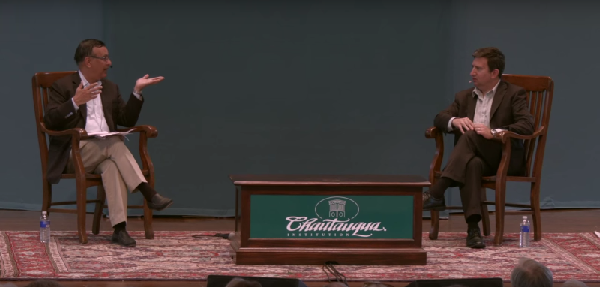
    [ by Charles Cameron — Ambassador Husain Haqqani and Daveed Gartenstein-Ross at Chautauqua ]
    .

    chautauqua haqqani daveed

    **

    From the outset, when cheers went up for Daveed’s birthplace, Ashland, Oregon, and Ambassador Haqqani’s, Karachi — and for the brilliant meeting of the minds that is Chautauqua — it was clear that we were in the presence of two gracious, witty and informed intelligences, and the seriousness of the conversation between them that followed did nothing to reduce our pleasure in the event. Daveed called it “easily the best experience I have ever had as a speaker.”

    I’ll highlight some quotes from each speaker, with the occasional comment:
    **

    Amb. Haqqani:

    None of the countries except Egypt, Turkey and Iran, none of the countries of the Middle East are in borders that are historic, or that have evolved through a historic process. And that’s why you see the borders a straight lines. Straight lines are always drawn by cartographers or politicians, the real maps in history are always convoluted because of some historic factor or the other, or some river or some mountains.

    You’ll see how neatly this fits with my recent post on borders, No man’s land, one man’s real estate, everyone’s dream?

    And now that whole structure, the contrived structure, is coming apart.

    Then most important part of it is, that this crisis of identity – who are we? are we Muslims trying to recreate the past under the principles of the caliphate .. or are we Arabs, trying to unify everybody based on one language, or are we these states that are contrived, or are we our ethnic group, or are we our tribe, or are we our sect? And this is not only in the region, it’s also overlapping into the Muslim communities in the diaspora..

    **

    If Amb. Haqqani emphasized the multiple identities in play in the Arabic, Islamic, Sunni, Shia, Sufi, and tribal worlds in his opening, Daveed’s emphasis was on the failure of the post-Westphalian concept of the nation state.

    Daveed G-R:

    In the economic sphere there’s this thing that is often called “legacy industries” – industries that fit for another time, but are kind of out of place today. Think of Blockbuster Video, once a massive, massive corporation.. that’s a legacy industry. So when Ambassador Haqqani talks about how it’s not just in the Middle East that we have this crisis of identity, I think the broader trend is that the Westphalian state that he spoke about, the kind of state that was encoded after the Peace of Westphalia, looks to a lot of people who are in this generation of the internet where ideas flow freely, it looks like a legacy industry.

    Why do you need this as a form of political organizing? And what ISIS has shown is that a violent non-state actor, even a jihadist group that is genocidal and implements as brutal a form of Islamic law as you could possibly see, it can hold territory the size of Great Britain, and it can withstand the advance of a coalition that includes the world’s most powerful countries including the United States. And what that suggests is that alternative forms of political organization can now compete with the nation state.

    **

    The Ambassador then turned to the lessons we should take from 1919’s US King–Crane Commission, reporting on the break-up of the Ottoman Empire — they concluded that it gave us

    a great opportunity — not likely to return — to build .. a Near East State on the modern basis of full religious liberty, deliberately including various religious faiths, and especially guarding the rights of minorities

    — down to our own times.

    Amb. Haqqani:

    What we can be sure of is that the current situation is something that will not be dealt with without understanding the texture of these societies. So for example, when the United States went into Iraq without full understanding of its sectarian and tribal composition, and assumed that, all we are doing is deposing a dictator, Saddam Hussein, and then we will hold elections and now a nice new guy will get elected, and things will be all right -– that that is certainly not the recipe. So what we can say with certainty in 2015 is .. over the last century what we have learnt is: outsiders, based on their interests, determining borders is not a good idea, and should certainly not be repeated. Assuming that others are anxious to embrace your culture in totality is also an unrealistic idea.

    The sentence that follows was a stunner from the Ambassador, gently delivered — a single sentence that could just as easily have been the title for this post as the remark by Daveed with which I have in fact titled it:

    Let me just say that, look, he ideological battle, in the Muslim world, will have to be fought by the likes of me.

    Spot on — and we are fortunate the Ambassador and his like are among us.

    **

    Daveed then turned to another topic I have freqently emphasized myself.

    Daveed G-R:

    The power of ideas – we as Americans tend not to recognize this when it falls outside of ideas that are familiar to us. So one thing that the US has been slow to acknowledge is the role of the ideology that our friend and ally Saudi Arabia has been promulgating globally, in fomenting jihadist organizations.

    And one of the reasons we have been slow to recognize that. I mean one reason is obvious, which is oil. .. But another reason has been – we tend to think of ideas that are rooted in religion – as a very post-Christian country – we tend to think of them as not being real – as ideas which express an ideology which is alien to us –as basically being a pretext, with some underlying motivation which is more familiar to us. That it must be economics, or it must be political anger. I’m not saying those are irrelevant, they’re not – but when Al-Qaida or ISIS explains themselves, taking their explanation seriously and understanding where they’re coming from – not as representatives of Islam as a whole, but as representatives of the particular ideology that they claim to stand for – we need to take that seriously. Because they certainly do.

    **

    Amb. Haqqani:

    The world is not a problem for Americans to solve, it’s a situation for them to understand.

    This makes a nice DoubleQuote with Gabriel Marcel‘s more general aphorism:

    Life is not a problem to be solved but a mystery to be lived.

    **

    Toward the end of the discussion, Daveed touched on some ideas of recurrent interest to Zenpundit readers..

    Daveed G-R:

    Looking at the US Government, questions that I ask a lot are: Why are we so bad at strategy? Why are we so bad at analysis? Why do we take such a short term view and negate the long term?

    He then freturned to the issue of legacy industries and nation-states:

    Blockbuster is a legacy industry. And the reason why legacy industries have so much trouble competing against start-up firms, is because start-ups are smaller, it’s more easy for them to change course, to implement innovative policies, to make resolute decisions – they can out-manoeuver larger companies. And so larger companies that do well adapt themselves to this new environment where they have start-up competitors. Nation-state governments are legacy industries. Violent non-state actors are start-up compoetitors.

    — and had the final, pointed word:

    We’re a legacy industry ina world of start-up competitors.

    **

    Having offered you these tastes, at this point I can only encourage you to watch the whole hour and a quarter, filled to the brim with incisive and articulately-stated insights:

    Turnabout is fair play?

    Thursday, August 20th, 2015

    [ by Charles Cameron — fascinated as always by the interweave of worlds ]
    .

    If not causality, then at least correlation?

    I’m really not sure which came first, the Joker or the Ray Gun.

    Only this morning I waS asking on Twitter:

    if ppl could travel into movies (think Purple Rose of Cairo) like they travel to Syria, which movies wld siphon off most ISIS recruits?

    On LapidoMedia: Mullah Omar’s death strengthens al-Baghdadi’s claim to the caliphate

    Thursday, August 20th, 2015

    [ by Charles Cameron — Mullah Omar, the Prophet’s cloak in Kandahar, & the title “Amir al-Mu’minin” ]
    .

    shrine of the cloak
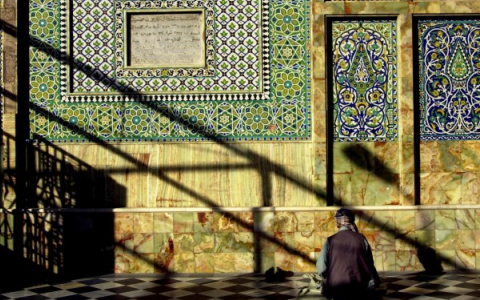
    A man prays at the Shrine of the Cloak of the Prophet, Kandahar. Photo: Tomas Munita/AP

    **

    My latest for LapidoMedia begins:

    ON THE FIRST anniversary of the death of US journalist James Wright Foley, the first US citizen to be killed by ISIS, it is timely to examine the credientials of the man who ordered it – the ‘caliph’ of the Islamic State, Abu Bakr al-Baghdadi.

    Baghdadi’s claim not just to the title of caliph but to that of Amir al-Mu’minin or Commander of the Faithful, underpins obedience of all Muslims to his will.

    To understand this, we need also to understand the impact of the recently announced death of Mullah Omar, the leader of the Taliban.

    The cloak of responsibility

    For jihadists and those who aspire to be jihadists, Mullah Omar’s death put to an end one of the two claims to the title of Amir al-Mu’minin.

    This title is one normally accorded to a caliph, but while Mullah Mohammed Omar Mujahid did not proclaim himself caliph or attempt to establish a global caliphate, he did indeed lay the foundations of one by creating the Islamic Emirate of Afghanistan in 1996.

    Read the whole thing..

    **

    Further recommendations:

  • Fabrizio Foschini & Bette Dam, Under the Cloak of History: The Kherqa-ye Sharif from Faizabad to Kandahar
  • JM Berger, Mullah Omar and the AQ-ISIS War
  • Aaron Y Zelin (podcast), The Death of Mullah Omar and its Implications with J.M. Berger
  • Barnett Rubin, What could Mullah Omar’s Death Mean for the Taliban Talks?
  • Barnett Rubin, Turmoil in the Taliban
  • Joanna Paraszczuk, Why Zawahri’s Pledge to Taliban could be a boon for IS 
  • Leah Farrall, Mullah Omar’s death and the Haqqani factor
  • For more on the cloak, see also:

  • Charles Cameron, The cloak, mantle and authority of the Prophet
  • No man’s land, one man’s real estate, everyone’s dream?

    Monday, August 17th, 2015

    [ by Charles Cameron — borders and distinctions from Trump to Revelation, plus one ]
    .

    Donald Trump‘s “three core principles of real immigration reform”:

    1. A nation without borders is not a nation.

    **

    G Spencer-Brown wrote of his book. Laws of Form, “The theme of this book is that a universe comes into being when a space is severed or taken apart” — or as Heinz Von Foerster rephrased him, “Draw a distinction and a universe comes into being”. Indeed, his book opens with the words:

    We take as given the idea of distinction and the idea of indication, and that we cannot make an indication without drawing a distinction.

    He writes:

    Distinction is perfect continence.

    That is to say, a distinction is drawn by arranging a boundary with separate sides so that a point on one side cannot reach the other side without crossing the boundary. For example in a plane a circle draws a distinction.

    Similarly, Gregory Bateson defines an idea as “A difference or distinction or news of differences”.

    **

    Borders are both physical and metaphysical: the border between the physical and the metaphysical passes through human beings, who are themselves both metaphysical and physical.

    Borders may thus be heeded or ignored.

    Smugglers don’t necessarily ignore them, they may take them very seriously, as do those who police them. Birds, however, ignore them, fishes, lizards, languages..

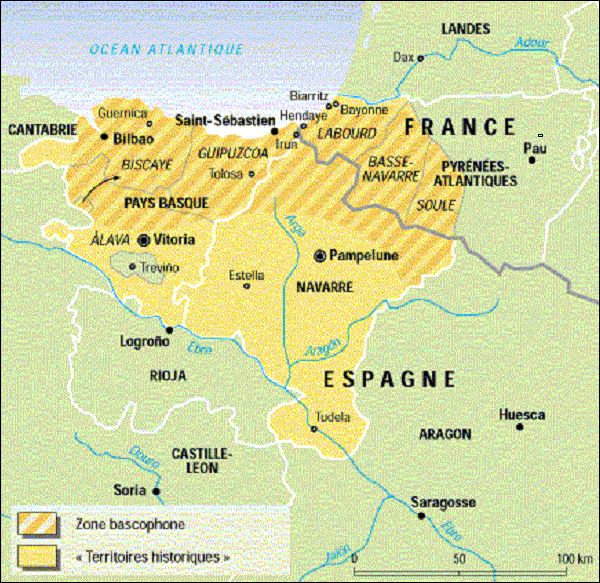
    There are would-be states that straddle national borders, as the Basque peoples straddle the border between France and Spain:
    Basque France Spain 600

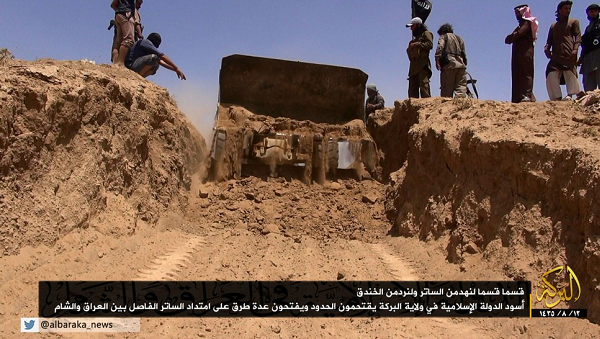
    There are also would-be states that literally erase national borders, as in the case of IS bulldozing thw border between Iraq and Syria:
    Iraq Syria Border 600

    Thus while borders may be tidy in separating one from a second, they are also untidy in straddling them, neither one nor two, yet (like Janus) both.. They are, in short, thresholds, limina. And so wahat we know of liminality applies to them. I have discussed tthis previosuly on Zenpundit in Liminality II: the serious part — suffice it to say here that limiality is a condition that exacerbates, intensifies.

    **

    The anthropologist Mary Douglas, in her book Purity and Danger: An Analysis of Concepts of Pollution and Taboo, quotes Leviticus 19.19:

    You shall keep my statutes. You shall not let your cattle breed with a different kind; you shall not sow your field with two kinds of seed; nor shall there come upon you a garment of cloth made of two kinds of stuff.

    Why these disjunctions? Dougles notes the repeated refrain in just such contexts:

    Ye shall therefore be holy, for I am holy

    and points out that Ronald Knox correctly — if “rather thinly” — translates this:

    I am set apart and you must be set apart like me

    She then tells us:

    Holiness means keeping distinct the categories of creation. It therefore involves correct definition, discrimination and order.

    noting that:

    The word ‘perversion’ is a significant mistranslation of the rare Hebrew word tebhel, which has as its meaning mixing or confusion.

    and concludes

    ideas about separating, purifying, demarcating and punishing transgressions have as their main function to impose system on an inherently untidy experience. It is only by exaggerating the difference between within and without, above and below, male and female, with and against, that a semblance of order is created.

    **

    The upper image, below, is taken from my recent post on Matrioshka cartography, and waas taken in turn from Say goodbye to the weirdest border dispute in the world in the Washington on August 1st..

    SPEC DQ maps

    … while the lower image is from Welcome to Liberland, the World’s Newest Country (Maybe) in the New York Times Magazine, dated Aug 11

    **

    Lydia Kiesling, in her post Letter of Recommendation: Uzbek in the NYT magazine today, writes:

    National borders can be risibly at odds with reality, especially in Central Asia, where Turks, Mongols, Persians and others roved and mingled, where ‘‘Uzbek’’ was, for a time, more of a descriptive antonym of ‘‘Tajik’’ — no­­madic versus settled — than an ethnic classification.

    And why not?

    They are, after all, distinctions drawn in the mind, lines drawn on paper. Thus the Sykes-Picot map:

    Sykes_Picot_Agreement_Map_signed_8_May_1916 600

    Sykes was quite clear about the “lines dorawn on paper” part. He is reported to have said:

    I should like to draw a line from the e in Acre to the last k in Kirkuk

    The map, in other words, is not the territory: the map is a map.

    To take another instance of importance in today’s world, the Durand Line:

    Durand_Line_Border_Between_Afghanistan_And_Pakistan 600

    Not only is the map not the territory in this case — it can be seen, as one-time Afghan president Hamid Karzai said, as “a line of hatred that raised a wall between the two brothers” — Afghanistan and Pakistan.

    **

    Sympathies which exist across borders can be potent forces for their dissolution. In a poem titled “Their Eyes Confer Fire” written in the 1980s about Basque country, I wrote

    We have
    little time,
    Marie explained,
    for those
    who, because
    it is hard
    to draw
    lines
    across actual
    mountains,
    carve up
    this earth on
    paper.

    France, Spain:
    we disdain
    boundaries, borders,
    and border guards.

    A canny reader noted that the entire poem could be read not as a description of the Basques as they exist in reality, but as a paean to the corpus callosum joining the two hemispheres of the brain — and thus the two modes of cognition of which I so recently wrote.

    **

    Returning to Lieberland, or Gornja Siga as the locals call it, we learn:

    Gornja Siga has come, over the last few months, to assume an outsize role in the imagination of many — not only in Europe, but also in the Middle East and in the United States. Its mere existence as a land unburdened by deed or ruler has become cause for great jubilation. There are few things more uplifting than the promise that we might start over, that we might live in the early days of a better nation. All the most recent states — South Sudan, East Timor, Eritrea — were carved from existing sovereignties in the wake of bitter civil wars. Here, by contrast, is a truly empty parcel. What novel society might be accomplished in a place like this, with no national claim or tenant?

    Consider one sentence alone as the key to that “outsize role in the imagination”:

    There are few things more uplifting than the promise that we might start over, that we might live in the early days of a better nation.

    The apocalyptic yearning here and its kinship with the Amrican dream are hard to miss — it is like a conflation of Matthew 5.14:

    A city that is set on an hill cannot be hid.

    with Revelation 21.1-2:

    And I saw a new heaven and a new earth: for the first heaven and the first earth were passed away; and there was no more sea. And I John saw the holy city, new Jerusalem, coming down from God out of heaven, prepared as a bride adorned for her husband.

    **

    Plus:

    Switch to our mobile site