zenpundit.com » theory

Archive for the ‘theory’ Category

Time for a Grand Strategy Board?

Monday, April 25th, 2011
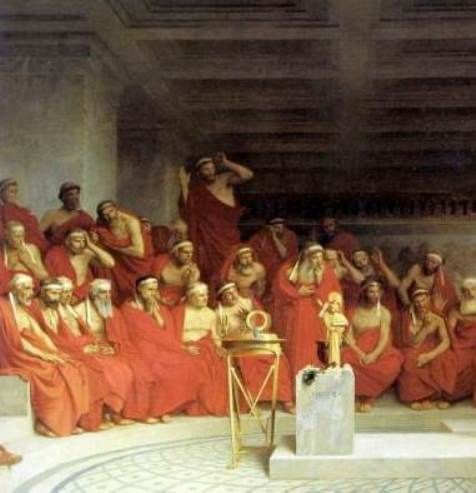
The Gerousia

“I have not lived so long, Spartans, without having had the experience of many wars, and I see among you of the same age as myself, who will not fall into the common misfortune of longing for war from inexperience or from a belief in it’s advantage and safety”

Archidamus, King of Sparta

One thing on which most commentators, academics and former officials seem to agree is that the United States government has a difficult time planning and executing strategy. Furthermore, that since 1991 we have been without a consensus as to America’s grand strategy, which would guide our crafting of policy and strategy. This failing bridges partisan divisions and departmental bureaucracies; there are many career officials, political appointees and even a few politicians, who can explain the nuances of the Afghan War, or the Libyan intervention, the depreciatory tailspin of the US Dollar or America’s Russia policy – but none who would venture to say how these relate to one another, still less to a common vision.

Sadly, they do not, in fact, relate to one another – at least not, as far as I can discern, intentionally.

Few American policies or even military operations (!) in one country can be said to have been conceived even within a coherent and logically consistent regional strategy and it is not just common, but normal, to have DIME agencies working at completely contradictory purposes in the same area of operations. The interagency process, to the extent that it exists, is fundamentally broken and incapable of interagency operational jointness; and the institutional coordinating mechanism for any “whole of government” effort, the National Security Council, has become too consumed with crisis management. A mismatched prioritization of resources which leaves little time for the kind of long range planning and strategic thinking that allows nations to seize the initiative instead of reacting to  events.

It would be a useful corrective for the better conception and execution of US policy, for the President and the Congress to create a special board for grand strategy that could give presidents and key officials frank assessments and confidential guidance to help weave their policy ideas into a durable and overarching national strategy. One that might last beyond a few days’ headlines in The New York Times.

The President of the United States, of course has a number of bodies that could, should but do not always provide strategic advice. There’s the Defense Policy Advisory Board, an Intelligence Advisory Board,  the National Intelligence Council, the State Department’s Policy Planning Staff, the Office of Net Assessment and not least, the NSC itself and the Joint Chiefs of Staff, whose Chairman, by act of Congress, is the military advisor to the President and Secretary of Defense. While strategic thinking does percolate from these entities, many have very specific mandates or, conversely, wide ranging briefs on matters other than strategy. Some operate many levels below the Oval Office, are filled with superannuated politicians or have personnel who, while intellectually brilliant, are excessively political and untrained in matters of strategy. The Joint Chiefs, the professionals of strategy, are highly cognizant of the Constitutional deference they are required to give to civilian officials and are very leery of overstepping their bounds into the more political realms of policy and grand strategy.

What  the President could use is a high level group just focused on getting strategy right – or making sure we have one at all.

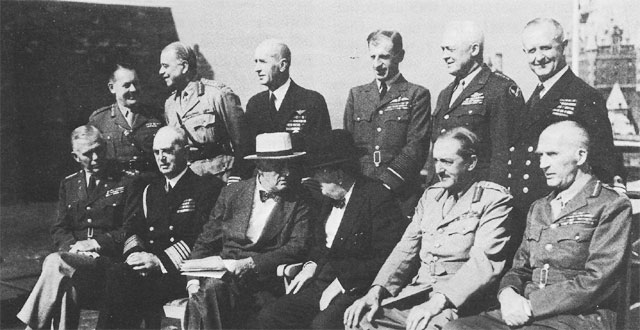
I’m envisioning a relatively small group composed of a core of pure strategists leavened with the most strategically oriented of our elder statesmen, flag officers, spooks and thinkers from cognate fields. A grand strategy board would be most active at the start of an administration and help in the crafting of the national strategy documents and return periodically when requested to give advice. Like the Spartan Gerousia, most of the members ( but not all) would be older and freer of the restraint of institutional imperatives and career ambitions. Like the Anglo-American joint chiefs and international conferences of WWII and the immediate postwar era, they would keep their eye on the panoramic view.
combined-chiefs.jpg

The Octagon Conference – FDR, Churchill and the Combined Chiefs of Staff

Here’s my grand strategy board in a hypothetical perfect world, unlike the one that prevails inside the beltway. I’m sure people will quibble with particular names or will suggest others. I freely admit, for example, that I do not have the best grasp of who our leading intellectual powerhouses are in the Navy, Air Force or the closed world of intelligence analysis and this impairs my ability to put together the list. Nevertheless, I’m trying anyway:

Let’s start with a group of acclaimed and eminent strategic thinkers who have demonstrated over a long tenure, their ability to consider matters of war, peace and statecraft as well as the nuances of strategic theory:

Thomas Schelling -Chairman
Andrew Marshall
Edward Luttwak
Colin Gray
Joseph Nye

Next, some senior statesmen:

Henry Kissinger
George Schultz
Zbigniew Brzezinski

Madeleine Albright

General officers and one colonel with a demonstrated talent for challenging conventional assumptions:

Lieutenant General Paul van Riper
General James Mattis 
General Jack Keane
Colonel John Warden

Two economists:

Alan Greenspan
Nouriel Roubini

Two scientists:

Freeman Dyson
E.O. Wilson

Mixed group of strategists, historians, practitioners and theorists:

David Kilcullen
John Robb
John Negroponte

Barry Posen
Antulio Echevarria

Chet Richards
Micheal Vlahos
Thomas P.M. Barnett
Stephen Biddle
Robert Conquest
Duane Clairridge
Jack Matlock
Martin van Creveld

Visionaries and Contrarians:

Nicholas Nassim Taleb
William Gibson
Ray Kurzweill
Andrew Bacevich

What are the problems with my grand strategy board (aside from having zero chance of coming into being)? 

For one, it is probably way too large. In my efforts to balance expertise in strategy with varied thinking it grew bigger than what is manageable in real life, if the group is to be productive.

Secondly, it is an exceedingly white, male and conservative leaning list – though to some extent that reflects the criteria of experience, the field of strategy itself and the nature of American politics.  Barbara Ehrenreich, for example, is definitely bright but her politics are fundamentally opposed to effectively maximizing American power in the world or the use of military force – thus making her of little use except as a voice of dissent.

Another limitation of this exercise is the idiosyncratic eclecticism of my approach – this was a blog post written over a few days in my spare time and not a methodical inquiry into who in American life would verifiably be the “best qualified” to help construct a grand strategy. There are “insiders” who command great respect within the national security, defense and intelligence communities who are unknown to the general public, or even this corner of the blogosphere, who would be enormously helpful to such a board. Finally, a grand strategy board would not be a panacea; it would be subject to all the inertial pressures that over time would reduce it’s ability to effect change, just as the Policy Planning Staff and the NSC have been “neutered” over decades by the forces of the status quo.

That said, the above group or one reasonably comparable to it could, for a time, markedly improve the construction of strategy , assuming American leaders are willing to enlist such advice, put aside short term political considerations and pursue long term strategic goals.

Whom would you nominate to a grand strategy board?

Grand Strategic Viewing:

More on Where Good Ideas Come From

Tuesday, April 19th, 2011

Dr. Von weighed in on Steven Johnson’s Where Good Ideas Come From with an extensive book review last December( I posted on Johnson here. On a related note, read Charles Cameron’s comment about the limitations of linear thinking here):

Where do New Ideas come from?

….But what exactly are innovation and creativity? The dictionary definition of innovation is ‘the introduction of new things or methods,’ while creativity is ‘the ability to create meaningful new ideas, forms or methods’ that are original and imaginative. So the key notion is the development of new ideas in whatever field one is working. A question naturally develops, which is where do new ideas come from? How do we begin preparing children now to be creative and innovative in the future? In the past, many would have first thought about the arts as being the training ground for creativity. Now, we realize that the development of the abilities and mindsets and skills necessary to be creative in every field of study is necessary.Steven Johnson’s new book, Where Good Ideas Come From: The Natural History of Innovation, provides the argument that there are seven common themes that have led to the vast majority of great ideas throughout history. He gives numerous examples of such ideas, ranging from Darwin’s development of the theory of evolution to the of the GPS system, from Google to the creation of the first mechanical computing devices centuries ago, and so on. It is an interesting read.Here is a summary of the seven themes that lead to good ideas. Keep in mind there is certainly some degree of overlap and relationships between the themes, but overall they can be thought of as distinct concepts.1. The Adjacent Possible: Even if you have an interest in some topic or problem, if there is not a good environment conducive to presenting the necessary pieces to solve the problem, good ideas will almost certainly not develop. You may be brilliant with some of the information (i.e. pieces of a puzzle) in your mind that is necessary to solve a problem, but if your surroundings are not able to provide the remaining pieces of information or experiences, you will endlessly search for them to no avail. If you are isolated from others who know something about your problem or issue, or if there is no means of gathering further information (which is becoming less of a problem with the advent of the Internet), or if your environment does not provide the physical infrastructure or supplies to finish building a new physical device, you will be unable to develop the Idea or solution to your problem.

2. Liquid Networks: Great ideas can develop when information is allowed to flow through a larger network. One possible network is a social network, or often and more specifically, a professional network. The focus of this is the ability to collaborate to solve problems. It turns out that there are almost no great ideas throughout history that have been developed in isolation or by an individual who did not need any help in the development of that great idea. One may think Newton or Einstein did their work in isolation, but this is not entirely true. Those two individuals come about as close as you can get to not needing a network to develop the laws of motion or relativity, but they relied on some level of feedback, reading others’ work, and ultimately talking and discussing issues with close colleagues and friends.
An interesting study was done that looked at how research groups reach the coveted ‘Eureka!’ moment, where a new discovery is made. It turns out that these rare moments of discovery or problem solving almost never happen in the lab! Instead, the ‘Aha!’ are yelled out at the conference table, where members of the group are throwing ideas around and sharing results of their latest work over the past week. The person who figures it out needs to have input they have not thought about from the larger group or network, before the grand idea is formed….

Read the rest here.

Social and Individual Components of Creativity

Thursday, April 14th, 2011

This is very good. And it is fast.

I have enjoyed several of Steven Johnson’s previous books, Emergence and Mind Wide Open and his latest one, Where Good Ideas Come From looks to be a must read, though I think those of you who have read Wikinomics or works like Flow by Mihaly Csikszentmihalyi will find some of Johnson’s points in the video to be familiar as will those long time readers who have seen my views on horizontal thinking   and  insight.

My students watched this and reacted by defining themselves as those who were creative mostly through social collaboration but a decided minority required solitude and an environmental filter to think clearly and creatively – not a catalyst of a series of  social-intellectual stimuli. For them, the cognitive load generated by the environment amounted to an overload, a distracting white noise that short-circuited the emergence of good ideas.

This suggests to me that there are multiple and very different neuronal pathways to creativity in the brain and a person’s predisposition in their executive function, say for example the classic “ADHD” kid at the back of the class, may have different requirements to be creative than a peer without that characteristic. It also means that creativity may be subject to improvement if we can cultivate proficiency in several “styles” of creative thinking.

Book Review: Narcos Over the Border by Robert J. Bunker (Ed.)

Tuesday, April 5th, 2011

Narcos Over the Border: Gangs, Cartels and Mercenaries by Dr. Robert J. Bunker (Ed.)I just finished my review copy of Narcos Over the Border. It is one of the more disturbing academic works recently published in the national security field, not excluding even those monographs dealing with Islamist terrorism and Pakistan. If the authors of this granular examination of Mexico’s immense problems with warring narco-cartels, mercenary assassins, systemic corruption, 3rd generation gangs and emerging “Narcocultas”of Santa Muerte are correct – and I suspect they are – Mexico’s creeping path toward state failure reprsents a threat to American national security of the first order.

The 237 page, heavily footnoted, book is organized into three sections: Organization and Technology Use by the narcos networks, Silver or Lead on their carrot and stick infiltration/intimidation of civil society and the state apparatus, and Response Strategies for the opponents of the cartels. Bunker’s co-authors Matt Begert, Pamela Bunker, Lisa Campbell, Paul Kan, Alberto Melis, Luz Nagle, John Sullivan, Graham Turbiville, Jr., Phil Wiliams and Sarah Womer bring an array of critical perspectives to the table from academia, law enforcement, intelligence, defense and security fields as researchers and practitioners. The effort to blend disciplinary approaches in Narcos Over the Border is both an intentional and commendable effort to break down academic and policy silos and bureaucratic “turf” perspectives that prevent analyzing Mexico’s security dilemmas as an interrelated threat increasingly resembling a full-fledged insurgency (albeit not on the classic Maoist Model).Some impressions I gained from reading Narcos Over the Border include:

  • The Narco-Cartels and the Zetas, which fight each other as well as Mexico’s military ( Mexican police generally are infiltrated, intimidated, outgunned and seriously outclassed by the Cartel gunmen, Zetas and Guatemalan Kaibiles) are better armed and better trained than are the Taliban. The deadly and efficient Zetas and Kaibiles are superior to regular Mexican military forces and have established safe haven training camps in Central America.
  • Narco-cartels are properly speaking, no longer narco-cartels but transnational criminal syndicates involved in a wider array of revenue generating activities, but with professional intelligence and military capabilities, and increasingly, political, social and religious agendas that are functionally reminiscient of Hezbollah and HAMAS.
  • The Mexican state is severely hampered in it’s response to the threat presented by the cartels by it’s own strategic use of corruption as a cost saving measure and a tool for sustaining elite control of Mexican politics, as well as a method of personal enrichment by members of Mexico’s ruling class.
  • The eschewing of the extreme violence by the cartels North of the border appears to be more of a sign of a strategic policy by cartel and Zeta bosses than a lack of capacity or evidence of a lack of infiltration into American society. To the contrary, Mexican cartel links to acutely dangerous American prison and street gangs such as the Mexican Mafia and MS-13 are significant and well documented.
  • The cartels are global, not regional or local operators.
  • The culture of the Narco-cartels, which draws on some romantic Mexican social and religious underground traditions, particularly the hybrid cartel La Familia , is morphing into a very dangerous “Narcocultas”, a neo-pagan, folk religion featuring ritualistic violence, beheadings and torture-murders carried out for reasons other than economic competition.
  • Mexico has departed the realm of having a serious law enforcement problem and has graduated to a significant counterinsurgency war against the cartels in which the Mexican state is treading water or making progress against some cartels (possibly displacing their activities to weaker states in Central America).

The authors do not assume the worst case scenario, state collapse, for Mexico but rather an insidious “hollowing out” of the state by the cartels and a mutation of Mexico’s native culture to host a 4GW nightmare. As Robert Bunker writes:

What is proposed here is that Mexico is not on it’s way to becoming a “rotting corpse” but potentially something far worse – akin to a body infected by a malicious virus. Already, wide swaths of Mexico have been lost to the corrupting forces and violence generated by local gangs, cartels and mercenaries. Such narco-corruption faced few bariers given the fertile ground already existing in Mexico derived from endemic governmental corruption at all levels of society and in some ways, it even further aided the ‘virus’ spreading through Mexican society from this new infection. Among it’s other symptoms, it spreads values at variance with traditional society, including those:

….conceivably derived from norms based on slaveholding, illicit drug use, sexual activity with minors and their exploitation in prostitution, torture and beheadings, the farming of humans for body parts, the killing of innocents for political gain and personal gratification and the desecration of the dead.

While meticulous, Narcos Over the Border is not all-encompassing in scope.  A fundamentally Mexico-centric collection of scholarly articles, it does not deal extensively with American policy makers involved in Mexico’s narco-insurgency, the intricacies of cartel financial operations or undertake case studies of narco activities in Mexican-American communities, though the authors do track narco-cartel and gang presence in cyberspace. Narcos Over the Borders represents a starting point for deeper investigation of narco-insurgency and for a national security comunity that has thus far treated Mexico as a third tier problem, a policy call to arms.Strongly recommended.

More Books and Reviews to Come

Wednesday, March 30th, 2011

Going to try to catch up this week on the backlog of book reviews I need to do, particularly those books sent to me by publishers. I may have to break down and do a set of mini-reviews, so far behind I have gotten myself.

So, naturally, that was a suitable pretext to order more books 🙂

Here’s what arrived the other day….


STRATEGY: The Logic of War and Peace by Edward Luttwak

War Before Civilization by Lawrence H. Keeley

WAR: In Human Civilization by Azar Gat

The World of Yesterday by Stefan Zweig

Why the West Rules – For Now by Ian Morris

Luttwak’s book is a strategy classic and I recently enjoyed his Grand Strategy of the Byzantine Empire. I first heard of Stefan Zweig from Lexington Green but nearly everyone who has read The World of Yesterday that I have encountered has raved about it, so I am looking forward to that one. Why the West Rules- For Now is another rec from the Chicago Boyz crowd but I do not think that anyone has reviewed it there as of yet. Finally, I am pairing War Before Civilization with Azar Gat’s War in Human Civilization – have a sense that Gat’s ideas may be somewhat in tune with Martin van Creveld.

Have you read any of these?


Switch to our mobile site

