zenpundit.com » geopolitics

Archive for the ‘geopolitics’ Category

The Need for Old Hands: Mackinlay on Old COIN

Friday, March 19th, 2010

Currently reading The Insurgent Archipelago by John Mackinlay. Not finished yet but I found this passage striking:

….The ratio of coloniser to colonised – and of the tiny British contingent to the vast numbers of the native population – suggested that a degree of consent to their presence was already inherent. The officials in each colony were competitively selected from an educated and ambitious British upper class, in many cases they were talented and intrepid men, used to living and campaigning in the field, with an intelligent grasp of their territory, its people, languages and culture. They survived and succeeded on their wits, natural authority and knowledge. When the colonised population rose up in insurrection and military force was rushed to the scene, it was subordinated to these same British administrators who became responsible for the direction of the campaign. All the problems of devising a political strategy, ensuring the legitimacy of the military actions and restoring the structures of governance were taken care of by a familiar hub of individuals. It was a continuously reconvening club in which personal relationships tended to override the ambiguities of their civil-military partnership.

Admittedly, there’s a shiny high gloss of romantic nostalgia for the Raj here, polishing the historical reality. The British Empire also saw examples of arrogance or cruelty by British colonial officials that helped provoke uprisings like the Sepoy Mutiny. Or, high-level imperial administrators could zealously pursue local colonial expansion, as Viscount Milner did in starting the needless Second Anglo-Boer War, which partially involved putting down a grueling Trekboer insurgency, that ultimately weakened the Empire at the strategic level.

Those calamities, as expensive and bloody as they were, were exceptions. Mackinlay is correct in assessing the value of Britain’s colonial administrative class, whose deliberate cultivation of “Old Hands” permitted a sixth of the earth’s surface to be ruled relatively cheaply from Whitehall. Lord Milner, for all his faults, could at least speak to President Kruger in his own language and understood the Boer states on which he was waging war, even if he disdained the Afrikaner settlers. It’s hard to imagine many American statesmen or senior generals (or sadly, CIA agents and diplomats) fluently debating foreign counterparts in Arabic, Pashto, Farsi or Chinese. British officialdom took the time – and had the time, professionally – to learn the languages, dialects and customs of the peoples with whom they allied or fought, conquered and ruled.

Not so in contemporary peacekeeping /crypto-COIN operations , according to Mackinlay:

By the 1990’s the colonial officials who had been the key element in every operation since Cardwell were now missing. Coalition forces were intervening in countries that were the antithesis of the former colonies, where the incoming military were regarded as occupiers and where there was no familiar structure of colonial officials and district officers to be seen. Moreover, the diplomats who belatedly attempted to fill this role, although no doubt intellectually brilliant, crucially lacked the derring-do, local credibility and natural authority of their colonial era predecessors. A few extra hands from the Foreign Office or the State Department could not compensate for the loss….

….Although at a local level the British counter-insurgent techniques proved to be successful, broader problems presented themselves as a result of an absence of strategy and a failure of campaign design, particularly in the civil-military structures. It was simply not a realistic option to fill the void left by the departure of a national government – with all its natural expertise and authority – with a band-aid package of contracted officials and flat-pack embassies.

New Hands cannot act or think like Old Hands. They lack not only the in-country experience and linguistic skills but the entire worldview and personal career interests of the American elite mitigate against it. “Punching tickets” is incompatible with becoming an Old Hand and aspiring to be an Old Hand is incompatible with continued employment at most foreign policy agencies of the USG.

American Foreign Service Officers, CIA personnel and flag officers never had the same historical frame of reference as their Imperial British cousins, but the culture of the Eastern Establishment approximated a high church Yankee Republican version that provided an elan, a worldly knowledge and moral certitude until the Establishment’s will to power and self-confidence was broken by the Vietnam War. Subsequent generations of American elite have been indoctrinated in our best institutions to instinctively distrust the marriage of cultural knowledge and political skills to the service of advancing national interest as “Orientalism“.

I am not an admirer of Edward Said but the man was no fool. He understood the strategic importance for his radical political faction of populalrizing the de-legitimization the learning of other cultures and languages as immoral for any reason except partisanship in their favor against the interests of the predatory West. This is why something as esoteric and parsimoniously funded as “Human Terrain Teams” meet with volcanic rage from  academic leftists, especially in the fields of anthropology and political science. This is the sort of censorious mindset that would have  made the works of Herodotus, Alexis de Tocqueville, the Marquis de Custine, Richard Francis BurtonT.E. Lawrence, Ruth Benedict, Rene GroussetRaphael Patai and Bernard Lewis, to name just a few, impossible.

Recovering our capacity to act effectively and see with clarity requires the training of a new generation of Old Hands to interpret and act as policy stewards and agents in regions of the world in which most Americans are unfamiliar and likely to remain so. Current academic PC ideological fetishes reigning at our Ivy League universities artificially shrink our potential talent pool. Alternative educational pathways through military service academies, think tanks, professional and Cross-cultural associations and better USG training programs need to be developed to route around the university gateway that is largely in control of keepers hostile or indifferent to American foreign policy objectives. By the same token, USG agency and military personnel and security clearance policies need a systemic overhaul to better take advantage of those already in service who find their career paths blocked or frustrated.

We waste talent on a massive scale.

Book Review: The Forty Years War

Tuesday, February 2nd, 2010

The Forty Years War: The Rise and Fall of the Neocons, from Nixon to Obama by Len Colodny and Tom Shachtman

I mentioned this book previously, expressing some serious skepticism of the authors’ core argument of a struggle between President Richard Nixon and the Neocons. Nevertheless, I ordered a copy and found The Forty Years War to be an absorbing read; for those with an interest in the administration of Richard Nixon, the history of the late Cold War period or the politics of American foreign policy, this book is a must read. I have a good working knowledge from my own research of primary and secondary source material related to Richard Nixon and his battle to re-shape American foreign policy and national strategy; yet I can say that and Colodny and Shachtman, working with newly transcribed archival material, demonstrated that we still have much to learn about the inner workings of the Nixon administration.

The authors have three important themes in The Forty Years War:

1. The intellectual legacy of militarist- moral idealism of Fritz G.A. Kraemer, the German-born Defense Department geopolitical theorist who was a mentor, adviser or ally to a glittering constellation of policy makers including Henry Kissinger, Alexander Haig, James Schlesinger, Fred Ikle, Andrew Marshall, Paul Wolfowitz, Donald Rumsfeld and others. Shachtman and Colodny call Kraemer:

“….the unacknowledged godfather of the George W. Bush administration’s ways of relating the United States to the rest of the world – more so than the philosophies of the university of Chicago’s Leo Strauss or those Trotskyites turned conservatives who founded the neocon movement”

2. That there has been a “forty years war” for the control over U.S. foreign policy not between Left and Right or Hawks and Doves but between foreign policy “Pragmatists” in the mold of Richard Nixon and “Neocons” or more broadly (and accurately in my view), “Hardliners” adhering to the rigid moralism and supreme confidence in military supremacy of Fritz Kraemer.

3. That Watergate, contrary to the orthodox historiography (argued by historians like Stanley I. Kutler and Robert Dallek), was exploited and aggravated by Kraemerites and proto-Neocons, especially General Al Haig, specifically to bring down Richard Nixon in an attempt to smash detente and institute more aggressive U.S. posture in the Cold War. Haig emerges as a central villain in the Watergate conspiracy in The Forty Years War and Nixon’s ability to inspire disloyalty in his closest aides is breathtaking.

While illuminating and deeply provocative, The Forty Years War is a quirky book, almost two different books with the first half devoted to the Nixon era and the second half sailing from Gerald Ford to Barack Obama. In a sense, this is unavoidable because it is the Nixon administration docs that are being rapidly declassified and subsequent administrations will not be releasing similar material for years or decades. Equal depth of treatment for every administration would also have swelled the number of pages to a staggeringly unmanageable size for authors and readers alike.

I am also not comfortable with the authors’ casual use of the label “Neocon” to describe a range of policy makers on the right, some of whom are not at all neoconservatives in a tight or ideological sense of the term. Toward the end of The Forty Years War, Colodny and Shachtman draw more nuanced distinctions that I think, is a more precise rendering of the positions of various figures in Republican administrations or Congress.

The Forty Years War is a book that deserves to have a much higher public profile as Colodny and Shachtman are marshalling new evidence to challenge conventional interpretations of late Cold War political history and foreign policy.

Strongly recommended.

Elkus on Science, Defense and Strategy

Friday, January 8th, 2010

My amigo Adam Elkus has an excellently constructed and well researched article up at OpenSecurity where he advances a Boydian critique for what ails us:

Science, defence and strategy

…Contemporary American strategic problems flow from the fact that we cannot adjust the ossified thinking of Washington D.C. to the constantly shifting observed reality of the outside world. A failure to match concepts to observed reality has amplified the already formidable entropy of the American political system. The corresponding failure to make strategy results in a search further inward towards the “science” of war.  Better strategy will come about only when the process by which strategy is made becomes supple, flexible, and less dominated by sacred cows and special interests.

Critics of American foreign policy often undermine their own case with conspiracy theorizing about the “military-industrial complex.” The real problem, however, is not James Bond villain-style secret plans and hidden agendas but basic human frailty. A largely homogenous group of people is not going to have all the answers to questions of war and peace because they are necessarily limited by their experience, specialization, and biases.

Nice work by Adam, read the whole thing here.

We face a number of problems when it comes to formulating strategy and grand strategy. Not least is that, whatever the shortcomings on that score within America’s officer corps, there is a yawning gap of comprehension between the senior brass and most of the civilian “influencer” elite in and out of government. Most of the latter tend to think in terms of a few simple paradigms into which they force-fit each new foreign policy problem – generally, everything is conceived either as appeasement at Munich or the quagmire of Vietnam. This tiresome dichotomy is the strategizing of simpletons.

The arch-Clausewitzians in the national security community fall down here. It is not enough to think of strategy in purely military terms. America is not Sparta or even the Roman Republic where politicians vied for a chance field command. The civilians here are masters of policy and the military are its servants – and are but one kind of servant among many in the DIME spectrum. Statesmen and general officers need to be speaking with a common vocabulary and have a shared understanding of what strategy is if we are to formulate effective ones.

There is a deficit of knowledge among the class of officials and staff members with the authority to make or not make the most critical decisions in matters of peace and war. It cannot be remediated by an uncertain and unhealthy dependency on the Pentagon’s advice and a frustrating dialogue where civilian and soldier talk past one another.

ADDENDUM:

Adam gets a nod from our friends on the Left at Newshoggers.com

Stocking Stuffers……

Saturday, December 12th, 2009

In a burst of raw self-interest – and also a little love for my blogfriends – these books make nifty gifts for any war nerd or deep thinker on your Christmas list:

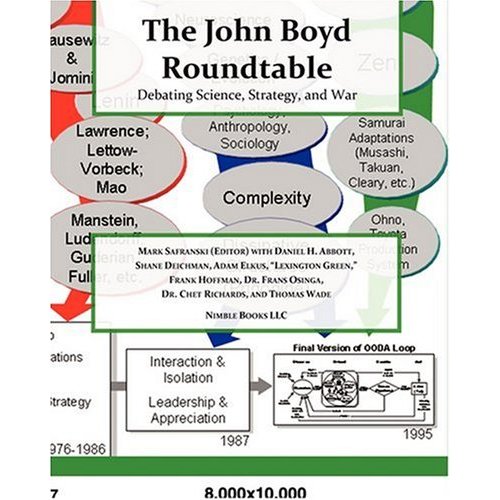
The John Boyd Roundtable: Debating Science, Strategy, and War – Mark Safranski (Ed.)


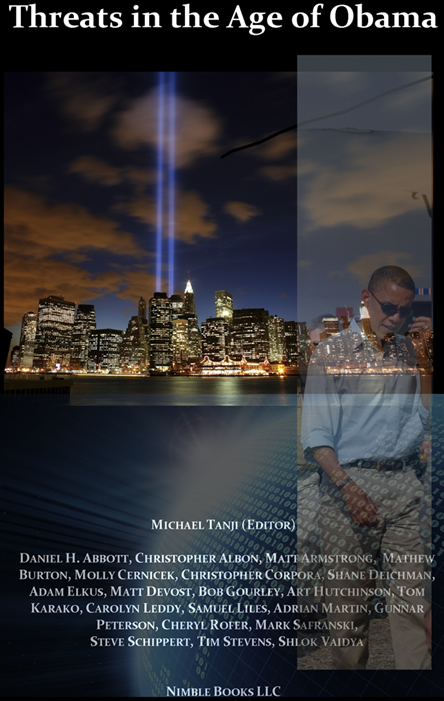
Threats in the Age of Obama – Michael Tanji (Ed.)

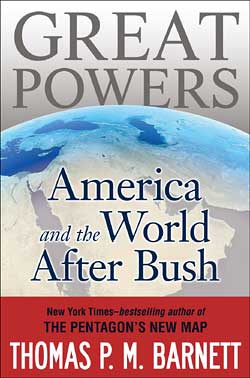
Great Powers: America and the World After Bush – Thomas P.M. Barnett

Brave New War: The Next Stage of Terrorism and the End of Globalization – John Robb

Science, Strategy and War: The Strategic Theory of John Boyd – Frans Osinga


The Genius of the Beast: A Radical Re-Vision of Capitalism  by Howard Bloom

Intelligence and How to Get It: Why Schools and Cultures Count  by Richard Nisbett

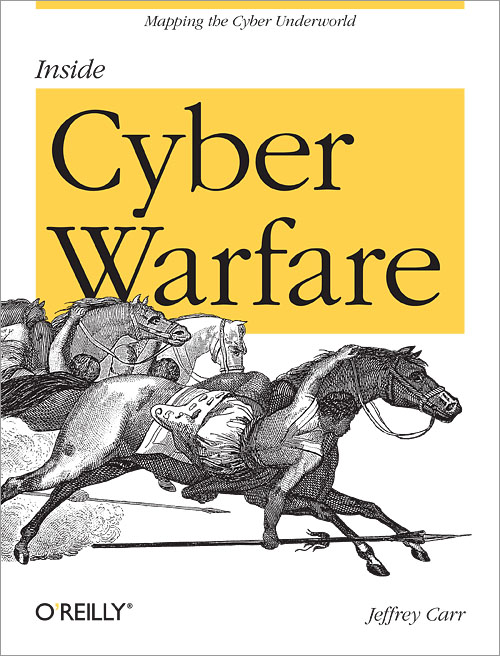
Inside Cyber Warfare: Mapping the Cyber Underworld  by Jeffrey Carr

This Is for the Mara Salvatrucha: Inside the MS-13, America’s Most Violent Gang  by Samuel Logan

Full Disclosure:

In copmpliance with new Federal regulations of dubious Constitutional merit, I hearby declare ZP does not accept money for publishing reviews or any paid advertising. Courtesy review copies were extended to me by authors or publishers acting on behalf of Sam Logan, Tom Barnett and Jeff Carr. I edited the first book in this post and was a contributing author to the second one. All of the books, with the exception of Cyber Warfare have been the subject of prior reviews or posts at ZP.

Nixon vs. The Neoconservatives?

Friday, December 11th, 2009


Some interesting, if oddly interpreted, background at HNN on Fritz Kraemer, the influential hardliner and  intellectual mentor of Henry Kissinger and Al Haig, and Kraemer’s influence in American foreign policy:

Luke A. Nichter: Who Was Fritz Kraemer? And Why We Should Care.

Whether Vietnam, Iraq, or now Afghanistan, wars come and go, but the real battle is a philosophic one between two sects of conservatives. In The Forty Years War: The Rise and Fall of the Neocons from Nixon to Obama, authors Len Colodny and Tom Shachtman challenge readers to examine the role of a little-known Pentagon figure named Fritz G.A. Kraemer. Colodny and Shachtman argue that Kraemer was the leading intellectual behind what became known as the neo-conservative movement, witnessed by the fact that Kraemer influenced so many high-ranking conservative figures over the course of  six decades.….This meeting was probably the only one to have occurred during the Nixon presidency in which Nixon and Kissinger permitted a rigorous debate, in the Oval Office no less, over the merits of not just Vietnam policy, but Nixon foreign policy more generally. Kraemer knew the issues well enough that both Nixon and Kissinger were forced to defend themselves to someone who represented an increasingly disenchanted sect of conservatives. Kraemer believed, as other conservatives did, that the conduct of Nixon foreign policy had became tainted by short-term political considerations, and that politicians had acted as a restraining influence on military leaders who believed they were capable of achieving a military victory.. 

The Nixon Quartet

….At the heart of the dance was a fundamental philosophic difference between Kraemer’s ideologically purist, militarist, anti-diplomacy stance, and Nixon’s quintessential pragmatic stance.  Kissinger and Haig were caught between these antipodal poles.  Kraemer had “discovered” Kissinger in 1944 at Camp Claiborne, had superseded his goal of becoming an accountant and readied him intellectually for Harvard.  As Kissinger would later acknowledge, “Kraemer shaped my reading and thinking, influenced my choice of college, awakened my interest in political philosophy and history, inspired both my undergraduate and graduate theses and became an integral and indispensable part of my life.”  In the Pentagon in 1961, Kraemer had similarly discovered Haig, and recommended him for greater responsibilities in the office of Secretary of Defense Robert McNamara.  At the moment of entering the White House in 1969, both Kissinger and Haig subscribed largely to Kraemer’s tenets.…..There’s much more to the story of this quartet, including Haig’s efforts to push Nixon up the plank toward resignation, and how those who detested Nixon’s foreign policies became the neocons in the Ford and Carter years, when they continued and magnified their efforts to undermine those presidents’ Nixonian foreign policies.

The two articles have a lot of interesting snippets of information but I am finding the ideological spin to be strange. The neoconservatives moved from the Left to the Right, starting roughly in this period, but they would not be identifiably so until the mid to late 1970’s. Nor are most of the conservative figures like Alexander Haig in the neoconservative group. When Haig was Secretary of State under Ronald Reagan, his relationship with the administration’s actual neoconservatives like Jeanne Kirkpatrick was very poor ( they were also poor with the administration’s moderates). The authors, in my view, are also overestimating Kraemer’s influence on Richard Nixon, who entered office with a firm vision of his foreign policy objectives.

Nevertheless, of serious interest to the Nixon scholar.


Switch to our mobile site