zenpundit.com » politics

Archive for the ‘politics’ Category

US Foreign Policy, Egypt and the Muslim Brotherhood

Wednesday, January 30th, 2013
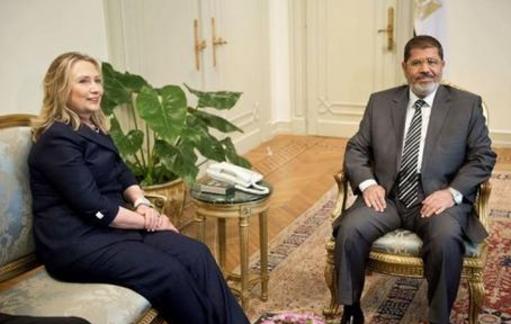
The Obama administration, though they would not characterize it as such nor have much desire to acknowledge it at all, have attempted  a strategic detente with the “moderate” elements of political Islam.

This policy has not been entirely consistent; Syria, for example, is a quagmire the administration has wisely refrained from wading directly into despite the best efforts of R2P advocates to drag us there.  But more importantly, under President Obama the US supported the broad-based Arab Spring popular revolt against US ally, dictator Hosni Mubarak, and pushed the subsequent ascendancy of the Muslim Brotherhood in Egypt and the Libyan revolution against the entirely mad Colonel Gaddafi. These appear to be geopolitical “moves” upon which the Obama administration hopes to build.

I would like to emphasize that there is one legitimate and valid strategic pro to this sub rosa policy; namely, if everything went well, it would provide the United States with powerful triangulation against revolutionary, apocalyptic, radical Islamism as expressed by al Qaida and various Salafi extremist movements. There are reasons, rooted in takfirism, strategy and the politics of lunacy that our terrorist enemies frequently hate and revile the Brotherhood as traitors, apostates or whatever. Isolating the most actively dangerous and violent revolutionary enemies from a large mass of potential allies is, at least, a good strategic goal.

It is also my view, that this “outreach” is as politically sensitive  to the Obama administration as was the China Opening was to Nixon and about which they have been equally opaque and misleading for fear of a domestic backlash. The weird, foot-dragging, dissembling, embittered, kabuki drama inside the Beltway about public statements and intelligence on whether Benghazi was caused by obscure crackpot Islamophobic film makers or a well-orchestrated terrorist attack  is in my view due to a major foreign policy strategy never having been framed in public for what it is. I’m sure people will differ strongly with me on this (which is fine), but I would characterize detente with Islamists as a strategic shift on par with the “Pivot to Asia”.

The downside here is that first, things are not likely to come out well at all, as unfinished revolutions tend to give birth to monsters; and secondly, any detente with “moderate” political Islam is an uncertain gamble based on certain exceptionally optimistic conceptions of not only what the Brotherhood might do, but about it’s very nature.

While the removal of Arab dictators resonated with American values , it was questionable realpolitik while the administration’s de facto support of  Egypt’s Muslim Brotherhood faction over poorly organized secular liberal modernists was an act of realpolitik that required a compromise of the democratic values so recently invoked to justify abandoning Mubarak. This was cynical diplomatic flexibility worthy of Talleyrand.

Unfortunately, the most democratic thing – perhaps the only thing – about Mr. Morsi and his Brotherhood supporters was his election.

The Egyptian people who are subjected now to thuggery from both Morsi’s Islamist stormtroopers and from the security forces of the Egyptian military are less sanguine than are the Brotherhood’s cheerleaders inside the administration. The Egyptian people, in fact, seem to be in revolt against domination by the Muslim Brotherhood’s shadow government.

The first question to ask in assessing if the Obama administration policy here is wise would be “What is the nature of the Muslim Brotherhood?” Americans love to personalize foreign policy, but if  Morsi were to be toppled or die, the Brotherhood will remain what it currently is, the best organized political force in Egypt and one widely influential throughout the Arab world and the West itself.

I am not an expert on the Muslim Brotherhood, nor am I an Arabist by education. Most of us aren’t – a group that I fear includes most of the Obama administration officials involved in shaping this policy. Almost fifty years after King Faisal determined to export Wahhabism, more than thirty years since Khomeini’s Revolution and more than ten years since 9/11 the USG still has less in-house expertise related to Islam than it did about the Soviet Union and Communism a decade after the Berlin Blockade.

Perhaps we all should begin learning more?

Here is an analysis from FPRI; it is extremely critical but it touches on organizational aspects of the Muslim Brotherhood that I have not seen elsewhere (hat tip to David Ronfeldt). Feel free to suggest others, both for and against. The Brotherhood is a very large group with a long history that includes violence , terrorism and subversion on one hand and peacefully representing expressions of pious, middle-class, social conservatism in other places and times:

Lecture Transcript: What Every American Should Know about Egypt’s Muslim Brotherhood, Delivered by Eric Trager 

….Two years ago when I was doing my dissertation fieldwork in Cairo, I sought out interviews with leaders from the Muslim Brotherhood, and I was referred to a man named Muhammad Morsi, now the President of Egypt. At the time, President Mubarak was ill and had gone off to Europe for operations amid a lot of mystery surrounding his health. I asked Muhammad Morsi whether the Muslim Brotherhood would run a presidential candidate if Mubarak died tomorrow. Here is what he said:

[From an audio file played by Trager]

Eric Trager: You don’t see the Muslim Brotherhood nominating a presidential candidate [if Mubarak dies tomorrow]?

Muhammad Morsi: No… because society is not ready… Our society is not ready yet to really defend its worth. We want a society to carry on its responsibilities, and we are part of this society. Another thing, if we are rushing things, then I don’t think that leads to a real stable position.

When he made that statement, I don’t think he was lying, and I don’t think he was being coy. I think that he didn’t expect that he would be faced with this reality in a mere six months. He did not expect that Mubarak would step down six months later and, to be completely honest with you, neither did I. My dissertation was entitled “Egypt: Durable Authoritarianism”—until the revolution.

What did Morsi mean when he said that the Brotherhood was trying to build a society? Let me give you some background on the Muslim Brotherhood. It was founded in 1928 by Hassan al-Banna, who was a schoolteacher in Ismailia. The Muslim Brotherhood’s goal was then—and remains now—to establish an Islamic state in Egypt. The way it pursues this goal is by trying to Islamize Egyptian society. Through social services, education, and the mosque, it sought to make Egyptians more religious and more Islamic as a grassroots strategy for building an Islamic state. That’s very, very different from a strategy that says, “We’re going to run for president, run for the Parliament, and use that power to transform society.” Rather, the Brotherhood says, in effect, “We’re going to Islamize society to build towards power.” It was a long-term strategy; it took them 84 years before they ran for and won the presidency. So Morsi told me in 2010 that the Muslim Brotherhood was not going to run for the presidency because it was not done Islamizing Egyptian society….

Read the rest here.
The Controversial CTC Report

Friday, January 25th, 2013

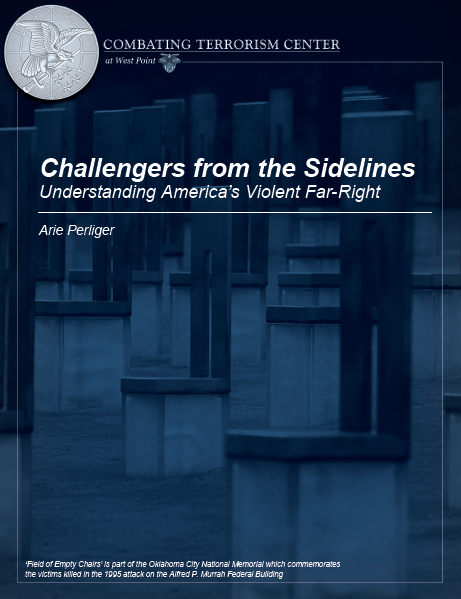
The Center for Combating Terrorism at West Point released a report on domestic terrorism that raised hackles for a number of reasons. Despite the dismissals of liberal political pundits, the reasons for objections to the CTC report are legitimate but they did not need to arise in the first place and might have been avoided with a slightly different editorial approach or appropriate caveats (I just finished reading the report, which is primarily focused on the usual suspects). Here’s why I think the normally well-regarded CTC stumbled into a hornet’s nest:

First, in this foray into domestic terrorism analysis, the center chose to concentrate only on the threat of violence of the Far Right while ignoring other threats coming from the Far Left, infiltration by criminal insurgent networks from Mexico, notably the ultraviolent Zetas whose reach has stirred gang violence in Chicago and Islamist terrorism, either homegrown “lone wolves” or from foreign infiltration or subversion. In itself, this is understandable if the CTC plans a series of reports with a separate focus on different domestic threats; but without that context, it is a myopic analytic perspective, particularly given the demonstrated capabilities of various AQ affiliates or just south of the border, the criminalinsurgency of  the narco-cartels. Had all of these been addressed in one omnibus report, any complaints from conservatives were likely to have been muted or nonexistent. This is not to say that the radical American Far Right does not have a violent threat potential of it’s own worth studying; it does and it is real. But available evidence indicates it to be the least organized, least operationally active and least professionally competent in terms of terrorist “tradecraft” of the three.

The second and most problematic aspect of the report is an intellectually sloppy definition of a dangerous “antifederalist movement”  where noxious concepts like “white supremacy” and wacko conspiracy theories are casually associated with very mainstream conservative (or even traditionally bipartisan !) political ideas – coincidentally, some of the same ideas that contemporary “big government” liberal elites tend to find irritating, objectionable or critical of their preferred policies. Part of the equation here is that American politics are evolvng into a very bitterly partisan, “low trust” environment, but even on the merits of critical analysis,  these two passages are ill-considered and are largely responsible for most of the recent public criticism of the CTC:

….The antifederalist rationale is multifaceted, and includes the beliefs that the American political system and its proxies were hijacked by external forces interested in promoting a “New World Order” (NWO) in which the United States will be absorbed into the United Nations or another version of global government.  They also espouse strong convictions regarding the federal government, believing it to be corrupt and tyrannical, with a natural tendency to intrude on individuals’ civil and constitutional rights.  Finally, they support civil activism, individual freedoms, and self government

….In contrast to the relatively long tradition of the white supremacy racist movement, the anti-federalist movement appeared in full force only in the early to mid-1990s, with the emergence of groups such as the  Militia of Montana and the Michigan Militia. Antifederalism is normally identified in the literature as the “Militia” or “Patriot” movement. Anti-federalist and anti-government sentiments were present in American society before the 1990s in diverse movements and ideological associations promoting anti-taxation, gun rights, survivalist  practices,and libertarian ideas 

This is taxonomic incoherence, or at least could have used some bright-line specifics ( like “Posse Commitatus” qualifying what was meant by “anti-taxation” activists) though in some cases, such as “libertarian ideas” and “civil activism”, I’m at a loss to know who or what violent actors they were implying, despite being fairly well informed on such matters.

By the standard used in the first paragraph, Glenn Greenwald, Ralph Nader and the ACLU would also be considered “far right antifederalists”. By the standards of the second, we might be in physical danger from Grover Norquist,  Congressman John Dingell and Penn Jillette. No one who opposed the recent increases in income tax rates, dislikes gun-control or thought the DOJ may have abused it’s power in the prosecution of Aaron Swartz or in their stubborn refusal to prosecute Bankster racketeering is likely to welcome a report under the auspices of West Point that juxtaposes such normal and perfectly valid American political beliefs with neo-Nazism. A move that is simply going to – and quite frankly, did – gratuitously irritate a large number of people, including many in the defense and national security communities who are a natural “customer base” for CTC reports.

As I said previously, this could easily have been completely avoided with more careful use of language, given that 99% the report has nothing to do with mainstream politics and is concerned with actors and orgs with often extensive track records of violence. As the CTC, despite it’s independence, is associated so strongly with an official U.S. Army institution, it needs to go the extra mile in explaining it’s analysis when examining domestic terrorism subjects that are or, appear to be, connected to perfectly legitimate participation in the political process. This is the case whether the subject is on the Left or Right – few activists on the Left, for example, have forgotten the days of COINTELPRO and are currently aggrieved by the activities of Project Vigilant.

I might make a few other criticisms of the report, such as the need for a better informed historical perspective, but that is hardly what the recent uproar was about.

“The Galula Doctrine”

Wednesday, January 23rd, 2013

Small Wars Journal has published another edition of the excellent COIN interview series conducted by Octavian Manea. Here he interviews A.A. Cohen, author of Galula: The Life and Writings of the French Officer who Defined the Art of Counterinsurgency 

The Galula Doctrine: An Interview with Galula’s Biographer A.A. Cohen

OM: Which were the role of Mao and the exposure to Chinese civil war in Galula’s story? It seems to be his decisive formative lab experience like Russia was for George Kennan.

AAC: Unquestionably, of all the influences exerted on Galula’s treatise, Mao and the Chinese Civil were the greatest. Galula had a strong intellectual admiration for Maoist revolutionaries, despite being very opposed to what they stood for. Before the Chinese Civil War, Galula had no interest in insurgency or counterinsurgency. He had not fought as a Partisan during WW2; he had no experience or interest in these fields until he was exposed to China as of late 1945, in the thick of its civil war. There, his analytical penchant led him to see himself as the decipherer of Mao, intent on getting to the bottom of what the revolutionaries were fundamentally about. Galula cut through the egalitarian propaganda and all that surrounding the People’s revolution. Above all, he wanted to understand why these guys were gaining momentum as they were despite the unfavorable odds. When he figured it out, he reverse-engineered their methods to arrive at a counter-process to revolution and insurgency. His embrace of Chinese dialectics, and with these, the notion of unity of opposites or yin and yang, was helpful in achieving this.

Is counterinsurgency to Galula more of a strategy or  more of a technique and a methodology?

What Galula offers, first and foremost, is a doctrine – not a strategy. His doctrine is underpinned by an important theory about people and what motivates them to take up arms, or to side with those who do. The theory goes that in times of danger (war), the majority of people will be motivated primarily by a fundamental need for security. Galula is adamant about this. But he also recognizes that there will be a minority of people – the instigators at the core of a movement – that will be ideologically, or even fanatically motivated. These are the true believers. He makes no qualms about prescribing that this is the group that the counterinsurgent or counterterrorist will need to find and neutralize, while protecting the rest of the population that aspires to a normal, if not better life. If you buy into this theory, Galula’s doctrine offers a multi-step framework for operations; in other words, a method to counterinsurgency. His famous eight steps are there to provide some logical linearity to what is otherwise a very nonlinear form of warfare. Within that framework, you have the flexibility to formulate your strategy and to conduct your operations to achieve your objectives.

Read the rest here.

I agree that Galula was not offering a strategy. Even more strongly, I think Cohen is correct about the historical importance of China’s long period of disorder, from the overthrow of the Q’ing dynasty to Mao ZeDong’s declaration of the People’s Republic, for Galula. However, not just for him but for anyone interested in questions of war and statecraft where insurgency, warlordism, state failure, state-building, foreign intervention, balance-of-power politics, ideological mass-movements, 4GW, revolution and total war coexisted and co-evolved.

The best comparison in our lifetime to China in this period would have been Lebanon  in the 1980’s, except that China’s polycentric conflict was even more complex and on an epic scale.

“Sustaining” your Way to Serfdom as a Grand Strategy

Monday, January 14th, 2013

Friend of the blog, commenter L.C. Rees, likes to point out that one of the most important part of a grand strategy, particularly one that is maintained despite evidence of being a geopolitical failure, are the domestic political effects that work to the advantage of the faction supporting it.  In my view, grand strategy usually has a political or cultural evolutionary component and, human nature being unchanging, Rees’s cynical observation has merit.

Last year, a couple of JCS aides/field grade officers wrote a grossly overpraised paper that was pushed by Anne-Marie Slaughter, Thomas Friedman and assorted worthies, that purported to be about a new grand strategy with which America could navigate the world. Mostly it centered on a preference for an America being run by a vaguely EU-like, technocratic, regime under the rubric of “sustainment”, in which the authors wisely folded in a number of  shibboleths popular with the corporate-liberal upper class who write large donation checks to think tanks or make their living in public policy and academia.

The talk of this nature died down when the election cycle began, but the themes were recently revived by the New America Foundation’s Grand Strategy Project whose director had an op-ed in Foreign Policy to reintroduce this agenda to the chattering classes now that the pesky voters are out of the way until 2014:

A New U.S. Grand Strategy 

….Walkable communities: The first pool of demand is homegrown. American tastes have changed from the splendid isolation of the suburbs to what advocates are calling the “five-minute lifestyle” — work, school, transit, doctors, dining, playgrounds, entertainment all within a five-minute walk of the front door. From 2014 to 2029, baby boomers and their children, the millennial generation, will converge in the housing marketplace — seeking smaller homes in walkable, service-rich, transit-oriented communities. Already, 56 percent of Americans seek this lifestyle in their next housing purchase. That’s roughly three times the demand for such housing after World War II.
If only Bismarck had included some “walkable communities” for Prussia, Europe might have avoided the tragedy of World War I.
.
Incidentally, all of this argument from assertion is unsupported rubbish keyed to a preexisting anti-suburban agenda the Obama administration brought with them into office in 2009. As Joel Kotkin explained:

….Whenever possible, the Clintons expressed empathy with suburban and small-town voters. In contrast, the Obama administration seems almost willfully city-centric. Few top appointees have come from either red states or suburbs; the top echelons of the administration draw almost completely on big city urbanites—most notably from Chicago, New York, Los Angeles, and San Francisco. They sometimes don’t even seem to understand why people move to suburbs.

Many Obama appointees—such as at the Departments of Transportation and of Housing and Urban Development (HUD) and at the Environmental Protection Agency (EPA)—favor a policy agenda that would drive more Americans to live in central cities. And the president himself seems to embrace this approach, declaring in February that “the days of building sprawl” were, in his words, “over.”

Not surprisingly, belief in “smart growth,” a policy that seeks to force densification of communities and returning people to core cities, animates many top administration officials. This includes both HUD Secretary Shaun Donovan and Undersecretary Ron Sims, Transportation undersecretary for policy Roy Kienitz, and the EPA’s John Frece.

Transportation Secretary Ray LaHood revealed the new ideology when he famously declared the administration’s intention to “coerce” Americans out of their cars and into transit. In Congress, the president’s allies, including Minnesota Congressman James Oberstar, have advocated shifting a larger chunk of gas tax funds collected from drivers to rail and other transit.

In addition, the president’s stimulus—with its $8 billion allocation for high-speed rail and proposed giant increases in mass transit—offers little to anyone who lives outside a handful of large metropolitan cores. Economics writer Robert Samuelson, among others, has denounced the high-speed rail idea as “a boondoggle” not well-suited to a huge, multi-centered country like the United States. Green job schemes also seem more suited to boost employment for university researchers and inner-city residents than middle-income suburbanites.

Suburbanites may not yet be conscious of the anti-suburban stance of the Obama team, but perhaps they can read the body language. Administration officials have also started handing out $300 million stimulus-funded grants to cities that follow “smart growth principles.” Grants for cities to adopt “sustainability” oriented development will reward those communities with the proper planning orientation. There is precious little that will benefit suburbanites, such as improved roads or investment in other basic infrastructure.

Kotkin nails it. Mr. Doherty is simply trying to find some national security window dressing for an elite preference that ordinary people will be much easier to manage, monitor and fleece if they are concentrated in high-density urban housing and prevented from voting with their feet by a network of punitive, anti-development, anti-mobility, Federal  regulations. The research paper, if you can call it that, justifying this authoritarian agenda can be found here. Judge for yourself.
.
However, this is no idle pipe dream, it has been done before. The  Japanese pursued a similar national “grand strategy” after WWII with the blessing of Washington to reconstruct defeated Japan: the old, independent,  Japanese business empires called zaibatsu were transformed by SCAP into submissive keiretsu that would take “administrative guidance” from the Ministry of International Trade and Industry and the Ministry of Finance. In return, the keiretsu were heavily subsidized by the government, which kept Japanese “salarymen” to an artificially low “middle-class” standard of living with macroeconomic policies that forced the Japanese to have an extremely high level of savings. A docile work force penned into tiny apartments, governed by a de facto one-party autocracy of the Liberal Democratic Party that kept the rent-farming machinery in place for big business for fifty years. It isn’t a great model, it is not what Walter Lippmann would have called “a good society” but it did work.
.
Mexico under the PRI dictatorship was a more backward version of this paradigm, as was Chicago under Mayor Daley.
.
Now back to our own grand strategy of walkable communitarianism:

…..Every continental-scale economic region must embark on a decisive sustainability strategy without delay. Working within existing norms of the World Trade Organization and the United Nations, America will lead the partnership of major economies to refashion the global economic system around eight or nine economic blocs, each boasting the scale necessary to support mature industrial ecosystems. This will mean promoting and strengthening regional economic blocs such as the Association of Southeast Asian Nations, the Union of South American Nations, the African Union, the Commonwealth of Independent States, and the Organization of Islamic Cooperation.

This part is literally nonsensical.

Say what you want about Osama bin Laden’s powers of rhetoric: he may have failed to convince his fellow Muslims to unite the ummah into a Caliphate but he evidently convinced a lot of people at The New America Foundation that Islam is an economy.

And as aside, why the hell is pushing political unification of South America or Africa under top-heavy, transnational bureaucracies in American interest? It sure isn’t in the interest of poor Africans or campesinos. For that matter, how can Africa unify if a third of their states will be in the OIC? WTF? Does Foreign Policy use editors or is it just a blog?

However, all that was simply geopolitical fantasizing over matters about which the United States has little control and would be unlikely to come off even under the best of circumstances. The next part I suspect is intended much more seriously. It certainly reflects a worldview that is pernicious and apparently more widespread among our elite than we realized, for which they are now testing the waters, to see if their fellow citizens are the herd they imagine us to be and if they can get away with it.

….Just as America would never fight a 21st-century war with Korean War-era weapons, it should not govern today with institutions devised for a bygone era. The Founding Fathers established a constitution that allows for the adaptation of the institutions of government to the knowledge, threats, and opportunities confronting each generation. Americans should make use of that foresight. Under this strategy, the country will adapt the institutions of its federal government to execute this grand strategy and invest in the American people to ensure that they receive the opportunities they need to be informed and engaged citizens. 

This is a tentative call, in milquetoast, coded, language, to find legal stratagems to gut the Bill of Rights and euthanize American democracy, or at least render it comatose, as a mere facade for a new paternalist technocracy that treats citizens as wards or children while we are rent-farmed for the benefit of a small elite. Certainly when we are all marooned in our government-regulated, high-density, housing, disarmed and without private transportation or much disposable income it will be too late for us to raise our voices in protest.  Doherty is correct about one aspect, such a society is probably “sustainable”; feudalism after all lasted more than a thousand years.

In plain English, the strategy of “sustainment” is a long term policy for postmodern serfdom with most of us intended to be walking behind the oxen when we are not wearing the yoke ourselves. Despite the nervous, thin-lipped, smiles and hasty reassurances, these people truly wish us and our children ill.

The good news is that none of this can come to pass without our consent. The U.S. Constitution is both sword and shield, if you are willing to pick it up. Speak, write, organize, litigate and vote out of office would-be authoritarians no matter what party label they wear. The best antidote for our creeping oligarchy is electing and appointing to office a large number of people outside of this exceedingly insular, geographically and intellectually narrow, social circle of graduates of  a handful of universities and last few percentage points of socioeconomic status who have in the last 15 years grabbed control of our government.

Really, we’re Americans – our talent pool is 315 million strong. We can easily do better.

They are being sincere, even if they are not being accurate

Saturday, January 12th, 2013

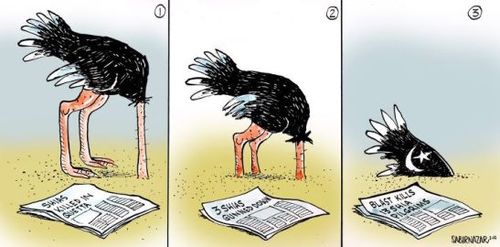
[ by Charles Cameron — disentangling religion / politics braids in Pakistan and elsewhere ]
.

image credit: Pakistani cartoonist and artist Sabir Nazar

.

Blog-friend Omar Ali writes:

The state will make a genuine effort to stop this madness. Shias are still not seen as outsiders by most educated Pakistani Sunnis. When middle class Pakistanis say “this cannot be the work of a Muslim” they are being sincere, even if they are not being accurate.

The “madness” he’s discussing is the extensive killing of Shia Muslims by Sunni Muslims in Pakistan, and I’d recommend both his own article on 3 Quarks Daily and Bahukutumbi Raman‘s on Raman’s strategic analysis as offering detailed background for a topic I addressed from a different angle in Ashura: the Passion of Husayn.

**

It’s Dr. Ali’s final sentence in the quote above that interests me, though, as you’ve probably deduced already from the title of this post:

When middle class Pakistanis say “this cannot be the work of a Muslim” they are being sincere, even if they are not being accurate.

I haven’t quite known how to say this succinctly before, but I think Dr Ali hits a whole array of nails on the head.

Religions are mostly preached to whoever listens — and those who listen can be a pretty diverse lot, particularly across continents and centuries. The upshot is that religions generally wind up being interpreted in a variety of ways to suit the wide variety of human temperaments and situations.

Et voilà! Members of a religion who see it as a force for peace will tend to say of those who dismay them by using it as a cover for violence, “this cannot be the work of a member of my faith” — and they are being sincere, their understanding of their own religion is as peaceable as they say it is.

They are being sincere — even if they are not being accurate, and their religion as a “big tent” across cultures, classes, continents and centuries, also includes sincere people whose views are radically and violently opposed to theirs.

**

If Walt Whitman can say it, you’d better believe it can be said of religions with a billion or more adherents:

Do I contradict myself? Very well, then I contradict myself, I am large, I contain multitudes.


Switch to our mobile site