zenpundit.com » insurgency

Archive for the ‘insurgency’ Category

Khan on Taliban Warfare

Friday, April 2nd, 2010

I take a very skeptical position toward America’s alliance with Pakistan, whose elite, to put it as charitably as I can, have a myopic policy toward the Taliban and Islamist extremist groups. That said, the DoD has in previous decades, had standing mil-mil exchanges with Pakistan’s Army that were usually better and far more productive than our diplomatic relationship with Islamabad  ( a situation that is mirrored in Latin American relations). This tradition generally involves talented Pakistani officers partaking in training and educational programs with their American counterparts or studying in our war colleges.

Going back through recent articles at SWJ leads me to recommend the following judicious analysis of the Taliban by LTC. Ehsan Mehmood Khan, currently a student at National Defense University. It’s an excellent survey of the Taliban’s strengths at formulating and implementing their political-military strategy within the context of different strategic schools of thought and it should have attracted more attention than it received when it was first published at SWJ Blog.

 A Strategic Perspective on Taliban Warfare

Taliban Warfare has occupied news headlines in the global information expanse for over a decade. It is also a topic of choice for academics and scholars. However, the subject is often viewed and analyzed in a subjective rather than objective manner. It is mostly looked at across the prism of terrorism – atrocities and crimes against humanity committed by a group of non-state, though not stateless, bandits. Seldom has a theorist or practitioner picked up the pen to draw on the military aspects of the war so as to reach correct conclusions as to how could this war come to an acceptable-by-all end. This line of thought and reasoning might hold good for a given category of politicians but the students of military strategy and those involved in kinetic operations in a counterinsurgency campaign remain bewildered on the nature of the war. There is a need to understand Taliban as people, not monster, and as warriors not gangsters. Likewise, Taliban Warfare is required to be understood in correct military perspective rather than a mere act of crime, terrorism or banditry.

Metz on Unruly Clients

Wednesday, March 31st, 2010

Dr. Steve Metz of SSI takes on a theme of the “tail wagging the dog” in geopolitical relationships in World Affairs Journal:

Unruly Clients: The Trouble with Allies

When Congress approved a massive, five-year assistance package for Pakistan in the fall of 2009, much of it earmarked for strengthening the country’s military and security forces, Pakistani leaders reacted by immediately biting the hand that was trying to feed them. During a talk in Houston, former President Pervez Musharraf slammed the conditions in the bill, asserting that Pakistan knew better than the United States how to root out terrorists. General Ashfaq Kiyani, the Pakistani army chief, labeled the offer of support “insulting and unacceptable.” Members of the Pakistani parliament called the $7.5 billion appropriation “peanuts.” Some of this grumbling may have been for show, another example of Pakistan’s finely honed skill at extracting more and more money from the United States, but it also reflected a cynicism and sense of estrangement on the part of the Pakistani elites. And in this regard the episode highlights a central flaw in American security strategy: reliance on allies whose perceptions, priorities, values, and objectives tend to be quite different from our own.

….So where does all this leave U.S. strategy? Americans could soldier on, hoping for miracles and redefining expectations at each inevitable failure. Washington’s flawed allies will continue superficial reform, at least until they conclude that the political and personal costs of doing so outweigh the benefits. But husbanding of power rather than the decisive defeat of the extremists or the building of a stable, liberal system will always remain their goal. They will never fully share America’s view of the threat or the solution to it. Some, like Nuri Kamal al-Maliki in Iraq, may eventually reach a point where they can wield power without much American assistance. Recognizing that association with the United States erodes their legitimacy, leaders in this position will end or downgrade the U.S. alliance, pressuring violent extremists who pose a direct threat to them while ignoring or even cooperating with those who target only foreigners. Others like Karzai-and whoever rules Pakistan-will continue to minimize conflict with violent extremists who do not target them directly and reject reform that might undermine them or the elites who support them.

Read the whole thing here.

A similar argument to Metz’s analysis of 21st century strategic foreign policy was made in The Cold War: A New History by John Lewis Gaddis, who detailed the extreme headaches satellite leaders caused Khrushchev and Brezhnev, or American troubles with the Shah, Somoza and Ngo Dinh Diem during the Cold War. Patrons who become dependent upon clients are hostage to their pawn’s incompetence and perverse defiance of political realities. In that myopia, patrons lose sight of their own real interests.

Metz hits on that delicate point, regarding the diffuse character of Islamist extremism:

….Americans ought to stop hoping for miracles and find realistic and affordable methods of protecting their interests. Continued improvement in homeland security is part of this. There may even come a time when the United States must consider limiting access to the American homeland for individuals from regions and nations that give rise to violent extremism. 

If the United States cannot get effective and reliable security cooperation with various Muslim states like Yemen or Pakistan, a more cost-effective response than turning all of our own domestic procedures into “security theater” is to sharply circumscribe immigration and travel from those states to a level consistent with “best practice” counterintelligence norms until we garner the cooperation we require in clamping down on our enemies. There’s no shortage of applicants for visas from other backgrounds in Asia, Africa, Latin America and Europe who pose few if any risks to American society. This by no means would solve all our security problems but it will put a dent in the probability of another underpants bomber getting a plane ticket to visit.

The Need for Old Hands: Mackinlay on Old COIN

Friday, March 19th, 2010

Currently reading The Insurgent Archipelago by John Mackinlay. Not finished yet but I found this passage striking:

….The ratio of coloniser to colonised – and of the tiny British contingent to the vast numbers of the native population – suggested that a degree of consent to their presence was already inherent. The officials in each colony were competitively selected from an educated and ambitious British upper class, in many cases they were talented and intrepid men, used to living and campaigning in the field, with an intelligent grasp of their territory, its people, languages and culture. They survived and succeeded on their wits, natural authority and knowledge. When the colonised population rose up in insurrection and military force was rushed to the scene, it was subordinated to these same British administrators who became responsible for the direction of the campaign. All the problems of devising a political strategy, ensuring the legitimacy of the military actions and restoring the structures of governance were taken care of by a familiar hub of individuals. It was a continuously reconvening club in which personal relationships tended to override the ambiguities of their civil-military partnership.

Admittedly, there’s a shiny high gloss of romantic nostalgia for the Raj here, polishing the historical reality. The British Empire also saw examples of arrogance or cruelty by British colonial officials that helped provoke uprisings like the Sepoy Mutiny. Or, high-level imperial administrators could zealously pursue local colonial expansion, as Viscount Milner did in starting the needless Second Anglo-Boer War, which partially involved putting down a grueling Trekboer insurgency, that ultimately weakened the Empire at the strategic level.

Those calamities, as expensive and bloody as they were, were exceptions. Mackinlay is correct in assessing the value of Britain’s colonial administrative class, whose deliberate cultivation of “Old Hands” permitted a sixth of the earth’s surface to be ruled relatively cheaply from Whitehall. Lord Milner, for all his faults, could at least speak to President Kruger in his own language and understood the Boer states on which he was waging war, even if he disdained the Afrikaner settlers. It’s hard to imagine many American statesmen or senior generals (or sadly, CIA agents and diplomats) fluently debating foreign counterparts in Arabic, Pashto, Farsi or Chinese. British officialdom took the time – and had the time, professionally – to learn the languages, dialects and customs of the peoples with whom they allied or fought, conquered and ruled.

Not so in contemporary peacekeeping /crypto-COIN operations , according to Mackinlay:

By the 1990’s the colonial officials who had been the key element in every operation since Cardwell were now missing. Coalition forces were intervening in countries that were the antithesis of the former colonies, where the incoming military were regarded as occupiers and where there was no familiar structure of colonial officials and district officers to be seen. Moreover, the diplomats who belatedly attempted to fill this role, although no doubt intellectually brilliant, crucially lacked the derring-do, local credibility and natural authority of their colonial era predecessors. A few extra hands from the Foreign Office or the State Department could not compensate for the loss….

….Although at a local level the British counter-insurgent techniques proved to be successful, broader problems presented themselves as a result of an absence of strategy and a failure of campaign design, particularly in the civil-military structures. It was simply not a realistic option to fill the void left by the departure of a national government – with all its natural expertise and authority – with a band-aid package of contracted officials and flat-pack embassies.

New Hands cannot act or think like Old Hands. They lack not only the in-country experience and linguistic skills but the entire worldview and personal career interests of the American elite mitigate against it. “Punching tickets” is incompatible with becoming an Old Hand and aspiring to be an Old Hand is incompatible with continued employment at most foreign policy agencies of the USG.

American Foreign Service Officers, CIA personnel and flag officers never had the same historical frame of reference as their Imperial British cousins, but the culture of the Eastern Establishment approximated a high church Yankee Republican version that provided an elan, a worldly knowledge and moral certitude until the Establishment’s will to power and self-confidence was broken by the Vietnam War. Subsequent generations of American elite have been indoctrinated in our best institutions to instinctively distrust the marriage of cultural knowledge and political skills to the service of advancing national interest as “Orientalism“.

I am not an admirer of Edward Said but the man was no fool. He understood the strategic importance for his radical political faction of populalrizing the de-legitimization the learning of other cultures and languages as immoral for any reason except partisanship in their favor against the interests of the predatory West. This is why something as esoteric and parsimoniously funded as “Human Terrain Teams” meet with volcanic rage from  academic leftists, especially in the fields of anthropology and political science. This is the sort of censorious mindset that would have  made the works of Herodotus, Alexis de Tocqueville, the Marquis de Custine, Richard Francis BurtonT.E. Lawrence, Ruth Benedict, Rene GroussetRaphael Patai and Bernard Lewis, to name just a few, impossible.

Recovering our capacity to act effectively and see with clarity requires the training of a new generation of Old Hands to interpret and act as policy stewards and agents in regions of the world in which most Americans are unfamiliar and likely to remain so. Current academic PC ideological fetishes reigning at our Ivy League universities artificially shrink our potential talent pool. Alternative educational pathways through military service academies, think tanks, professional and Cross-cultural associations and better USG training programs need to be developed to route around the university gateway that is largely in control of keepers hostile or indifferent to American foreign policy objectives. By the same token, USG agency and military personnel and security clearance policies need a systemic overhaul to better take advantage of those already in service who find their career paths blocked or frustrated.

We waste talent on a massive scale.

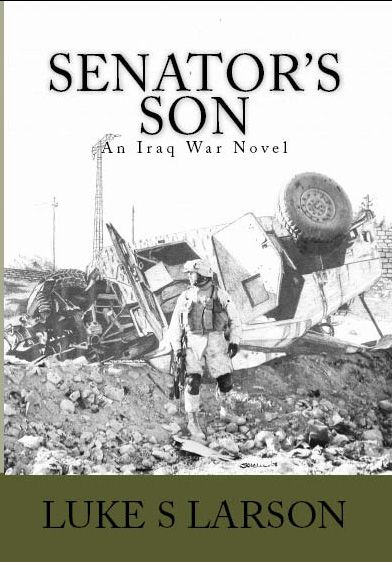
Review: Senator’s Son by Larson

Monday, March 15th, 2010

larson.jpg

Senator’s Son: An Iraq War Novel by Luke S. Larson

Fiction is not a genre that I usually review here, or get an opportunity to read often, but I received a courtesy review copy of a book Senator’s Son, by Iraq war vet, Marine officer and new novelist Luke Larson and was curious. The Iraq War and the War on Terror have produced a fine array of thoughtful books by veterans, war reporters and military thinkers like FiascoOne Bullet Away  and The Strongest Tribe, all of which were non-fiction memoirs, journalistic histories and quasi-policy books. By virtue of writing Senator’s Son as a novel, Larson was taking a different path in explaining his war.

There are two books at once in Senator’s Son. The first, is of course, a story, with characters and a plot and rising action, action, tragedy and theme – all the usual aspects of literature which I am not especially practiced at evaluating here. The second part is a contextual explanation of COIN by an author who lived the Iraq War. To his credit, Larson contacted me personally to request a “No bulls**t review”, so I will give the man what he asked for.

As an explanation of COIN, I think the book is a must read for anyone unfamiliar with the subject and the nuanced complexities that COIN entails. The gritty, unforgiving, human suffering and moments of triumph of soldiers waging “pop-centric” COIN that gets lost in powerpoint slides, in the dry abstractions of journal articles and blogospheric arguments far removed from the ground is present in ample measure in Senator’s Son. Many times, I paused in a passage and thought, “hmmm….I did not consider that”. Or “This is what the soldiers bear up under without complaint”. More people need to read that and digest what we ask of our men and women in Iraq and Afghanistan.

Senator’s Son also lays out, fairly methodically, how COIN theory may have been interpreted and debated by soldiers outside the wire, including cameo appearances or mention of real life COIN leaders woven into the story. The characters Bama, Cash, Rogue, Isaac, Gonzo the Iraqi and more, resist and adapt, struggling with their environment, unseen enemies and the political pressures of higher authorities, registering both frustration and progress in executing the mission of Golf Company. There’s even diagrams. If Senator’s Son is not on official COIN reading lists, it should be.

As a pure novel, judged on literary standards, Senator’s Son reflects its’ status as a “first novel” of a talented author whose vision of the craft is emerging. Larson excels at creating scenarios, staccato vignettes for the characters to act ( Larson may also have a future as a screenwriter – his book naturally flows in the mind like a movie). There’s always a believable, environmental, “texture” present that exceeds that of short story and science fiction writers, yet as a novelist, Larson leaves enough to the reader’s imagination so that the story moves at a dramatic pace.

Characterization in Senator’s Son is uneven. It takes a while for the individual personalities of the characters to shine beyond their common “Marine-ness” and we get only the briefest glimpse of the malign nature of the enemy, and that secondhand through the eyes of an Iraqi character. That probably is an accurate representative of the experience of most US soldiers and Marines in Iraq who are not interrogators; furthermore, having the antagonist that the characters struggle against be the total environment is perfectly legitimate. It would have been interesting for me to have seen how Larson would develop and utilize a figure who was the focus of evil; however that task would be fairly incompatible with getting an effective message across regarding COIN, success of which does not hinge on the defeat of super-villains or the resolution of black-white moral absolutes but is complexity written in shades of gray.

Finally, as an avid reader, I found Senator’s Son to be a page-turner. Several times, I looked at the clock while reading for what seemed to me a short time, noted it was 1:30 am and was regretful that I had to put it on my bedstand ( I always finished the chapter first though 🙂 ) only to repeat the process the following night.  Strongly recommended.

ADDENDUM – OTHER REVIEWS of SENATOR’S SON by:

Thomas P.M. Barnett 

Shrinkwrapped 

Shane Deichman

Cameron on Conflicts of Commands, Part II. – A Guest Post Series

Friday, March 12th, 2010

Charles Cameron, my regular guest blogger, is the former Senior Analyst with The Arlington Institute and Principal Researcher with the Center for Millennial Studies at Boston University. He specializes in forensic theology, with a deep interest in millennial, eschatological and apocalyptic religious sects of all stripes.  Here is part II. of a three part series by Charles, entitled “CONFLICT OF COMMANDS”.

PREFACE: 

I would like to state quite categorically that I am not in the business of making “moral equivalences” here. I have culled these quotes from a wide variety of sources – from friend and foe alike, moderate and extremist, local and far-flung. The fact that I juxtapose a variety of quotations in which the issue of divided lines of command comes up in no way means that I equate the principled opposition to state brutality of one quotation with the wilder reaches of conspiracist rhetoric in another. Part I has further details and provides my context. Please note too that as an appendix, I have attached two quotes that only indirectly address the issue of conflict of commands – a white supremacist quote, immediately followed by a principled quote about militia movement members “disgust at the genocidal fantasies in white supremacist discourse” – because I believe it is important to be aware just how far the rhetoric of hatred can go, and just how firmly it can be rebutted.        – Charles Cameron

Conflict of Commands II: Quotations

by Charles Cameron

Principle IV, Principles of International Law Recognized in the Charter of the Nüremberg Tribunal and in the Judgment of the Tribunal, 1950.

The fact that a person acted pursuant to order of his Government or of a superior does not relieve him from responsibility under international law, provided a moral choice was in fact possible to him.

*

No man can serve two masters: for either he will hate the one, and love the other; or else he will hold to the one, and despise the other…

Jesus Christ, in the Gospel according to Matthew, 6.24

*

Archbishop Romero to the Salvadoran military, March 24, 1980:

No soldier is obliged to obey an order that is contrary to the will of God. Now it is time that you recover your consciences and that you first obey your conscience rather than an order to sin.

Carolyn Forche, “Oscar Romero” in Susan Bergman, ed., Martyrs.

*

And we call on every soldier working in the crusader armies and puppet governments to repent to Allah and follow the example of the heroic Mujahid brother Nidal Hassan, to stand up and to kill all the crusaders by all means available to him supporting the religion of Allah and to make the word of Allah most supreme on earth.

Operation by the Mujahid brother Omar Al-Farooq the Nigerian, AQAP statement, 26 December 2009

*

Oath-Keepers’ Declaration of Orders We Will NOT Obey:

Recognizing that we each swore an oath to support and defend the Constitution against all enemies, foreign and domestic, and affirming that we are guardians of the Republic, of the principles in our Declaration of Independence, and of the rights of our people, we affirm and declare the following:

1. We will NOT obey any order to disarm the American people.

*

US Special Forces have conducted multiple raids into Pakistani territory, local daily The Nation reported today in a front-page article that was basically just quoting an earlier Guardian story. 

One previous US raid that occurred in 2008 was already known about. And when it happened, there was serious concern as to whether such actions by the Americans might lead to the breakdown of the Pakistani army. One respected London-based Pakistan academic said if American troops kept crossing into Pakistani territory he could envisage a situation where Pakistani commanders would lose control over soldiers who would want to fight the incursions.

Londonstani, blogging on CNAS’ Abu Muqawama

*

SINCE its meeting on 28th Shvat 5765, the Sanhedrin has deliberated the initiative of the Prime Minister of Israel, the decisions of the government, and legislation enacted by the Knesset regarding the plan known as “The Disengagement,” henceforth referred to in this document as “the uprooting.”

This plan involves the uprooting of Jewish communities in the Gaza strip and northern Samaria, the forced expulsion of Jews from their homes, and the willful transfer of these lands to a foreign power. Following an intensive study which took place regarding the halachic (authentic Jewish law) questions that arise from the government’s decision, the Sanhedrin hereby brings its conclusions and decisions to the public’s attention. [ … ]

7. Any Jew – including a soldier or policeman – who supports the uprooting, whether directly or indirectly, whether by voting in its favor, or by giving council, or by supplying vehicles or materials, and obviously, anyone who actively participates in the uprooting… by so doing, transgresses a large number of Torah commandments.

*

Members of all branches of the United States Military will soon be facing a most critical decision. A report emerged that Obama is using the deployment of additional troops to Afghanistan to cover for the movement of some 200,000 troops, presently on duty in countries other than Iraq and Afghanistan, to USNORTHCOM to prepare for the “expected outbreak of Civil War within the United States before the end of winter.”

LewRockwell.com

*

Rabbis and teachers from Hesder yeshivas, which offer Torah studies alongside military service, released a letter to students in which they reiterated their assertion that soldiers must refuse orders if they are commanded to evacuate settlements, arguing that Torah law is above the Israel Defense Forces. … “Unfortunately, the IDF has been used for purposes unrelated to Israel’s defense and directly opposed to God’s wishes for quite some time,” the rabbis wrote in the letter. “This situation faces IDF soldiers with a contradiction between Jewish commandments and commanders’ orders.”

Chaim Levinson, “Hesder yeshiva rabbis: Torah law is above IDF”, Ha’aretz, Deecember 18, 2009.

*

AL-JAZEERA: How can you agree with what Nidal did as he betrayed his American nation?”

AL-AWLAKI : More important than that is that he did not betray his religion. Working in the American Army to kill Muslim is a betrayal to Islam. American today is Yesterday’s pharaoh; it is an enemy to Islam. A Muslim is not allowed to work in the American Army unless he intends to walk the steps of our Brother Nidal. Loyalty in Islam is to Allah, His messenger and the believers, and not to a handful of soil they call “nation.” The American Muslim’s loyalty is to the Muslim Nation and not to America, and brother Nidal is a proof on that through [executing] his blessed operation, so may Allah reward him with the best of the rewards for that.

Al-Jazeera Interview with Anwar al-Awlaki regarding Maj. Hasan, December 23, 2009

*

You must understand that the desire of the nation isn’t meaningful for someone who believes in the creator.

Rabbi Ariel Bareli, quoted in Christian Science Monitor

(more…)


Switch to our mobile site