zenpundit.com » physics

Archive for the ‘physics’ Category

Pew II: Prevalence of belief in the Jinn

Monday, August 13th, 2012

[ by Charles Cameron — Corbin on Queen Bilqis, Qur’an and hadith regarding jinn, Pew statistics on belief in jinn — with some earlier Natsec implications & a non-serious suggestion from contemporary physics ]
.
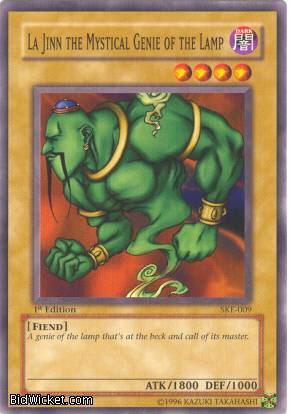
La Jinn the Mystical Genie of the Lamp
from the Yu-Gi-Oh card game

.

I’ve been “fond” of the jinn (djenoun) since first encountering them in the brilliant short stories of Paul Bowles, and notably his A Hundred Camels in the Courtyard.

But that’s a literary fondness, neither science nor belief-based on my part. In my view, that’s only right and proper, since djenoun belong in the realm of imagination — or better said, the Imaginal, as Henry Corbin terms it — see note 16, p, 326. of his Creative Imagination in the Sufism of Ibn ‘Arabi, where he speaks of the Sheikh’s Bilqis Queen of Saba in his poetry as a being “born from a jinn and a woman” — it’s a fascinating passage, connecting Bilqis with Jesus in terms of the (unorthodox) angelology that Corbin envisioned uniting the Abrahamic faiths at a visionary level.

**

Here are two of the mentions of jinn in the Qur’an:

And the Jinn race We had created before from the fire of a scorching wind. [Sura 15, 27]

Say: It has been revealed to me that a company of Jinns listened (to the Qur’an). They say ‘We have really heard a wonderful Recital! It gives guidance to the Right and we have believed therein: We shall not join (in worship) any (gods) with our Lord. And exalted is the Majesty of our Lord: He has taken neither a wife nor a son.’ [Sura 72, 1-3]

And here is a tale of the Prophet and a jinn, as narrated by the Companion Malik ibn Anas:

The Prophet said to the jinni: “This is the stride of a jinni, as well as the tone of his voice!” The jinni replied: “My name is Hamah ibn Laqqis ibn Iblis.” The Prophet said: “Only two generations seperate you from him [Iblis].” He replied: “True.” The Prophet asked: “How long have you lived?” The jinni replied: “Almost all of time. I was a small boy when Abel was killed. I believed in Noah and repented at his hands after I stubbornly refused to submit to his call, until he wept and wept. I am indeed a repentant — God keep me from being among the ignorant! I met the prophet Hud and believed in his call. I met Abraham, and I was with him when he was thrown in the fire. I was with Joseph, too, when his brothers hurled him into the well—I preceded him to its bottom. I met the prophet Shu’ayb, and Moses and Jesus the son of Mary, who told me: ‘If you meet Muhammad, tell him Jesus salutes thee!’ Now I’ve delivered his message to you, and I believe in you.” The Prophet said: “What is your desire, 0 Hamah?” He said: “Moses taught me the Torah, Jesus the Gospels, can you teach me the Qur’an?” So the Prophet taught him the Qur’an.

The Tasneem Project

**

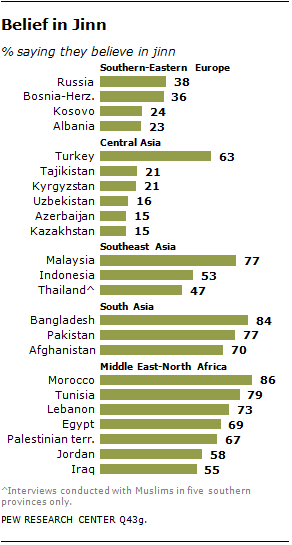
Literal vs metaphorical, let alone imaginal belief is not something the interviewers who conducted the Pew poll had the leisure to distinguish — but for the record, here are their findings as to the Muslim belief in jinns:

According to the Quran, God created jinn as well as angels and humans. Belief in jinn is relatively widespread – in 13 of 23 countries where the question was asked, more than half of Muslims believe in these supernatural beings.

In the South Asian countries surveyed, at least seven-in-ten Muslims affirm that jinn exist, including 84% in Bangladesh. In Southeast Asia, a similar proportion of Malaysian Muslims (77%) believe in jinn, while fewer in Indonesia (53%) and Thailand (47%) share this belief.

Across the Middle Eastern and North African nations surveyed, belief in jinn ranges from 86% in Morocco to 55% in Iraq.

Overall, Muslims in Central Asia and across Southern and Eastern Europe (Russia and the Balkans) are least likely to say that jinn are real. In Central Asia, Turkey is the only country where a majority (63%) of Muslims believe in jinn. Elsewhere in Central Asia, about a fifth or fewer Muslims accept the existence of jinn. In Southern and Eastern Europe, fewer than four-in-ten in any country surveyed believe in these supernatural beings.

In general, Muslims who pray several times a day are more likely to believe in jinn. For example, in Russia, 62% of those who pray more than once a day say that jinn exist, compared with 24% of those who pray less often. A similar gap also appears in Lebanon (+25 percentage points), Malaysia (+24) and Afghanistan (+21).

The survey also asked if respondents had ever seen jinn. In 21 of the 23 countries where the question was asked, fewer than one-in-ten report having seen jinn, while the proportion is 12% in Bangladesh and 10% in Lebanon.
**

Two markers concerning National Security concerns regarding Pakistan, nuclear weapons and those who believe (literally, energetically) in jinns — from the early 2000s, but dating back by implication to the era of Zia ul-Haq:

Just after the September 2001 terrorist attacks in the U.S., Pakistan’s intelligence service detained two retired nuclear scientists who had met with senior members of al Qaeda, including Mr. bin Laden, during charity work in Afghanistan. One, Sultan Bashiruddin Mahmood, was a former director at the Pakistan Atomic Energy Commission and a controversial Islamic scholar who had postulated that energy could be harnessed from fiery spirits called djinns.

WSJ, Inside Pakistan’s Drive To Guard Its A-Bombs

But as a subscriber to a brand of what is known to practitioners as “Islamic science,” which holds that the Koran is a fount of scientific knowledge, Mr. Bashiruddin Mahmood has published papers concerning djinni, which are described in the Koran as beings made of fire. He has proposed that these entities could be tapped to solve the energy crisis, and he has written on how to understand the mechanics of life after death.

NY Times, Pakistani Atomic Expert, Arrested Last Week, Had Strong Pro-Taliban Views

— together with a Pakistani critique:

If a scientist is European or Hindu he will be restricted in his vision by reason. A Muslim scientist has unlimited scope; he will relate his science to miracles, mostly performed by himself. Sultan Bashiruddin, our top enrichment expert, believed he could draw electricity from a captured jinn. (For Pakistan’s needs just one jinn would suffice.)

Khaled Ahmed, Scientists, our kind

There are times when beliefs have, or might just have, consequences.

**

Jinn are significant not only for their own sakes, so to speak, but also for their etymological implications. To quote again from the Tasneem Project:

One saying of the Prophet (aws) mentions that, “God divided the jinn and the humans into ten parts. One part makes up the human race, and the other nine parts is made up of the jinn.” The invisible is everywhere. The Arabic language itself bears witness to how the invisible realm insinuates itself on everyday life. In Arabic, each time the two letters jeem and nun occur together, as in jinn, they convey the meaning of invisible or hidden. Thus, paradise is jannah because paradise is hidden from the human sight; janin is the foetus in the womb; the expression ajannahu al-layl means the night covered him.

The jinn, like paradise itself, are among the hidden secrets…

**

And how large is the universe, that it might encompass the angels and jinn? Hugh Everett III quite brilliantly argued for what has come to be known as the “many worlds” hypothesis in quantum measurement while still a grad student:

Hugh Everett III was a student in his mid-twenties in 1957 when he presented his revolutionary formulation of quantum mechanics in his PhD thesis. Everett himself called his theory variously; pure wave mechanics, the relative-state formulation of quantum mechanics, and the theory of the universal wave function. His theory, however, came to be popularly known as the many-worlds interpretation, because it predicts that everything that might happen, does in fact happen. As the physicist Bryce DeWitt later described it, Everett’s theory predicts that our universe is composed of countless parallel universes that are each constantly splitting into yet further copies, and in the process, creating copies of each observer, each of which subsequently observes a different quantum universe and splits into further copies.

While a science fiction fan might embrace such a theory simply by dint of how cool it would be if something like that were true, one might naturally wonder what good scientific reason one might have for believing that our universe is in fact composed of countless parallel splitting universes.

**

The whole article from which that quote was taken, The Quantum Measurement Problem and the Everett Interpretation, is indeed worth reading. But whereas physicists and (most) science fiction writers might confine their “many worlds” to physical, “materialist” universes, students of the imaginal are under no such restriction, as the same Tasneem Project article suggests:

The Muslim universe has always been made up of multiple worlds – the Qur’an itself refers to “universes” in the plural, in its open chapter al-fatihah. According to prophetic tradition, the cosmos consists of 18000 universes. …

So the jinn when summoned might come — somewhat unexpectedly — from one of Everett’s more hidden “many worlds”, perhaps?

One bead for a rosary

Friday, June 22nd, 2012

[ by Charles Cameron — one bead from NASA for the glass bead game as rosary ]
.


photo credit: Norman Kuring, NASA’s Goddard Space Flight Center
.

Consider her sacred, treat her with care.

Conceptual blending

Monday, May 28th, 2012

[ by Charles Cameron — cross posted from Sembl — creativity as the blending of ideas ]
.

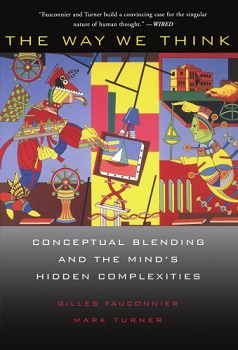
Gilles Fauconnier and Mark Turner‘s The Way We Think: Conceptual Blending and the Mind’s Hidden Complexities gives us a fascinating look at the way the human mind weaves a world out of seemingly disparate elements — in a very similar manner to that in which the creative mind weaves an aha! out of seemingly disparate ideas. The book deals with the formation of perceptions as well as ideas, but it was a specifically conceptual blend that intrigued me the other day.

First, they note that when we use expressions like “I had reached the boiling point. I was fuming. He exploded.” we are making a metaphorical mapping in which “a heated container maps to an angry individual, heat maps to anger, smoke and steam (signs of heat) map to signs of anger, explosion maps to uncontrolled rage.” Then they add in the “folk theory of physiological effects of anger” including ” increased body heat, blood pressure, agitation, redness of face” – and thus we have a threefold scheme, in which physiology, emotions and the physics of heat are intricately cross-correlated, so that we can say without much thought “He was so mad I could see smoke coming out of his ears”.

Here Fauconnier and Turner describe the mechanics of this remarkable conceptual blending process – which can yield such a seemingly unremarkable phrase:

In addition to the metaphoric mapping between Heat and Emotions and the vital-relation connection between Emotions and Body, there is a third partial mapping between Heat and Body. In this mapping, steam as vapor that comes from a container connects to perspiration as liquid that comes from a container, the heat of a physical object connects to body heat, and the shaking of the container connects to the body’s trembling.

The three partial mappings set the stage for a conventional multiple blend in which the counterparts in the inputs are fused, yielding, for example, a single element that is heat, anger, and body heat and a different single element that is exploding, reaching extreme anger, and beginning to shake. Once we have this blend, we can run it to develop further emergent structure and we can recruit other information to the inputs to facilitate its development.

*

What interests me here is the phrase:

the inputs are fused, yielding, for example, a single element that is heat, anger, and body heat

and what it reminds me of is CS Lewis writing in The Allegory of Love:

It must always be remembered … that the various senses we take out of an ancient word by analysis existed in it as a unity.

Thus the King James Version of the Bible, John 3.8, reads:

The wind bloweth where it listeth, and thou hearest the sound thereof, but canst not tell whence it cometh, and whither it goeth: so is every one that is born of the Spirit.

In the Greek, the word here translated wind is pneuma, and the sentence accordingly means “the pneuma blows where it wills, and you hear its sound but can’t tell where it comes from or is going: and so it is with all those born of pneuma“…

Recalling Lewis’ remark about the “various senses we take out of an ancient word”, this in turn means simultaneously and without separation:

the wind blows where it wills, and you hear its sound but can’t tell where it comes from or is going: and so it is with all those born of wind…

the breath blows where it wills, and you hear its sound but can’t tell where it comes from or is going: and so it is with all those born of breath…

and:

spirit blows where it wills, and you hear its sound but can’t tell where it comes from or is going: and so it is with all those born of spirit…

Take this a step further, realize that spirit can be defined as what inspires us, and we have:

inspiration blows where it wills, and you hear its sound but can’t tell where it comes from or is going: and so it is with all those born of inspiration…

Four meanings, all making good sense, and all present simultaneously and inseparably in the one gospel phrase…

*

Now consider that Fauconnier and Turner are speaking of how “three partial mappings set the stage for a conventional multiple blend in which the counterparts in the inputs are fused, yielding, for example, a single element that is heat, anger, and body heat” and compare it with Lewis’ “unity” from which we take out “the various senses” by “analysis”, as applied to the “ancient word” pneuma, with its meaning encompassing wind, breath, spirit… inspiration.

Are wind, breath and spirit or inspiration in fact three “primitives” that conceptual mapping in ancient Greek thought has brought together? What do we gain, and what do we lose if we view them this way?

And what do we lose, what do we gain if we view them as a single rich concept, now reduced to three or four separate — and separately less complexly interesting — ideas?

Sanctity, vision, science, ecology and the creativity of diagrams

Saturday, May 12th, 2012

[ by Charles Cameron — of [almost] no military or intelligence interest, this is a post for computer scientists, historians, scientists, artists, contemplatives and other creatives ]
.

I’ve been on a bit of a binge about medieval and renaissance diagrams recently, putting together an anthology of early “semantic networks” for the Sembl game site – but also thinking about the alternate track of art history which would focus on diagrams rather than paintings (I’m thinking of two dimensions here, hence no mention of sculpture) – an alternate history which may have something to teach our richly diagrammatic and data-visual times.

My interest in all this tracks back at least to my early encounter with an essay by the computer scientist Margaret Masterman in Theoria to Theory (1967).

*

Yesterday brought me a post from Jason Wells, a scientist and bright all-rounder I follow on Google+, in which he posted an image of the cosmos from the Ptolemaic (pre-Copernical) point of view, which I’ve put at the head of this post.

Jason commented on this diagram:

As pretty as this is, this is not how your universe works.

That is all.

The diagram Jason posted purports to be mathematically and astronomically based: it is, if you like, a quantitative diagram. I don’t happen to think it’s pretty, although the two creatures (angels, goddesses?) up towards the top of the circle may be, and the serpent eating its tail around it is nicely done -– I think it has a rather austere beauty to be honest, but I’m likely to concede to Jason that it isn’t “true” in the sense of being an accurate representation of the (abstract) laws of celestial motion.

But then I also think there’s more to truth than accuracy, useful though that may be – there’s also a qualitative element to truth, and perhaps “beauty” is (among other things) a name for it.

*

Yesterday also brought me a news bulletin that ties into that same interest in medieval and renaissance diagrams. From the Vatican Information Service (via Chant Cafe) , we learn that Hildegarde of Bingen (1098 – 1179) is now a saint of the Catholic Church with universal cultus:

Vatican City, 10 May 2012 (VIS) – The Holy Father today received in audience Cardinal Angelo Amato S.D.B., prefect of the Congregation for the Causes of Saints. During the audience he extended the liturgical cult of St. Hildegard of Bingen (1089-1179) to the universal Church, inscribing her in the catalogue of saints.

Consider, then, in contrast to Jason’s mechanistic Ptolemaic diagram, this diagram which today’s fresh-minted saint produced in the late 1140s or early 1150s to illustrate her visionary intuitions of the universe in the first of three books, Scivias:

and these two, from Liber divinorum operum:

and:

These, I take it, are purely qualitative images in contrast to the Ptolemaic diagram — making no propositional claims as to physical or mathematical accuracy, but portraying Hildegarde’s sense of cosmic order. And just as we would not argue whether it is Van Gogh or El Greco who is “right” about the skies in their respective paintings, so I don’t think Hildegarde is worried about which of her diagrams is “right” in its portrayal of the world she lived and prayed in – each one illustrates some aspect of her vision of the world, and one does not necessarily contradict another.

*

Here are two descriptions of Hildegarde’s world, which may give us some insight into the diagrams above. For the top one:

For Hildegard of Bingen, twelfth century German Benedictine abbess, the universe is like an egg in the womb of God. Her view of the universe, conditioned as it is by her times and her education, represents her visionary understanding of God’s motherhood of this sphere that we call the universe. Hers is a view that is organic and holistic, coloured neither by Greek philosophy nor Enlightenment rationalism, refreshing and strikingly “true” in its perceptions around the source of created life.

Jean Evans, RSM, Viriditas and Veritas: The Ecological Prophets Hildegard of Bingen and Miriam Therese MacGillis, OP

And for the third:

God created the world out of the four elements, to glorify His name. He strengthened the world with the wind. He connected the world to the stars. And he filled the world with all kinds of creatures. He then put human beings throughout the world, giving them great power as stewards of all Creation. Human beings cannot live without the rest of nature, they must care for all natural things.

von Bingen, Physica, 755, quoted in Stephanie Roth, The Cosmic Vision of Hildegard of Bingen,” The Ecologist 30, no. 1 (2000).

It’s probably worth mentioning that three of the “four elements” of the ancients are still known to us, though we call them “states” rather than “elements” at this point — the solid, liquid and gaseous states correspond with what the ancients called “earth”, “water” and “air”, respectively — and it has even been suggested that their “fire” corresponds to the fourth state we now term “plasmas” — not my line of business, however, so who knows?

*

Hildegarde picked up the word “viriditas” from Gregory the Great and made it peculiarly her own. It means greeness, literally, and freshness by extension — but for Hildegarde’s integral view of all that is, it also carries a theological dimension, Christ being the greening of the world for her:

For Hildegard, viriditas was an attribute of the Divine nature, a reflection of God’s goodness and beauty. It stood for vitality, fertility, fruitfulness and growth; in fact all the things that we now associate with the “greenness” of nature. For us today “greenness” is a sign that the Earth is healthy and flourishing. Similarly, for Hildegard, viriditas was synonymous with physical and spiritual health, with the continuing vivifying force of the Holy Spirit.
.
Dr Carmel Bendon Davis, Hildegard of Bingen: Eco-warrior and Superwoman

This greening or freshening is not, for Hildegarde, just a matter of earth and water, of river and forest, it is also infused with fire and air:

I am likewise the fiery life of the substance of divinity. I flame over the beauty of the fields and sparkle in the waters, and I burn in sun, moon, and stars. And with an airy wind that sustains all things with invisible life, I raise them up vitally. For air lives in greenness and flowers, waters flow as if alive, the sun, too, lives in his light, and when the moon comes to her decline she is kindled by his light, as it were to live again… Thus I, the fiery force, am hidden in [the winds], and they take fire from me, just as breath continually moves a man, and as a windy flame exists in fire. All of these live in their essence and are not found in death, because I am life.

Nor is it “merely” natural, it can also be found in the soul:

Understanding in the soul is like the Veriditas of the branches and the leaves of the tree

It is, in fact, neither exclusively natural nor supernatural, but non-dual.

*

Dylan Thomas, being a Welshman and a poet, thus has an insight that bears a family resemblance to Hildegarde’s, but phrases it in a way that leaves the “force” neither personified nor otherwise… and thus with no necessary doctrinal implication:

The force that through the green fuse drives the flower
Drives my green age; that blasts the roots of trees
Is my destroyer.
And I am dumb to tell the crooked rose
My youth is bent by the same wintry fever.

Due to the idiocy of copyright, you’ll have to go elsewhere to read the whole, fine poem.

For Hildegarde, this “force” is also Christ — for he himself is the “the fiery life of the substance of divinity” — and his coming to earth a greening and freshening of a world until then barren of the love he brought.

*

Hildegarde was the abbess in charge of a small flotilla of nuns — but also a mystic, a visionary, philosopher, poet, painter and songstress…

Her song of creation, O Viriditas, bears comparison in spirit with St FrancisCanticle of the Sun. She writes to her “green” Christ and his “green” planet:

O greenness of God’s finger
with which God built a vineyard
that shines in heaven
as an established pillar:
You are glorious in God’s preparation.
And o height of the mountain
that will never be dispersed
in the judgment of God,
you nevertheless stand from afar as an exile,
but it is not in the power
of the armed man
to seize you.
You are glorious in God’s preparation.
Glory be to the Father and to the Son
and to the Holy Spirit.
You are glorious in God’s preparation.

And she sets her words to the music of the times:

Indeed, her music is sung even today…

How’s that for a twelfth century statement of what we’d these days call “ecology”?

*

But all this risks getting far too ethereal, I have wandered far along my own epicycles from Jason Wells’ point, and methinks I should bring us back down to earth.

Dennis The Constitutional Peasant, in Monty Python and the Holy Grail, meets King Arthur and complains, “What I object to is you automatically treatin’ me like an inferior.” It’s understandable — but so, perhaps, is king Arthur’s response: “Well, I am king.”

Two worldviews clash here — and in the ensuing debate, Arthurian myth meets contemporary politics:

Dennis’ Mother: Well how’d you become king, then?
Arthur: The Lady of the Lake,… [Angel chorus begins singing in background] her arm clad in the purest shimmering samite, held aloft Excalibur from the bosom of the water signifying by Divine Providence that I, Arthur, was to carry Excalibur. [Angel chorus ends] That is why I am your king!
Dennis: Listen. Strange women lying in ponds distributing swords is no basis for a system of government. Supreme executive power derives from a mandate from the masses, not from some farcical aquatic ceremony.
Arthur: Be quiet!
Dennis: You can’t expect to wield supreme power just ’cause some watery tart threw a sword at you!
Arthur: Shut up!
Dennis: I mean, if I went ’round saying I was an emperor just because some moistened bint had lobbed a scimitar at me, they’d put me away!

Or if some bint told me the universe was a cosmic egg in the womb of God, for that matter — even if Benedict XVI did just add her to the calendar of saints.

*

Here you go, courtesy of YouTube:

*

Frankly I appreciate both modes of thinking — the mythic and the scientific — and believe we’re in the sort of territory here that Nils Bohr was thinking of when he said:

The opposite of a true statement is a false statement. But the opposite of a profound truth may be another profound truth.

For more on the story of diagrammatic and pictorial imagery in western civilization, see Ioan Couliano, Eros and Magic in the Renaissance (University of Chicago, 1987). And for more diagrams from the renaissance, there’s nothing I know of better than SK Heninger, The Cosmographical Glass: Renaissance Diagrams Of The Universe (Huntington Library, 1977).

Announcement: “Legacies of the Manhattan Project” May 12-13

Tuesday, May 8th, 2012

From blogfriend Cheryl Rofer as well as Molly Cernicek and Susan Voss at Nuclear Diner, – an event for those interested in nuclear weapons, science, Cold War diplomatic history, national security, strategic theory and American strategists:

Nuclear Diner Teams With Santa Fe Institute To Bring You Legacies of the Manhattan Project 

Next weekend, May 12-13, at the Santa Fe Institute, a hand-picked group of physicists, historians, social scientists, systems theorists, and writers will examine the long-term legacies of the Manhattan Project in a timely discussion of an important event in world history that still influences science and society today. Harold Agnew, who was part of the historic effort to develop the first atomic bomb, will participate in the discussion.

SFI is collaborating with the Nuclear Diner to bring the discussion to you live on Twitter. You can participate before, during, and after by searching for the hashtag #bomblegacy or following @nucleardiner. Before the event, you can also leave questions at Nuclear Diner and the Facebook event page. If you “like” the Facebook page, you will get updates throughout the week and continuing information after the workshop.

The group will discuss new information, review original records, and mine the memories of project participants to present a case study in conflict from an important period in scientific history.

More about the Santa Fe Institute working group, including biographies of the participants and discussion topics, here.

Many of SFI’s founders were senior fellows at Los Alamos National Laboratory. As the Institute has emerged as a leader in complexity science, particularly in working toward a theory of conflict in human and animal societies, the Manhattan Project has become an important case study for understanding conflict. The project’s history also illustrates the occasional tension between pure theoretical research and applied science.

Photo: Harold Agnew holding the core of the Nagasaki bomb.

An excellent opportunity for students, grad students, historians and practitioners in various fields to participate here via twitter.


Switch to our mobile site

